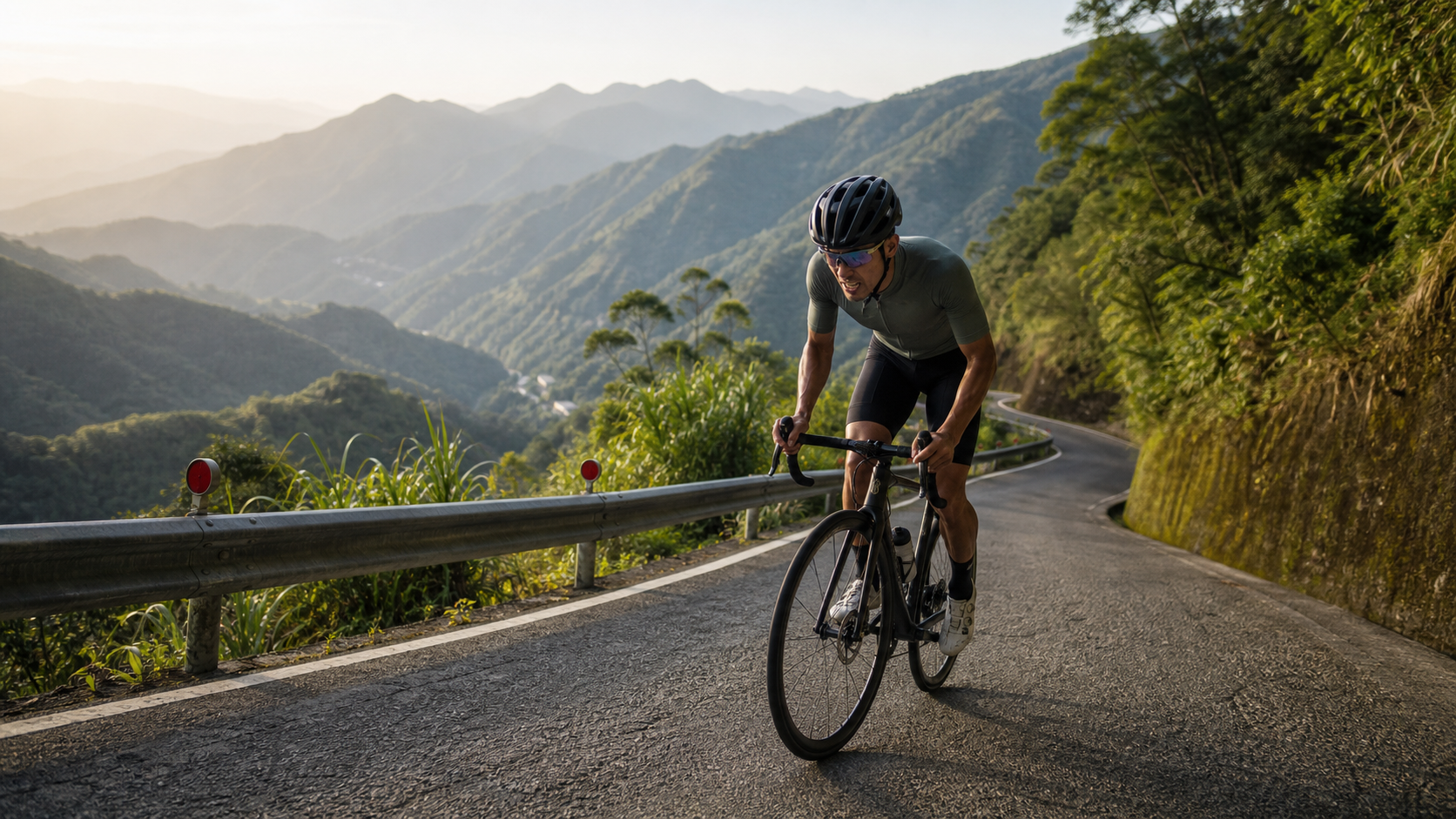
If Wuling is the climb that crushes you with “length,” then the Guguan climb is the one that pins you to the wall with sheer “steepness.”
Let’s look at the real numbers first: The Guguan climb (Strava segment 22204187) is approximately 4.43 km long, with 533.6 meters of total elevation gain and an 11.7% average gradient, rated Category 3 on Strava. It’s not long, but an 11.7% average gradient is a number that makes most amateur cyclists gasp—it means there’s almost no respite on the entire route. This is a true “steep-grade crucible.”
This article takes an engineer’s perspective to break down this 4.43 km of tough climbing, showing you how to ride it to the top without blowing up or putting a foot down.
Route Overview: Short and Brutal at 11.7%
| Item | Data |
|---|---|
| Segment Distance | 4,425 meters (approx. 4.43 km) |
| Total Elevation Gain | 533.6 meters |
| Average Gradient | 11.7% |
| Strava Category | Category 3 |
| Location | Heping, Taichung / Guguan surrounding mountains (often administratively marked near Nantou) |
| Characteristics | Short distance, extremely high average gradient, sustained steep climbing |
First, let’s establish the right perspective: an 11.7% average gradient is the “heavyweight division” of climbing. For comparison, the overall average gradient of Wuling is about 7.2%, and the early section of the western approach to Wuling is only 2%. A 4.4 km road with an average gradient approaching 12% means you’re fighting gravity head-on almost the entire way, with no slight descents to recover. This kind of “sustained steep” profile doesn’t test your explosive power—it tests your ability to maintain rhythm and heart rate at high intensity.
Why an “11.7% Average” Is So Brutal
The pain of climbing comes from the gradient, and its impact on power demand is non-linear. At the same speed, a 10% gradient requires far more power than 5%, and 12% is even more extreme than 10%. When a road’s average is 11.7%, it means there are inevitably short walls of 15%, or even approaching 20%, mixed in.
More critically: short, high-intensity segments often create the illusion that “it’ll be over soon,” leading riders to start too hard. The result is hitting max heart rate by the 2 km mark, legs full of lactate, and the remaining 2 km becomes a painful struggle, sometimes forcing a dismount. The cruelty of the Guguan climb lies in the fact that it’s “short enough to make you want to push, but steep enough that you can’t.”
Section Strategy 1: Setting the Anchor at the Start (0 – 1.5 km)
There’s no real warm-up zone on this road—it’s steep from the very beginning. So the starting strategy is even more important—you must use discipline to fight the adrenaline.
- Pacing Principle: From the start, keep your power at an intensity you can sustain for “30–40 minutes,” meaning close to but not exceeding FTP. Do not start with a sprint mentality just because the “distance is short.”
- Cadence: Use your easiest gear to maintain a cadence of 60–70 rpm. On 11%+ gradients, cadence will naturally drop; the key is to not let it fall into the “can’t turn the pedals” death zone below 50 rpm.
- Heart Rate: Keep your heart rate below 85% of max during this section to leave some room for later.
Section Strategy 2: The Core Grind (1.5 – 3.5 km)
This is the most agonizing part of the entire segment and the key to whether you can finish. This is typically where the gradient is most concentrated and the short walls are most frequent.
- Gearing Is Your Lifeline: On a road like this, a 34×34, or even 34×36 or mountain-bike-level gearing, isn’t excessive. It’s far better to have gearing that’s too easy and spin a bit faster than to grind with a gear that’s too hard—the latter is a knee killer and the main cause of putting a foot down.
- Pacing Strategy: Accept the fact that “your speed will be very slow.” Dropping to 7–8 km/h is normal; your job is to “keep the pedals turning,” not to “maintain speed.”
- Using the Out-of-Saddle: When you hit short walls over 15%, you can briefly stand and power for 5–10 seconds to get over the steepest point, but sit back down immediately and relax to avoid losing control of your heart rate. While standing on steep climbs lets you use your body weight, it’s extremely oxygen-hungry, so use it sparingly.
- Upper Body: Relax your shoulders and grip, focusing your power in your lower body. A tense upper body wastes precious energy.
Section Strategy 3: Gritting Through the Finish (3.5 – 4.43 km)
For the final less-than-1 km, if you’ve paced well and haven’t blown up, this is where you close it out.
- Pacing: If you have energy to spare, you can push slightly harder to lift your average output.
- If You’re at Your Limit: The only goal is “don’t put a foot down, don’t cramp, and spin smoothly to the end.” On a gradient this steep, once you dismount, restarting on a 12% slope is extremely difficult—which is why a “survival gear” is so crucial.
Gearing and Equipment Recommendations
Facing an 11.7% average gradient, gear strategy is more critical than on any other route:
| Rider Level | Recommended Chainring | Recommended Cassette | Notes |
|---|---|---|---|
| General Rider | 50/34T Compact | 11-34T or lighter | Survival gearing; lighter is better than heavier |
| Advanced | 50/34T | 11-32T | Requires a solid climbing base |
| Competitive | 52/36T | 11-30T | Only recommended for those with a high power-to-weight ratio |
Other key points:
- Tires: 25c–28c, with slightly lower pressure for increased grip. Losing traction on a steep climb will cause a direct slide and dismount.
- Bike Weight: On a purely steep segment like this, “light” is fast. Any weight you can shed is worth shedding.
- Brakes: The 11.7% descent on the way down is a severe test for your brakes. Disc brakes are preferred; if using rim brakes, be sure to check your brake pads and tire pressure.
Nutrition and Hydration Strategy
Although it’s only 4.43 km, the high intensity will cause significant energy depletion and sweating in a very short time.
- Before the Climb: Be sure to top up your water and energy in Guguan or at the bottom first, because it’s nearly impossible to eat or drink while riding on a climb this steep.
- Strategy: Treat it like a high-intensity interval. Consume carbs and electrolytes 15 minutes before starting, and replenish water and food immediately after finishing.
- Multiple Repeats: Many riders use this segment for repeated climb training. If you do, be sure to hydrate on every descent to avoid cumulative dehydration.
Weather and Seasons
- Spring/Autumn: The most comfortable seasons—cool and dry, ideal for an all-out attempt.
- Summer: The mountain area is hot and humid, making high-intensity climbing feel even worse. It’s recommended to start in the early morning and increase hydration.
- Afternoon: Thunderstorms are common in the central mountain area in the afternoon. Wet roads on 11% gradients are extremely dangerous—be sure to avoid them.
- Winter: Mornings are cold, so warm up more thoroughly to avoid injuring cold muscles under high intensity.
Common Mistakes and DNF Risks
- Gearing Too Heavy: Using gearing that isn’t light enough for an 11.7% gradient is the number one cause of dismounting and knee injuries.
- Starting Too Hard: Misled by the “short distance” and sprinting off, blowing up by the 2 km mark.
- Cadence Dropping Too Low: Grinding into the “dead zone” below 50 rpm, instantly flooding the muscles with lactate.
- Dismounting and Restarting: Once you put a foot down on a steep climb, restarting is extremely difficult, often leading to a DNF.
- Excessive Out-of-Saddle Riding: Frequent standing burns oxygen too quickly, causing heart rate to spiral out of control.
Target Times for Riders of Different Levels
Based on 4.43 km, 533 m of climbing, and an average gradient of 11.7%:
| Rider Level | Reference Time | Average Speed |
|---|---|---|
| Competitive Racer | 15–18 min | 15–18 km/h |
| Advanced Enthusiast | 19–24 min | 11–14 km/h |
| General Enthusiast | 25–32 min | 8–11 km/h |
| Recreational Challenge | 33+ min / aiming just to finish | Below 8 km/h |
The Guanguan climb is a brutal yet honest mirror: it doesn’t play pacing games with you; it only uses the purest steepness to ask you one question—“Is your power-to-weight ratio good enough?” Train hard on this road, and you’ll find your resilience on all steep climbs dramatically improves. It’s short, it hurts, but it makes you stronger. That is the value of a hard climb.
The Power Demand of Steep Climbs: A Brutal Math Lesson
To truly understand why the Guanguan climb is so hard, you first need to do the math. The power required to climb is mainly used to overcome gravity, and the formula is roughly: Power ≈ Weight × Gravitational Acceleration × Speed × Gradient (plus rolling and air resistance). This formula tells us one thing: at a fixed speed, when the gradient doubles, the power needed to overcome gravity nearly doubles as well.
Assume a 70 kg rider (about 80 kg with the bike) wants to maintain 8 km/h on an 11.7% gradient. Just overcoming gravity requires a sustained output of over 200 watts, and adding rolling resistance, the total demand easily exceeds 210 watts. For many amateur riders, 210 watts is already close to or above their FTP (Functional Threshold Power). This means—on a climb like Guanguan, you’re essentially riding at your threshold the entire time, with no room to breathe. That’s why it’s so punishing: it doesn’t give you any “easy” sections; every meter drains you. Once you understand this math, you’ll see why a “bailout gear” and “pacing discipline” are so critical here—because on this kind of gradient, any extra output can instantly push you past the red line and blow you up.
Power-to-Weight Ratio: The Key to Conquering the Guanguan Climb
If Lilen tests your pacing wisdom, then the Guanguan climb tests your most naked power-to-weight ratio (W/kg). On such a steep climb, the gaps between riders are magnified infinitely—every kilogram lighter, every ten watts more powerful, is directly reflected in your speed and your level of suffering.
| Sustained Climbing Power-to-Weight Ratio | Estimated Speed on 11.7% Gradient | Difficulty to Finish |
|---|---|---|
| 4.0 W/kg and above | 12–15 km/h | Finish with ease |
| 3.0–4.0 W/kg | 9–12 km/h | Requires serious pacing |
| 2.5–3.0 W/kg | 7–9 km/h | Tough but finishable |
| Below 2.5 W/kg | Below 7 km/h | Recommend lighter gearing; aim to finish without putting a foot down |
There are only two ways to get stronger on the Guanguan climb: increase your power, or decrease your weight. And the training for both can be done right on the Guanguan climb itself—it’s the best W/kg testing station and the best climbing strength training ground.
Hill Repeats: Using the Guanguan Climb as a Workout
Because the Guanguan climb is short and steep, it’s an excellent venue for “Hill Repeats” training. This type of training efficiently improves your climbing strength, anaerobic capacity, and lactate tolerance.
A sample workout: after a thorough warm-up, climb the Guanguan road at full (or near-full) effort and record your time; descend back to the start, spin easy for 5–8 minutes to let your heart rate come down; then climb a second and third time. Beginners start with 2–3 reps, while advanced riders can do 4–5. The key is that “every rep must have quality”—if your speed drops too much on the later reps, it means you haven’t recovered enough or you’re doing too many reps. Better to cut the volume than to grind out junk reps. This type of training places significant stress on the knees and muscles, so be sure to pace yourself, and stretch and refuel thoroughly afterward. Treat the Guanguan climb as your “climbing gym,” check in once or twice a week, and after a month you’ll clearly feel your resilience on steep climbs has improved.
FAQ
Q: My FTP isn’t high. Can I ride the Guanguan climb? Yes, but be sure to have a light enough gear (34×34 or even lighter), aim to “finish without putting a foot down,” and accept that your speed will be slow. Finishing is a victory in itself.
Q: Why do I always want to put my foot down on steep climbs? It’s usually because your gear is too heavy and your cadence drops too low, causing lactic acid to flood your muscles instantly. Switching to a lighter gear and increasing your cadence can make a huge difference.
Q: Will the Guanguan climb hurt my knees? If you grind with too heavy a gear and a low cadence, there is indeed a risk. Maintaining a higher cadence and using a lighter gear to spread out the force is the key to protecting your knees.
Q: How should I recover after the ride? Rehydrate and take in carbs immediately, stretch your legs (quads, glutes, calves), and if you have the chance, soak in the Guanguan hot springs to relax—it works wonders.
Standing vs. Seated: The Choice on Steep Climbs
On an 11.7% gradient, knowing when to sit and when to stand is an art. Seated climbing is more economical and uses less oxygen, making it suitable for sustained efforts; standing and grinding lets you use your body weight to push the pedals and engages different muscle groups, but it burns oxygen rapidly and spikes your heart rate.
On the Guanguan climb, the principle is “seated as the foundation, standing as a supplement.” Save the standing sprint for the truly short walls above 15%, use your body weight to carry you through the steepest few seconds, then immediately sit back down, relax, and let your heart rate settle. Avoid prolonged standing and grinding at all costs—it will push your oxygen debt to the limit in a very short time, causing your heart rate to spiral out of control and blowing you up early. Technique for standing: hold the bars lightly, shift your center of gravity slightly forward, and let the bike rock naturally side to side in rhythm with your pedal stroke, rather than desperately pulling on the bars with your arms. Smooth, efficient standing is what separates the veterans from the novices. If you find yourself gasping for air and your heart rate maxing out the moment you stand, it means you’re pushing too hard—sit back down and solve the problem with cadence.
Weather and Road Conditions: The Overlooked Variables
The Guanguan climb may be short, but the impact of weather and road conditions on it should not be underestimated. High heat makes this kind of high-intensity climb feel even more miserable—your body has to divert blood flow to cool itself down, reducing the energy available to your muscles, and your finish time may suffer noticeably as a result. In summer, be sure to start in the early morning and step up your hydration and electrolyte intake.
As for road conditions, afternoon thunderstorms are common in the central mountains. A wet road on an 11.7% gradient is extremely dangerous—on the way up, your rear wheel can slip and spin out; on the way down, braking distances lengthen and grip plummets, creating a high-risk situation. After rain on the Guanguan climb, fallen leaves, moss, and loose gravel can all cause you to lose traction and crash. Therefore, it’s strongly recommended to avoid riding in the rain or during the slippery period after rain. Also, be mindful of the temperature differences in the mountains—it’s warm at the bottom, but the summit and shaded areas can be noticeably cooler. After working up a heavy sweat and then stopping to rest, you can easily catch a chill, so bring a light jacket. These seemingly trivial variables are often what determine whether a ride is safe and enjoyable or harrowing and miserable.
Conclusion: Steep Climbs Make You Honest
The Guanguan climb is a road where you cannot hide. It doesn’t play pacing games with you, it doesn’t use high altitude as an excuse—it only uses the purest steepness to ask you bluntly: “Is your power-to-weight ratio good enough?” Here, there is no luck, no shortcuts—only the most direct confrontation between you and gravity.
And precisely because of that, it is the best training ground and the most honest mirror. When you can ride the Guanguan climb with ease, you’ll find your resilience on all steep climbs has dramatically improved—the climbs that once intimidated you suddenly become manageable. It’s short, it hurts, but it genuinely makes you stronger. That is the value of a hard climb, and it’s the most solid gift this road offers to every rider willing to face it head-on. Pack your lightest gear, find a cool morning, and go have an honest conversation with yourself on that wall.
Starting Anchored and Core Grind: Practical Details
There is no real warm-up zone on the Guguan climb—you hit the steep slopes immediately, which makes your starting strategy even more critical. You must use discipline to fight the adrenaline. From the start, hold your power at an intensity you can sustain for 30 to 40 minutes—close to but not exceeding FTP. Do not adopt a sprint mentality just because the distance is short. Use your easiest gear to maintain a cadence of 60 to 70 rpm; on slopes above 11%, your cadence will naturally drop, but the key is to keep it from falling into the 50 rpm death zone where you can no longer turn the pedals. Keep your heart rate below 85% of your maximum during this section, saving some room for later.
Once you enter the core grind section, the gradients are most concentrated and the short walls are most numerous—this is where the ride is won or lost. Gearing is your lifeline. On a road like this, 34×34, or even 34×36 or mountain-bike-level gearing, is not excessive. Far better to have gearing that is too light and spin a bit faster than to muscle through with a big gear—the latter is a knee killer and the main cause of putting a foot down. Accept that your speed will be very slow; dropping to 7 to 8 km/h is normal. Your job is to keep the pedals turning, not to maintain speed. Relax your shoulders and grip, concentrating your power in your legs—a tense upper body wastes precious energy. These details determine whether you grit your teeth to the top or are forced to put a foot down halfway.
Why the Guguan Climb Is the Best Training Ground for Rapid Progress
Many coaches agree on one thing: the most effective way to rapidly improve your climbing ability is to “train on steep slopes.” And the Guguan climb is one of the most ideal steep-slope training grounds in central Taiwan. There are three reasons: first, it is steep enough—an average gradient of 11.7% provides sufficient stimulus to your muscles, forcing your body to adapt to high-intensity output; second, it is short enough—at 4.43 kilometers, you can repeat the climb multiple times to accumulate training volume; third, it is relatively accessible, allowing you to check in regularly and train consistently.
Regularly performing repeated climbing intervals on the Guguan climb simultaneously improves your maximal strength, anaerobic capacity, and lactate tolerance. These improvements will be reflected across all your climbing performance—not just on the Guguan climb, but also on long climbs like Wuling and Jiji Mountain, which you will find easier. That is the value of steep-slope training: with maximum efficiency, it trains the abilities your body needs most. Of course, high-intensity training also carries a higher risk of injury, so be sure to warm up thoroughly, ride within your limits, progress gradually, and schedule adequate recovery between sessions. Treat the Guguan climb as your climbing gym, and after one training cycle, you will be amazed at your progress.
Complete Planning for Nutrition, Weather, and Seasons
Although the Guguan climb is only 4.43 kilometers, the high intensity will cause you to burn energy and sweat heavily in a very short time. Before the climb, be sure to top up your water and energy at Guguan or at the bottom of the mountain, because on slopes this steep, eating while riding is nearly impossible. Treat it as a high-intensity interval: consume carbohydrates and electrolytes 15 minutes before starting, and replenish water and food immediately after finishing. If you are doing multiple repeated intervals, be sure to hydrate on every descent to avoid cumulative dehydration.
In terms of seasons, spring and autumn are the most comfortable—cool and dry, ideal for all-out efforts. In summer, the mountain area is hot and humid, making high-intensity climbing feel even worse; start early in the morning and increase your hydration. In winter, early mornings are cold, so warm up more thoroughly to avoid injuring cold muscles under high intensity. Central Taiwan’s mountain areas often see afternoon thunderstorms; wet roads on 11% gradients are extremely dangerous, so be sure to avoid them. As for equipment, beyond life-saving gearing, tires of 25c to 28c with slightly reduced pressure are recommended for better grip, and reduce bike weight wherever possible—on a purely steep climb like this, light means fast. On the descent, the 11.7% downhill is a severe test for your brakes; disc brakes are preferred, and if you use rim brakes, be sure to check your brake pads and tire pressure. Take care of all these details, and you can safely and enjoyably conquer this textbook-grade steep climb.
Target Times and Rider Category Comparison
Based on 4.43 kilometers, 533 meters of climbing, and an average gradient of 11.7%: competitive racers finish in about 15 to 18 minutes, advanced riders in about 19 to 24 minutes, general riders in about 25 to 32 minutes, and recreational challengers take 33 minutes or more, with completing the ride as their goal. These numbers may look simple, but behind them lies the unforgiving reality of power-to-weight ratio—on slopes this steep, the gaps between riders are magnified endlessly. Every kilogram lighter and every ten watts more power directly translate into speed and the level of suffering.
If this is your first attempt at the Guguan climb, set your goal as “completing without putting a foot down,” not chasing a time. Prepare a 34×34 or even lighter gear ratio, use your easiest gear throughout, maintain your cadence, and accept that your speed will be very slow. On a climb this steep, once you put a foot down, restarting on an 11% grade is extremely difficult, and you will often end up with a DNF. Therefore, it is far better to crawl at single-digit speeds than to stop turning the pedals. When you complete the Guguan climb without putting a foot down for the first time, the sense of accomplishment will far exceed any impressive finishing time—because you have proven that when faced with a seemingly impossible steep climb, as long as you don’t give up, you can make it. And this belief—that “as long as you don’t give up, you can make it”—is exactly what the Guguan climb wants to teach you.
Integrating the Guguan Climb into Your Training Cycle
The Guguan climb is not just a one-off challenge; it is a training asset you can use long-term. Incorporating it into your periodized training can build a solid foundation for your climbing ability. During the base phase, you can use fewer repeats and more conservative intensity, treating it as an introduction to muscular adaptation. During the intensity phase, you can increase the number of repeats and raise the intensity for high-quality repeated climbing, fully stimulating anaerobic capacity and lactate tolerance. In the pre-race phase, you can use it for a final calibration of your climbing feel.
A practical progress indicator is to record your completion time and power every time you ride the Guguan climb. Choose days with similar weather conditions (for example, both on cool early mornings with no wind), go all out for one run, and write down the data. When you find that your completion time on the same section has shortened, that is the most direct proof that your power-to-weight ratio has improved. This kind of quantifiable progress feedback is the best motivation for continued training. The Guguan climb is like a strict but fair coach—it will not flatter you, but if you take it seriously, it will honestly turn every bit of your effort into visible progress. Ride it until you know it inside and out, and you will be amazed at your transformation on all steep climbs.
Related Reading
- A Conversation with a Wall: The Guguan Climb, the Most Honest Steep Slope Beside a Hot Spring Resort
- Luchang Steep Slope Practical Guide: A Complete Analysis of the 4.09 km, 9.6% Average Gradient Ultimate Challenge
- Shibi Yunling Zhiqiu Practical Guide: The Art of Endurance and Pacing on a 10.76 km Long Gentle Climb
- Koyasan Guide: A Complete Guide to Endurance Pacing, Gearing, and Nutrition on a 17.4 km, 4.4% Long Climb
台北闊瀨陡坡 騎旅 / 日本單車雜誌編輯車友臨時加入!/ 髮香才是最強的 / feat. 北迴歸線小隊 / 公路車 CT Yeh
6 個月前
【武嶺全紀錄】均推4.x太瘋狂!JJSC破三圓夢直播,直擊2h38m
3 個月前
大禹嶺 到 武嶺牌樓 全程前後實況錄影 | 北進武嶺 | 東進武嶺 | KOM | 訓練台 | 坡度分析 | Taiwan KOM Last 10 km HARD | 公路車
6 年前
#公路車 #西進武嶺 配速配瓦實驗 坡度分析 四小時內攻略 建大盃 NeverStop #西進武嶺攻略
6 年前
#北橫 + #北進武嶺 最硬的員工旅遊 EP1 | #公路車 #拉拉山 | 明池 | 武嶺 | 武陵農場 | 雲海 | Taiwan Cycling Route Wulin
6 年前
半日 小台灣 極限單車路線挑戰實錄
7 年前
西進武嶺 8000名單車友數據分析 PART1 | 從新手到高手數量/瓦數/推力比/FTP推力比/功率計使用率 大解析 | 公路車 | CTYeh
5 年前
雨戰! 西進武嶺員工旅遊 加料 各路段大數據分析 | 同事端出5公斤的公路車來挑戰!? EP1
4 年前