Jiji Mountain Relay Station Guide: A Pacing Guide for the 1,000-Meter Hard Climb Hidden by the Green Tunnel
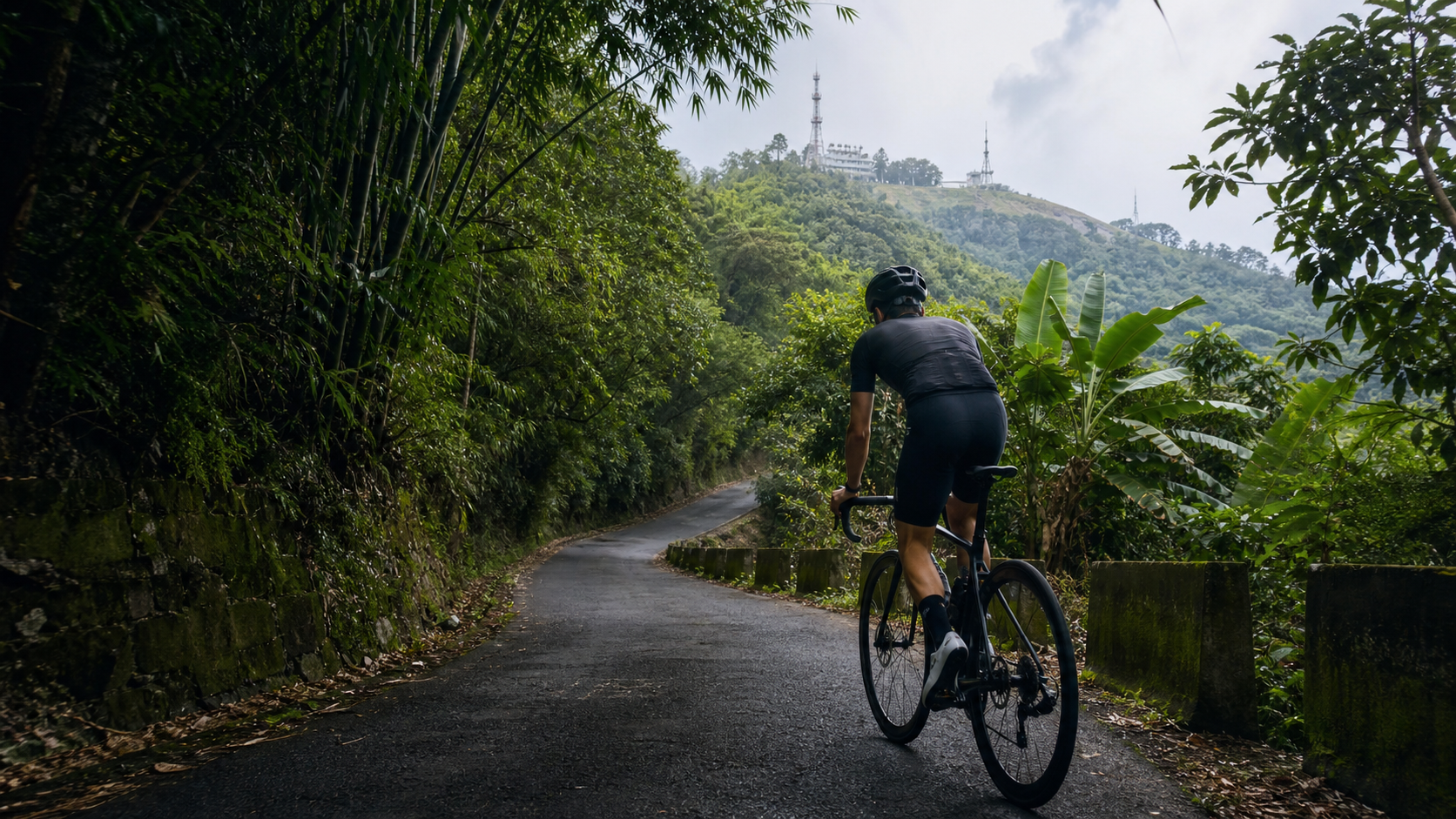
When most people think of Jiji, they picture the Green Tunnel and the small train. But for climbing enthusiasts, the real challenge in Jiji lies hidden in the mountains behind the town—an industrial road leading up to the Jiji Mountain television relay station.
Let’s look at the real numbers: The Jiji Mountain relay station (Strava segment 13869273) is approximately 14.39 km long with 1,030.4 meters of total elevation gain and an average gradient of 7.0%. Strava classifies it as the highest Category 5 (HC). With over 1,000 meters of climbing and 14 km of continuous ascent, this seemingly obscure route is actually comparable in difficulty to many famous climbs. It’s what Nantou cyclists consider the ultimate “hidden hard workout.”
This article takes a data-driven approach, breaking down those 14.39 kilometers into an executable pacing and gear-ratio strategy.
Route Overview: A Hard Climb Hidden Beneath the Green Tunnel
| Item | Data |
|---|---|
| Segment Distance | 14,390 meters (approx. 14.39 km) |
| Total Elevation Gain | 1,030.4 meters |
| Average Gradient | 7.0% |
| Strava Classification | Category 5 (HC) |
| Location | Jiji Township, Nantou County |
| Finish | Jiji Mountain TV Relay Station (at approx. 1,392m elevation) |
| Start Reference | Around Jiji urban area (approx. 250–300m elevation) |
The climb up Jiji Mountain typically starts on the industrial road near the Fushan branch of Yongchang Elementary School, winding upward along the meandering access road, flanked by a green tunnel woven from bamboo groves, trees, and banana plants. At the end of the industrial road (at approximately 1,392 meters elevation), there’s a sign for the central Taiwan television relay station, complete with transmission towers and parking space—this is the summit of the route.
The 7.0% average gradient may look gentle at first glance, but the key to this road lies in its “relentlessness”—nearly the entire 14 km is uphill with little flat respite, and the inconsistent surface quality of the industrial road makes it a severe test of endurance and pace management.
Segment Strategy 1: Town to Trailhead (Warm-Up Section)
The stretch from Jiji urban area to the industrial road trailhead is a relatively gentle transition zone. Be sure to use this section to warm up properly.
- Pacing Principle: Keep your heart rate in the aerobic zone, hold power at 65%–70% of FTP, and let your muscles gradually ease into working condition.
- Equipment Check: Before the real climbing begins, confirm smooth gear shifting, top off your water bottles, and verify correct tire pressure.
- Mindset: The real battle on this road lies ahead—don’t rush the early section.
Segment Strategy 2: Green Tunnel Gentle Climb (Trailhead – Midpoint)
Once you enter the industrial road, the gradient gradually rises to 6%–8%, with bamboo groves and trees forming a shaded green tunnel on both sides. This is the core section for establishing your rhythm.
- Pacing Strategy: Use a “steady output” mode, holding power at 75%–80% of FTP, and push forward with a sustainable rhythm.
- Cadence: Maintain 80–90 rpm. The industrial road has occasional short steep pitches and pavement damage; use a higher cadence to absorb gradient changes.
- Road Surface Reminder: The industrial road may have fallen leaves, moss, loose gravel, and potholes. Pay special attention to traction on shaded, damp sections, and slow down through corners.
Segment Strategy 3: Steepening Section (Midpoint – Near Summit)
The closer you get to the relay station, the less forgiving the gradient becomes, with some sections exceeding 10%. At the same time, elevation gradually increases—not enough to cause altitude sickness, but accumulated fatigue will begin to show.
- Gear Ratio Advice: From this section onward, make good use of light gears like 34×30 and 34×32. Shift down decisively on steep pitches to maintain cadence.
- Pacing Strategy: Accept that your speed will drop, and focus on “keeping the pedals turning without interruption.” This section is a dual test of willpower and pacing discipline.
- Fueling Timing: Use slightly flatter sections to take in carbohydrates and fluids—don’t wait until you bonk to think about eating.
Segment Strategy 4: Relay Station Final Section
You’ll finally reach the relay station at approximately 1,392 meters elevation. With its transmission towers and parking space, it’s an excellent spot to rest and take in the views.
- Pacing: If you have energy to spare, you can push slightly harder on the final stretch. If you’re near your limit, the principle is “spin it out smoothly without putting a foot down.”
- Recovery: After arriving, be sure to hydrate, stretch, and add layers. Temperature and humidity at the summit differ significantly from the base.
Gear Ratio and Equipment Recommendations
| Rider Level | Recommended Chainring | Recommended Cassette | Notes |
|---|---|---|---|
| General Cyclist | 50/34T Compact | 11-34T | Plenty of bailout gearing for long climbs |
| Advanced | 50/34T | 11-32T | For those with an endurance base |
| Competitive | 52/36T | 11-30T | For those with a high power-to-weight ratio |
Other key points:
- Tires: 25c–28c. The industrial road surface quality is inconsistent; slightly lower tire pressure improves comfort and traction.
- Tread: Choose tires that balance grip and puncture resistance, as mountain access roads have more loose gravel.
- Brakes: The descent demands a lot from your brakes. Control your speed especially on the industrial road downhill—disc brakes are preferred.
Fueling and Hydration Strategy
There are virtually no resupply points along the Jiji Mountain industrial road—this is the most important thing to plan for.
- Before Climbing: Stock up on water and energy in Jiji town. The town has convenience stores and shops—this is your last chance to resupply.
- Carry Amount: At least two bottles of water, plus enough energy gels or food. A 14 km continuous climb burns far more than you’d expect.
- Strategy: Replenish carbohydrates and electrolytes every 40–50 minutes to avoid energy depletion in the later stages.
Weather and Seasons
- Spring/Autumn: The ideal riding seasons—cool, dry, and clear visibility.
- Summer: Humid and hot at lower elevations, but the green tunnel provides shade. Start early in the morning to avoid afternoon thunderstorms.
- Afternoon Fog: Higher elevations in the mountains tend to get foggy after noon. Plan to complete the challenge by late morning.
- After Rain: The industrial road becomes slippery after rain, with a higher risk of rockslides and fallen branches. Always check road conditions before heading up.
Common Mistakes and DNF Risks
- Underestimating the Sustained Effort: Misled by the “7% average,” riders overlook the endurance drain of 14 km with almost no respite.
- Starting Too Fast: Rushing through the town-to-trailhead section, only to fade by the middle of the access road.
- Insufficient Supplies: No resupply points along the route, yet not carrying enough water and food—leading to dehydration and bonking in the later stages.
- Road Surface Errors: Slipping on damp, shaded sections or gravel patches. The surface risks of industrial roads are often underestimated.
- Losing Control on the Descent: The long downhill return tests your brakes and focus, and fatigue makes mistakes more likely.
Target Times by Rider Level
Based on 14.39 km, 1,030 meters of climbing, and a 7% average gradient:
| Rider Level | Reference Time | Average Speed |
|---|---|---|
| Competitive Racer | 42–52 min | 16–20 km/h |
| Advanced Cyclist | 53 min – 1 hr 5 min | 13–16 km/h |
| General Cyclist | 1 hr 6 min – 1 hr 25 min | 10–13 km/h |
| Recreational Challenge | Over 1 hr 25 min | Below 10 km/h |
The Jiji Mountain relay station is a “hard climb hidden beneath the green tunnel.” It lacks the fame of Wuling, yet with over a kilometer of sustained climbing, it honestly tests your endurance and pacing discipline. When you gaze out over the Jiji valley and the Zhuoshui River from beneath the transmission tower, you’ll understand: some of the most solid training is hidden in these unassuming industrial roads.
The Endurance Science of a 1,000-Meter Climb: Why “Sustained” Is More Grinding Than “Steep”
The Jiji Mountain relay station has an average gradient of only 7%—far gentler than Guguan’s 11.7% climb—but its difficulty comes from another dimension: “sustained effort.” A continuous 14.39 km ascent with over 1,000 meters of climbing doesn’t test instantaneous power; it tests your endurance engine’s ability to maintain a steady output over a long period.
From a physiological standpoint, this kind of prolonged, moderate-to-high-intensity continuous climbing primarily engages your aerobic system and glycogen stores. When you pedal continuously for over an hour, glycogen gradually depletes. If you don’t fuel adequately, you’ll hit the so-called “wall”—your body suddenly gives out, legs feel like lead, and your willpower wavers. Therefore, Jiji Mountain tests not just physical fitness, but also fueling rhythm and mental management. This is why many cyclists regard it as the top choice for “endurance workouts”: it forces you to learn how to hold your pace, your fueling, and your mindset steady through a long climb. Anyone who can ride Jiji Mountain with composure will face other long climbs (like the middle section of Wuling) with far more confidence.
Training Your Aerobic Engine: Treating Jiji Mountain as a Long Interval
Jiji Mountain’s completion time of roughly 45 minutes to 1.5 hours makes it an ideal venue for “long interval (Tempo/Threshold)” training. Here’s a reference workout: after a thorough warm-up, ride the entire route steadily at 76%–90% of FTP (the Tempo to Sweet Spot range), maintaining even power or heart rate throughout, avoiding surges and fades. This type of training efficiently improves your aerobic threshold and your ability to sustain output over time.
For a more advanced approach, you can insert several threshold intervals into the climb—for example, every 10 minutes of climbing, add 3 minutes at 95%–105% of FTP, then return to Tempo. This variable-intensity training simultaneously stimulates both aerobic and anaerobic systems, simulating the ability to handle gradient changes in real-world racing. Whichever workout you choose, Jiji Mountain’s length and steady gradient provide an ideal training environment. Remember to fuel and recover thoroughly afterward—long climbs take far more out of your body than you might think.
Industrial Road Riding Essentials
Jiji Mountain’s route is primarily an industrial road, which differs from regular roads in several key ways. Be sure to note the following:
- Inconsistent Surface Quality: The access road may have potholes, cracks, fallen leaves, moss, and loose gravel. Use 25c–28c tires with slightly reduced pressure for better comfort and traction. Slow down on corners and descents, leaving room to react.
- Shaded and Damp Conditions: The green tunnel formed by bamboo and trees is cool, but shaded sections of the road tend to stay damp and grow moss, reducing grip.
- Limited Visibility: The access road has many blind corners and poor sightlines. Agricultural vehicles, motorcycles, or pedestrians may appear—never take corners at speed.
- Scarce Resupply Points: There are virtually no resupply points along the access road. Stock up on water and food in Jiji town before heading up.
- Poor Cell Reception: Some sections of the mountain may have weak signal. Let friends or family know your itinerary, and carry basic repair tools and a spare tube.
FAQ
Q: Can a standard road bike handle this route? Yes, but because the industrial road surface is rougher, it’s recommended to use 28c tires with slightly lower pressure, and to have sufficiently light gearing for the steep sections.
Q: How much food and water should I bring? At least two bottles of water, plus 2–3 energy gels or bars. The 14 km continuous climb is demanding, and there are no resupply points along the way—bring enough.
Q: Is it suitable for beginners? Jiji Mountain is quite difficult (HC-rated). It’s recommended for cyclists with some climbing and long-distance experience. Beginners can build a foundation on gentler routes like Tou 101 first.
A Practical Breakdown of Segment Pacing
Jiji Mountain can be broken into four segments for pacing based on feel. The first segment is the warm-up from town to the trailhead: keep your heart rate in the aerobic zone, hold power at 65% to 70% of FTP, let your muscles gradually ease into working condition, and take the opportunity to check gear shifting and tire pressure. The second segment is the green tunnel gentle climb after entering the industrial road, where the gradient rises to 6% to 8%: use a steady output mode, hold power at 75% to 80% of FTP, maintain a cadence of 80 to 90 rpm, and use the higher cadence to absorb the access road’s short steep pitches and pavement damage.
The third segment is the steepening section. The closer you get to the relay station, the less forgiving the gradient becomes, with some sections exceeding 10%. From here, make good use of light gears like 34×30 and 34×32, shift down decisively on steep pitches, and focus on keeping the pedals turning without interruption. The fourth segment is the relay station final section: if you have energy to spare, you can push slightly harder; if you’re near your limit, the principle is to spin it out smoothly without putting a foot down. After reaching the relay station at approximately 1,392 meters, be sure to hydrate, stretch, and add layers—temperature and humidity at the summit differ significantly from the base. Keep these four segments’ rhythms in mind, and you’ll always stay in control of your condition throughout the long climb, rather than being dragged along by the endless road.
Summary of Common Mistakes and DNF Risks
Jiji Mountain may not be the steepest road, but it has several traps that can trip riders up. First is underestimating the sustained effort—misled by the 7% average, riders overlook the endurance drain of 14 km with almost no respite, only to run out of steam by the middle of the access road. Second is starting too fast, rushing through the town-to-trailhead section and burning through your energy early. Third is insufficient supplies—no resupply points along the route, yet not carrying enough water and food, leading to dehydration and bonking in the later stages. Fourth is road surface errors—slipping on damp, shaded sections or gravel patches; the surface risks of industrial roads are often underestimated. Fifth is losing control on the descent—the long downhill return tests your brakes and focus, and fatigue makes mistakes more likely.
The core of avoiding these risks is keeping the word “sustained” in mind. Jiji Mountain isn’t a road you conquer with a burst of power; it’s a road you grind through with endurance and discipline, bit by bit. From the very start, pace yourself at an intensity you can sustain for over an hour, fuel steadily, and stay focused on the road. You’ll ride this 1,000-meter hard climb hidden beneath the green tunnel safely and with composure. It will honestly repay your preparation—the better prepared you are, the more smoothly you ride; underestimate it, and it will teach you a proper lesson with its endless climbing and scarce resupply points.
Gear Ratios, Equipment, and Target Time Reference
Facing Jiji Mountain’s 14.39 km and over 1,000 meters of climbing, gear ratio selection is crucial. General cyclists are advised to use a 50/34T compact chainset with an 11-34T cassette—plenty of bailout gearing; advanced cyclists can use 11-32T; competitive cyclists with a high power-to-weight ratio can use 52/36T with an 11-30T. Choose 25c to 28c tires, as the industrial road surface quality is inconsistent—slightly lower tire pressure improves comfort and traction, and tires that balance grip and puncture resistance are recommended. The descent demands a lot from your brakes; control your speed especially on the industrial road downhill, and disc brakes are preferred. If extending to higher elevations, temperature differences increase with altitude, so bring a windbreaker.
Based on 14.39 km, 1,030 meters of climbing, and a 7% average gradient: competitive racers finish in about 42 to 52 minutes, advanced cyclists in about 53 minutes to 1 hour 5 minutes, general cyclists in about 1 hour 6 minutes to 1 hour 25 minutes, and recreational challengers in over 1 hour 25 minutes. This road lacks the fame of Wuling, yet with over a kilometer of sustained climbing, it honestly tests your endurance and pacing discipline. When you gaze out over the Jiji valley and the Zhuoshui River from beneath the transmission tower, you’ll understand: some of the most solid training is hidden in these unassuming industrial roads. Ride Jiji Mountain until you know it well, and you’ll find your endurance on all long climbs improves along with it—this is its true value as a hidden hard workout.
Route Overview and Difficulty Assessment
The Jiji Mountain relay station is approximately 14.39 km long with 1,030.4 meters of total elevation gain and an average gradient of 7.0%, classified by Strava as the highest Category 5 (HC). It typically starts on the industrial road near the Fushan branch of Yongchang Elementary School, winding upward along the meandering access road, flanked by a green tunnel woven from bamboo groves, trees, and banana plants. At the end of the industrial road (at approximately 1,392 meters elevation), there’s a sign for the central Taiwan television relay station, complete with transmission towers and parking space—this is the summit of the route.
The 7.0% average gradient may look gentle at first glance, but the key to this road lies in its sustained nature—nearly the entire 14 km is uphill with little flat respite, and the inconsistent surface quality of the industrial road makes it a severe test of endurance and pace management. Its difficulty comes not from steepness but from length; it tests not explosive power but endurance. This is why, despite lacking Wuling’s fame, its actual difficulty rivals many well-known climbs. Calling it HC-rated is no exaggeration. For cyclists looking to improve their long-climb endurance, Jiji Mountain is a severely underrated hidden hard workout—with over a kilometer of sustained climbing, it thoroughly tests and trains your aerobic engine and willpower. Ride it with composure, and you’ll face any long climb with greater confidence.
Final Words of Advice for Challengers
Finally, a few practical tips for those preparing to take on Jiji Mountain. First, be sure to stock up on water and food in Jiji town—this is your last resupply opportunity before heading up, as there are virtually no resupply points along the access road. Second, choose a day with stable weather, avoiding afternoon fog and post-rain slickness; the industrial road is prone to rockslides and fallen branches after rain. Third, let friends or family know your itinerary—some sections of the mountain may have poor cell reception—and carry basic repair tools and a spare tube. Fourth, know your limits—this is an HC-rated hard climb. If you’re new to climbing, build a foundation on gentler routes like Tou 101 before taking this on.
When you’re fully prepared and set out on a cool morning, you’ll discover that Jiji Mountain is actually an incredibly captivating road. It’s quiet and expansive, allowing you to spend deep time with yourself during the long ascent. The moment you reach the transmission tower and gaze out over the entire central mountain valley, you’ll understand that these 14 kilometers of solitude and sweat have earned you a sense of groundedness and vastness that no one can take away. This is the most precious gift Jiji Mountain offers to everyone willing to ride upward.
Why “Sustained-Type” Climbs Are a Required Course for Advanced Riders
At some point in many cyclists’ careers, they hit a plateau: they can sprint up short climbs, but on long climbs they always fade. This often isn’t a matter of insufficient muscle strength, but rather a problem of aerobic endurance and pacing discipline. And the best way to break through this plateau is to deliberately practice “sustained-type” long climbs—and Jiji Mountain is the ideal training ground for exactly this kind of workout.
Sustained-type climbs force you to maintain steady output, steady fueling, and a steady mindset over a long period. They train not explosive power, but the efficiency of your endurance engine and the management of your glycogen. When you can ride Jiji Mountain’s 14 km, 1,000-meter-plus sustained ascent with composure, you’ll find that on the middle section of Wuling, or in any long-distance climbing event, you no longer hit the wall as easily. There’s no shortcut to building this ability—only through repeated long-climb training, gradually stacking your body’s endurance foundation. Jiji Mountain is unassuming and far from Instagram-worthy, yet it’s precisely the best venue for this kind of solid training. It quietly helps you build your endurance, and then one day, you’ll suddenly realize that the long climbs that once left you exhausted are now something you can handle with ease. This is what sustained-type climb training—and Jiji Mountain—offers advanced riders in the most tangible way.
Trailhead and Approach Section
The trailhead for Jiji Mountain typically starts on the industrial road near the Fushan branch of Yongchang Elementary School. Before entering the steeper access road, the stretch from Jiji town to the trailhead is a relatively gentle transition zone. Be sure to use this section to warm up properly—keep your heart rate in the aerobic zone, hold power at 65% to 70% of FTP, and let your muscles gradually ease into working condition. Before the real climbing begins, confirm smooth gear shifting, top off your water bottles, and verify correct tire pressure. The real battle on this road lies ahead—don’t rush the early section.
It’s worth noting that Jiji town is your last full resupply opportunity for the entire route. The town has convenience stores and shops—be sure to stock up on water and food here, because once you enter the industrial road, there are virtually no resupply points along the way. A common mistake is underestimating the demands of this 14 km continuous climb, not bringing enough water and food, and ending up dehydrated and bonked in the later stages. So, better to carry one extra bottle and one extra energy gel than to find your supplies running dry halfway up the mountain. With proper warm-up and fueling preparation on the approach section, you’ll be in optimal condition when you enter the real climb, ready to take on this 1,000-meter hard climb hidden beneath the green tunnel with composure.
Complete Weather, Season, and Road Condition Advice
The weather and season you choose for Jiji Mountain directly affect the safety and enjoyment of your ride. Spring and autumn are the ideal riding seasons—cool, dry, and clear visibility; summer is humid and hot at lower elevations, but the green tunnel provides shade, so start early in the morning to avoid afternoon thunderstorms; higher elevations in the mountains tend to get foggy after noon, so plan to complete the challenge by late morning. After rain, the industrial road becomes slippery and prone to rockslides and fallen branches—always check road conditions before heading up.
Take care of all these details, and you’ll be able to conquer this HC-rated hidden hard climb safely and to the fullest. It lacks the fame of Wuling, yet with over a kilometer of sustained climbing, it honestly tests your endurance and pacing discipline. When you gaze out over the Jiji valley and the Zhuoshui River from beneath the transmission tower, you’ll understand: some of the most solid training is hidden in these unassuming industrial roads. Ride Jiji Mountain until you know it well, and you’ll find your endurance on all long climbs improves along with it—this is its most precious value as a hidden hard workout. What it teaches you isn’t just how to climb a mountain, but how to hold your rhythm and will steady through long and solitary effort.
Related Reading
- Jiji Beyond the Small Train: The Solitude and Vastness of Riding to the Jiji Mountain Relay Station
- Pinglin North 42 Practical Guide: A Hidden Hard Climb with 12% Steep Pitches Concealed in 5.1 km—Full Data Contradiction Breakdown
- Xitou Shanlinxi Alpine Guide: The Hidden Difficulty of 5% Below 1,600 Meters Elevation
- Lugu Tou 101 Guide: A 4.3% Beginner-Friendly Workout, Gateway to the Dalunshan Scenic Area
台北闊瀨陡坡 騎旅 / 日本單車雜誌編輯車友臨時加入!/ 髮香才是最強的 / feat. 北迴歸線小隊 / 公路車 CT Yeh
6 個月前
半日 小台灣 極限單車路線挑戰實錄
7 年前
團練) 4K NEKO 雙崎部落 間歇 狂拉 爽飛天 19/05/11
7 年前
阿里山塔塔加 兩倍特濃版!全新隧道開通! 進喔!公路車 | CT Yeh
3 年前
單車 梅山36灣 坡度介紹 路段介紹 空拍 (相關遊記影片,請參考說明或我的頻道喔,歡迎訂閱)
6 年前
一定要騎一次!阿里山最深處:里佳部落!單車旅行 | 2800m爬升 | 深度部落體驗:嗨翻晚會、螢火蟲、銀河 | feat. JJSC & 廢物伙伴 | 公路車 CT Yeh
10 個月前
4K單車實境) 舊陽金P字道 第1P 仰德大道至小油坑 誤跟武嶺神人們 被拉爆爽飛天 Taiwan Cycling Climb Route Recommend
7 年前
西進武嶺各路段 前8000名 大數據分析 配速攻略/功率/心律/推力比/維持率/踏頻/踏瓦比/牽車率 大公開 | 建大盃 NeverStop 可參考 | 公路車 | CT Yeh
5 年前