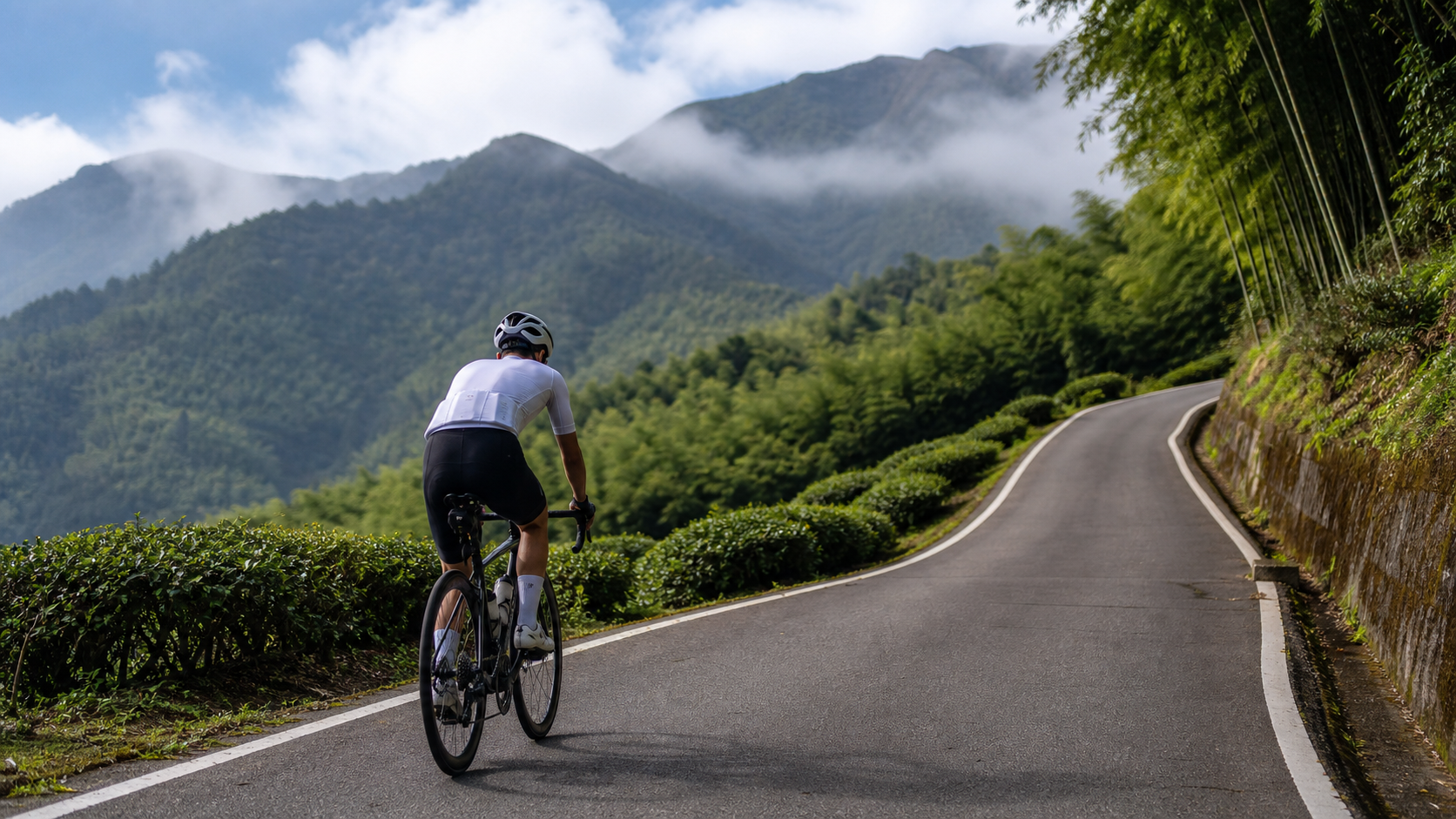
Hidden among the tea gardens and bamboo groves of Lugu, Nantou, lies a route cyclists affectionately call a beginner-friendly workout—Tou 101. It serves as the gateway to the tea plantations and forested hidden realm of Xitou and Dalunshan, and for many, it’s the first step into “Nantou climbing.”
Let’s look at the real numbers: Lugu Tou 101 (Strava segment 8946746) is approximately 7.61 km long, with 537.4 meters of total elevation gain and an average gradient of 4.3%, rated Category 3 on Strava. An average gradient of 4.3% is relatively approachable among Nantou’s notoriously tough climbs, but don’t underestimate it—the value of this road lies precisely in its “moderate difficulty, pleasant scenery, and strong extensibility,” making it an excellent venue for training pacing discipline and aerobic endurance.
This article takes an engineer’s perspective, breaking down this 7.61 km into an executable pacing and gear ratio strategy.
Route Overview: Gateway to the Tea Country Hidden Realm
| Item | Data |
|---|---|
| Segment Distance | 7,614 meters (approx. 7.61 km) |
| Total Elevation Gain | 537.4 meters |
| Average Gradient | 4.3% |
| Strava Category | Category 3 |
| Location | Lugu Township, Nantou County |
| Route Direction | From Lugu toward Xitou / Dalunshan, along County Road 101 |
| Nearby Landmarks | Xitou, Dalunshan Scenic Tea Plantations, Ginkgo Forest |
Lugu is one of Taiwan’s most important tea towns, the birthplace of Dongding Oolong tea, with tea plantations and bamboo groves spread across the hillsides. Tou 101 is a key climbing route from downtown Lugu toward Xitou and Dalunshan. Compared to Guguan’s 11.7% gradients or the sustained thousand-meter climbs of Jiji Mountain, Tou 101’s 4.3% average gradient is far more forgiving. This makes it: a starting point for beginner cyclists to build climbing confidence, a foundational route for advanced riders’ aerobic endurance training, and the essential passage to the hidden realm of Dalunshan’s Ginkgo Forest.
Segment Strategy 1: Warm-Up Start (0 – 2 km)
The early section of Tou 101 typically features gentler gradients, making it an excellent warm-up zone.
- Pacing Principle: Keep power at 65%–70% of FTP, control heart rate in the aerobic zone, and let your body smoothly transition into climbing mode.
- Cadence: Maintain a high cadence of 85–95 rpm, using an easy gear to warm up the muscles first.
- Mindset: Although the gradient is gentle, this is a full training segment—don’t burn through your energy in the warm-up zone.
Segment Strategy 2: Steady Climb (2 – 5 km)
Entering the middle section, the gradient holds a steady 4%–6% range, with occasional slightly steeper short pitches. This is the core zone for establishing rhythm and practicing “even output” across the entire segment.
- Pacing Strategy: This gradient is ideal for “Sweet Spot” training—hold power steadily at 84%–90% of FTP for extended periods, which is highly effective for raising your aerobic threshold.
- Cadence: Maintain 80–90 rpm, pushing forward with a fixed rhythm to avoid speed fluctuations.
- Gear Usage: A compact crankset paired with mid-range cassette cogs handles this comfortably; a 4.3% gradient doesn’t require emergency bailout gearing.
Segment Strategy 3: Tea Plantation Scenery (5 – 7.61 km)
Higher up, the views of tea plantations and bamboo groves open up, while the gradient remains within a manageable range. This section blends training with enjoyment.
- Pacing: If training is the goal, hold Sweet Spot intensity to the finish; if the experience is the priority, relax the pace and savor the tea country scenery along the way.
- Finishing: Near the end, if you have energy to spare, apply a bit more pressure to lift your average output and complete a full climbing time trial.
- Extension: Tou 101’s greatest appeal lies in its “extensibility”—after finishing this segment, you can continue toward Xitou and Dalunshan, taking on the higher-altitude Ginkgo Forest route.
Gear and Equipment Recommendations
| Rider Level | Recommended Chainring | Recommended Cassette | Notes |
|---|---|---|---|
| Beginner / Leisure | 50/34T Compact | 11-32T | Cadence first, complete with ease |
| Advanced | 50/34T | 11-30T | Balances Sweet Spot training and flats |
| Competitive | 52/36T | 11-28T | Pursues power output efficiency |
Other key points:
- Tires: 25c–28c; the tea country mountain roads are in decent condition, standard tire pressure works fine.
- Bottles: Two bottles recommended; supplies are available in downtown Lugu, but scarce once you extend toward Dalunshan.
- Warmth: If extending to Dalunshan (elevation approx. 1,250–1,600m), temperature differences increase with altitude, so pack a windbreaker.
Nutrition and Hydration Strategy
- Downtown Lugu: Top up on water and food before departure. Shops and supply points are available in downtown Lugu and around Xitou.
- Xitou: An important supply and rest point for extended rides, with shops and dining options.
- Dalunshan Direction: If extending to the Ginkgo Forest, supply points dwindle—make sure to stock up beforehand.
- Tea Country Specialty: Don’t forget Lugu is the birthplace of Dongding Oolong tea; consider stopping to enjoy a cup of local tea along the way.
Weather and Seasons
- Spring & Autumn: The most comfortable seasons, with lush green tea plantations and pleasant weather.
- Summer: Humid and hot at lower elevations, but cooler as altitude increases; an early morning start is best.
- Afternoon Fog: The Dalunshan area is prone to fog after noon; if extending the ride, aim to complete it in the morning.
- Late Autumn & Early Winter: If extending to Dalunshan, this is when the ginkgo trees turn yellow—stunning scenery but colder temperatures, so extra warmth is needed.
Common Mistakes and DNF Risks
Tou 101 itself is moderately difficult with a low DNF risk, but a few points still warrant attention:
- Underestimating the Extension: Seeing only Tou 101’s 4.3% average, riders get caught off guard by the steeper gradients and higher altitude when extending to Dalunshan.
- Insufficient Supply Planning: Supplies are scarce beyond the Dalunshan direction, yet riders fail to bring enough water and food.
- Poor Visibility from Afternoon Fog: Dalunshan gets foggy in the afternoon, reducing visibility and increasing descent risk.
- Undisciplined Pacing: Though the gradient is gentle, erratic speed changes undermine the training effect.
Target Times for Different Rider Levels
Based on 7.61 km, 537 meters of climbing, and a 4.3% average gradient:
| Rider Level | Reference Time | Average Speed |
|---|---|---|
| Competitive Rider | 18–22 min | 21–25 km/h |
| Advanced Rider | 23–28 min | 16–20 km/h |
| General Rider | 29–36 min | 13–16 km/h |
| Leisure Beginner | 37+ min | Below 13 km/h |
Tou 101 is a route that is “beginner-friendly, yet as deep as you want it to be.” Want an easy ride? It’s a leisurely path through tea country scenery. Want to train seriously? It’s an excellent workout for Sweet Spot and aerobic endurance. Want a challenge? It’s the gateway to the hidden realm of Dalunshan’s Ginkgo Forest. No matter what stage of your cycling journey you’re at, Tou 101 offers you a ride that’s just right. This “flexibility” is precisely what makes it a classic Nantou route.
Sweet Spot Training: The Ideal Workout for Tou 101
With an average gradient of 4.3%, Tou 101 is an excellent venue for “Sweet Spot Training.” The Sweet Spot refers to the intensity range of 84% to 90% of FTP—high enough to effectively stimulate the aerobic engine and raise FTP, yet not so high that you fatigue quickly like with threshold intervals, allowing for sustained efforts and substantial training volume. This high-return training is regarded by many coaches as the most efficient way to improve endurance performance.
Tou 101’s steady 4% to 6% gradient allows you to sustain Sweet Spot intensity without blowing up. A reference workout: after a thorough warm-up, ride Tou 101 steadily at Sweet Spot intensity, maintaining even power or heart rate throughout, avoiding erratic speed changes. If your fitness allows, descend back to the start and climb a second time. This type of training isn’t as hard on the knees or as mentally draining as repeated steep climbs, yet it solidly builds your aerobic foundation—making it the top choice for a base-building period. Treat Tou 101 as your Sweet Spot training ground, one to two sessions per week, and over a training cycle, your FTP and endurance will show noticeable improvement. And those gains will be reflected across all your riding performance.
Extended Challenge: The Complete Guide from Tou 101 to Dalunshan
Tou 101’s greatest appeal lies in its extensibility. After finishing these 7.61 kilometers, you can continue toward Xitou and Dalunshan, taking on the higher-altitude Ginkgo Forest route. Dalunshan sits at approximately 1,250 to 1,600 meters above sea level, and this extension features steeper gradients and higher altitude than Tou 101 itself—a complete challenge with a step up in difficulty.
Pacing and supplies for the extension need to be re-planned. The higher you go, the steeper the gradients and the higher the altitude, with afternoon fog reducing visibility. Therefore, if extending to Dalunshan, it’s strongly recommended to start and finish in the morning, avoiding the afternoon fog and potential weather changes. For supplies, shops and supply points are available along Tou 101 in downtown Lugu and around Xitou, but they become scarce toward Dalunshan—be sure to stock up on water and food at Xitou first. For gearing, the steeper sections of the extension require easier gears; have 34×30 and 34×32 ready. For equipment, Dalunshan’s high altitude brings significant temperature swings—even if it’s warm at the base, it can be noticeably cooler up top, so pack a windbreaker. Stringing Tou 101 and Dalunshan together into one complete ride, you can experience the full spectrum from a beginner-friendly gentle climb to a high-altitude challenge in a single day—this is precisely the charm of a route that can be as easy or as demanding as you choose.
Route Overview: Gateway to the Tea Country Hidden Realm
Lugu Tou 101 is approximately 7.61 km long, with 537.4 meters of total elevation gain and an average gradient of 4.3%, rated Category 3 on Strava. Located in Lugu Township, Nantou County, it’s a key climbing route from downtown Lugu toward Xitou and Dalunshan. Lugu is one of Taiwan’s most important tea towns, the birthplace of Dongding Oolong tea, with tea plantations and bamboo groves spread across the hillsides. Compared to Guguan’s 11.7% gradients or the sustained thousand-meter climbs of Jiji Mountain, Tou 101’s 4.3% average gradient is far more forgiving.
This makes it a starting point for beginner cyclists to build climbing confidence, a foundational route for advanced riders’ aerobic endurance training, and the essential passage to the hidden realm of Dalunshan’s Ginkgo Forest. Its value lies precisely in its moderate difficulty, pleasant scenery, and strong extensibility. Want an easy ride? It’s a leisurely path through tea country scenery. Want to train seriously? It’s an excellent workout for Sweet Spot and aerobic endurance. Want a challenge? It’s the gateway to the hidden realm of Dalunshan’s Ginkgo Forest. No matter what stage of your cycling journey you’re at, Tou 101 offers you a ride that’s just right. This flexibility is precisely what makes it a classic Nantou route.
Segment Pacing and Cadence
Tou 101 can be split into three segments for pacing based on feel. The early section, roughly 0 to 2 kilometers, typically has gentler gradients and is an excellent warm-up zone—keep power at 65% to 70% of FTP, maintain a high cadence of 85 to 95 rpm, and let your body smoothly transition into climbing mode. Though the gradient is gentle, this is a full training segment—don’t burn through your energy in the warm-up zone. The middle section, roughly 2 to 5 kilometers, holds a steady 4% to 6% gradient range; this is the core zone for establishing rhythm and practicing even output, and it’s ideal for Sweet Spot training—hold power steadily at 84% to 90% of FTP for extended periods, which is highly effective for raising your aerobic threshold.
The latter section, from roughly 5 kilometers to the finish, offers increasingly open views of tea plantations and bamboo groves as you climb, with the gradient remaining within a manageable range. If training is the goal, hold Sweet Spot intensity to the finish; if the experience is the priority, relax the pace and savor the tea country scenery along the way. Near the end, if you have energy to spare, apply a bit more pressure to lift your average output and complete a full climbing time trial. For gearing, a compact crankset paired with mid-range cassette cogs handles this comfortably; a 4.3% gradient doesn’t require emergency bailout gearing. Choose tires from 25c to 28c; the tea country mountain roads are in decent condition, and standard tire pressure works fine. Bring two bottles; supplies are available in downtown Lugu, but scarce once you extend toward Dalunshan. This road is moderately difficult with a low DNF risk, but if extending toward Dalunshan, be sure to watch for steeper gradients, higher altitude, and poor visibility from afternoon fog.
Target Times and Action Plans
Based on 7.61 km, 537 meters of climbing, and a 4.3% average gradient, competitive riders finish in about 18 to 22 minutes, advanced riders in about 23 to 28 minutes, general riders in about 29 to 36 minutes, and leisure beginners in 37 minutes or more. These reference numbers help you gauge your training progress and positioning.
For riders with different goals, Tou 101 offers different ways to play. If you’re a beginner, treat it as the first step in building climbing confidence—use an easy gear and a sustainable rhythm, and enjoy the sense of accomplishment from climbing a hill under your own power. If you want to train seriously, treat it as a Sweet Spot workout—ride steadily at 84% to 90% of FTP to solidly build your aerobic foundation. If you’re seeking a challenge, treat it as the gateway to Dalunshan—after finishing Tou 101, continue upward to experience the full spectrum from a beginner-friendly gentle climb to a high-altitude hidden realm. Whichever way you play it, Tou 101 gives you just the right feedback. It doesn’t drain you like hardcore steep climbs; instead, it’s like a gentle guide, leading you step by step into the joy of climbing, into the tea fragrance and sea of clouds of Lugu. This is precisely what makes it such a charming beginner-friendly workout.
Detailed Gear and Equipment Recommendations
For a beginner-friendly route like Tou 101, gear choices are relatively flexible. Beginner and leisure riders are advised to use a 50/34T compact crankset with an 11-32T cassette, prioritizing cadence for an easy completion; advanced riders can use an 11-30T to balance Sweet Spot training and flats; competitive riders pursuing power output efficiency can use a 52/36T with an 11-28T. Choose tires from 25c to 28c; the tea country mountain roads are in decent condition, and standard tire pressure works fine. If extending to Dalunshan (elevation approx. 1,250 to 1,600 meters), temperature differences increase with altitude, so pack a windbreaker.
For supplies, top up on water and food in downtown Lugu before departure; shops and supply points are available in downtown Lugu and around Xitou. Xitou is an important supply and rest point for extended rides, with shops and dining options. If extending to the Ginkgo Forest, supply points dwindle—be sure to stock up beforehand. Don’t forget Lugu is the birthplace of Dongding Oolong tea; consider stopping to enjoy a cup of local tea along the way. These seemingly trivial preparations make riding Tou 101 more relaxed and enjoyable. It’s not a hard mountain that demands serious preparation, but a road you can ride with a light heart, stopping as you please and savoring the experience. With your equipment properly prepared, you can devote all your attention to enjoying the tea plantations, bamboo groves, and sea of clouds along the way.
Common Mistakes and Extension Considerations
Tou 101 itself is moderately difficult with a low DNF risk, but a few points still warrant attention. First is underestimating the extension—seeing only Tou 101’s 4.3% average, riders get caught off guard by the steeper gradients and higher altitude when extending to Dalunshan. Second is insufficient supply planning—supplies are scarce beyond the Dalunshan direction, yet riders fail to bring enough water and food. Third is poor visibility from afternoon fog—Dalunshan gets foggy in the afternoon, reducing visibility and increasing descent risk. Fourth is undisciplined pacing—though the gradient is gentle, erratic speed changes undermine the training effect.
Therefore, if you plan to extend Tou 101 into a complete Dalunshan challenge, be sure to do three things: start and finish in the morning to avoid afternoon fog; stock up on water and food at Xitou; and bring easy gearing for the steep sections and a windbreaker for the temperature swings. With these in place, you can safely enjoy the full spectrum from a beginner-friendly gentle climb to a high-altitude hidden realm. Tou 101’s charm lies precisely in its flexibility—you can ride just the segment itself, enjoying a relaxed tea country climb, or extend the challenge to experience the awe of Dalunshan’s ginkgo forest, the largest in Southeast Asia. Whichever you choose, as long as you prepare accordingly, this road will give you a wonderful and safe journey.
The Science of Sweet Spot Training and Long-Term Benefits
We mentioned earlier that Tou 101 is well-suited for Sweet Spot training; here’s a deeper look at why. Sweet Spot training is championed by many coaches because it hits the optimal balance point of training benefit. Intensity too low (like pure aerobic easy riding) provides insufficient stimulus and slow progress; intensity too high (like repeated VO2max intervals) causes rapid fatigue, long recovery, and difficulty accumulating training volume. The Sweet Spot (84% to 90% of FTP) sits right in between—intense enough to effectively raise your aerobic threshold and FTP, yet not so high that you fatigue quickly, allowing for sustained efforts and substantial effective training time.
Tou 101’s steady 4% to 6% gradient provides the ideal environment for maintaining the Sweet Spot—not so steep that you’re forced above the range, and not so gentle that you struggle to hold intensity. Long-term, regular Sweet Spot training can significantly raise your functional threshold power—the maximum output you can sustain for extended periods. This means you’ll ride faster, longer, and more efficiently on all climbs and all long-distance rides. Treat Tou 101 as your Sweet Spot training ground, schedule one to two sessions per week, stay consistent, and after a few training cycles, you’ll clearly feel your overall riding ability leap forward. This solid, injury-free progress is exactly why Tou 101, as a beginner-friendly workout, can accompany you for the long haul.
Conclusion: A Road That’s Just Right
Tou 101 is a road that’s just right. Its gradient is just right—enough to bring the satisfaction of climbing, yet not enough to scare off beginners; its length is just right—enough for a complete training session, yet not so exhausting as to deter riders; its scenery is just right—tea plantations, bamboo groves, forests, and seas of clouds accompany you all the way without stealing the show. This perfect balance makes Tou 101 one of Nantou’s most beloved beginner classics.
Whether you’re a newcomer just entering the road cycling world or a battle-hardened veteran, Tou 101 gives you exactly what you need. Beginners find confidence and joy here; veterans find training and relaxation. It’s like a considerate friend, always adapting to your current mood and condition, offering you the most suitable journey. Next time you don’t know which road to ride—when you want to train but not overdo it, want to relax but still have a bit of challenge, want to see scenery without going too far—remember Tou 101. This gateway to the tea country hidden realm will give you a ride that’s just right with its just-right gradient, just-right scenery, and just-right difficulty. And that sense of “just right” is often the rarest and most needed thing in our cycling, and in our lives.
Weather, Seasons, and Safety Reminders
For riding Tou 101, spring and autumn are the most comfortable seasons, with lush green tea plantations and pleasant weather; summer is humid and hot at lower elevations, but cooler as altitude increases, with an early morning start being best; the Dalunshan area is prone to fog after noon, so if extending the ride, aim to complete it in the morning; in late autumn and early winter, if extending to Dalunshan, it’s the season when the ginkgo trees turn yellow—stunning scenery but colder temperatures, so extra warmth is needed. These seasonal characteristics determine how you should plan your itinerary and what gear to carry.
For safety, Tou 101 itself has friendly road conditions, but after extending to Dalunshan, a few points need attention: the roads on Dalunshan are less smooth, so ride carefully; due to the higher altitude, fog is common after noon, so an early morning visit is recommended. When descending into fog, be sure to slow down, turn on your lights, and stay focused. Additionally, agricultural vehicles and tourist cars occasionally appear in the mountain area—never cross the centerline on corners. With these safety preparations in place, you can confidently enjoy Tou 101’s complete charm from a beginner-friendly gentle climb to a high-altitude hidden realm. The beauty of this road lies in how it lets beginners enter safely while allowing advanced riders to take on the extension—as long as you prepare according to your level, it will reward you with a safe and unforgettable journey.
Combining Repeated Climbs with Aerobic Endurance Training
Beyond the Sweet Spot, Tou 101 is also well-suited for long-duration aerobic endurance (Zone 2) training. You can ride at a lower intensity with a higher cadence, treating Tou 101 as part of your aerobic base riding to accumulate volume and build your endurance foundation. This low-intensity riding may seem easy, but it’s key to improving fat metabolism and expanding your aerobic engine—the cornerstone of all advanced training.
If you want to use Tou 101 more comprehensively, you can structure it as a workout incorporating multiple intensities: warm up in Zone 2 on the gentle early section, do the main Sweet Spot set on the steady middle section, and add a threshold challenge on the latter section if extending to Dalunshan. In a single ride, you can simultaneously stimulate your aerobic base, aerobic threshold, and anaerobic capacity—extremely high training efficiency. Tou 101’s gradient variations and extensibility allow it to accommodate a wide range of training needs, which is precisely what makes it so flexible as a training ground. Whatever you want to train, Tou 101 can almost always accommodate—this versatility makes it one of the highest-frequency routes in Nantou cyclists’ go-to lists.
Making Tou 101 Your First Step Toward the Mountains
For many newcomers to road cycling, the mountains are both alluring and intimidating. They long for the sense of accomplishment from conquering, yet fear the embarrassment of not making it up or having to put a foot down halfway. Tou 101 is the perfect first step to dissolving that fear. Its gentle gradient, moderate distance, and pleasant scenery allow beginners to experience the rhythm and joy of climbing for the first time in a relatively friendly environment.
When you first ride up Tou 101 under your own power, watching the tea plantations spread out below and the mist swirling in the distance, that sense of achievement will ignite your love for climbing and the mountains. Starting from Tou 101, you’ll gradually build confidence, then take on longer, steeper, higher roads step by step—Jiji Mountain, Guguan, and even Wuling. Tou 101 is like a gentle mentor; it doesn’t intimidate you or push you, but patiently leads you through that first step, helping you fall in love with these mountains and with climbing. And that initial spark of passion often stays with you throughout your entire cycling career. This is the most profound and precious significance of Tou 101 as a beginner-friendly workout.
Related Reading
- Between Tea Fragrance and Seas of Clouds: Riding Tou 101 into the Lugu Dalunshan Ginkgo Forest Hidden Realm
- Xitou Shanlinxi High Mountain Guide: The Hidden Difficulty of 5% at 1,600 Meters Elevation
- Zhongliao Erjian Mountain Guide: Complete Analysis of Nantou’s Rolling Tea Country 7.3% Hardcore Hidden Climb
- Luye Songlin Practical Guide: How to Ride the Short, Explosive 3.8 km Climb with Steepest Sections Over 20%
台北闊瀨陡坡 騎旅 / 日本單車雜誌編輯車友臨時加入!/ 髮香才是最強的 / feat. 北迴歸線小隊 / 公路車 CT Yeh
6 個月前
西進武嶺各路段 前8000名 大數據分析 配速攻略/功率/心律/推力比/維持率/踏頻/踏瓦比/牽車率 大公開 | 建大盃 NeverStop 可參考 | 公路車 | CT Yeh
5 年前
嘉義單車路線推薦:碧湖山茶園超陡坡挑戰!里佳部落-奮起湖-瑞峰 (附路線)
7 個月前
藤枝二集團 單車行 Day1 | 南部小武嶺 | 爬坡爬到罵罵叫 | JJSC | 公路車 | CT Yeh
3 年前
大武山後門26%歡樂陡坡!JJSC南台灣單車行Day2 / 被颱風追著跑 / 公路車 / CT Yeh
2 年前
一定要騎一次!阿里山最深處:里佳部落!單車旅行 | 2800m爬升 | 深度部落體驗:嗨翻晚會、螢火蟲、銀河 | feat. JJSC & 廢物伙伴 | 公路車 CT Yeh
10 個月前
萬年峽谷! 30% 超激陡坡 里佳部落DAY2 還是很硬! | 公路車 | CT Yeh
3 年前
#公路車 #西進武嶺 配速配瓦實驗 坡度分析 四小時內攻略 建大盃 NeverStop #西進武嶺攻略
6 年前