136 Chikan Summit Guide: How to Conquer Taichung Riders' Test Course with Its Gentle Start and Steep Finish
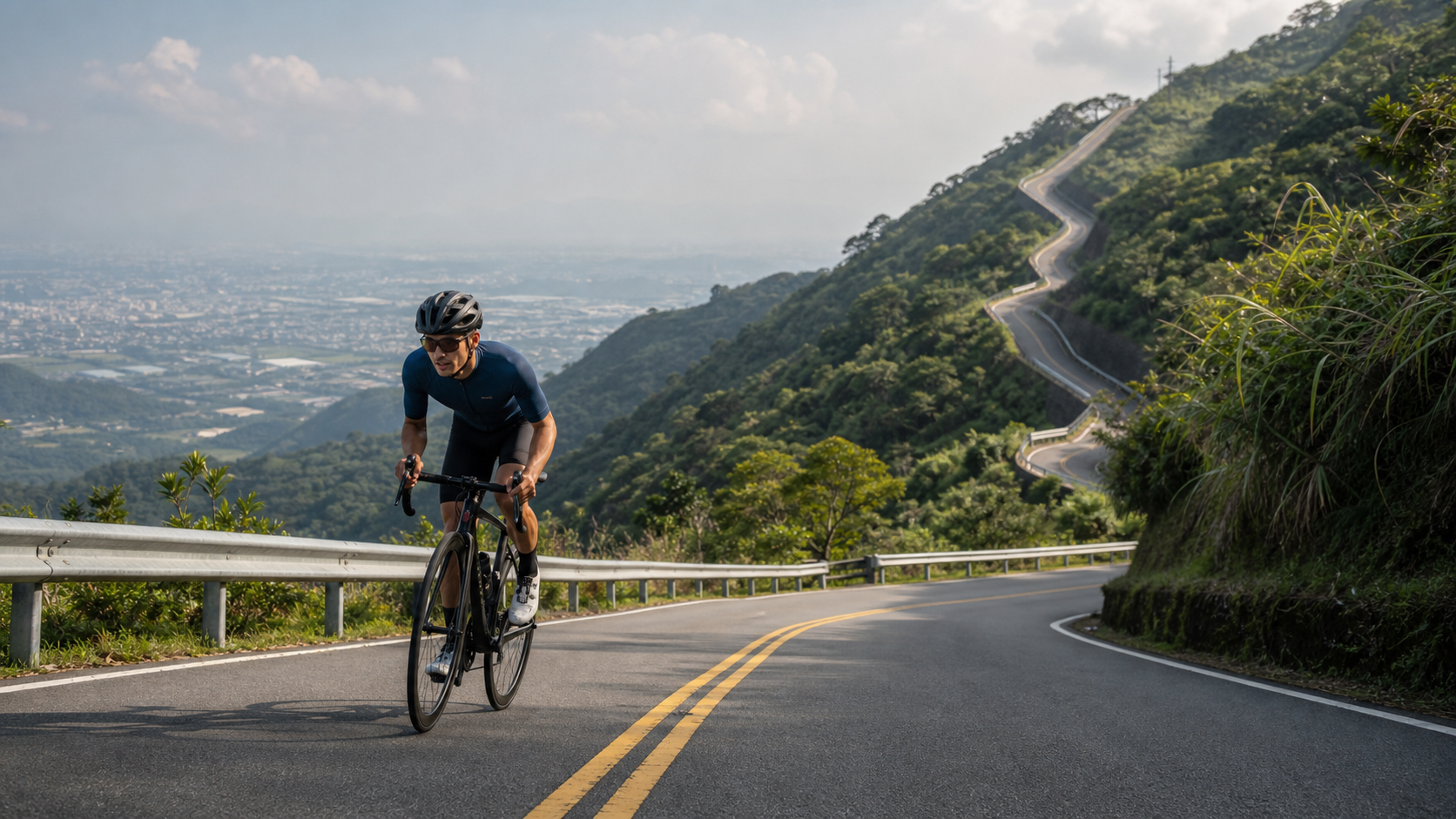
In Taichung’s cycling circles, there’s a half-joking saying: “136, the place where Taichung riders take the most exams.” This County Road 136 in Taiping District—the section leading to Chikan Summit—is the “exam hall” countless Taichung riders use to test their abilities. Want to know if your training this season has paid off? Take the 136 exam once and you’ll find out.
Let’s look at the real data: 136 (the core segment of Taichung’s “Da San Yuan” as designated by Strava) is approximately 14.46 km long, with 579.8 meters of total elevation gain and an average gradient of 3.7%. It’s rated Category 3 on Strava, starting in Taiping District, Taichung City. The 3.7% average gradient may seem gentle, but don’t be fooled—136’s difficulty lies not in its gradient, but in its “gentle-front, steep-back, broken-rhythm” structure, as well as its legendary status as part of the classic “Da San Yuan” route.
This article takes an engineer’s perspective to break down this 14.46-kilometer “exam paper.”
Route Overview: Taichung Riders’ Test of Strength
| Item | Data |
|---|---|
| Segment Distance | 14,459 meters (approx. 14.46 km) |
| Total Elevation Gain | 579.8 meters |
| Average Gradient | 3.7% |
| Strava Rating | Category 3 |
| Location | Taiping District, Taichung City |
| Nickname | Taichung Da San Yuan (Third Peak: Chikan Summit) |
| Start Reference | Taiping Yijiang Bridge |
The Chikan Summit section of County Road 136 is the core of the “Taichung Da San Yuan” route. The so-called Da San Yuan refers to three famous peaks in central Taiwan—Zhongxingling, Baimaoshan (Lingding), and Chikan Summit—which together form a classic mid-distance training route in central Taiwan, spanning approximately 90 km with about 1,600 meters of climbing. The Chikan Summit section of 136 is the most iconic of the three peaks and the one most frequently used to “compare strength.”
Starting from Taiping Yijiang Bridge to Chikan Summit, the distance is about 15 km with nearly 600 meters of climbing. The legendary aspect of this route: it was once the standard segment for judging riders’ abilities, with the professional best record set by Feng Chun-Kai of the Merida Lampre team at approximately 34 minutes 53 seconds. This number is the “perfect score” that countless amateur riders consider unreachable.
Why 136 Is an “Exam Hall”
The key to 136 being a true test of strength lies in its structure:
- Gentle front: From Yijiang Bridge, the first 9 km are gently rolling uphill with a mild gradient, tempting riders to accelerate.
- Steep back: After the gentle section, a steep climb of about 1 km appears, followed by another brief flat section, repeating in this pattern.
- Broken rhythm: The entire road alternates “flat—steep—flat—steep,” testing your ability to maintain steady output and control heart rate while shifting gears.
This structure makes 136 an honest mirror: riders without pacing discipline will push too hard on the gentle front section and collapse on the steep back section; truly capable riders know to hold back and conserve energy on the gentle front, then apply steady power on the steep back.
Segment Strategy 1: Yijiang Bridge to the Gentle Section (0 – 9 km)
The first 9 km are gently rolling uphill—this is the area that most tests your “discipline.”
- Pacing core: Resist the urge to push hard. The gradient is mild and your legs feel strong, so many riders unconsciously accelerate or even get drawn into wheel-sucking battles. Keep power at 75%–80% of FTP, keep heart rate below threshold, and save energy for the later sections.
- Cadence: Maintain a high cadence of 85–95 rpm, cruising comfortably on the big ring and mid cassette.
- Mindset: Treat these 9 km as “warm-up plus energy conservation.” The energy you save here determines your success or failure on the Chikan Summit section.
Segment Strategy 2: The Steep Climb Forge (9 – 12 km)
After the gentle section, a steep climb of about 1 km appears, followed by a brief flat, then another steep climb. This is the core area that determines your result.
- Gear usage: Prepare 34×28 or 34×32 for the steep sections. Downshift decisively when it gets steep, using cadence to maintain rhythm.
- Pacing strategy: Adopt an interval rhythm of “slightly above threshold on steep sections, recover on flats.” On steep points, you can push to 90%–95% of FTP, but immediately downshift and ease off once past the steep point to let heart rate drop.
- Key point: Don’t max out your heart rate on the steep climbs, or the subsequent rolling terrain will cause a complete collapse.
Segment Strategy 3: Chikan Summit Finish (12 – 14.46 km)
The final section leads to Chikan Summit. If you’ve paced well up front, this is where you can push your average output to the max.
- Pacing: If chasing a time, you can enter the 100%–110% of FTP range in the finish. If you’re already near your limit, prioritize “steady, no slowdown.”
- Judgment: 136’s cruelty lies in not giving you an easy finish—be sure to save one last breath for the end.
Gear and Equipment Recommendations
| Rider Level | Recommended Chainring | Recommended Cassette | Notes |
|---|---|---|---|
| General Riders | 50/34T Compact | 11-32T | Balances speed on flats with survival on steep climbs |
| Advanced | 50/34T | 11-30T | For those with training foundation |
| Competitive | 52/36T | 11-28T | For those pursuing power output efficiency |
Other key points:
- Tires: 25c–28c. The mountain roads have many tight corners; adjust tire pressure based on body weight.
- Brakes: The entire 136 route is mountain roads with many steep sections and tight corners. Descents are a severe test for brakes—make sure they’re in good condition.
- Reminder: Officials have clearly stated that 136 is entirely mountain roads with many steep sections and tight corners, making it challenging. It’s recommended that only riders who regularly complete 100 km or more take on this challenge.
Nutrition and Hydration Strategy
- Yijiang Bridge: Before departure, stock up on water and food at convenience stores near Yijiang Bridge (such as Hi-Life). This is an important starting-point supply stop.
- Carry amount: At least two bottles of water. Supply points are limited in the 136 mountain area, so be sure to bring enough.
- Strategy: Start taking small amounts of nutrition during the gentle front section—don’t wait until you’re bonking on the steep climbs to think about eating.
Weather and Seasons
- Spring/Autumn: The most comfortable seasons—cool and dry, ideal for chasing times.
- Summer: The mountain roads are hot and stuffy; it’s recommended to start early in the morning to avoid afternoon thunderstorms.
- Afternoon: Central Taiwan mountain areas often have weather changes in the afternoon; wet, tight corners on mountain roads are extremely dangerous.
- Winter: Mornings are cold; warm up thoroughly and watch for hypothermia on descents.
Common Mistakes and DNF Risks
- Pushing too hard on the gentle front section: 136’s biggest killer. Going too fast in the first 9 km leads to collapse on the Chikan Summit section.
- Being misled by the 3.7% average: Ignoring the true difficulty of the steep back section and broken rhythm.
- Insufficient gearing: Grinding with too-large gears on steep sections, causing both knees and heart rate to blow up.
- Mistakes on tight corners: The route is full of tight corners; losing control is easy on descents or when fatigued.
- Insufficient supplies: Underestimating the distance between supply points in the mountains, leading to dehydration in the later stages.
Target Times for Riders of Different Levels
Based on the approximately 14–15 km from Taiping Yijiang Bridge to Chikan Summit with nearly 600 meters of climbing (professional best approximately 34 minutes 53 seconds):
| Rider Level | Reference Time | Notes |
|---|---|---|
| Professional / Elite | 35–45 min | Feng Chun-Kai’s record of 34:53 is the benchmark |
| Competitive Riders | 46–55 min | Team level |
| Advanced Riders | 56 min – 1 hr 10 min | With training foundation |
| General Riders | Over 1 hr 10 min | Aim for steady completion |
136 is Taichung riders’ annual exam paper. It doesn’t intimidate you with high altitude, nor does it crush you with pure steepness—instead, through its “gentle-front, steep-back, broken-rhythm” structure, it honestly tests your pacing discipline and willpower. Want to know how well you’ve trained this season? Don’t ask your power meter—take the 136 exam once, and it will give you the most honest score.
Pacing Details: Gentle Start, Steep Finish
The difficulty of Route 136 lies not in its gradient, but in its structure. Starting from Taiping Yijiang Bridge, the first 9 kilometers are a gentle, slight incline—this is the section that most tests your discipline. The core of pacing here is holding back—the slope is mild, your body feels strong, and many riders unconsciously accelerate, even getting into pace-line battles. Keep power at 75% to 80% of FTP, control heart rate below threshold, and save energy for the later sections. Maintain a high cadence of 85 to 95 rpm, cruising comfortably on the big chainring and middle cassette. Treat these 9 kilometers as a warm-up and energy reserve—the effort you save here determines your success on the Chikan Ridge section.
After the gentle section, a steep climb of about 1 kilometer appears, followed by a brief flat, then another steep climb—this is the core zone that decides your result. Prepare 34×28 and 34×32 for the steep points, downshift decisively when the road tilts up, and adopt an interval rhythm of slightly exceeding threshold on the steep sections and recovering on the flats—you can push to 90% to 95% of FTP on the steep points, then immediately downshift and ease off once past them to let your heart rate drop. Don’t max out your heart rate on the steep sections, or the successive rollers ahead will completely break you. The final section is the road to Chikan Ridge—if you’ve paced well up front, this is where you maximize your average output; if you’re already near your limit, the principle is to hold a steady pace without fading. The cruelty of 136 is that it won’t let you ease up before the finish—be sure to save one last breath for the end.
The Complete Picture of the Big Three and Its Training Value
The Chikan Ridge section of 136 is actually part of a bigger game—part of Taichung’s “Big Three.” The so-called Big Three refers to three famous climbs in central Taiwan: Zhongxingling, Baimaoshan (Lingding), and Chikan Ridge. String them together and you get a classic central Taiwan training route of about 90 kilometers with roughly 1,600 meters of climbing. Each of the three climbs has its own character: the first, Zhongxingling, heads toward Dakeng, with a climb of about 8.4 kilometers and 327 meters of elevation gain; the second, Baimaoshan, heads toward Xinshe, with a climb of about 6.8 kilometers and 349 meters of elevation gain; the third, Chikan Ridge, heads toward Taiping, with a climb of about 12.3 kilometers and 576 meters of elevation gain—that’s the 136 section.
Conquering all three climbs in a single day and completing the Big Three is a badge of honor for many Taichung riders. And mastering 136 is the key to completing the Big Three—because Chikan Ridge is the longest and most iconic of the three. Route 136 is entirely mountainous, with many steep sections and tight switchbacks, making it highly challenging. Officials recommend that only riders who regularly complete 100-kilometer rides or more take on this challenge. Its training value lies in that structure of a gentle start, steep finish, and broken rhythm—it forces you to develop the ability to maintain steady output and control heart rate while shifting through changing gears. This ability is the core skill for handling all complex terrain routes. Ride 136 thoroughly, and you won’t just conquer a classic route—you’ll have honed a climbing ability that can handle any rhythm.
Route Overview: Taichung Riders’ Test of Strength
Route 136 (the core segment of Taichung’s Big Three as designated on Strava) spans approximately 14.46 kilometers with 579.8 meters of total elevation gain and an average gradient of 3.7%. It’s rated Category 3 on Strava, starting in Taichung’s Taiping District. The 3.7% average gradient looks gentle, but don’t be fooled—the difficulty of 136 lies not in its gradient, but in its structure of a gentle start, steep finish, and broken rhythm, as well as its legendary status as part of the classic Big Three route.
From Taiping Yijiang Bridge to Chikan Ridge, the distance is about 15 kilometers with nearly 600 meters of climbing. The legendary status of this road comes from this: it was once the standard segment for judging a rider’s ability, with the professional best record set by Feng Chun-kai of the Merida Lampre team at approximately 34 minutes and 53 seconds. That number is the unattainable perfect score in the minds of countless amateur riders. The reason 136 can serve as a touchstone of strength lies in its structure: the first 9 kilometers are a gentle incline with a mild gradient that tempts you to accelerate; after the gentle section, a steep climb of about 1 kilometer appears, followed by another brief flat, and so on. The entire road alternates between gentle, steep, gentle, and steep, testing your ability to maintain steady output and control heart rate while shifting through changing gears. This structure makes 136 an honest mirror: riders without pacing discipline will go too fast on the gentle early section and collapse on the steep later section; while truly capable riders know to hold back and conserve energy on the early gentle section, then apply steady power on the later steep section.
Gearing, Equipment, Nutrition, and Target Times
Facing the gentle-start, steep-finish profile of 136, your gearing needs to cover both ends. For general riders, a 50/34T compact crankset paired with an 11-32T cassette is recommended, balancing speed on the gentle sections with survival on the steep ones; advanced riders can use an 11-30T; competitive riders pursuing output efficiency can use a 52/36T with an 11-28T. Choose tires from 25c to 28c—the mountain roads have many tight switchbacks, so adjust tire pressure according to body weight. Route 136 is entirely mountainous with many steep sections and tight turns, and the descents are a severe test for your brakes—make sure they’re in good condition.
For nutrition, stock up on water and food at the convenience store near Yijiang Bridge (such as Hi-Life) before departing—this is an important starting-point resupply. Carry at least two bottles; resupply points in the 136 mountain area are limited, so be sure to bring enough. Start taking in small amounts of nutrition during the gentle early section—don’t wait until you blow up on the steep sections to think about eating. Based on the benchmark of Taiping Yijiang Bridge to Chikan Ridge at about 14 to 15 kilometers with nearly 600 meters of climbing (professional best around 34 minutes 53 seconds), competitive riders should aim for 46 to 55 minutes, advanced riders 56 minutes to 1 hour 10 minutes, and general riders 1 hour 10 minutes or more, with a steady completion as the goal. Route 136 is Taichung riders’ annual exam paper. It doesn’t intimidate you with high altitude, nor does it crush you with pure steepness—instead, it uses its gentle-start, steep-finish, broken-rhythm structure to honestly test your pacing discipline and willpower. Want to know how well you’ve trained this season? Don’t ask your power meter—come take the 136 exam. It will give you the most honest score.
Complete Breakdown of Section Pacing
Section pacing on 136 is the core that determines success or failure. The first section is the 9 kilometers from Yijiang Bridge through the gentle section—this is the area that most tests your discipline. The first 9 kilometers are a gentle incline with a mild slope and a strong body, leading many riders to unconsciously accelerate or even get into pace-line battles. The core of pacing is holding back: keep power at 75% to 80% of FTP, control heart rate below threshold, save energy for the later sections, and maintain a high cadence of 85 to 95 rpm. Treat these 9 kilometers as a warm-up and energy reserve.
The second section is the steep-climb crucible from kilometers 9 to 12. After the gentle section, a steep climb of about 1 kilometer appears, followed by a brief flat, then another steep climb. Prepare 34×28 and 34×32 for the steep points, and adopt an interval rhythm of slightly exceeding threshold on the steep sections and recovering on the flats—you can push to 90% to 95% of FTP on the steep points, then immediately downshift and ease off once past them to let your heart rate drop. Don’t max out your heart rate on the steep sections, or the successive rollers ahead will completely break you. The third section is the Chikan Ridge finish from kilometer 12 to the end. If you’ve paced well up front, this is where you maximize your average output; if you’re chasing a time, the finish can enter the 100% to 110% of FTP range; if you’re already near your limit, the principle is to hold a steady pace without fading. The cruelty of 136 is that it won’t let you ease up before the finish—be sure to save one last breath for the end. This pacing art of a gentle start, steep finish, and broken rhythm is the most valuable lesson 136 has to offer.
Common Mistakes and DNF Risks
Although Route 136 has an average gradient of only 3.7%, there are several traps that can easily trip riders up. The first is going too fast on the gentle early section—this is the biggest killer on 136. Push too hard in the first 9 kilometers, and you’ll collapse on the Chikan Ridge section. The second is being misled by the 3.7% average, overlooking the true difficulty of the steep later sections and the broken rhythm. The third is insufficient gearing—grinding a big gear on the steep sections will break both your knees and your heart rate. The fourth is mistakes on tight switchbacks—the entire route has many tight turns, and it’s easy to lose control on descents or when fatigued. The fifth is insufficient nutrition—underestimating the distance between resupply points in the mountains leads to dehydration in the later stages.
The core of avoiding these risks comes back to the old saying: you must hold back in the early section. Route 136 uses its gentle early section to tempt you into spending your energy too early; only those who know how to conserve and hold back can apply steady power on the Chikan Ridge section and ride a good time. Officials clearly state that 136 is entirely mountain roads with many steep sections and tight switchbacks, making it highly challenging, and recommend that only riders who regularly complete 100-kilometer rides or more take on this challenge. Therefore, if you lack climbing experience, it’s advisable to build a foundation on gentler routes first before taking on this test of strength for Taichung riders. When you’re well-prepared and your pacing is disciplined, 136 will reward you honestly—at the Chikan Ridge finish, it will give you a result earned through your effort, telling you whether this season’s training has truly been solid.
Why Route 136 Is the Best Fitness Benchmark
Among all training routes, Route 136 is held in the highest regard by Taichung cyclists because it simultaneously possesses three key conditions that make it a fitness benchmark. First, its difficulty is moderate yet comprehensive—unlike pure steep climbs that only test explosive power, or high-mountain long climbs that are affected by altitude, Route 136’s structure of gentle slopes followed by steep sections comprehensively tests your pacing discipline, threshold output, and heart-rate control. Second, it is conveniently accessible and highly repeatable—you can ride it anytime and test yourself repeatedly, accumulating long-term data. Third, it has clear benchmarks—Feng Chun-kai’s professional record of approximately 34 minutes 53 seconds, along with countless publicly posted times from fellow cyclists, allow you to precisely gauge your own fitness level.
These three conditions combined make Route 136 the most honest and universally recognized fitness benchmark among Taichung cyclists. Want to know whether this season’s training has paid off? Ride Route 136 once and see if your time has improved—the answer will be immediately clear. This kind of instant, quantifiable feedback is the most powerful source of motivation for sustained training. Treat Route 136 as your annual exam paper—check in regularly, record your times, and you will clearly see your own growth trajectory. And when the day comes that your Route 136 time breaks through a barrier that once seemed unreachable, that sense of accomplishment will make all your training efforts feel worthwhile. This is the most tangible value Route 136 delivers to every serious rider as a fitness benchmark.
Integrating Route 136 Into Your Training Plan
Route 136 is not just a one-off exam—it is a training asset you can leverage over the long term. You can incorporate it into periodized training: during the base phase, ride it at lower intensity from start to finish to work on pacing and endurance; during the intensity phase, go all-out and chase times to stimulate threshold and anaerobic capacity; before races, use it for final climbing-feel calibration. This versatile approach allows Route 136 to accompany you through your entire training cycle.
One practical suggestion is to treat Route 136 as a fixed monthly test segment. Choose days with similar weather conditions, ride it at full effort, and record your time and power. When you notice steady improvements in your times, that is ironclad proof that your training is working. This quantifiable, comparable feedback is the most powerful driver of sustained training. Route 136’s structure of gentle slopes followed by steep sections comprehensively tests your pacing discipline, threshold output, and heart-rate control, making it the most complete climbing-fitness touchstone. Ride it thoroughly, and you will not only conquer a classic route but also hone climbing ability that can handle all kinds of complex terrain. This improvement in capability will be reflected across all your riding performance—this is the most tangible value Route 136 offers as a training ground.
Descending Technique and Handling Tight Corners
Route 136 is entirely mountain roads with numerous steep descents and tight corners, which means the descents and the return leg demand equal attention. When descending, shift your weight back, lift slightly off the saddle, keep both hands on the drops, and use your index and middle fingers for intermittent braking to control speed—avoid prolonged dragging that can overheat rims or rotors. Brake early before entering corners, use the technique of pressing down with the outside foot and guiding with the inside hand to let the bike lean naturally through the turn, and never cross the centerline mid-corner—always anticipate oncoming cars or motorcycles.
Fatigue is the invisible killer of descending errors. After an all-out effort at Chikan Summit, your body is already quite exhausted, and your reaction speed and judgment on the descent will be diminished, making mistakes more likely. Therefore, you must be more focused and conservative on the descent than usual—better to be slower and get down safely. Route 136’s tight corners and steep descents are a severe test for rim brakes; if you use rim brakes, be sure to check brake pad condition and tire pressure before riding. Safety is always the first rule of cycling—a complete Route 136 ride is not just about your time to Chikan Summit, but also about the entire journey of riding safely back to Yijiang Bridge. Only when you nail both the effort on the climb and the caution on the descent have you truly mastered this fitness exam of Taichung cyclists.
Conclusion: Take the Test on Route 136
Route 136 is the annual exam paper for Taichung cyclists. It doesn’t intimidate you with high altitude, nor crush you with pure steepness—instead, with its structure of gentle slopes followed by steep sections and broken rhythm, it honestly tests your pacing discipline and willpower. Want to know how you’ve trained this season? Don’t ask your power meter—take the test on Route 136. It will give you the most honest score.
Ride Route 136 thoroughly, and what you gain is not just a time, but climbing ability that can handle all kinds of complex terrain, as well as the capacity to be honest with yourself. It teaches you to hold back on the gentle sections and push hard on the steep ones, to not be fooled by appearances, to make no excuses, and to only compare yourself with the you from yesterday. These are things far more precious than any time. Next time you want to test your training results, or simply want to give yourself a challenge, ride up to Yijiang Bridge and head for Chikan Summit. This fitness exam in the hearts of Taichung cyclists will, with its gentle-then-steep slopes, honestly tell you—just how far you have come. And whatever the answer, the you who gasped for breath at Chikan Summit yet never gave up deserves to be proud.
Related Reading
- “What’s Your 136 Time?”: The Exam Ground, Da San Yuan, and Shared Language of Taichung Cyclists
- Maebashi Akagi Mountain Hill Climb Official Course Guide: 18.6 km, 60+ Consecutive Corners, 1,238 m Elevation Gain—A True Climbing Challenge
- Provincial Highway 3 Guanziling Practical Guide: An 11.5 km Mid-Distance Climb to One of Taiwan’s Four Major Hot Springs
- Chiayi Meishan Taiping Mountain Route: Detailed Analysis of a Climbing Training Route in Chiayi County
台北闊瀨陡坡 騎旅 / 日本單車雜誌編輯車友臨時加入!/ 髮香才是最強的 / feat. 北迴歸線小隊 / 公路車 CT Yeh
6 個月前
爬坡ITT實境)台中 魔王 松鼠坡 首航 6:12 大肚山 大三元 科福路
8 年前
台中大三元 計時賽 爆笑關主ALL IN 拚了 | NEKO'S FUN | 公路車 | Taiwan Cycling Route
6 年前
小野田真的存在!日本赤城山爬坡公路賽 台灣首發團完全實錄 | 頭文字D真實賽道! | 看完東奧自行車賽後好想再去騎一次啊! | 公路車 | CT Yeh
4 年前
梅山36彎 奮起湖 #公路車 之旅 2400m
6 年前
嘉義大埔、阿婆灣挑戰賽,美到以為在日本!ft. 環騎5 Cool 西拉雅188 / 公路車 / CT Yeh
7 個月前
梅山36彎 奮起湖 單車挑戰 下集 #公路車
6 年前
2023 彰化經典百K 多視角臨場版! Remix 第一集團視角 | 美利達兆豐盃|公路車 | CT Yeh
3 年前