Lengshuikeng Practical Guide: A Tough Climb on the East Side of Yangmingshan — 3.59 km, 290 m Elevation Gain, 7.0% Average Grade
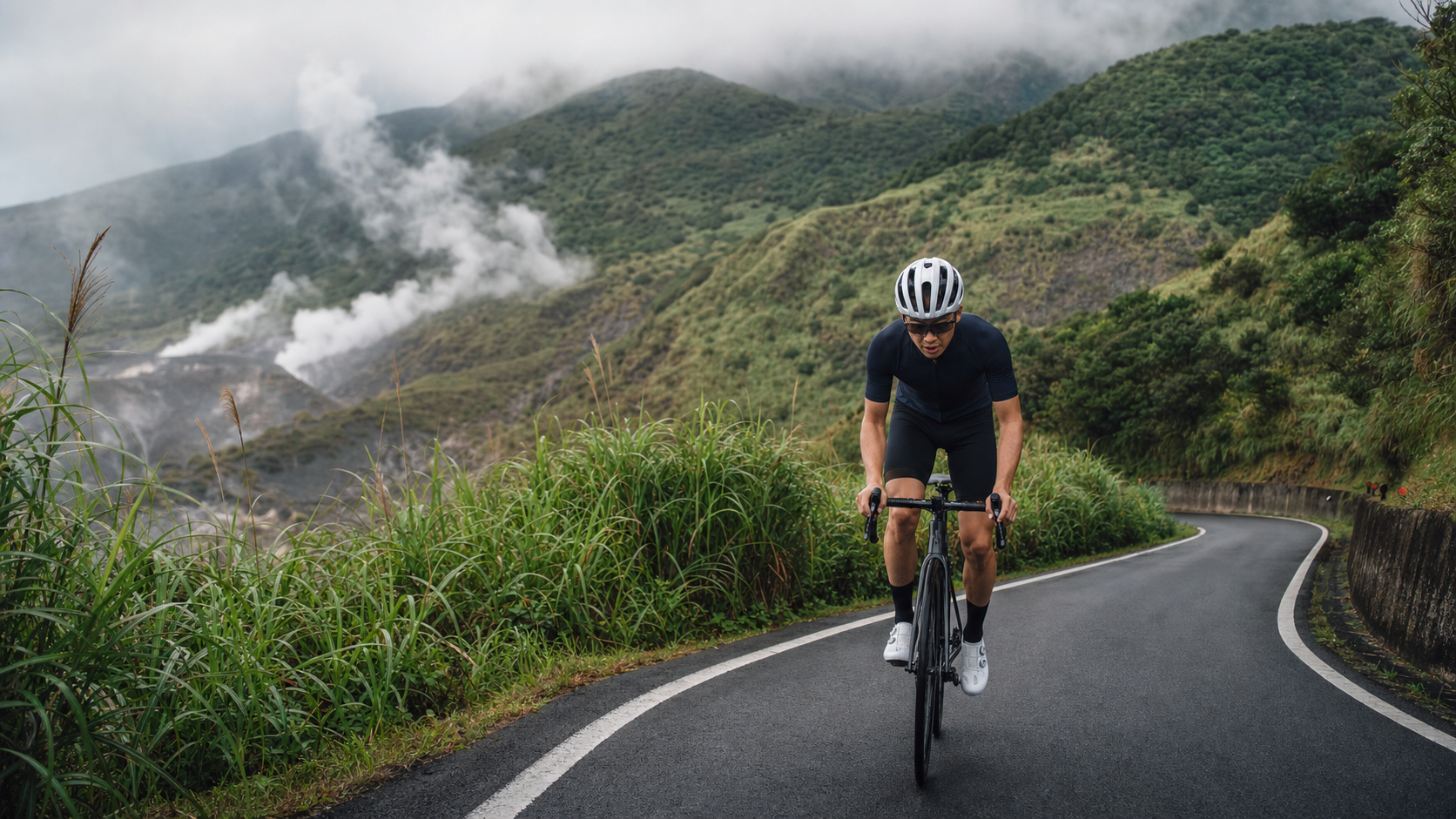
Route Basic Info: Cold Spring Pit is located on the east side of Yangmingshan National Park in Taipei City. Total length is 3593.1 meters, total elevation gain is approximately 289.6 meters, average grade is 7.0%, and the official difficulty rating is Category 2. The following data is based on measurements from the route database; for actual grade transitions and landmark locations, please refer to on-site signage and official announcements.
Route Overview: A Key Climbing Node on the East Side of Yangmingshan
Cold Spring Pit is by no means an unfamiliar name to road cycling enthusiasts in Taipei. Located on the east side of Yangmingshan National Park, it is an important waypoint for many riders heading toward Qingtiangang or the Qixing Mountain area, and it is also one of the most well-known geothermal landscape areas in the Yangmingshan system. From a cycling route perspective, Cold Spring Pit itself is a solid climbing challenge: 3593.1 meters in total length, 289.6 meters of total elevation gain, an average grade of 7.0%, and a Category 2 difficulty rating.
Looking at these numbers together, the meaning is clear—Cold Spring Pit is a “short-distance, high-average-grade” climbing route. While 3.59 kilometers is not particularly long, concentrating nearly 290 meters of elevation gain into such a short distance means climbing roughly 7 meters for every 100 meters of horizontal distance. This intensity is enough to leave most riders with noticeable muscle soreness and cardiovascular strain after finishing. Compared to the previously mentioned Zhongshe Road (3.94 km, 244.9 m elevation gain, 6.3% average grade), Cold Spring Pit has a steeper average grade and more concentrated climbing intensity, making it, in a sense, an advanced version of the grade challenge.
From a geographical perspective, a large part of why Cold Spring Pit holds a special status in Taipei’s cycling community lies in its “node role.” It is an important junction in the road network on the east side of Yangmingshan National Park, and many riders tackling the more advanced routes toward Qingtiangang Grassland or Qixing Mountain pass through the Cold Spring Pit area. As such, Cold Spring Pit is not just a standalone training route; it is often incorporated into “East Yangmingshan Grand Loop” itineraries, serving as a pivotal segment that connects the earlier and later parts of the ride.
The area around Cold Spring Pit is also a well-known geothermal landscape zone in Yangmingshan, famous for the Sulfur Valley geological scenery. During the ride, you may occasionally catch a faint sulfur smell—a distinctive feature that sets this area apart from other climbing routes in Yangmingshan. For riders, this riding experience accompanied by geological scenery adds an extra layer of sensory stimulation and interest to the high-intensity climbing challenge.
Segment-by-Segment Guide: Four Key Sections Under a 7% Average Grade
Facing Cold Spring Pit’s 7.0% average grade, “pacing strategy” matters more than brute force. Below, based on the typical riding rhythm experience of general riders, the full route is broken down into four stages. For actual grade transition points and landmarks, please refer to on-site conditions and the official route map.
Stage 1: Starting Warm-Up Segment (approximately first 700-800 meters)
The starting segment of Cold Spring Pit typically enters a noticeable grade immediately, unlike some routes that have a longer gentle approach section—this is also why many riders feel “pressure from the very start” on this route. It is recommended to ensure a thorough warm-up before officially starting, including dynamic joint mobility exercises and a light heart rate elevation, to avoid the risk of muscle strain from facing a steep grade in a cold state. Cadence is recommended to be maintained at 80-90 rpm, with heart rate starting at around 75% of your personal maximum, preserving reserves for the sections ahead.
Stage 2: Mid-Section Sustained Steep Grade (approximately 800 meters to 2.2 km)
This is the core section where Cold Spring Pit’s 7.0% average grade truly shows its power. The sustained grade with no obvious recovery points will cause riders’ heart rates to climb rapidly toward near-lactate-threshold levels, making this the most demanding section of the entire route for endurance and mental fortitude. It is recommended to primarily ride in a stable seated position, paired with deep, regular breathing rhythms, avoiding premature “blowing up” caused by rapid breathing leading to insufficient oxygen supply. If paced properly through this section, it should feel “continuously tough but manageable,” rather than “wanting to give up at any moment.”
Stage 3: Local Steep Ramp (2.2 km to 3 km)
Most climbing routes in the Yangmingshan system feature “local steep ramps” in the mid-to-late sections where the grade noticeably exceeds the average, and Cold Spring Pit is no different. This section may include brief stretches with grades exceeding 10% or even higher, testing riders’ instantaneous power output. It is recommended to mentally prepare before entering this section, adjust the gear ratio to the lightest setting, and use an alternating approach of “brief standing sprints, quickly returning to seated position” to push through, keeping each standing effort to around 10-15 seconds to avoid heart rate spiking to exhaustion and losing subsequent pacing ability.
Stage 4: Final Stretch and Geothermal Landscape Area (3 km to the finish)
Entering the latter part of the route, as you approach Cold Spring Pit’s famous geothermal landscape area, the grade typically eases somewhat, giving riders a chance to gradually recover their breathing rhythm. Beyond physical adjustment, this section is also a good opportunity to appreciate the surrounding unique geological scenery—the faint sulfur smell in the air reminds riders that they are within Yangmingshan’s distinctive volcanic geological region. It is recommended that after reaching the finish, you do not sit down to rest immediately, but instead walk around with your bike for a few minutes at a slow pace, allowing your heart rate to gradually settle and avoiding discomfort from blood pooling suddenly in the lower limbs.
Gear Ratio and Equipment Recommendations: The Right Setup for a 7% Average Grade
With a 7.0% average grade and local sections possibly exceeding 10%, Cold Spring Pit demands a higher tier of gearing than Zhongshe Road. It is strongly recommended that riders of all levels use a compact crankset (50-34T) paired with an 11-32T or wider 11-34T cassette, ensuring a reasonable cadence (recommended no lower than 60 rpm) can be maintained on the steepest sections, avoiding the need to grind at extremely low cadences due to insufficient gearing, which places excessive stress on the knee joints over time.
For riders planning to take on the more complete East Yangmingshan loop (Cold Spring Pit continuing toward Qingtiangang and Qixing Mountain), it is recommended to prepare a cassette with an even wider range, as the grades and mileage of subsequent sections will further increase the demand for endurance-oriented gearing.
For equipment checks, since Cold Spring Pit is within Yangmingshan National Park, mountain weather conditions fluctuate more dramatically than in the city. It is recommended to confirm the overall mechanical condition of the bike before departure, including the braking system, derailleur cable tension, and tire pressure (recommended 90-105 psi, adjusted according to rider weight). Additionally, due to the higher elevation and lower temperatures in the Yangmingshan area compared to the city, it is recommended to carry a lightweight windbreaker or arm warmers to cope with the temperature differences between morning and evening in the mountains and the perceived temperature drop during descents.
Nutrition and Hydration Management: Special Considerations in the Geothermal Landscape Area
Although the area around Cold Spring Pit is a well-known geothermal landscape zone, this does not mean supplies are easily accessible along the way. Be sure to confirm you are carrying sufficient water and energy supplements before riding. Given the sustained high-intensity output of a 7.0% average grade, it is recommended to complete a full meal 1-2 hours before riding and consume easily absorbable carbohydrate sources 15-20 minutes before departure.
It is recommended to carry at least 500-750 ml of water in bottles, especially during hot summer periods. Although mountain temperatures are slightly lower than in the city, sustained high-intensity climbing will still cause significant sweating. It is recommended to take small sips of water in the relatively gentler final section (near the geothermal landscape area), avoiding drinking while pushing hard on steep sections to prevent choking.
If your itinerary plans to use Cold Spring Pit as a staging point en route to Qingtiangang or Qixing Mountain, be sure to plan the nutrition strategy for the entire trip in advance, including the quantity of energy gels and electrolyte supplements to carry, as well as the locations of possible rest and supply points along the way, to avoid running out of energy on subsequent sections due to insufficient supplies.
Weather and Seasonal Recommendations: Yangmingshan’s Unique Climate Patterns
Due to its terrain and elevation factors, Yangmingshan National Park has a climate that differs noticeably from Taipei’s urban area. Be sure to pay attention to these special climate characteristics before riding Cold Spring Pit.
Spring (March-May) is a popular season for flower viewing and cycling in Yangmingshan, with moderate temperatures. However, be aware that traffic in Yangmingshan increases significantly on holidays and weekends. It is recommended to avoid peak flower-viewing crowds by choosing weekdays or early morning departures, while also noting that higher humidity in the mountains may cause slippery road surfaces.
Summer (June-September) afternoon thundershowers in the mountains are the most important risk factor to watch. Due to orographic lifting effects, afternoon thundershowers in the Yangmingshan area often occur earlier and with greater intensity than on the plains. It is recommended to depart early in the morning and complete the ride as early as possible, while continuously monitoring weather changes. If you notice dark clouds gathering or a sudden temperature drop, retreat early to avoid encountering heavy rainfall on steep sections.
Autumn and Winter (October-February) the Yangmingshan area is prone to dense fog, low temperatures, and strong winds under the influence of the northeast monsoon, especially on the open terrain near Qingtiangang and Qixing Mountain, where wind speeds can increase significantly. When riding Cold Spring Pit and subsequent sections, it is recommended to strengthen warmth protection and safety measures for poor visibility, including reflective vests and front/rear lights, while closely monitoring the effects of slippery roads and strong winds on bike stability.
Overall, because Cold Spring Pit is located in a national park mountain area, seasonal climate changes require more careful assessment than urban routes. Riders are advised to check the Central Weather Administration’s mountain weather forecast before departure and carry contingency equipment with them.
Common Mistakes and DNF Risks: Typical Pitfalls of Steep Routes
With a 7.0% average grade, Cold Spring Pit offers less margin for error in pacing strategy than Zhongshe Road. Below are several common failure modes observed among riders:
- Incorrect gear ratio configuration: Underestimating the route’s steepness and using a standard crankset with heavier gearing, forcing extremely low cadence grinding on local steep ramps, which can lead to excessive knee stress or premature exhaustion.
- Loss of pacing control in the early section: Because the starting segment already has a noticeable grade, some riders push too hard out of nervousness, prematurely depleting energy and leaving nothing for the mid-to-late sections.
- Ignoring mountain weather changes: Failing to account for special climate risks such as Yangmingshan’s afternoon thundershowers or strong winds and dense fog, recklessly attempting the ride and creating safety concerns, or even being forced to turn back midway.
- Insufficient nutrition planning: Especially when incorporating Cold Spring Pit into a longer itinerary toward Qingtiangang and Qixing Mountain, failing to properly plan the full nutrition strategy can lead to energy depletion on subsequent sections.
- Neglecting descent risks: The Yangmingshan area has many curves and significant grade changes, and with the humid mountain climate, road grip on the descent back may not be as expected. It is recommended to maintain moderate speed and braking control.
Reference Target Times for Riders of Different Levels
The following times are for reference only. Actual performance is affected by weather, physical condition, and bike condition on the day. Riders are advised to use their own past performance on similar grade routes as a benchmark for setting target times.
| Rider Level | Characteristic Description | Reference Finish Time Range |
|---|---|---|
| Beginner | New to road bike climbing, still accumulating mountain route experience | 24-32 minutes |
| General Enthusiast | Has a regular riding habit, occasionally challenges Yangmingshan routes | 17-24 minutes |
| Intermediate Rider | FTP-to-weight ratio around 3.0-3.5 W/kg, regular climbing training | 12-17 minutes |
| Advanced Rider | FTP-to-weight ratio 3.5-4.5 W/kg, has racing experience | 8-12 minutes |
| Competitive Level | FTP-to-weight ratio above 4.5 W/kg | Within 8 minutes |
Since Cold Spring Pit’s average grade is slightly higher than Zhongshe Road’s, and the instantaneous grade challenges on local steep ramps are more pronounced, it is recommended that riders complete foundational climbing routes such as Zhongshe Road before advancing to Cold Spring Pit, progressively building climbing strength.
Data Comparison with Zhongshe Road: Positioning on the Difficulty Spectrum
For riders looking to challenge both Zhongshe Road and Cold Spring Pit, understanding the relative positions of these two routes on the difficulty spectrum helps in planning a logical training sequence. The table below organizes the core data comparison of the two routes:
| Item | Zhongshe Road | Cold Spring Pit |
|---|---|---|
| Total Length | 3944.22 meters | 3593.1 meters |
| Total Elevation Gain | 244.9 meters | 289.6 meters |
| Average Grade | 6.3% | 7.0% |
| Difficulty Rating | Category 2 | Category 2 |
| Elevation Gain per Kilometer | Approximately 62 m/km | Approximately 81 m/km |
From the converted value of “elevation gain per kilometer,” it is clear that although Cold Spring Pit’s total length is about 350 meters shorter than Zhongshe Road’s, the concentration of climbing intensity is significantly higher—Cold Spring Pit requires climbing approximately 81 meters per kilometer, compared to Zhongshe Road’s 62 meters, an intensity nearly 30% higher. This also explains why many riders feel that Cold Spring Pit is “more breathless and harder” in actual riding experience, even though both routes are classified at the same Category 2 difficulty.
It is recommended that novice riders without much mountain climbing experience first use Zhongshe Road as an introductory test to establish basic climbing rhythm and pacing concepts, before advancing to the steeper Cold Spring Pit. For intermediate and above riders who already have a solid climbing foundation, both routes can be treated as regular members of the training menu, alternately arranged across different weeks of the training plan to develop two different but equally important climbing abilities: “long-duration steady output” (Zhongshe Road) and “short-duration high-intensity output” (Cold Spring Pit).
Training Planning: Incorporating Cold Spring Pit into an Advanced Climbing Menu
Given Cold Spring Pit’s 7.0% average grade and even steeper local sections, riders who have already accumulated basic climbing ability are advised to use the following progressive training framework to arrange regular training on Cold Spring Pit.
Stage 1: Adaptation Rides (1-2 sessions). The goal is to complete the full route without giving up midway, without specifically pursuing speed. The focus is on gradually adapting the body and mind to the route’s sustained high-intensity grade characteristics, and identifying your suitable gear ratio and pedaling rhythm on the local steep ramps.
Stage 2: Pacing Optimization (3-4 sessions). This stage begins to focus on the stability of heart rate and power data, attempting to maintain steady output on the mid-section sustained steep grade, avoiding power fluctuations caused by nervousness or rushing. A heart rate monitor or power meter can be used for training, with clear target zones set as reference for each ride.
Stage 3: Intensity Breakthrough (arranged according to individual circumstances). Once pacing is stable, you can attempt to add interval intensity training on the local steep ramps, simulating the ability to respond to sudden steep grades when actually challenging longer mountain routes such as Qingtiangang and Qixing Mountain, while also improving overall anaerobic threshold performance.
Through this progressive training arrangement, most riders can noticeably feel improvement in their performance on high-average-grade routes like Cold Spring Pit within one to two months, while also building a solid foundation for challenging other more demanding sections of Yangmingshan.
Braking and Cornering Techniques on Slippery Mountain Roads: Yangmingshan’s Unique Risk Management
The characteristics of mountain roads in Yangmingshan National Park, beyond steep grades, include dense curves and road surfaces that can easily become slippery due to moisture or rainfall—additional risk factors that must be carefully managed when riding Cold Spring Pit and surrounding sections. Compared to urban roads, mountain roads often have less consistent drainage design and coefficients of friction. Especially in the early morning or after rain, roads may retain dew or standing water, and grip performance will be noticeably lower than in dry conditions.
For cornering technique, it is recommended when riding routes like Cold Spring Pit with steep grades and dense curves to follow the basic principle of “brake before the corner, maintain speed through the corner, accelerate after the corner,” avoiding braking mid-corner, as sudden braking while leaning can cause tire slip and loss of control. On the descent back, it is recommended to make good use of both front and rear brakes in combination, avoiding prolonged use of a single brake that can lead to overheated brake pads and reduced braking power—the “brake fade” phenomenon. Especially on continuous descents, it is recommended to control speed with intermittent tapping of the brakes rather than sustained braking pressure.
For tire grip, it is recommended to choose training tires with better grip and tread designs suited to varied road conditions for mountain riding, and to adjust tire pressure moderately based on the day’s weather conditions. In dry conditions, standard tire pressure ranges can be maintained, but if slippery conditions are expected, it is recommended to lower pressure by 5-10 psi to increase the tire’s contact patch with the road, improving grip during cornering and braking.
Equipment Differences Between Night and Early Morning Rides: Responding to Yangmingshan’s Low Temperatures and Visibility Changes
Cold Spring Pit is located in Yangmingshan National Park, at a considerably higher elevation than the city. Even on the same day, early morning and nighttime temperatures can be several degrees lower than in the city, and equipment preparation needs special attention to this elevation effect. If planning to depart before dawn, in addition to basic lights and reflective gear, it is recommended to carry an extra lightweight insulating layer to cope with the low temperatures and moisture that may occur in the mountain early morning; after arriving at the Cold Spring Pit area and beginning the climb, the body will warm up rapidly due to high-intensity output, at which point it is recommended to remove outer layers in a timely manner to avoid overheating, excessive sweating, and rapid electrolyte loss.
For night riding, although most riders do not recommend challenging mountain night rides without sufficient lighting and familiarity, if there is indeed a need for nighttime riding in the Cold Spring Pit area (such as participating in a specific night ride event), be sure to ensure adequate light brightness, sufficient battery life for the entire ride, and carry backup lighting equipment. Visibility is poor in the mountains at night, and with dramatic grade changes, safety requirements are more stringent than daytime riding. It is strongly recommended to ride with companions and avoid solo night mountain riding.
Advanced Challenge: Long-Distance Itinerary Planning from Cold Spring Pit to Qingtiangang and Qixing Mountain
For riders already familiar with the basic Cold Spring Pit challenge who want to further plan a complete East Yangmingshan itinerary, the following itinerary framework is provided for reference. The entire trip can be divided into three stages: the first stage is a warm-up ride from the city to the Cold Spring Pit entrance, recommended to be completed at an easy pace to preserve energy for the high-intensity climb ahead; the second stage is the core challenge of Cold Spring Pit itself, completing this 7.0% average grade section according to the segment pacing strategy described earlier; the third stage is the route continuing toward Qingtiangang, where the terrain gradually transitions from steep mountain roads to open grassland terrain, requiring corresponding adjustments in riding rhythm and style.
Nutrition planning for the entire trip is crucial. It is recommended to fully estimate the total water and energy supplement requirements for the whole journey before departure, rather than preparing only for the Cold Spring Pit section. Since the mileage and elevation of subsequent sections will further increase, it is recommended to carry an extra backup supply and take the opportunity at the relatively flat final section of Cold Spring Pit to replenish water and energy, preparing for the challenges ahead.
Weather assessment is equally indispensable in long-distance itinerary planning. It is recommended to check the complete mountain weather forecast before departure, including precipitation probability, wind speed predictions, and visibility conditions. If weather conditions on the day are unfavorable, consider shortening the route scope or rescheduling the full route for another day, rather than insisting on completing the planned itinerary while ignoring safety risks.
Conclusion: An Important Link in the East Yangmingshan Road Network
As a key climbing node on the east side of Yangmingshan National Park, Cold Spring Pit’s significance lies not only in independently completing this 3.59-kilometer, 7.0% average grade challenge, but also in being an important waypoint on the route toward the more advanced Qingtiangang Grassland and Qixing Mountain routes. For Taipei riders seeking to systematically improve climbing ability and progressively challenge the complete Yangmingshan road network, Cold Spring Pit is an unavoidable checkpoint. It is recommended that riders make good use of the segment pacing strategies, gear ratio recommendations, nutrition planning, and advanced training framework provided in this article, progressively accumulate riding experience on this route, and alternately train with other climbing routes such as Zhongshe Road to comprehensively and balancedly improve climbing strength, laying a solid foundation for future challenges on the more demanding complete East Yangmingshan itinerary.
Related Reading
- The Sulfur Scent and Clouds of Cold Spring Pit: A Riding Memory of Persistence on the East Side of Yangmingshan
- Complete Guide to Yangmingshan Classic Routes: The Best Climbing Practice Ground for Taipei Riders
- Complete Guide to Yangmingshan Loop Routes: Five Classic Cycling Circuit Recommendations
- Pingjing Street Climbing Combat Guide: 4.66 km at 6.3% Average Grade, A Complete Breakdown of the Cold Spring Pit Prelude
半日 小台灣 極限單車路線挑戰實錄
7 年前
台北闊瀨陡坡 騎旅 / 日本單車雜誌編輯車友臨時加入!/ 髮香才是最強的 / feat. 北迴歸線小隊 / 公路車 CT Yeh
6 個月前
2016/05/13 單車 冷水坑下滑
10 年前
車隊介紹) 台北 一年開團365天 車隊 Apollo Ride 晨騎 好選擇 ( 陽明山 風櫃嘴 冷水坑 平等里 聖人 關渡 大稻埕 ) 找人騎車
7 年前
大武山後門26%歡樂陡坡!JJSC南台灣單車行Day2 / 被颱風追著跑 / 公路車 / CT Yeh
2 年前
萬年峽谷! 30% 超激陡坡 里佳部落DAY2 還是很硬! | 公路車 | CT Yeh
3 年前
一定要騎一次!阿里山最深處:里佳部落!單車旅行 | 2800m爬升 | 深度部落體驗:嗨翻晚會、螢火蟲、銀河 | feat. JJSC & 廢物伙伴 | 公路車 CT Yeh
10 個月前
單車 梅山36灣 坡度介紹 路段介紹 空拍 (相關遊記影片,請參考說明或我的頻道喔,歡迎訂閱)
6 年前