Sanxia Xiongkong Mountain Crossing Practical Guide: A Hellish Climb Under Three Kilometers—Are You Really Ready?
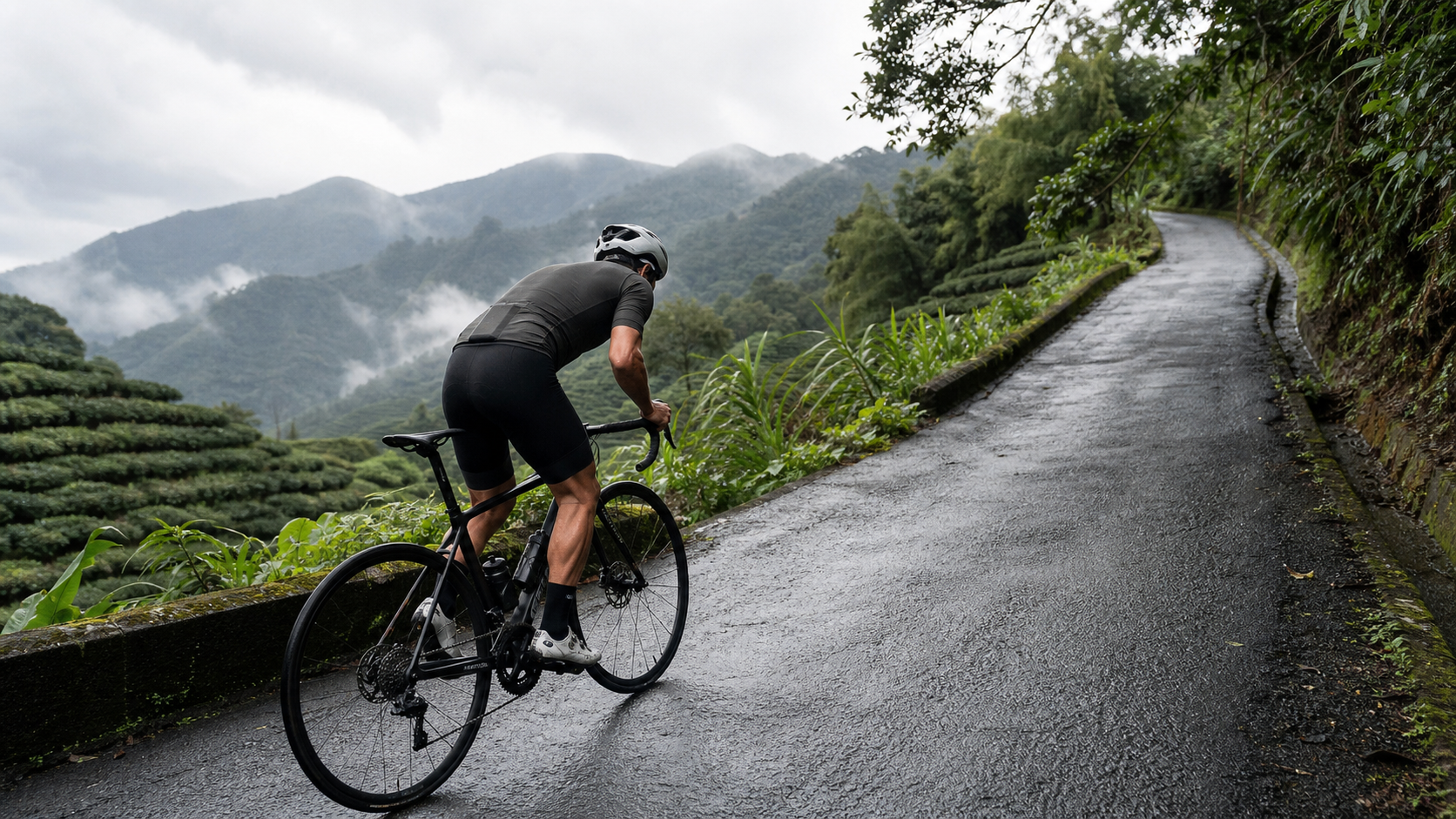
Distance 2.9 km, elevation gain 289.7 m, average gradient 7.0%. The numbers look unremarkable, but my engineer’s instinct tells me: this route’s “equivalent gradient” is far more brutal than the surface figures suggest. In this article, we let the data speak.
Sanxia Xiongkong Yue Ling—for many road or mountain bikers just getting started, it might just look like another “short distance, should be easy to handle” option on the Strava segment list. But if you’ve ever been on the industrial road beside Xiongkong Tea Garden and had your legs buckle from the sudden string of steep pitches, your heart rate spiking near its maximum, you know that “short” on this route has never been synonymous with “easy.” The goal of this article is to use an engineer’s data-driven mindset to break this route down into every gradient segment and every shifting moment, so you can have your tactics figured out before you set off—rather than discovering halfway up that you brought the wrong gearing.
1. Route Overview and Real Data Analysis
Let’s lay out the most basic numbers first. According to the route database, the official data for Sanxia Xiongkong Yue Ling is as follows:
| Item | Value |
|---|---|
| Route Name | Sanxia Xiongkong Yue Ling |
| Location | Sanxia District, New Taipei City |
| Distance | 2904.9 m (approx. 2.90 km) |
| Total Elevation Gain | 289.7 m |
| Average Gradient | 7.0% |
At first glance, a 7.0% average gradient isn’t particularly extreme among Taiwan’s famous climbing routes—compared to long climbs like Beiyi or Fengguizui, which stretch well over ten kilometers with average gradients in the 5–7% range, Xiongkong Yue Ling is far shorter. Many people’s first reaction upon seeing “under three kilometers” is, “Should be done in ten minutes, easy.”
But this is exactly where the route misleads people most, and it’s the part I, as a data-focused writer, must honestly lay out.
First, a simple physics calculation: If a route has a distance of 2904.9 m and an average gradient of 7.0%, the theoretical elevation gain should be:
2904.9 m × 7.0% ≈ 203.3 m
But the actual elevation gain recorded in the database is 289.7 m—a full ~86 m more than the theoretical value. In other words, if we reverse the calculation and use the actual gain to derive the “true equivalent average gradient”:
289.7 m ÷ 2904.9 m ≈ 9.97%, close to 10%
This discrepancy isn’t a data error; it’s a classic characteristic of “short-distance mountain-crossing routes”—the elevation gain recorded by GPS tracks typically accumulates all the ups and downs along the route (i.e., “cumulative gain” rather than just “net gain”). Combined with the fact that the Xiongkong area is naturally hilly terrain with interlocking peaks and valleys, there are very likely one or even multiple sections in the middle of the route approaching or exceeding 10% gradient, which is what pushes the total gain far above the theoretical “distance × labeled gradient” value.
In plain terms: The labeled 7.0% is only an “average,” but averages mask the most painful few hundred meters. In the moment, the gradient you actually feel is likely to approach or even exceed 10% on certain sections—on a road bike, that subjective intensity has already entered the “you can only keep moving by standing and grinding” tier.
The engineer’s conclusion is simple: Don’t underestimate this route just because the total distance is only 2.9 km. Even preparing with the breathing rhythm you’d use for a 10 km climb might not be enough; what you need is the mental and physical preparation for a short, maximal-intensity effort.
2. Section-by-Section Strategy: Pacing Tactics for Three Key Segments
Since the official GPX waypoint details still depend on actual on-site conditions, what’s provided here is a section-by-section pacing framework based on the general terrain logic of “short and steep” mountain-crossing routes, combined with the concentrated elevation gain characteristic of Xiongkong Yue Ling. Riders are advised to fine-tune using their own power meter or heart rate monitor during actual rides.
Opening Segment (first 500–800 m): Keep Your Adrenaline in Check
This is where the route is easiest to mess up. Because the distance is short, many people subconsciously treat it like a “sprint segment”—especially when you’re not fully warmed up and have just turned from a gentle industrial road onto the climb. When you see the gradient suddenly ramp up, the instinct is to hammer hard and try to “get it over with in one go.”
This is a fundamentally wrong strategy.
The biggest taboo on a short climb is spending your anaerobic lactate system’s entire bank in the opening. The explosive power your body’s anaerobic metabolism can provide won’t last more than two or three minutes, and if you ride Xiongkong Yue Ling at moderate intensity for the full distance, your time will fall between 5–15 minutes (see the time reference table in Section 6). That means you can’t rely purely on anaerobic output—you need to keep your heart rate in a sustainable range.
Tactical advice: In the opening segment, aim for about 90–95% of your FTP (Functional Threshold Power), keeping your heart rate at 85–90% of max. Avoid going near all-out from the start. Save your strength for the truly steep section in the middle.
Mid-Section Steep Zone (estimated middle of route, gradient possibly 10% or more): When to Switch Between Standing and Seated
Based on the gradient discrepancy analysis above, the hardest part of this route is most likely concentrated in the middle. This is where the ride is won or lost.
Seated pedaling vs. standing grind—how do you choose?
- Seated pedaling: Its advantage is maintaining a steady aerobic efficiency, with cardiovascular load spread more evenly. It suits gradients below 8%, as long as you still have the capacity to hold a cadence of 70–85 rpm.
- Standing grind: When the gradient approaches or exceeds 10%, especially when you’ve already shifted to your easiest gear and your cadence is still dropping below 50–60 rpm, standing up lets you use your body weight and upper-body strength to keep forward momentum, avoiding crawling to a near-stop or even falling over.
Real-world timing cues: When you notice your cadence dropping below 60 rpm, you can feel the torque deficit clearly while seated, and the bike starts to sway and feel like it might tip over—that’s your signal to stand. But grinding out of the saddle is extremely costly in anaerobic energy and upper-body strength, so it’s not recommended for the entire climb. Instead, use an interval-style switch: “stand for 30–60 seconds in the steep zone, then immediately sit back down and recover once the gradient eases,” giving your body a chance to catch its breath.
Final Segment (approaching the summit point): Save One Last Breath for the Finish
Because the total distance is short, many riders exhaust themselves in the mid-section steep zone and end up with nothing left for the finale. It’s recommended to hold some reserve through the opening and middle sections so you have extra energy for a final push at the end. That will yield a better finishing time than the “all-out early, collapse late” approach.
3. Gearing and Equipment Advice: A Short-Distance, High-Intensity Training Profile
Because this route is “short in distance, steep in gradient,” the equipment advice differs fundamentally from long climbing routes (such as Beihuan, Nanheng, and other long-endurance climbs).
Gearing Recommendations
Long climbs typically favor a “sustainable output” gearing setup—something conservative like 34×28 or 34×30 is usually enough. But for a short mountain-crossing route like Xiongkong Yue Ling, where local gradients can spike above 10%, your low gear should be lighter:
- Casual recreational riders: A 34T chainring paired with a max 32T cassette cog (commonly called 34×32) is recommended, ensuring you still have enough spinning room on the steepest sections and avoiding knee injury from gears that are too heavy.
- Riders with some climbing foundation: 34×30 or 34×28 can handle it, but it’s still advisable to confirm beforehand whether you can maintain a cadence above 60 rpm on a 10% gradient.
- Mountain bike / gravel bike riders: If tackling it on a mountain bike, a 1x system with a 42T or even 50T low gear is a safer choice. Since some sections around Xiongkong may include loose gravel or unpaved surfaces, the low-speed control of a mountain bike gives you an advantage.
Key reminder from an engineer’s perspective: This is not a route where you need an “endurance-style” big-ring/small-cog setup; it’s a short-interval route demanding “instant high torque output.” The cost of wrong gearing on this kind of route is far more immediate than on a long climb—you don’t have time to gradually adjust your cadence, and a wrong gear can force you off the bike to walk at the steepest point.
Other Equipment Recommendations
- Tires: If you know the surface includes gravel or potholes, choose puncture-resistant training tires with good grip. Slightly lower tire pressure can increase traction (for road bikes, adjust within the 90–100 psi range based on body weight; for mountain bikes, go lower depending on tire width and terrain).
- Braking system: A mountain-crossing route means what goes up must come down—whether you return the same way or continue onto other crossing routes. Check brake pad condition and disc/rim brake performance before departure.
- Bike computer / head unit: Given the short distance and concentrated intensity, a head unit with real-time gradient display is recommended, letting you anticipate an upcoming steep pitch 50–100 m in advance and adjust your gearing and pedaling rhythm early.
4. Nutrition, Hydration, Weather, and Seasonal Advice
This is where Xiongkong Yue Ling differs most from long routes: because the total riding time may only be 5–15 minutes, the focus of fueling is not “mid-ride” at all—it’s “before you leave.”
Preparation Before Departure Is What Matters
On long climbs, we emphasize hydrating every 20–30 minutes and taking in carbohydrates every hour. But on a short, high-intensity route like Xiongkong Yue Ling, you simply don’t have time to drink or eat a gel mid-ride—the moment you let go of the handlebar to grab your bottle on the steepest section could be the start of a crash.
Recommended approach:
- 30–60 minutes before departure: Make sure you’ve fully hydrated and don’t feel thirsty.
- 10–15 minutes before departure: Do a dynamic warm-up to raise your heart rate and muscle temperature, avoiding the cardiovascular and muscular strain of hitting a steep slope cold (especially important for riders whose cardiovascular systems are still adapting).
- During the ride: Unless there happens to be a clear flat or gentle section mid-route where you can safely let go of the bars, hold off on drinking until you reach the summit point or a safe stretch.
Weather and Seasonal Advice
The Sanxia mountain area has a typical northern Taiwan humid climate, with higher rainfall probability than the plains. Combined with the relatively enclosed terrain around Xiongkong, where clouds and fog tend to accumulate, it’s recommended to:
- Post-rain conditions: Watch out for slippery surfaces and possible accumulations of fallen leaves and loose gravel. Mountain roads can have localized slippery traps after rain, and traction drops significantly on steep sections when wet.
- Summer: Although the mountain shade provides some cover, the combination of short, high-intensity climbing with muggy, high-humidity conditions still carries heatstroke and heat exhaustion risks. Avoid riding during the midday hours.
- Specific weather conditions: Defer to actual on-site weather and road condition advisories; check real-time weather information before heading out.
5. Common Mistakes and DNF Risks
The most dangerous thing about a short, steep route is often not a lack of fitness, but “psychological complacency.” Here are the most common failure modes:
Mistake 1: The “It’s Only Three Kilometers” Complacency
This is the classic trap of Xiongkong Yue Ling. Many riders see the 2.9 km distance and charge in with the same mindset they’d use on flat or gentle terrain. The result: they blow up instantly in the mid-section steep zone, heart rate spiking near max with a long way still to climb, and end up walking the bike to the top.
How to counter it: Prepare for this route as if it were a “three-minute all-out interval,” not a “relaxed three-kilometer sightseeing ride.” Mental preparation deserves the same seriousness as physical preparation.
Mistake 2: Overexerting in the Opening Segment, Leading to Cramps
Because the gradient is noticeable from the start, many riders pour all their power into the first 500 meters. This explosive style of effort quickly builds up lactate in the quadriceps or calf muscles, triggering cramps. Once cramps hit on a steep section, you can’t keep pedaling—and there’s a real risk of crashing.
How to counter it: Follow the section-by-section pacing advice in Section 2. Keep the opening segment at 90–95% FTP and save your maximum effort for the mid-section steep zone where you truly need it.
Mistake 3: Gearing Too Heavy, Forced to Crawl or Stall
If your cassette’s largest cog is only 25T or 28T, and you try to stay seated on sections approaching 10%, you’ll likely see your cadence drop below 40 rpm, the bike becoming unstable and eventually stalling (your legs can no longer turn the pedals) or even tipping over.
How to counter it: Be sure to follow the gearing advice in Section 3. Better to have gearing lighter than you think you need than to be forced off the bike on a steep pitch.
Mistake 4: Ignoring Risk Management on the Descent and Return
Many riders focus all their attention on “getting up,” overlooking that the descent after the summit demands just as much focus. After a continuous climb, your hands and core are already fatigued, and braking reaction and cornering judgment may be compromised. It’s recommended to take a brief rest at the summit before starting the descent.
DNF Risk Summary
The Xiongkong Yue Ling route itself is short, so a “fuel depletion” type of DNF is theoretically unlikely. But the common reasons for giving up mid-route are mostly:
- Insufficient gearing on the mid-section steep zone, forcing a dismount and walk (not strictly a DNF, but it severely impacts finishing time and riding experience)
- Poor power distribution in the opening segment leading to mid-route cramps, forcing a stop to rest
- Poor weather (slippery surfaces) leading to a mid-route turnaround for safety reasons
6. Target Time Reference Table for Riders of Different Levels
Because this route is short and intensity is concentrated, the finishing-time brackets are completely different from long climbs—measured in minutes, not hours. The times below are for reference only; actual finishing times will vary based on individual fitness, daily condition, weather, and road conditions. Prioritize your own safety above all, and don’t push beyond your ability just to chase a time.
| Rider Level | Estimated Finish Time | Average Power Reference (70 kg Rider) | Notes |
|---|---|---|---|
| Pro / Elite Amateur | Approx. 5–7 min | 4.5–5.5 W/kg or higher | Near-threshold or above intensity for the entire effort |
| Experienced Strong Climber | Approx. 7–9 min | 3.8–4.5 W/kg | Proficient in standing/seated transitions |
| Competitive Club Rider | Approx. 9–12 min | 3.0–3.8 W/kg | Needs to adjust rhythm on the mid-section steep zone |
| Advanced Recreational Rider | Approx. 12–15 min | 2.2–3.0 W/kg | Recommended to use light gearing |
| General Recreational / Beginner | Approx. 15+ min, including brief walking | Depends on individual fitness | No need to force riding the entire way; walking steep sections is a reasonable choice |
Table usage note: This time reference table is a reasonable estimate based on the “short and steep, equivalent gradient near 10%” characteristics of the route, not official race timing data. Climbing ability varies enormously between individuals. For a first attempt, aim for “safe completion” rather than comparing yourself to the times in the table.
7. Power and Heart Rate Training Framework: Turning Xiongkong Yue Ling into Your Interval Training Ground
For riders with some training foundation who want to use this route more systematically, Xiongkong Yue Ling is actually an ideal short-duration, high-intensity interval training (HIIT) segment.
Why It Works as a Training Segment
- The duration falls right in the golden zone for VO2max intervals: In exercise physiology, all-out efforts lasting roughly 3–8 minutes are the most effective duration for stimulating improvements in maximal oxygen uptake (VO2max). For most riders with a training base, the finish time on Xiongkong Yue Ling lands right in this window.
- The gradient provides natural resistance, eliminating the need to manage aerodynamic drag: On an indoor trainer or flat-road sprints, wind resistance management is a major variable; climbing lets you feel the relationship between power output and gradient more purely.
- The terrain is enclosed and safety is relatively controllable: Mountain-crossing roads typically have lower traffic volumes, making them suitable for high-intensity interval training that demands focus (still be mindful of oncoming vehicles and other road users).
Suggested Training Framework
Beginner Adaptation Phase (no clear FTP data yet):
- Ride the full route at a Rating of Perceived Exertion (RPE) of 7–8 out of 10, first familiarizing yourself with the route’s gradient distribution and your own physical responses.
- Repeat 2–3 times, using the descent or flat riding between efforts as recovery.
Intermediate Interval Training (knows their FTP or max heart rate):
- Target intensity: 105–120% of FTP, or 90–95% of max heart rate.
- Suggested sets: 2–3 all-out efforts, with 8–10 minutes of low-intensity recovery between efforts (can use the descent combined with easy flat riding).
- Training frequency: no more than 1–2 sessions per week, allowing adequate recovery and avoiding overtraining.
Advanced Riders (race preparation phase):
- Can combine “climbing sprints + seated endurance” mixed training—for example, deliberately using a heavier gear in the early section to maintain seated output and build muscular endurance, then switching to standing sprints in the later steep zone to simulate the ability to adapt to terrain changes in actual racing.
8. Positioning Comparison with Other Sanxia Mountain Crossing Routes Around Xiongkong
The Sanxia mountain area itself is a popular training ground for road and mountain bikers in northern Taiwan, and the Xiongkong area is a key node leading deeper into the mountains, with some routes connecting toward Lala Mountain, the Xueshan direction, or other crossing paths. Placing Xiongkong Yue Ling within the broader Sanxia mountain route network, its positioning is actually quite distinctive:
- Distance positioning: The Sanxia mountains are not short of long climbing routes (often stretching 10–20+ km). At under three kilometers, Xiongkong Yue Ling stands out as one of the few short options for “quickly building intensity” without spending an entire afternoon.
- Intensity positioning: As the data analysis above shows, Xiongkong Yue Ling’s equivalent gradient approaches 10%, making it one of the higher “gradient density” segments among the many routes in the Sanxia mountains. It works well as a “final challenge segment” in a longer traverse itinerary, or as a standalone interval training venue.
- Connection positioning: As a crossing node leading deeper into the mountains, the Xiongkong area is also a common必经 or connecting segment when planning longer traverse routes. Riders planning long-distance itineraries are advised to factor the high-intensity nature of Xiongkong Yue Ling into their overall energy allocation, rather than treating it with the same pacing logic as other relatively gentle sections.
9. Equipment Checklist (5-Minute Pre-Departure Quick Reference)
Finally, here’s a concise pre-departure checklist for riders short on time who just want to quickly confirm their equipment status:
- [ ] Confirm gearing setup (at least 34×32 or an equally easy gear recommended)
- [ ] Confirm brake pad / brake shoe condition (needed for the descent)
- [ ] Fully hydrated before departure
- [ ] Complete a 10–15 minute dynamic warm-up before departure
- [ ] Confirm tire pressure and tire condition (especially if the route may include gravel sections)
- [ ] Carry basic puncture repair tools and a spare tube (mountain signals may be poor; self-sufficiency matters)
- [ ] Confirm bike computer / head unit battery and gradient display function
- [ ] Check the day’s weather and road condition information; be especially cautious of slippery surfaces after rain
- [ ] Mental preparation complete: this is a “short but steep” route—don’t be complacent
Sanxia Xiongkong Yue Ling, summed up from an engineer’s perspective in one sentence: Short distance doesn’t mean low intensity; the devil is always in the details behind the numbers. Squeezing 289.7 m of elevation gain into a 2.9 km route yields an equivalent gradient approaching 10%—this is a route where you need to have your pacing, gearing, and mental preparation figured out before you start, not a short sightseeing ride you can casually wing on the spot. Bring your light gearing and your interval-training mindset, and Xiongkong Yue Ling will be one of the highest-value segments on your Sanxia mountain training list.
Related Reading
- Sanxia Xiongkong Yue Ling: Three Kilometers, Yet the Closest I’ve Felt to the Mountain
- Sanxia Bei 113 Dongyan Bridge Combat Guide: Don’t Be Fooled by the “6.7% Average Gradient”—This Road Hides a 12%-Grade Killer
- Sanxia Li Shan Temple Combat Guide: A Technical Short Climb of 6.3 km at 6.1% Average Gradient
- Sanxia Zihe Road Combat Guide: 2.87 km, 498 m of Climbing—Are You Ready to Face 14.9%?
台北闊瀨陡坡 騎旅 / 日本單車雜誌編輯車友臨時加入!/ 髮香才是最強的 / feat. 北迴歸線小隊 / 公路車 CT Yeh
6 個月前
爬坡ITT實境)台中 魔王 松鼠坡 首航 6:12 大肚山 大三元 科福路
8 年前
大禹嶺 到 武嶺牌樓 全程前後實況錄影 | 北進武嶺 | 東進武嶺 | KOM | 訓練台 | 坡度分析 | Taiwan KOM Last 10 km HARD | 公路車
6 年前
半日 小台灣 極限單車路線挑戰實錄
7 年前
一日北高 11小時 賽後心得分享篇 | TWB北高360 | 一日雙城 | 單車 | 公路車
6 年前
新竹羅平 x 天湖部落 大禹嶺級變態陡坡! 4K超高畫質 空拍 | 公路車
5 年前
西進武嶺 世界紀錄挑戰!破2:30 ?!一群人推著一個夢上山 直播精華版 / ft. 張翰允 & 台視主播魏于恬 & KPLUS / #cycling 公路車 CT Yeh
2 個月前
#北橫 + #北進武嶺 最硬的員工旅遊 EP1 | #公路車 #拉拉山 | 明池 | 武嶺 | 武陵農場 | 雲海 | Taiwan Cycling Route Wulin
6 年前