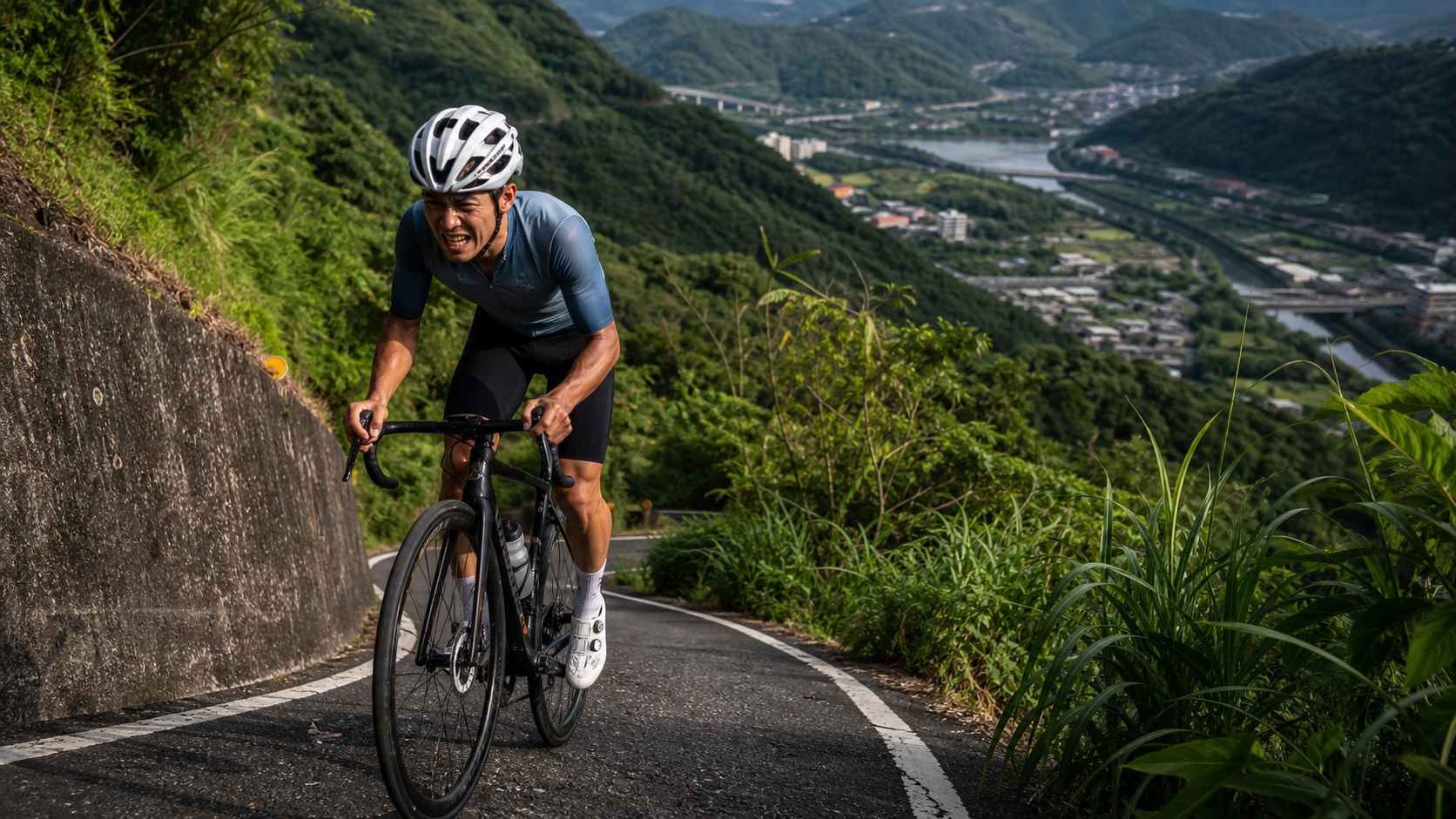
This is not a route you can “just finish.” This is a wall.
Sanzia Zihe Road stretches only 2,870.0 meters in total length, yet climbs a staggering 498.3 meters, with the database recording an average gradient of 14.9%. If that number doesn’t mean much to you yet, let’s put it in more intuitive terms: for every kilometer you ride, you ascend roughly 174 meters vertically—the equivalent of a 58-story building’s height, compressed into less than 3 kilometers of asphalt. This article won’t soften the difficulty with phrases like “scenic views” or “pushing your limits.” Instead, it takes an engineer’s approach, laying the data bare for you to judge for yourself: this route—today, are you truly ready?
1. Route Overview and Real Data Analysis
1.1 Basic Data
| Item | Value |
|---|---|
| Route Name | Sanxia Zihe Road |
| Location | Sanxia District, New Taipei City |
| Total Distance | 2,870.0 meters (approx. 2.87 km) |
| Total Climbing | 498.3 meters |
| Average Gradient | 14.9% |
| Route Type | Short-distance, extreme-intensity “Wall Climb” |
First, let’s explain what “14.9% average gradient” actually means. Gradient percentage is defined as “vertical ascent ÷ horizontal distance × 100%.” A 14.9% gradient means for every 100 meters of horizontal distance traveled, you climb 14.9 meters. What does that translate to? Generally, road cyclists consider a “noticeable climb” to be around 4%–6%. Above 8%, most amateur riders start gasping for air. Over 12% enters “wall” territory. And Sanxia Zihe Road’s average sits at 14.9%—note, that’s the average, not the maximum.
Multiplying distance by gradient to back-calculate theoretical climbing: 2,870 meters × 14.9% ≈ 427.6 meters, which still falls short of the database’s measured 498.3 meters. This gap isn’t an error—it’s a strong signal: the instantaneous gradient in the middle or certain sections of the route very likely far exceeds 14.9%, spiking into the 20% range or even higher. In other words, Zihe Road isn’t a climb that’s uniformly painful; it hides “even more brutal key sections” within, waiting to test you.
1.2 Positioning Against Other Famous Steep Climbs
Taiwan’s cycling community recognizes plenty of “demon-grade” steep climbs: certain sections of the Beiyi Highway, the final few hundred meters near the summit of Fengguizui, and countless short steep walls hidden along industrial roads in Sanxia and Wulai all have their reputations. But it’s worth emphasizing that most famous climbing routes have an “average gradient” typically falling in the 5%–10% range. Even sections dubbed “hell slopes” are usually “undulating overall with particularly steep local sections.” Routes that can sustain an average gradient of 14.9% while spanning less than 3 kilometers are rare.
Sanzia Zihe Road’s positioning is closer to a “concentrated, enhanced version” of certain short steep sections on the Beiyi Highway, or the scale of Fengguizui’s final sprint stretch extended into an entire route. If you’ve ever felt that despair near Fengguizui’s summit—“How is the bike nearly stopping even with every gear used up?”—Zihe Road demands you endure similar or even more exaggerated intensity from the very start, with no gentle sections to catch your breath or recover your heart rate.
1.3 The Uniqueness of Short-Distance, High-Intensity Climbs
Many riders harbor a misconception: “It’s only 2.87 kilometers—that’ll be over quickly, right?” That thought gets brutally slapped down on Zihe Road. Short distance doesn’t mean easy—quite the opposite. Precisely because the distance is short, the gradient can be compressed to the extreme. You don’t get the chance, like on long climbs (e.g., Wuling, Hehuanshan), to find gentler sections to regulate breathing, recover heart rate, and redistribute effort. Zihe Road’s intensity curve is closer to “anaerobic sprinting” than “aerobic endurance climbing,” placing a completely different type of load on the body. Many riders who perform well on long climbs severely misjudge their first attempt at this kind of short wall climb.
Honest Rating: This route’s difficulty level is “Hell Grade” (spiritually analogous to Hors Catégorie). It is recommended only for riders with substantial steep-climb experience who have completed other known demon slopes (e.g., multiple steep sections of Beiyi Highway, full Fengguizui). Beginners and those lacking climbing experience should not attempt it rashly.
2. Section-by-Section Strategy: Start, Out-of-Saddle, and Seated Analysis
Since Zihe Road currently lacks a complete official section-by-section timing and gradient distribution map, the following section strategies are based on general cycling mechanics principles for “short, ultra-steep climbs.” Actual road conditions and gradient changes should be confirmed on-site. Always visually inspect the road before riding to decide on your strategy.
2.1 Starting Strategy: Don’t Burn Out at the Start
The biggest mistake most riders make on steep climbs is going all-out in the first 200–300 meters, thinking “let’s build some momentum.” The result: by the time they hit the truly steep core sections, heart rate is already near its ceiling, legs are flooded with lactate, and the rest is unsustainable. Zihe Road is only 2.87 kilometers, seemingly leaving no need for “pacing”—but quite the opposite: on a route averaging 14.9%, pacing matters more than on any long climb, because you have zero margin for error.
Suggested starting strategy:
- Before entering the road, confirm your heart rate and breathing are stable; don’t charge into the steep slope with residual heat from your warm-up
- For the first 200 meters, deliberately ride at a pace 10–15% slower than what “feels faster,” keeping heart rate below the lactate threshold
- Continuously scan the road ahead for gradient changes, anticipate upcoming steeper sections 2–3 pedal strokes in advance, and shift to an easier gear one step early to avoid chain jams or drops during sudden shifts on steep sections
2.2 Out-of-Saddle and Seated Switching Strategy on the Steepest Sections
When the gradient exceeds 15% and approaches 20%, pure seated pedaling often can’t generate enough torque, making out-of-saddle riding (standing) nearly essential. However, standing on ultra-steep climbs carries its own risks and techniques that can’t simply mirror habitual climbing form.
Three-Phase Out-of-Saddle Technique:
-
Initiation Phase: Grip the top of the handlebars lightly (not the brake levers), shift your center of gravity slightly forward to avoid rearward lean causing the front wheel to lift. When starting to stand, don’t suddenly surge cadence; instead, let body weight work with the cadence, pressing naturally onto the pedals rather than relying purely on leg muscle force.
-
Sustained Phase: On gradients above 15%, slow down your standing rhythm. Each pedal stroke must genuinely transfer force to the rear wheel, avoiding rear-wheel slip or spin-out caused by excessive steepness. Keep your core engaged throughout to stabilize the pelvis and prevent excessive side-to-side rocking, which can cause instantaneous loss of rear-wheel traction.
-
Seated Return Judgment: Standing consumes far more cardiovascular and upper-body energy than seated pedaling. If you feel heart rate spiking rapidly or breathing spiraling out of control, return to a seated position on a relatively gentler section (even just 10 meters), let your heart rate drop slightly, and rebuild your reserve for the next standing effort.
2.3 How to Prevent Front-Wheel Lift
This is the most overlooked yet extremely dangerous risk in ultra-steep climbing. When the gradient approaches or exceeds 20%, if your center of gravity shifts too far back (common among riders trying to muscle through with brute force, or those with saddles set too far back), the front wheel loses sufficient vertical load and begins to lift. Mild cases cause uncontrolled handlebar wobble; severe cases lead to flipping over and crashing.
Specific measures to prevent front-wheel lift:
- When standing, actively shift your center of gravity forward; you can even lower your upper body slightly toward the handlebar
- Avoid tackling this type of route with setups featuring excessive saddle setback or overly rearward saddle tilt
- At the first sign of the front wheel feeling light, proactively press your weight down and forward—don’t instinctively lean back to “stabilize” (leaning back only worsens the situation)
- If insufficient gearing forces you to muscle through with brute force and you already feel unstable front-wheel control, dismount and walk rather than risk pushing through
2.4 How to Prevent Rear-Wheel Slippage and Loss of Traction
The counterpart to front-wheel lift is rear-wheel spin-out from insufficient traction on ultra-steep climbs. This is especially likely during seated pedaling with the center of gravity shifted too far forward, and the risk rises significantly on roads with fallen leaves, fine sand, or damp moss.
Specific measures to prevent rear-wheel slippage:
- Apply pedal force “smoothly” rather than “explosively”; sudden bursts of torque can exceed the friction limit between tire and road, causing instant slip
- Use tires with better grip; avoid overly worn tires or race-oriented low-rolling-resistance tread patterns for this battle
- When the road is wet, rear-wheel slip risk multiplies non-linearly (see Section 4 for details); it’s recommended to abandon the attempt entirely
- If you feel the rear wheel starting to spin, don’t instinctively stomp harder to “power through.” Immediately ease off the pedal force to let the rear wheel regain traction. If necessary, stop standing and switch to slow seated pedaling, or even consider a zigzag (S-line) path to find a relatively gentler gradient through that section
3. Gear Ratio and Equipment Recommendations: 34×32 Minimum—Standard Road Bike Configurations Are Almost Certainly Insufficient Here
This is the section of the article that most needs honest confrontation. If your bike still has a standard factory road configuration (50/34 chainrings, 11-28 cassette), Zihe Road is highly likely to be a “walking route” rather than a “riding route” for you.
3.1 Why Standard Configurations Aren’t Enough
Calculating for an average gradient of 14.9% with local sections possibly exceeding 20%, even professional-level riders need a relatively light gear to maintain an effective cadence (typically recommended at 60–80 rpm). For the common 34×28 combination (the so-called “small ring with big cog” entry-level climbing setup) seen on many amateur bikes, the resulting pedal resistance on gradients above 14.9% will force most riders’ cadence down to below 40 rpm, or even make it completely impossible to turn the pedals—legs locking up—ultimately forcing a dismount and walk.
3.2 Recommended Gear Ratios
| Rider Level | Recommended Chainring | Recommended Cassette | Notes |
|---|---|---|---|
| Strong rider with extensive steep-climb experience | 34T | 32T | 34×32 is already one of the lowest gear combinations currently supported by road bike drivetrains; recommended as the minimum standard for attempting this route |
| General advanced rider | 34T | 34T (requires special rear derailleur support) | Some newer Di2/eTap or GRX-level drivetrains support up to a 34T large cog; strongly recommend upgrading for a more manageable cadence |
| Conservative / stability-focused rider | MTB-grade low gears (e.g., 1×12 with 30–34T chainring paired with wide-range cassette) | — | If your bike allows modification, ultra-low gearing from mountain or gravel bikes offers significant advantages on this type of route |
Important note: Even with “known extreme low gears” like 34×32, sections with instantaneous gradients exceeding 20% may still present pedaling difficulties requiring standing efforts or brief walking. This is dictated by the route’s nature, not a reflection of rider inadequacy.
3.3 Other Equipment Recommendations
- Wheels and Tires: Use training or all-round tires with better grip and deeper tread; avoid pure race-oriented slick low-rolling-resistance tires
- Pedals and Cycling Shoes: Ensure cleat tension is properly adjusted; on ultra-steep climbs, failure to unclip in time due to excessive force increases fall risk
- Saddle Height and Angle: Before attempting, consider slightly tilting the saddle nose down (if needed) to aid forward center-of-gravity control when standing, but don’t overdo it to avoid compromising comfort on longer rides
- Brake System: See Section 5; brake system condition on the descent back down is equally critical
4. Nutrition, Hydration, Weather, and Seasonal Recommendations
4.1 Hydration and Nutrition
Given the short total distance (under 3 km), a single attempt’s riding time may fall between a few minutes and over ten minutes (depending on individual ability and whether you stop or walk mid-route). Theoretically, you don’t need to carry large amounts of supplies to refuel mid-route. However, because intensity is extreme and cardiovascular and muscular loads approach anaerobic limits, adequate hydration and energy reserves before the attempt, plus immediate recovery nutrition afterward, matter more than mid-route refueling.
- Before attempting, complete a thorough warm-up and confirm you’re in a well-hydrated state
- If planning multiple repeated attempts (e.g., training-oriented repeat hill sprints), give your body ample recovery time between efforts and appropriately replenish fluids and electrolytes
- After the attempt, immediately perform cool-down exercises to avoid discomfort from a too-rapid heart rate drop
4.2 Weather and Wet-Road Risk
This is the most serious safety warning in this article: on rainy days or when the road surface is damp, attempting Sanxia Zihe Road is strongly discouraged.
The relationship between gradient and road friction is not linear. On gentle sections, a wet road might just slightly dull the riding feel. But on gradients of 14.9% or higher, a wet surface further reduces the already marginal friction between tire and road, and the probability of rear-wheel slippage or front-wheel loss of traction multiplies, even rising geometrically. Moreover, if you crash on an ultra-steep slope, the energy of the fall and impact is often far harder to absorb than a crash on flat ground.
- Do not attempt this route on rainy days, when the road is wet, or when the road hasn’t fully dried after rain
- Taiwan’s mountainous areas have a high probability of afternoon thunderstorms; even if it’s clear when you set out, keep monitoring weather changes and immediately abort the attempt if conditions turn
- Mountain roads are prone to fallen leaves, moss, and fine sand accumulating on corners or shaded areas; even in clear weather, maintain the habit of scanning road conditions
- Choose a dry, well-lit time slot (avoiding backlight or poor visibility) for your attempt, and avoid the one to two days following continuous rainfall
4.3 Seasonal Recommendations
In summer, pay special attention to the perceived load during high-temperature midday hours. Ultra-steep climbing itself rapidly raises core body temperature, and combined with Taiwan’s humid summer heat, heatstroke and heat exhaustion risks cannot be ignored. Choose cooler morning or evening slots. In winter, be mindful of potentially low morning temperatures in mountain areas affecting muscle warm-up; always warm up thoroughly before tackling steep climbs to avoid suddenly bearing high-intensity loads on under-activated muscles.
5. Common Mistakes and DNF Risk: Honestly Face Your Limits
DNF (Did Not Finish) on Sanxia Zihe Road isn’t shameful—it’s one of this route’s “normal outcomes.” Below are the real, frequently occurring risks and mistakes. Please read carefully.
5.1 Forced Dismount Due to Insufficient Gearing
This is the most common situation and the one least deserving of frustration. As noted, on gradients averaging 14.9% with local sections possibly exceeding 20%, most riders on standard road bike configurations will hit a point where cadence drops to zero and their legs completely lock up, unable to apply further force. At that moment, the only safe action is to immediately stop pedaling, safely unclip and dismount, walk through the steepest section, then remount. Forcing through with brute strength risking handlebar loss or a crash is far more worth avoiding than walking a short stretch.
5.2 Front-Wheel Lift and Loss of Control
As described in Section 2, front-wheel lift is a real risk when center-of-gravity control fails. Once the front wheel lifts and the rider fails to react in time, mild cases cause handlebar wobble and off-line riding; severe cases result in flipping backward. Although speeds in such incidents are usually low (given the slow pace on ultra-steep climbs), the angle and impact pattern of the fall can still injure wrists, shoulders, or the head. Always wear a certified helmet.
5.3 Incorrect Standing Posture Causing Lower Back or Knee Injuries
Prolonged, high-intensity standing with improper form places significant strain on the lumbar spine and knee joints. Common errors include: knees caving inward or bowing outward excessively while standing, excessive forward trunk lean causing lower back muscles to compensate, and uncoordinated standing rhythm with cadence subjecting joints to abnormal torque. If you have existing injuries or insufficient joint stability, consult a professional coach or physical therapist for assessment before attempting. Never push through with an injury.
5.4 Sudden Heart Rate Spikes Causing Physical Distress
The cardiovascular load pattern of short, ultra-high-intensity climbs resembles anaerobic sprinting, and heart rate spiking to near or even above personal maximum in a very short time is not uncommon. If you experience chest tightness, dizziness, blurred vision, nausea, or other discomfort during the attempt, you must immediately stop, rest in place, and slowly regulate your breathing. Don’t push on because “I’m almost there” or “I don’t want to give up.” Riders with a history of cardiovascular disease or without professional cardiopulmonary assessment should consult a physician before deciding whether to attempt this type of route.
5.5 Descent Return Risks
The descent back down after completing the climb demands equally high attention. A long descent averaging 14.9% gradient places far greater thermal load on the brake system than typical routes—see the equipment checklist in Section 7. Maintain moderate speed on the descent, leave ample reaction distance, and avoid over-accelerating due to the psychological shift of “the hard part’s over, time to relax.”
6. Reference Time Table for Riders of Different Levels
The following times are for reference only. Actual completion times vary enormously based on individual fitness, daily condition, road surface, and whether you stop or walk mid-route. Honest reflection: given this route’s 14.9% average gradient and local sections possibly exceeding 20%, a significant proportion of riders—especially first-timers or those lacking ultra-steep-climb experience—may not complete the entire route riding, requiring varying degrees of walking assistance. This is a completely normal and reasonable outcome, not a sign of inadequacy.
| Rider Level | Estimated Completion Method | Reference Time (Full Route) | Notes |
|---|---|---|---|
| Elite climber (professional or near-professional climbing ability) | Full ride completion | Approx. 8–12 minutes | Requires ultra-light gearing and extensive steep-climb experience |
| Senior amateur strong rider (long-term training, completed other known demon slopes) | Full ride completion, possibly with brief standing struggles | Approx. 12–18 minutes | Strongly recommend configuring 34×32 or lighter gearing |
| General advanced rider (some climbing experience but rarely tackles ultra-steep climbs) | Mostly riding, may need to walk the steepest local sections | Approx. 18–30 minutes (including walking time) | Mental preparation and gearing readiness are equally important |
| General recreational rider (lacks specific steep-climb training) | A significant proportion of the route requires walking | 30+ minutes, depending on walking proportion | Recommend accumulating experience on other low-to-moderate climbs first |
| Beginner / no climbing experience | Not recommended to attempt rashly | — | Start with gentler, longer routes to build experience and confidence |
7. Advanced Training Framework and Equipment Checklist
7.1 Power and Heart Rate Training Framework: An Excellent Venue for Maximal Strength and Anaerobic Power Training
From a sports science perspective, short ultra-steep climbs like Sanxia Zihe Road are actually ideal venues for training “anaerobic power” and “maximal strength output,” making them excellent additions to structured training plans as repeat hill sprints for interval training.
Suggested training framework directions:
- If equipped with a power meter, observe peak power and average power output during the attempt. These short, all-out efforts are ideal for assessing and training the anaerobic power zone (generally corresponding to Zones 6–7 in power training, i.e., anaerobic capacity and neuromuscular power)
- In terms of heart rate response, because intensity is extreme and duration short, heart rate often doesn’t have time to reach a stable lactate threshold before the attempt ends. Therefore, heart rate data has limited reference value on this type of route; power data is a more precise training assessment tool
- If used as a repeat training session, allow ample recovery between efforts (depending on individual recovery ability, 5–15 minutes of easy riding or static rest may be needed) to avoid fatigue accumulation causing technical form breakdown and increased injury risk
- This type of training is especially suited for competitive riders preparing for short hill time trials or needing to handle sudden steep sections in races
7.2 Positioning Against Other Famous Taiwan Steep Climbs
If you plotted Taiwan’s well-known climbing routes on a quadrant chart by “average gradient” and “total distance,” Sanxia Zihe Road would land in the “extremely short distance, extremely high gradient” corner—a completely different challenge type from long-endurance climbs like Wuling or Hehuanshan, which feature “very long distance, moderate average gradient.” Comparing to Fengguizui or certain steep sections of Beiyi Highway, Zihe Road is closer to extracting “the most painful short stretch” from those routes and stretching it into an entire route.
This is why many riders with extensive experience on long climbs like Wuling or Hehuanshan severely “misfire” on their first attempt at short-wall routes like Zihe Road—their bodies are accustomed to long-distance endurance pacing rhythms, yet must instantly switch to short-duration all-out anaerobic output mode. The physical qualities and riding skills required for the two differ considerably.
7.3 Equipment and Brake System Checklist (Descent Heat Fade Risk)
A long descent averaging 14.9% gradient, with local sections possibly exceeding 20%, is a serious test for the brake system. On this type of short, high-gradient route, riders often need to apply sustained, substantial braking force to control speed on the descent, easily causing brake system overheating (commonly known as “brake fade”), leading to reduced braking power and delayed response—a major safety hazard during the descent return phase.
Pre-attempt checklist:
- [ ] Brake pad / rotor wear level: Confirm sufficient thickness remains; avoid starting the attempt already near the wear limit
- [ ] Hydraulic disc brake system (if hydraulic disc): Confirm no fluid leaks, no abnormal hoses, and normal lever feel
- [ ] Cable brake tension (if traditional rim brakes): Confirm brake cables aren’t loose, worn, or rusted/stuck
- [ ] Wheel braking surface (if rim brakes with aluminum rims): Confirm no excessive wear grooves on the braking surface
- [ ] Tire pressure and condition: Confirm no significant wear or cracking; adjust pressure appropriately for the day’s road conditions and body weight (on wet days, slightly lower pressure increases contact patch, but always stay within manufacturer-recommended ranges)
- [ ] Descent braking technique: On long descents, use intermittent pulsing of the brakes (rather than continuous full grip), giving the brake system room to cool and avoiding sustained high temperatures leading to brake fade
- [ ] Alternate front and rear brakes: Avoid relying heavily on only the front or rear brake; distributing braking between front and rear disperses thermal load and maintains bike stability
Conclusion: Honestly Facing Difficulty, Riding Within Your Limits Is the True Spirit of Cycling
Sanzia Zihe Road, with its sub-3-kilometer distance, 498.3 meters of climbing, and 14.9% average gradient, stands as an unapologetic hell-grade route among Taiwan’s many mountain climbs. This guide has no intention of using romanticized language to downplay its difficulty—because honestly facing difficulty, thoroughly preparing equipment and mental readiness, is the responsible attitude toward your own safety.
If you already possess substantial steep-climb experience, appropriate low gearing, favorable weather conditions, and sound physical condition, this route is an outstanding anaerobic strength training venue and a personal record challenge target. But if this is your first encounter with this type of short wall climb, or you lack sufficient confidence in your climbing ability, please don’t feel that walking mid-route or even aborting early is shameful. Knowing your limits and safely completing—or safely stopping—the challenge is always more worthy of pride than stubbornly pushing through.
Finally, a reminder to all riders: all section strategies, reference times, and gradient descriptions above are based on existing database records and general ultra-steep-climb riding principles. Actual road conditions, gradient changes, and surface states should be confirmed on-site. Before setting out, consider scouting the route or checking other riders’ latest on-site reports, and prepare thoroughly before heading up.
Related Reading
- That Wall, Called Zihe Road: A One-on-One Conversation with 2.87 Kilometers of Limits
- Sanzia Xiongkong Yue Ling Practical Guide: A Sub-3-Kilometer Hell Slope—Are You Really Ready?
- Sanzia Bei 113 Dongyan Bridge Practical Guide: Don’t Be Fooled by the “6.7% Average Gradient”—This Road Hides 12%-Grade Killers
- Biaoliujia Driveway Complete Guide: Section Pacing, Gearing, and Steep Wall Strategy for 4.7 km at 8.8% Average Gradient
台北闊瀨陡坡 騎旅 / 日本單車雜誌編輯車友臨時加入!/ 髮香才是最強的 / feat. 北迴歸線小隊 / 公路車 CT Yeh
6 個月前
半日 小台灣 極限單車路線挑戰實錄
7 年前
萬年峽谷! 30% 超激陡坡 里佳部落DAY2 還是很硬! | 公路車 | CT Yeh
3 年前
單車 梅山36灣 坡度介紹 路段介紹 空拍 (相關遊記影片,請參考說明或我的頻道喔,歡迎訂閱)
6 年前
大武山後門26%歡樂陡坡!JJSC南台灣單車行Day2 / 被颱風追著跑 / 公路車 / CT Yeh
2 年前
大武山20%魔王陡坡【JJSC南台灣遊騎Day2】!屁股真的要裂開了...凡士林抹滿也沒用?神秘金教堂還有超便宜夜市
3 個月前
2016 彰化經典百K - 74號爬坡全程
10 年前
單車 一日北高 ( 雙城 ) 肥宅雙人瘋狂行 紀錄片 REACTO
10 年前