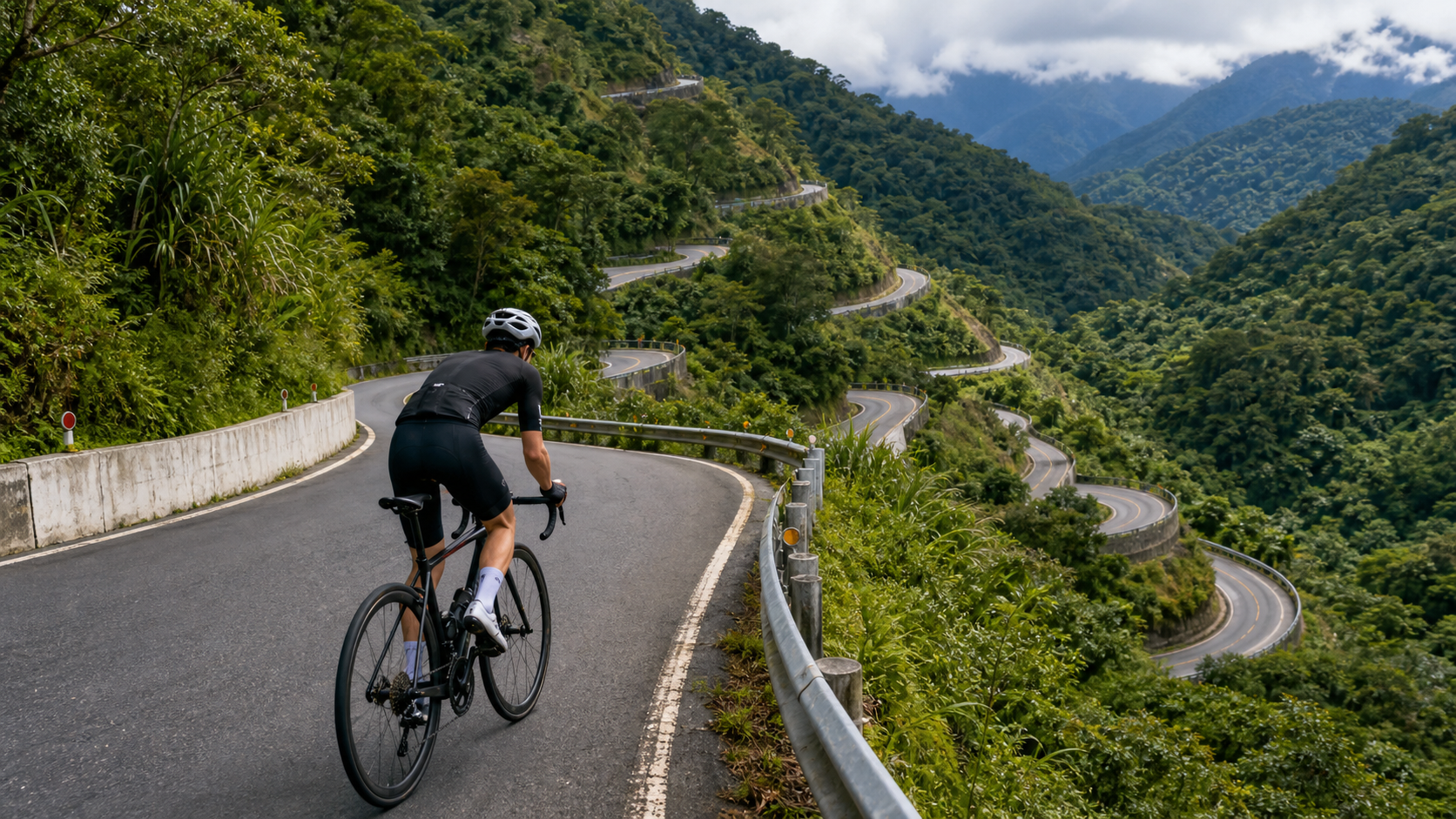
Route Overview and Real Data Analysis
Meishan’s 36 Bends, also known as “Meishan 36 Curves,” is one of the most iconic sections of Provincial Highway 18 (Alishan Highway) in Meishan Township, Chiayi County, and is widely recognized in Taiwan’s cycling community as a challenging route ranking among the top in both difficulty and fame. According to Strava segment data, the route is 11,841.4 meters long, or 11.84 km, with an average grade of 6.4%, and is classified by Strava as a Category 4 climb. At first glance, the Cat. 4 classification—the same as Dongshan Coffee Road—might lead one to misjudge it as being of similar difficulty. However, just looking at the average grade reveals that Meishan’s 36 Bends at 6.4% far exceeds Dongshan Coffee Road’s 3.9%. Combined with the route’s fame for consecutive hairpin turns, the actual physical and psychological load during the ride is on an entirely different level from a simple, steady climb.
The same data verification note applies here: the elevation gain (elevation_m) field for this segment in the database is recorded as 0, which is clearly a missing value or data anomaly and holds no reference value. Using the “distance × average grade” method to estimate, 11.84 km multiplied by 6.4% yields a net elevation gain of approximately 758 meters. This estimated figure is the baseline used for all subsequent pacing plans, energy expenditure calculations, and finish time estimates in this article. If readers see different elevation figures cited elsewhere, we recommend verifying by back-calculating with distance and grade yourself—developing that checking habit is worthwhile.
With 758 meters of climbing spread over 11.84 km, the average grade reaches 6.4%—a combination that enters the “hard climb” category. Compared to common domestic and international climb grading standards, a 6.4% average grade already crosses the threshold where many amateur riders begin to struggle. Add to that the route’s nationwide fame for its “36 consecutive hairpin turns,” and it stands as one of the most visually striking and engineering-representative sections on Provincial Highway 18’s Alishan Highway. Consecutive hairpin turns mean the grade is not a uniform, gentle rise; instead, there are noticeable grade spikes near the entry and exit of each corner. This is why, even though the average grade is “only” 6.4%, the actual riding sensation is often described as “obstacles at every turn.”
From a power-training perspective, an average grade of 6.4% approaches or even exceeds the FTP (Functional Threshold Power) range for most amateur riders. In other words, without targeted climbing training, attempting the entire route rashly can easily push you into an anaerobic state by the middle section, resulting in a soaring heart rate, rapid breathing, and quickly fatigued legs. This is also the core reason why, even though Meishan’s 36 Bends is only 11.84 km—far shorter than Dongshan Coffee Road’s 16.41 km—many riders subjectively feel that Meishan’s 36 Bends is “harder to ride”: the intensity density is far higher than what the distance alone suggests. Therefore, if your training plan includes both routes, we recommend treating Meishan’s 36 Bends as an interval-intensity training segment and Dongshan Coffee Road as an aerobic endurance volume segment. Using them together can more comprehensively improve your climbing ability.
Another point worth mentioning: because of its unique terrain and clearly numbered bends, this route has long been recognized in Taiwan’s cycling community as one of the benchmark “touchstone” routes. Many teams and training camps use “time to complete Meishan’s 36 Bends” as one of the metrics for evaluating members’ climbing progress. A route with this kind of community consensus and word-of-mouth fame inherently carries a special appeal, drawing many riders to make the trip specifically to take on the challenge and leave their own completion record.
Section-by-Section Guide from Start to Finish: Riding Techniques for the 36 Bends
Section 1 (0–3 km, approximately Bends 1–10): The Opening Phase, Finding Your Rhythm
The most classic feature of Meishan’s 36 Bends is that nearly every hairpin turn has a clear number marker. For riders, this is an excellent psychological anchor—you can clearly know how many bends you’ve conquered and how many remain. This “visualized progress” design, to some extent, reduces the mental fatigue that tends to build during long climbs. In the opening phase of the first ten bends, we recommend riders take time to discover their pedaling rhythm on consecutive hairpin terrain. The inside of a hairpin turn is usually steeper than the outside, so when cornering, try to choose the shallower line on the outside of the bend, while moderately lowering cadence and pushing a heavier gear through the apex. After exiting the corner, gradually return to normal cadence and speed as the road allows.
Another key point in this phase is establishing a baseline sense of how much energy one bend consumes. Since each bend’s grade and length are not exactly the same, the first ten bends provide an excellent sampling opportunity. Before formally entering the high-intensity middle section, you can roughly gauge how much your heart rate and breathing rise with each bend, and how much straight-line recovery you need to stabilize. This “calibration” process has decisive reference value for your energy allocation strategy across the remaining thirty-plus bends. Don’t skip it, and don’t rush to post an impressive average speed in the opening phase.
Section 2 (3–6 km, approximately Bends 11–20): The Core Intensity Zone
After entering the middle section, the density of consecutive hairpin turns typically reaches its highest point on the entire route—this is also the main reason the overall average grade is pushed up to 6.4%. For this section, we recommend an alternating strategy: “full recovery on the straight sections between bends, steady output through the apex.” In other words, don’t maintain the same intensity throughout the entire corner-plus-straight cycle. Instead, use the relatively gentler straight connectors between bends to ease off the cadence slightly, regulate your breathing, and save energy for the next bend’s climb. This rhythm management ability is the key to successfully completing the core middle section.
Many riders make a classic mistake in this phase: the visual stimulation and adrenaline rush from consecutive corners can create an illusion of “getting more excited the longer you ride,” unconsciously treating every apex as a short sprint point and going all out. This pattern might sustain a decent average speed in the short term, but energy consumption will far outpace the body’s recovery rate. Once you enter the willpower-testing zone of Section 3, the cost of being overdrawn comes back with interest. In this core intensity zone, we recommend deliberately using a heart rate monitor or power meter for real-time monitoring. Once you notice values continuously approaching or exceeding your usual threshold limits, actively back off the pace rather than stubbornly pushing through on feel.
Section 3 (6–9 km, approximately Bends 21–30): The Willpower Test Zone
The physical difficulty of this section may not be the highest on the route, but because the rider’s energy and willpower have already been depleted by the first two sections, the subjective feeling of fatigue is often at its peak. Many riders’ DNF (Did Not Finish) or forced dismounts happen in this zone. Here, we strongly recommend letting go of any attachment to speed and time, simplifying your goal to just “ride past the next bend.” Break the remaining distance into small chunks to reduce psychological burden, rather than constantly thinking about how far the finish line still is.
This is also the section where “self-talk” technique is most needed. Many experienced climbers share the same advice: instead of thinking “six more bends”—a dauntingly large number—narrow your focus to “the next bend,” a small goal you can handle immediately. This psychological strategy has a corresponding theoretical basis in sports psychology: reducing the scope of the goal lowers psychological pressure and effectively delays the onset of subjective fatigue. We recommend doing this mental preparation before attempting Meishan’s 36 Bends, rather than scrambling for coping strategies only after you’ve hit the wall.
Section 4 (9–11.84 km, approximately Bends 31–36): The Finishing Sprint Zone
As the bend numbers approach 36, the finish line is in sight. In this section, we recommend riders reassess their remaining energy. If conditions allow, you can slightly increase output intensity on the last few bends, completing the route’s challenge in a near-ritualistic manner. If energy is nearly depleted, there’s no need to force a sprint—steadily riding out the final bends is equally a completion result to be proud of. After reaching the end of Bend 36, if you plan to descend back the same way, be sure to control your descending speed. Consecutive hairpin terrain is also a high-risk section for out-of-control crashes on descents; mastering braking and cornering lines is no less important than energy management on the way up.
It’s worth mentioning that many riders experience unexpectedly strong emotional reactions the moment they complete the 36th bend—whether it’s the relief of utter exhaustion or an indescribable sense of achievement. This intensity of emotional fluctuation is, to some degree, one of the reasons Meishan’s 36 Bends has built its unique reputation in the cycling community. After completing the challenge, we recommend resting at a safe spot first, replenishing fluids and calories, before considering next steps. Don’t rashly decide to start a high-speed descent while your energy and attention are both at a low point.
Hairpin Turn Riding Technique Details
When facing consecutive hairpin terrain, beyond the section-by-section strategy above, several specific riding techniques deserve special emphasis:
- Line Selection: Stay as far to the outside as possible before entering a corner, allowing the cornering path to form a larger turning radius. This shortens the actual riding distance over the steepest sections while maintaining higher cadence and speed stability.
- Shift Gears Early: Don’t wait until you’re already in the steep section to frantically downshift. Complete your gear changes before approaching the corner to avoid chain skipping or dropping under high load.
- Weight Control: When cornering, shift your center of gravity slightly forward and lower it, to avoid insufficient front-wheel traction or rear-wheel slipping caused by the combined forces of grade and steering angle.
- Eye Guidance: When riding consecutive corners, your eyes should look ahead toward the apex of the next bend rather than staring at the road directly in front of you. This is a fundamental skill common to all cornering terrain, whether climbing or descending.
Gear Ratio and Equipment Recommendations
Given the route’s characteristics—6.4% average grade with steeper local sections—the gear ratio requirements are significantly higher than those of a typical gentle climb. Unless you’re a competitive-level rider with solid climbing ability, we don’t recommend tackling Meishan’s 36 Bends with a standard crankset paired with a narrow rear cassette.
| Rider Level | Recommended Front Chainring | Recommended Rear Cassette | Notes |
|---|---|---|---|
| Beginner / First-time consecutive hairpin challenge | 34T small ring (compact) | 11-32T or 11-34T | Make sure the lightest gear can handle the local steep sections |
| Intermediate / Some climbing foundation | 34T or 36T small ring | 11-28T or 11-30T | Adjust cruising intensity flexibly based on the day’s conditions |
| Competitive level | 36T or 39T small ring | 11-25T or 11-28T | Can be used as a climbing interval or time-trial segment |
One particularly important reminder: because of the consecutive hairpin terrain, the instantaneous grade near the apex is often noticeably higher than the route average. Even for riders with a solid foundation, it’s better to bring one extra lighter cassette gear as insurance than to be forced to stop and dismount mid-corner because the gear is too heavy. That frustration often outweighs the cost of carrying a little extra equipment weight.
For tire pressure and wheel selection: since consecutive hairpins demand higher cornering stability, we don’t recommend choosing overly narrow or overly hard tire setups just to chase extreme climbing weight savings. A moderate tire width (generally recommended between 25C and 28C) paired with reasonable pressure can maintain rolling resistance efficiency while providing better cornering grip and road feedback. Regarding frame geometry: if your road bike already has a lower center of gravity design or a longer wheelbase, it should theoretically offer better stability on consecutive corner terrain. However, this falls into advanced equipment considerations—most riders don’t need to switch frames specifically for a single route. With proper riding technique and gear ratios, you can complete the challenge successfully.
For safety equipment: given that this route has a slightly higher likelihood of falling rocks and potholes than typical urban roads, we strongly recommend wearing a certified road cycling helmet and confirming that your braking system (whether traditional rim brakes or hydraulic disc brakes) is in good condition. Consecutive hairpin terrain places far greater demands on the braking system than straight roads. If you plan to descend immediately after completing the challenge, check brake pad wear in advance to avoid danger from insufficient braking power during the descent.
Nutrition and Hydration Strategy
At 11.84 km with 758 meters of climbing, plus the extra energy expenditure from consecutive hairpins, the completion time for most riders will fall between 50 minutes and nearly 2 hours (see the estimate table in the next section). Compared to the longer Dongshan Coffee Road, Meishan’s 36 Bends is shorter in distance but significantly higher in intensity density. Recommended nutrition strategy:
- Before Departure: Be sure to hydrate properly and consume adequate carbohydrates. Supply points along the Meishan mountain area are limited, so don’t rely on luck.
- During the Ride: Since consecutive hairpin terrain makes it difficult to drink while riding, use the relatively gentler straight sections between bends to take small sips. Never get distracted by drinking during a steep corner, as it can compromise handling safety.
- Electrolytes and Snacks: In summer or under high perceived exertion, bring electrolyte supplements and at least one portable snack—especially if you plan to descend back the same way or link up with other segments after completing the 36 bends.
From an energy metabolism perspective, riding at an average grade of 6.4% while maintaining moderate-to-high intensity output for an extended period depletes muscle glycogen stores faster than a shallower route. This is why, even though Meishan’s 36 Bends isn’t particularly long in total distance, it should still be treated as a route requiring serious nutrition planning—not dismissed with the intuition that “it’s under twelve kilometers, so I probably don’t need supplies.” Especially for riders aiming for a personal best or planning to link Meishan’s 36 Bends with other segments into a long ride, carbohydrate-loading meals the day before are a detail that should not be overlooked.
Weather and Seasonal Recommendations
Meishan Township is located in the mountainous northeastern part of Chiayi County, where the climate is far more variable than in the plains. The probability of afternoon clouds, fog, and showers in the mountains is significantly higher than on flatland routes. For tackling Meishan’s 36 Bends, we recommend prioritizing the dry season from late autumn to early spring of the following year, when temperatures are moderate and rainfall probability is lower. If riding in summer, be sure to start early in the morning to avoid the period when afternoon convective cloud systems develop in the mountains. Also note that on wet or slippery surfaces, braking distance increases noticeably and grip decreases significantly on consecutive hairpin terrain—attempting the route in rain or on wet roads is not advisable.
Mountain temperatures are typically lower than in the plains, and perceived temperature drops as altitude increases. Even in summer, we recommend carrying a lightweight windbreaker or arm warmers depending on the day’s conditions—especially for riders planning to linger in the mountains after completing the challenge or to descend at high speed back down. The combination of mountain wind and wind-chill from descending can make the perceived temperature much lower than expected, so thermal gear should not be completely omitted just because it’s summer. Additionally, cloud and fog conditions in the Meishan mountain area can change faster than in the plains, with visibility potentially dropping dramatically in a short time. We recommend carrying reflective or warning equipment, especially for riders planning to ride in the pre-dawn darkness or in low-light evening conditions. Managing riding safety and visibility is an aspect that cannot be ignored.
Common Mistakes and DNF Risks
- Insufficient Gear Ratios: This is the most common cause of failure on Meishan’s 36 Bends. Many riders underestimate the intensity of the local steep sections within consecutive hairpins, and their cassette combinations can’t handle it, forcing them to stop and catch their breath mid-corner or even dismount.
- Pacing Too Hard in the Early Section: The “visualized progress” design of 36 bends can easily make riders overly excited and push too hard in the first ten bends, causing a sharp energy decline in the middle and later sections.
- Inadequate Mental Preparation: The visual and psychological fatigue from consecutive hairpins often makes riders want to give up earlier than pure physical exhaustion does. Establishing correct mental expectations beforehand is crucial.
- Underestimating Descent Risks: Many riders focus on the climbing challenge but underestimate the handling difficulty and braking load of descending consecutive hairpins. This is an equally serious safety concern.
- Poor Hydration Timing: Because the corner terrain makes it hard to drink while riding, riders tend to delay hydration, and dehydration symptoms are only noticed in the later stages of the ride—by which time it’s too late.
Estimated Completion Times by Rider Level
| Rider Level | Estimated Average Speed | Estimated Completion Time | Notes |
|---|---|---|---|
| Beginner (first-time high-intensity consecutive corner challenge) | Approx. 6–8 km/h | 90–120 minutes | Plan multiple short breaks; no need to force a non-stop completion |
| Intermediate (some climbing experience) | Approx. 9–12 km/h | 60–79 minutes | Adjust pace based on the day’s conditions |
| Competitive (club team riders, racers) | Approx. 14–18 km/h or more | 40–51 minutes | Often used as a benchmark test segment for climbing ability |
Overall, Meishan’s 36 Bends is indeed a classic challenge route with “solid difficulty and strong landmark significance.” It is not merely a grueling physical test but a comprehensive examination of consecutive-corner handling skills and mental resilience. For riders without prior experience on consecutive hairpin turns, we recommend making a successful completion the primary goal without obsessing over time performance. Once you’ve accumulated enough handling confidence and fitness foundation, you can then challenge higher-intensity pacing targets.
Finally, one more reminder: the estimated completion times in the table above are only rough reference values. Actual performance can vary considerably depending on the day’s weather, wind direction, personal fitness condition, and even whether you stop multiple times to photograph the magnificent scenery along the way. Rather than focusing all your attention on comparing completion times with others, treat every attempt at Meishan’s 36 Bends as a valuable opportunity to assess your climbing ability and mental fortitude. That is the core value that makes this classic route truly worth long-term investment, repeated challenges, and careful refinement for cycling enthusiasts.
Related Reading
- Alishan Highway Challenge Plan: 11% Average Grade Training from Chiayi to Alishan
- 36 Bends, 36 Conversations with Yourself: The Road Spectacle and Riding Philosophy of Meishan’s 36 Bends
- Chiayi Meishan Taiping Mountain Route: Detailed Analysis of a Climbing Training Route in Chiayi County
- Complete Guide to Alishan Highway: The 53.57 km, 2,000+ Meter Climb Southern Taiwan Long-Ride Pilgrimage
梅山36彎 奮起湖 單車挑戰 下集 #公路車
6 年前
單車 梅山36灣 坡度介紹 路段介紹 空拍 (相關遊記影片,請參考說明或我的頻道喔,歡迎訂閱)
6 年前
梅山36彎 奮起湖 #公路車 之旅 2400m
6 年前
4K單車實境) 嘉義 梅山36灣 訓練台 爬坡 輕鬆騎
6 年前
大武山後門26%歡樂陡坡!JJSC南台灣單車行Day2 / 被颱風追著跑 / 公路車 / CT Yeh
2 年前
台北闊瀨陡坡 騎旅 / 日本單車雜誌編輯車友臨時加入!/ 髮香才是最強的 / feat. 北迴歸線小隊 / 公路車 CT Yeh
6 個月前
大武山20%魔王陡坡【JJSC南台灣遊騎Day2】!屁股真的要裂開了...凡士林抹滿也沒用?神秘金教堂還有超便宜夜市
3 個月前
半日 小台灣 極限單車路線挑戰實錄
7 年前