Southern Cross-Island Highway Eastbound Practical Guide: Full Breakdown of the Category 5 Battle from Chulai to Xiangyang, 48 km with 2,074 m of Climbing
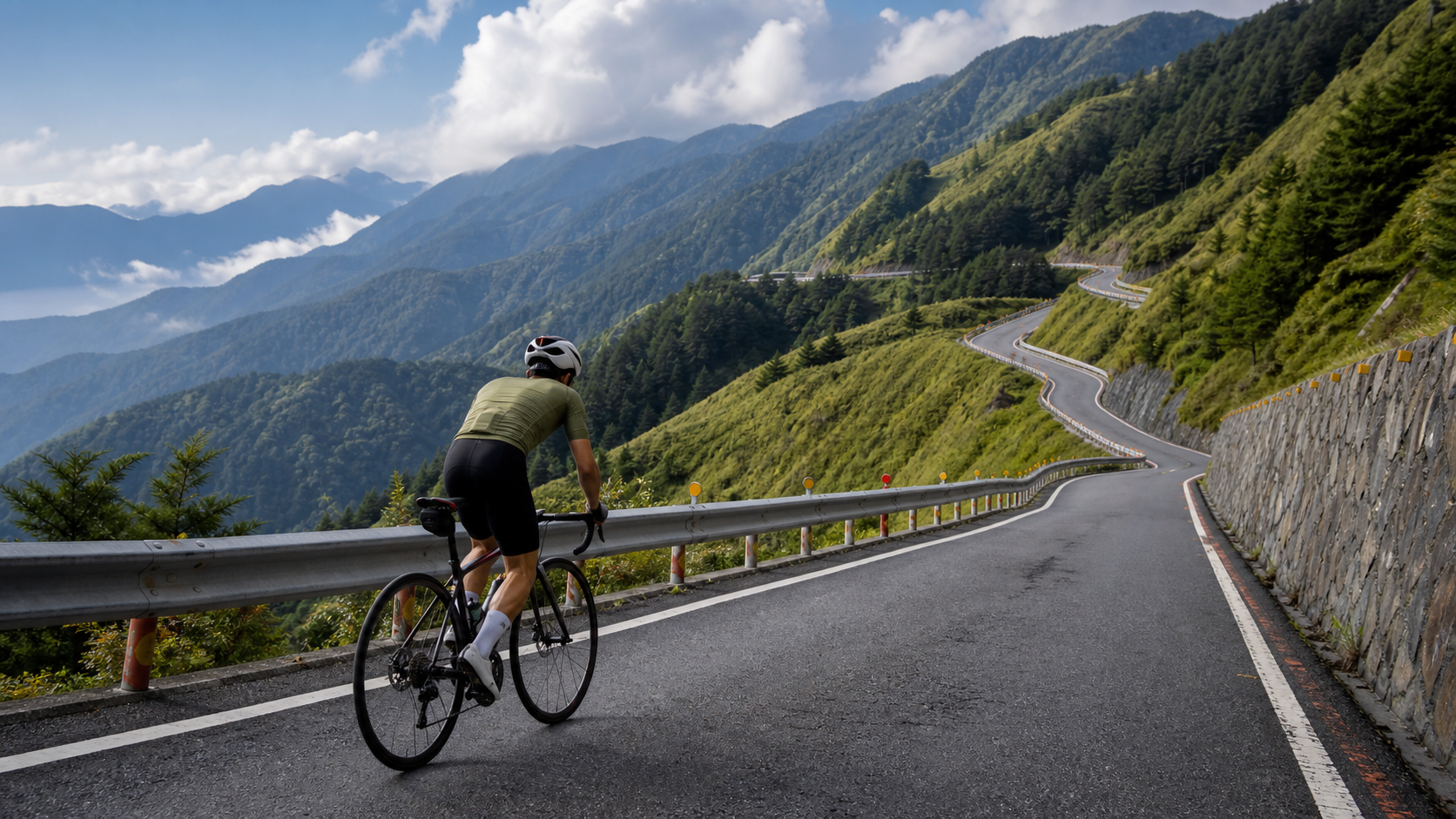
Practical Guide to Riding Fengguizui: 6.13 km, 410.8 m of Climbing, a Section-by-Section Breakdown and Gear Ratio Calculations for Taipei’s Cycling Mecca
When Taipei cyclists want to practice climbing, nine out of ten will be told by more experienced riders to “go ride Fengguizui first.” Located in Xishan Village, Shilin District, right on the edge of Yangmingshan National Park, this route is the most accessible climb in Taipei City and the entry-level mountain road most often used to test climbing ability. Below is a data-driven breakdown of the route so you can run the entire ride through your mind before you even set off.
Route Overview: Getting the Numbers Straight First
Before discussing riding rhythm, let’s lay out the hard data. The route commonly starts from the Fenglin Bridge area at an elevation of about 182 meters and climbs all the way to the Fengguizui Saddle at 597 meters.
| Item | Value |
|---|---|
| Route Distance | 6.13 km (6,132.75 m) |
| Total Climbing | 410.8 m |
| Average Gradient | 7.2% |
| Category | 3 (Moderately Hard) |
| Start Elevation | Approx. 182 m (Fenglin Bridge area) |
| Finish Elevation | Approx. 597 m (Fengguizui Saddle) |
An average gradient of 7.2% doesn’t look particularly extreme at first glance, but this is the “overall average,” meaning there are steeper sections that get pulled down by relatively flatter ones. In practice, the pressure in the early part of the ride will feel significantly greater than the numbers suggest. A category 3 rating places this route in the moderately hard range—a tough challenge for beginners, an excellent ability test for riders with some foundation, and a common warm-up or interval training ground for advanced riders.
Short distance, high climbing density, and easy access—these three characteristics combined are the fundamental reasons Fengguizui can be called “Taipei’s cycling mecca.” You don’t need to take time off work or travel long distances; you can fit in a ride after work or on a weekend morning, yet still get a solid climbing stimulus. This kind of “return on investment” is rare among routes near Taipei.
From a training perspective, there’s another often-overlooked reason this route gets recommended repeatedly: its gradient distribution isn’t a single linear climb but a three-part structure of “steep section + rolling section + final kick.” This structure means that within a single ride, your body experiences at least two different types of climbing stimulus—the front section is near-steady-state high-intensity endurance, while the middle and later sections are repeated variable-effort interval loads. For riders preparing for long-distance climbing events, Fengguizui may be short, but it can simulate both the “sustained output” and “handling terrain changes” abilities required during a climb, making it an excellent high-efficiency training ground in a short amount of time.
Because of this characteristic, many coaches and experienced riders schedule Fengguizui into their midweek interval training plans, not just as a warm-up route for weekend long rides. The following sections break down the start, middle, and finish phases in order, explaining what rhythm and mindset to use for each.
The Start: Fenglin Bridge to the First 1.5 km, Pedaling Rhythm on 5-8% Gradients
Most riders choose to start from the Fenglin Bridge area, which is one of the most iconic starting points for this route. As soon as you get on the bike, the first 1.5 km delivers a rude awakening for beginners—the gradient in this section generally falls between 5-8%, and there’s almost no flat respite to catch your breath.
The key to this section isn’t “pedal hard” but “find a cadence you can sustain for the entire ride.” Practical recommendations:
- Lock your cadence at 75-85 rpm: A cadence that’s too low (below 60) will cause lactic acid to build up quickly in your leg muscles, while a cadence that’s too high will push your cardiovascular system into the red zone prematurely. Either one will leave you unable to hold on by the middle section.
- Keep your upper body relaxed; don’t yank on the bars with brute force: Many beginners unconsciously use their arms to drive their whole body’s output. This compensatory movement disrupts your core stability and breathing rhythm, pushing you into the anaerobic zone faster.
- Stay seated for the most part; only briefly stand and sprint on the steepest corners: The first 1.5 km is steep, but not steep enough to require standing the whole way. Save the standing efforts for the truly hard corners later, so you don’t exhaust your leg strength prematurely.
The most common mistake in this section is getting carried away by the excitement of starting out and riding the climb at your flat-road cruising heart rate. If you push too hard in the first 1.5 km, the next 3 km will be agonizing—this will be covered in more detail in the “Common Mistakes” section later.
If you have a power meter, the target for the first 1.5 km can be set at “85-92% of Functional Threshold Power (FTP).” This range is enough to maintain efficient climbing output without slipping into anaerobic metabolism too early. For riders without a power meter, a simple check is “can you still speak a full short sentence while breathing?”—if you can’t get out even three or four words, you’re pushing harder than this section calls for. Heart rate watch users can use “70-80% of Heart Rate Reserve (HRR)” as the target range for the front section—an intensity roughly equivalent to an effort that’s sustainable for a long time but already clearly noticeable as pressure.
It’s worth noting that while the gradient in this section is demanding, the road surface quality is generally good and the corner curvature is relatively gentle, unlike some mountain roads that have broken pavement or sharp-corner traps. In other words, the challenge here comes mainly from physiological load rather than technical handling difficulty. This is another reason Fengguizui is often listed as the “first choice for beginner climbing training”—it lets riders focus on the single task of pacing their energy without having to simultaneously deal with complex road condition assessments.
The Middle and Later Sections: Rolling Terrain, Knowing When to “Hold Back” on Pacing
After surviving the hardest climb in the front section, the route gradually transitions into rolling terrain. This isn’t a continuous steep climb but a rhythm of “up a bit, ease off a bit, up again.” The demands on your cardiovascular system and muscles shift from “a single type of endurance” to “repeated adaptation to changing effort.”
What this section truly tests is pacing discipline. Many riders get a false sense that “the hardest part is behind them” after surviving the steep section, so they surge on the flatter stretches to make up time—only to hit the next uphill segment with another anaerobic shock. Repeat this a few times, and your body will fatigue faster than if you’d maintained a steady climb.
Recommended approach:
- Treat the flatter sections as recovery, not as opportunities to accelerate: Bring your heart rate back down to just below the lactate threshold zone and let your breathing truly settle.
- Approach every small uphill with the same level of effort rather than the same speed—the undulating terrain means you should judge how hard to push by “feel of effort” rather than “maintaining a certain speed.”
- Look ahead and anticipate the gradient change after the next corner: Fengguizui’s road profile lets you see a short stretch ahead on many sections. Use this information to shift gears in advance, which is far smoother than fumbling with the shifters at the last moment.
This rolling section is also where the views start to open up. The roadside vegetation gradually transitions from dense forest to lower scrubland, and on clear days you can steal a glance at the valley below—but keep your focus on the road while riding and save the sightseeing for the summit.
This rolling terrain is also great for practicing “gear anticipation.” Unlike a single-gradient section where you can stay in one gear the whole way, rolling terrain requires you to complete your downshift or upshift before you actually enter the next climb. Many beginners wait until they clearly feel the pedaling resistance change before shifting, which often leaves them half a beat behind—entering a steep section with too heavy a gear and putting unnecessary strain on both knees and cardiovascular system simultaneously. The recommended approach: in the last few dozen meters of a flatter section, complete your downshift in advance so your cadence is already in a stable range when you enter the next climb, rather than frantically dropping two or three gears mid-climb.
Additionally, if you’re riding this rolling section in a group, pay extra attention to distance control with the rider ahead. The undulating terrain easily creates an “accordion effect”—the rider in front accelerates on the flats, the rider behind can’t keep up, then gets forced to brake hard on the steep sections before accelerating again. This stop-and-start riding style is far more energy-draining than steady pacing and also increases the risk of rear-end collisions. If you’re riding in a group, give yourself a bit more following distance so you have the buffer to adjust to your own rhythm rather than staring at the wheel in front and forcing yourself to match it.
The Finish: The Final Push to the Fengguizui Ridge Line
Near the end, the route has a short section where the gradient kicks back up—the “last straw” that many people underestimate. You’ve already spent most of your energy, yet right before the finish you hit another small steep pitch, and the psychological frustration often outweighs the physical fatigue.
Recommendations here:
- Start “mentally preparing yourself” one to two hundred meters in advance that there’s still one more climb to go, so you’re not caught off guard.
- Drop one gear lower than you were using in the middle rolling section, using a lighter gear to get through the final gradient change rather than stubbornly mashing a heavy gear.
- Once you reach the saddle, the wind will pick up noticeably—Fengguizui gets its name precisely because it’s the saddle passage through which the northeast and southwest monsoons enter and exit the Taipei Basin. The wind is strong year-round, and the moment you crest the ridge you’ll often feel a noticeable crosswind. Keep your handlebar stable, especially if you have deeper-section wheels or items mounted on the sides.
The moment you reach the top, the view from 597 meters makes all the effort feel worthwhile—this is the most charming aspect of Fengguizui as a training route: the time investment is low, but the visual and sense-of-accomplishment payoff is immediate.
If this ride is an out-and-back, don’t rush to turn around and descend immediately after reaching the top. Take a minute or two to let your heart rate drop back to an easy zone and check that your tires and brake lever feel are normal. After a sustained climb, your core body temperature is elevated, and your hands may be slightly stiff from gripping the bars for a long time. Heading straight into a descent can compromise your reaction speed. Pausing briefly, stretching your wrists and neck, and then starting the descent is a habit many experienced riders have developed.
For riders who use Fengguizui as a repeated training venue, here’s a simple workout template for reference: after a 10-15 minute warm-up, complete one full climb at the intensity recommended for the front section (85-92% FTP or 70-80% HRR), descend, recover for 5-8 minutes on the flat ground at the bottom, then go for a second rep. Depending on your condition, schedule 2-4 reps as one training block. When increasing the number of reps, watch for “whether each rep’s completion time is getting noticeably slower”—if your pace drops by more than 10%, your recovery that day isn’t sufficient to support more reps, and you should stop and switch to an easy spin to avoid diminishing returns or even overtraining.
Gear Ratio and Equipment Recommendations
Given this route’s gradient distribution (average 7.2%, with continuous steep sections of 5-8%), a standard road bike setup is more than sufficient—there’s no need to change your chainrings specifically for this route.
| Rider Level | Recommended Chainring | Recommended Cassette | Notes |
|---|---|---|---|
| Beginner/General recreational rider | 34T (or smaller inner ring) | 28-32T | Prioritize a stable cadence; don’t force a heavy gear |
| Rider with some climbing foundation | 34-36T | 25-28T | May increase gear slightly depending on leg strength |
| Advanced/Expert | 36-39T | 23-25T | Can use a heavier gear to maintain rhythm when chasing speed |
A standard road bike with a 32-34T chainring and 28-32T cassette is already enough to handle the full gradient range of Fengguizui—there’s no need to force yourself to mash a heavy gear. Rather than obsessing over gear ratio numbers, put your energy into “maintaining a steady cadence”—the biggest fear on a climbing route isn’t that your gear isn’t light enough, but that riders stubbornly use a heavy gear out of pride and exhaust their leg strength prematurely in the middle section.
Other equipment reminders:
- Tire pressure: Mountain roads occasionally have potholes and piles of fallen leaves. You don’t need to inflate to the maximum pressure used for flat cruising; dropping it slightly increases grip and comfort.
- Brake system check: There are many hairpin turns on the descent. Before setting off, make sure your brake pads and cables (or hydraulic system) are in good condition.
- Lightweight front and rear lights: Even if you set off during the day, light conditions vary greatly in shaded mountain sections. A rear light improves your visibility to oncoming traffic and motorcycles behind you in corners.
Nutrition and Hydration Management
Although Fengguizui is short (only 6.13 km), the concentrated gradient and high climbing density mean the perceived exertion is no less than a longer but flatter route. Recommendations:
- Hydrate fully before departure: Since there are virtually no obvious refueling points along the way, filling your bottles before you leave is basic practice. At this distance and intensity, one standard bottle is usually enough, but carry a second one in hot weather.
- Simple carbohydrate intake: If you’re planning multiple out-and-back reps (many riders use Fengguizui as a repeated climbing training venue), bring energy gels or bananas for quick absorption.
- Rest briefly at the summit: There are a few chicken restaurants near the Fengguizui summit where many cyclists and motorcyclists stop to eat and rehydrate after the challenge. If you’re not in a hurry, taking a short break there before descending will improve your focus on the way down.
Weather and Seasonal Considerations
Fengguizui sits at the saddle passage where the northeast and southwest monsoons enter and exit the Taipei Basin. “Strong winds year-round” is the most distinctive weather feature of this route, and riding feel varies significantly by season.
Winter (northeast monsoon dominant period): The windward side tends to be damp and cold, and the chance of mountain fog is much higher than in the lowlands. Fog directly affects visibility on the descent. Recommendations:
- Carry or wear windproof and insulating layers, especially since the wind at the Fengguizui saddle is even stronger than along the climb.
- If visibility drops noticeably, reduce your speed on the descent. Better to go slower and ensure you can react in time to corners and oncoming traffic.
- Wet surfaces extend braking distance. Brake early and avoid emergency braking that could lock the wheels.
Summer (southwest monsoon dominant period): Generally drier, but afternoon thunderstorms are a regular variable in Taipei’s mountain areas during summer. It’s recommended to set off in the early morning and finish before noon to avoid the thunderstorm-prone afternoon hours, while also applying sun protection—although there’s plenty of shade along the mountain road, the ridge line and some open sections are still exposed to direct sun.
Common Mistakes and Risk Reminders
Here are the most common mistakes riders make on Fengguizui—knowing them in advance lets you avoid them:
“Going out too fast and running out of steam later” is the most typical failure script on this route—many riders get fired up by the steep first 1.5 km and sprint at near-maximal heart rate, only to slow dramatically—or even have to stop and walk—once they hit the rolling middle section.
Specific risks and countermeasures are summarized below:
| Common Mistake | Consequence | Countermeasure |
|---|---|---|
| Pushing too hard in the front section | Lactic acid buildup in the middle and later sections, slowing down or even walking | Deliberately hold back in the first 1.5 km, saving energy for later |
| Descending hairpin corners too fast | Narrow roads and sharp turns increase the chance of close calls with oncoming cars and motorcycles | Control speed throughout the descent; brake before corners, not in them |
| Ignoring crosswinds on the ridge line | Gusts affect handlebar stability the moment you crest | Slow down as you approach the saddle; grip the bars firmly with both hands |
| Not carrying enough water | No obvious refueling points along the way; increased dehydration risk | Fill your bottles completely before departure |
| Ignoring the possibility of fog in winter | Reduced visibility on the descent; shorter reaction time | Slow down in poor weather; consider postponing if necessary |
The descent deserves special attention: the roads around Fengguizui are narrow with dense hairpin turns. Besides bicycles and scooters, you’ll occasionally encounter sport motorcycle riders practicing. On the descent, keep your line predictable—don’t hug the center line or cut corners. This is one of the most common causes of accidents on mountain roads.
Another easily overlooked risk is riding side-by-side in groups. Most sections of this route are narrow, especially on the steep parts. If a group habitually rides two abreast while chatting on the climb, it not only blocks oncoming traffic’s view but also makes it harder for vehicles behind (including cars and motorcycles) wanting to overtake to judge distances accurately. It’s recommended to switch to single-file riding on sections where the gradient steepens noticeably and the road width is limited, giving each other—and other road users—safe space.
Reference Finish Times for Riders of Different Levels
Based on a standard road bike, an average gradient of 7.2%, and a distance of 6.13 km, riders of different levels can expect to finish roughly within the following ranges (for training planning reference only; actual times will vary with daily conditions, bike weight, and wind):
| Rider Level | Reference Finish Time | Characteristics |
|---|---|---|
| Beginner/First attempt | Approx. 35-45 minutes or more | May need to stop briefly mid-way to catch breath |
| General recreational rider | Approx. 28-35 minutes | Can maintain a steady cadence throughout; some slowing in the middle section |
| Advanced rider | Approx. 22-28 minutes | Has a solid climbing foundation; paces the entire route well |
| Expert/Race-oriented | Approx. 18-22 minutes or faster | Has specific climbing training foundation; maintains high output throughout |
Deliberately, no specific online leaderboard numbers or personal records are cited here, because each person’s weight, daily wind conditions, and road conditions create significant variation. Rather than obsessing over “what time to beat,” treat Fengguizui as an anchor route for repeatedly comparing “your own rate of improvement”—this is why many Taipei cyclists use it as a fixed training benchmark.
It’s worth noting that the time ranges in the table above assume continuous riding without deliberate stops for photos or rest. In reality, most recreational riders on their first attempt will stop to take photos or simply catch their breath, so total time will naturally be longer. This is completely normal and nothing to feel frustrated about. The point of climbing training is long-term accumulation, not a single result.
Practical Value as a Training Benchmark
Another often-overlooked value of Fengguizui is its use as a benchmark for measuring your own “climbing economy.” Climbing economy refers to whether, under the same climbing and distance conditions, the energy your body expends and the cardiovascular load decrease as training accumulates. Because this route is short and easy to repeat, it’s well-suited for re-challenging every so often (e.g., once a month) using the same warm-up routine and similar weather conditions, while recording average heart rate, finish time, and Rating of Perceived Exertion (RPE).
As training volume accumulates, the ideal progression trajectory is typically: finish time stays flat or improves slightly, but average heart rate drops and perceived exertion decreases—this means your body is doing the same amount of work at a lower physiological cost, which is a signal that climbing ability has genuinely improved. This reflects real fitness changes better than simply chasing a personal record.
For riders preparing to tackle other famous long-distance climbing routes in Taiwan, Fengguizui also serves as an excellent “pre-race status check.” Since the entire ride can be completed in around half an hour without requiring a full day of planning, it’s well-suited for scheduling two to three weeks before a long-distance challenge to assess whether your current climbing output and recovery are at the expected level, allowing you to adjust your final training intensity accordingly.
Final Thoughts: Using Fengguizui as a Yardstick for Long-Term Progress
The reason Fengguizui has become the “cycling mecca” in the minds of Taipei riders isn’t just its convenient access and manageable distance—it’s that it condenses nearly every element needed for climbing: steep-section pedaling rhythm, rolling-terrain pacing discipline, ridge-line crosswind handling, and descent technical control, all packed into just 6.13 km.
On your first attempt, most riders will get a lesson from the steep first 1.5 km. But as long as you find the right rhythm and control your early output, this route is actually an excellent training ground for repeated practice. Record your finish time and heart rate data each time, and regularly return to challenge the same route—it’s the most direct way to track your climbing improvement.
Finally, whether you’re a beginner taking on the challenge for the first time or a veteran using it as an interval training venue, Fengguizui’s core value has never changed: the shortest time investment for the most solid climbing stimulus. Write down your data, lock in your rhythm, and prepare your equipment—this 6.13 km route will remain the most faithful fitness gauge for Taipei cyclists.
Related Reading
- Practical Guide to Riding Fengguizui: 6.13 km, 410.8 m of Climbing, a Section-by-Section Breakdown and Gear Ratio Calculations for Taipei’s Cycling Mecca
- Complete Analysis of Fengguizui Climbing Technique: Tips for the Northern Training Mecca
- Classic Fengguizui Climb Analysis: The Northern Training Mecca
- The Windy Saddle: Riding Up Fengguizui, Written for Every Taipei Beginner Cyclist’s First Milestone
風櫃嘴時間 預測西進武嶺時間?13000名車友統計數據分析告訴你 !
5 年前
#公路車 台北 #風櫃嘴 23:47 全台單車實境請訂閱鎖定
7 年前
風櫃嘴 | 全台最多大砲的單車路線 | 尋寶網攝影師告訴你怎麼擺拍起來才好看 | 熱門攝影地點巡禮
6 年前
台北闊瀨陡坡 騎旅 / 日本單車雜誌編輯車友臨時加入!/ 髮香才是最強的 / feat. 北迴歸線小隊 / 公路車 CT Yeh
6 個月前
半日 小台灣 極限單車路線挑戰實錄
7 年前
大武山20%魔王陡坡【JJSC南台灣遊騎Day2】!屁股真的要裂開了...凡士林抹滿也沒用?神秘金教堂還有超便宜夜市
3 個月前
#北橫 + #北進武嶺 最硬的員工旅遊 EP1 | #公路車 #拉拉山 | 明池 | 武嶺 | 武陵農場 | 雲海 | Taiwan Cycling Route Wulin
6 年前
西進武嶺 8000名單車友數據分析 PART1 | 從新手到高手數量/瓦數/推力比/FTP推力比/功率計使用率 大解析 | 公路車 | CTYeh
5 年前