From Shouka to Xuhai: A Cycling Memory Crossing the Highest Point of the South Link Highway Toward the Ocean
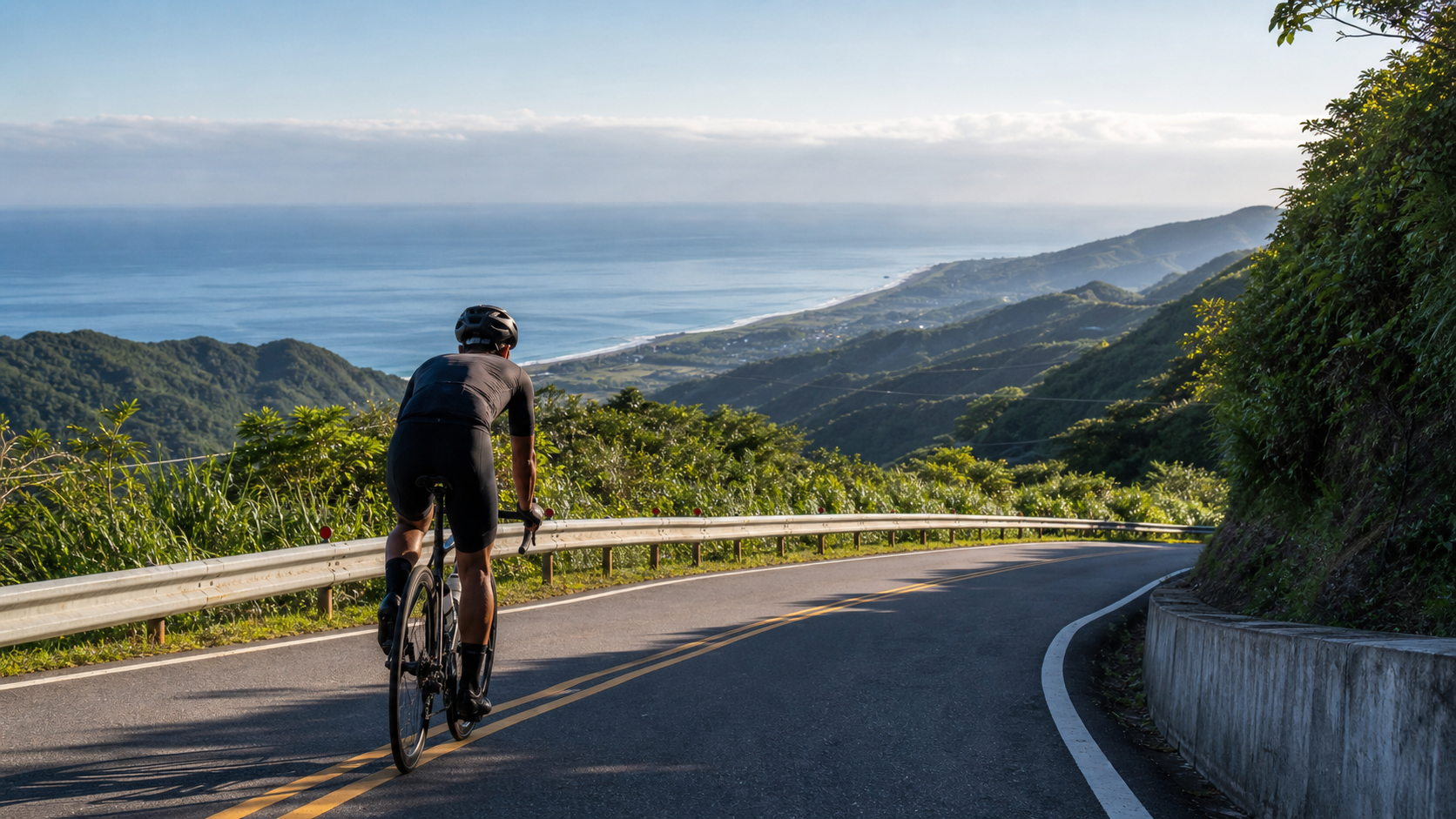
The Last Glance Before Departure
Dawn had not yet broken, and my gear was already packed. I stared at the winding route on the map that led to Shouka and then extended to Xuhai, my heart filled with anticipation and the unease of the unknown. This was not my first time on the South Link Highway, but it was the first time I had truly set my destination as Xuhai—a place name that sounds inherently poetic. That mix of familiarity and novelty accompanied me as I pushed down on the pedals and slowly made my way toward Shouka.
Beyond Shouka Lies a Different World
Among Taiwan’s island-circumnavigating cyclists, there is a saying: once you cross Shouka, you officially say hello to Pingtung or Taitung. This saddle, located at the junction of Provincial Highway 9’s South Link section and County Road 199, is the highest point of the South Link Highway and a collective coordinate of memory forged by countless turning pedals. I have heard more than one veteran island-circumnavigator describe the moment of reaching Shouka—that complex emotion mingling gasps for breath, sweat, and a sense of accomplishment—as one of the most vivid moments of the entire journey.
This time, I chose not to continue south or north along Provincial Highway 9 from Shouka. Instead, I turned onto County Road 199, heading toward Xuhai. This route stretches nearly 20 kilometers with an elevation gain of over 500 meters. Compared to the leg-weakening climbs around Shouka itself, the ride ahead felt far gentler—but this gentleness concealed a completely different kind of scenery and a shift in mindset.
A Landscape Transition from Mountains to Coast
After leaving Shouka, the road began a gradual descent, and the vegetation on both sides shifted from the dense mid- and low-elevation forests around the South Link Highway to more open, rolling low-mountain terrain. This transition in landscape was not an abrupt, dramatic change but a slow, frame-by-frame progression, like a cinematic tracking shot. I particularly enjoy this kind of gradual scenic transformation—it gives a rider ample time to digest and absorb the distinct atmosphere each stretch of terrain brings.
County Road 199 passes through several settlements in Mudan Township, an area where the Paiwan people and a small number of Amis people live together. While I could not thoroughly research the complete historical context of every settlement during the ride, the atmosphere—mountain breezes gently blowing, the slow and unhurried pace of tribal life—was something I could genuinely feel while passing through. Occasionally, I spotted crops laid out to dry by the roadside, a few chickens strolling leisurely, and children playing in front of their homes. These scenes of everyday life lent this road, originally just a connector between two places, a warm human touch.
The Moment of Choice at the Fork
Riding into the Upper Mudan area, I arrived at the fork where County Road 199’s main line splits from the 199A branch. This is a geographically unremarkable yet route-planning-critical node—continuing left (or straight ahead, depending on the actual terrain) along the 199 main line leads to Mudan’s town center, Shimen, and Sichongxi; turning onto the 199A branch leads all the way to Xuhai. I paused briefly at the fork, looking at the two roads heading in entirely different directions, and suddenly felt the scene was deeply metaphorical: in life, we too often stand at seemingly similar crossroads, making choices that determine the scenery of our future.
After turning onto 199A, this branch road of about 8.6 kilometers carried me toward Xuhai on the eastern side of the Hengchun Peninsula. A faint salty scent of the ocean began to drift through the air, and the wind direction shifted with it. These subtle changes in smell and touch were signals my body registered long before my mind—signs that the sea was drawing near.
The Unique Character of the Hengchun Peninsula’s East Side
The eastern side of the Hengchun Peninsula, where Xuhai sits, is a world apart from the bustling Kenting commercial district on the west. Here, a relatively unspoiled natural landscape remains, untouched by excessive tourism development. The distant coastline shimmered under the sunlight, and mountains and sea leaned against each other in an intimate embrace, creating a distinctive geography—while riding, you can simultaneously feel the undulating terrain of the mountains and the widening vista as you approach the ocean. This interweaving of mountain and sea is an experience not easily replicated on other routes in Taiwan.
The Hengchun Peninsula is renowned for its fierce “luo shan feng” (falling mountain wind). Although the core affected areas are mostly concentrated on the peninsula’s western side, I could still feel gusts of strong wind brushing against my face while riding the 199A section near Xuhai. That sensation of needing to adjust my center of gravity and maintain balance on the bike was, in a way, this land showing its character—behind the gentle coastline lies a natural force not to be underestimated.
Cycling Philosophy in the Falling Mountain Wind
To be honest, riding for the first time on a stretch with noticeable crosswinds feels like being forced into a direct dialogue with nature’s power. You cannot fight the wind with brute force; you can only learn to go with it, to adapt. Lowering your speed, relaxing your upper body, letting your body subtly adjust its angle with the rhythm of the wind—this riding technique is, in a sense, also a practice of the mind: when faced with external conditions beyond your control, rather than clashing head-on, it is better to learn to understand them, to yield to them, and to find a way to coexist with them.
Riding in a region as famous for strong winds as the Hengchun Peninsula is, to some extent, an exercise in humility. This land will not go easy on you just because you are a rider who has come from afar. It has its own temperament and rhythm, and all you can do is approach it with respect, learning how to coexist with such natural conditions, rather than deluding yourself into thinking you can conquer it through sheer will.
A Brief Stop at the Shouka Rest Station
Before officially setting off, I paused briefly at the cyclist rest station at Shouka, took a few sips of water, and exchanged a few words with several young riders who had arrived at the same time and were in the midst of their island-circumnavigation challenge. That unspoken camaraderie between strangers who happen to cross paths is one of the most touching aspects of long-distance cycling culture—everyone may come from different cities with different riding goals, but in that moment, having jointly crossed Shouka, that geographic and psychological watershed, a connection beyond words naturally formed among us.
I watched them continue south along Provincial Highway 9 to complete the rest of their island loop, while I turned onto County Road 199, heading toward Xuhai. Though our paths diverged from there, that brief moment of convergence at Shouka became an unexpectedly warm interlude in this cycling journey.
Traces of Life and Human Landscape Along the Way
Riding along County Road 199 and 199A, beyond the changes in natural scenery, what impressed me most were the seemingly casual yet deeply life-filled details scattered along the roadside—fishing nets or crops laid out to dry in courtyards, wisps of incense rising from small roadside temples, and the occasional local resident passing by who nodded in greeting. These scenes bore no deliberate tourist packaging, and precisely because of that, they felt especially authentic and moving, lingering in my memory long after.
I have always believed that one of the greatest appeals of cycling travel is that it gives you the chance, at a speed closest to the land, to observe and absorb those details of life that high-speed transportation flashes past in an instant. The route from Shouka to Xuhai may not boast many well-known landmarks, but through its unadorned roadside scenery, it reminded me that the essence of travel has never been merely about reaching a destination—it is about those unexpected little moments along the way.
The Feeling of Arriving at Xuhai
As the view gradually opened up and the distant horizon line of the sea came clearly into sight, the sense of arrival was especially powerful. Xuhai—the name itself carries poetry: the coast that greets the rising sun. Although I arrived not at dawn and missed the chance to witness the sunrise that the name promises, the afternoon sunlight scattering across the sea’s surface in shimmering ripples held its own quiet, expansive beauty.
Standing at the shore, I looked back at the road I had just traveled—from the high saddle of Shouka, descending and turning, finally reaching this open coastline. That experience of landscape and mindset transforming in tandem was the most profound gift this route gave me. It taught me that the meaning of riding has never been about conquering numbers of elevation or distance, but about giving yourself the opportunity, through movement, to truly feel the complete pulse of a land, from mountain to sea.
A Word to the Next Rider
If you are also planning to take on the route from Shouka to Xuhai, I want to tell you: do not treat it merely as a “must-complete” transitional stretch in your island circumnavigation. Slow down, pay attention to the signs at the forks, and take note of the unassuming scenes of life along the way. This route may not give you impressive elevation numbers on your Strava record, but it will give you a complete landscape transition from mountain ridges to coastline, from clamor to tranquility—and that kind of experience is often far more worth cherishing than a purely physical challenge.
Before leaving Xuhai, I took one last look at this open coastline and silently noted in my heart the emotion this place had stirred in me. If I ever have the chance to visit again, I would plan more time to explore this relatively unspoiled yet vibrant land on the eastern side of the Hengchun Peninsula, getting to know every story here at an even slower pace.
The Historical Echoes of Shouka Checkpoint
For many younger riders, the name Shouka might simply be a check-in point along the round-island route, but it actually carries a deeper layer of historical significance. This place was once a “mountain control checkpoint,” playing the role of regulating people’s entry into and exit from mountain administrative areas during a specific historical period, until it was officially decommissioned in 1997 and faded into history. Today, this checkpoint that once bore the duty of control has transformed into a welcoming cyclist rest stop, witnessing Taiwan’s societal evolution from control to openness, from vigilance to friendliness.
Standing before the Shouka rest stop, watching the weary round-island cyclists come and go—taking photos, refilling water, cheering each other on—I suddenly felt that this place itself is a silent narrative about time and transformation. What was once a border control post has now become a warm node where travelers converge and encourage one another. This reversal in historical significance is worth savoring far more than any scenic photograph.
County Highway 199 and Route 199A: Two Sides of the Same Road Narrative
The main line of County Highway 199 and Route 199A are like two different endings to the same story. The main line leads to Mudan township, Shimen, and Sichongxi, eventually reaching Tongpu, passing through more settlements and cultural landscapes along the way; the branch line 199A is comparatively simpler, heading straight toward the coastline of Xuhai, with even fewer people along the route—yet it preserves more of the pristine and tranquil natural atmosphere.
During my ride, I often imagined a parallel version of myself in another timeline, choosing the main line instead of the branch, wondering what different scenery I would have seen, what different people and stories I would have encountered. This “possibility of choice” is, to some extent, the most enchanting aspect of cycle touring—the same starting point, but because of different route choices, ultimately leads you to entirely different destinations and states of mind. This time, I’m glad I chose Route 199A toward Xuhai, giving this journey a more complete narrative arc that hugs the ocean, and granting me a more dimensional, deeper understanding of this land’s geographical texture.
Another Interpretation of the Luoshan Wind
The Luoshan wind of the Hengchun Peninsula is, in meteorological terms, a powerful downslope wind formed by topographic effects, but for the residents who have lived on this land for generations, it perhaps feels more like a rhythm of life lived in coexistence with nature. I’ve heard (though I couldn’t verify every detail during my ride) that local residents have long adapted their farming, fishing, and daily routines to the seasonal patterns of the Luoshan wind. This wisdom of flowing with nature rather than resisting it, to some extent, echoes the mindset I came to understand while facing strong headwinds during my ride—the art of going with the flow.
As a passerby, I cannot fully comprehend the profound, generationally accumulated understanding between this land and the Luoshan wind, but at least, through this firsthand experience of riding in the wind, I’ve gained a measure of reverence and understanding for this land, and a more grounded appreciation for the phrase “adapting to local conditions.”
A Rider’s Soliloquy Between Sea and Mountains
On the final few kilometers of Route 199A approaching Xuhai, I deliberately slowed down, giving myself more time to absorb the coastline gradually unfolding before me. On the left stretched the rolling low mountain ridgelines; on the right, the Pacific coast grew increasingly distinct. This riding experience of simultaneously possessing both mountain and sea vistas is not particularly common on other routes in Taiwan.
I recalled my first round-island ride, when I also experienced that indescribable sense of expansiveness at a similar mountain-sea junction—as if both body and mind were simultaneously embraced and healed by the mountains and the ocean before me. This feeling is difficult to capture fully in precise language, but once you’ve experienced it firsthand, you understand why countless riders keep returning to Taiwan’s coasts and mountains, using their wheels to measure every inch of this land’s texture.
A Letter to My Future Self
If one day, because of the hectic pace of life, I gradually forget this riding experience from Shouka to Xuhai, I hope these words will remind my future self: there was once an afternoon when you paused briefly at the highest point of the South Link Highway, exchanged a knowing smile with a fellow round-island cyclist you’d never met, then turned onto a comparatively quiet branch road, riding all the way toward that open and tranquil coastline on the eastern side of the Hengchun Peninsula.
That day, the wind was strong, with mountain winds and sea breezes alternating directions along the way. You learned how to maintain your center of gravity and patience in strong winds, and you also learned to slow down and appreciate those unremarkable yet genuinely moving details of everyday life along the route. Such experiences may never appear on any list of popular attractions, yet they will leave in your heart a unique, private memory of mountains, sea, and wind.
Fellow Travelers Met Along the Way
Besides the round-island cyclists I briefly crossed paths with at the Shouka rest stop, I also encountered a middle-aged man riding a vintage motorcycle, solo-touring the island, along Route 199A. We both happened to stop for a rest at a wide-open curve, and he told me with a smile that he’d ridden this road three times already, each experience feeling different. This time, he deliberately chose a weekday to avoid the weekend traffic and enjoy a purer riding experience.
That kind of devotion and passion for repeatedly discovering different feelings on the same route left a deep impression on me, and made me reconsider that “repetition” and “freshness” are not necessarily opposing ends. Perhaps this is the most fascinating paradox of travel and riding—even on the same road, different seasons, different states of mind, and different weather can make familiar scenery present entirely different faces and meanings. This gave me a new understanding and anticipation for “revisiting the same place.”
Small Human Warmth at the Supply Stop
Although supply points along this route are relatively scarce, during my brief stop at the Shouka rest stop to refill water, I still experienced a rare warmth of human kindness. The staff member there, seeing me drenched in sweat and covered in road dust, proactively handed me a cup of cold water and chatted with me briefly about the day’s weather and road conditions. This kind of casual care, during a long ride, often brings unexpected psychological comfort—you realize that even in relatively remote areas with limited resources, the simple goodwill between people has never been diluted.
Such small moments always reinforce my conviction that the truly moving core of cycle touring is never just the magnificent scenery or impressive stats, but those seemingly trivial encounters scattered along the journey that genuinely warm the heart.
Looking Back at the South Link, Looking Back at This Journey
When I finally arrived at Xuhai and sat on the seawall, gazing at the shimmering Pacific in the distance, recalling the entire journey that began at Shouka, an indescribable sense of fulfillment welled up inside me. This wasn’t the exhilarating rush of completing a grueling climb, but a quieter, more enduring inner satisfaction—as if through my wheels, I hadn’t just covered nearly 20 kilometers, but had fully experienced a landscape narrative from a high mountain saddle to an open coastline, and along the way, engaged in a sincere and profound dialogue with the natural forces and cultural scenery of this land.
If I ever have the chance to return to this route in the future, I would choose a different season, a different time of day—to experience the most powerful Luoshan wind in winter, or the gentlest Xuhai seascape at dawn—using different light and wind speeds to rewrite this unique dialogue and unforgettable memory between me and this land. I also look forward to sharing this journey with more friends who share a love for cycling and stories of the land, so we can together experience the unique charm where mountains and sea intertwine at the junction of the South Link and the Hengchun Peninsula. Because I’ve come to understand that the appeal of this route has never lain in a one-time conquest, but in the fact that every return reveals different details and emotions. From Shouka to Xuhai, this understated yet story-rich route deserves to be visited and written about again and again.
In Closing: To Everyone Who Crosses Shouka
In Taiwan’s round-island cycling culture, the significance Shouka carries has long transcended its geographic definition as the highest point of the South Link Highway. It is, in countless travelers’ hearts, that symbolic threshold where “once you cross over, you’re in a whole new world,” and a stage where story after story of perseverance, encounters, and self-dialogue unfolds. And the stretch of Highway 199 and Route 199A extending from Shouka toward Xuhai, with its comparatively gentle gradients and gradually unfolding coastal views, provides a soothing and healing coda to this story of perseverance.
If you have already crossed Shouka, or are about to, I’d like to invite you: as you continue on your way, spare a little more time for this branch road leading to Xuhai. Slow down, feel the subtle shifts as mountain winds and sea breezes alternate, and feel how this relatively unspoiled yet vibrant land on the eastern side of the Hengchun Peninsula welcomes, in its own way, every traveler willing to get to know it on two wheels. This road deserves to be ridden slowly and thoroughly, and it deserves to be revisited years later, carrying a wealth of memories.
Related Reading
- Shouka to Xuhai Route Guide: The 19.9 km Long-Distance Challenge Connecting the Southern Cross-Island Highway’s Highest Point with the Hengchun Peninsula
- Cycling Route No. 1 Southern Section: Mountain-Crossing Guide for the South Link Highway from Fenggang to Taitung
- South Link Highway Section: Experiencing the Mountain-Sea Border from Taitung to Pingtung
- Pingtung Hengchun Peninsula Cycling: Complete Guide to the Long-Distance Route Through the Southern End’s Mountain and Sea Landscapes
山道猴出沒!? JJSC屏東單車行 Day1 一直催 / 皮卡丘來了!/ 墾丁 旭海 恆春 社頂 / 公路車 / CT Yeh
2 年前
嘉義大埔、阿婆灣挑戰賽,美到以為在日本!ft. 環騎5 Cool 西拉雅188 / 公路車 / CT Yeh
7 個月前
觀霧 變好騎了! | 北高車友爆笑大會師 | 公路車 | 單車旅遊 Taiwan Cycling Route GuanWu
6 年前
台北闊瀨陡坡 騎旅 / 日本單車雜誌編輯車友臨時加入!/ 髮香才是最強的 / feat. 北迴歸線小隊 / 公路車 CT Yeh
6 個月前
大武山後門26%歡樂陡坡!JJSC南台灣單車行Day2 / 被颱風追著跑 / 公路車 / CT Yeh
2 年前
大武山20%魔王陡坡【JJSC南台灣遊騎Day2】!屁股真的要裂開了...凡士林抹滿也沒用?神秘金教堂還有超便宜夜市
3 個月前
#墾丁 #單車 微蜜月旅行 | 社頂公園絕景 | 恆春 鵝鑾鼻公園
6 年前
雙十節的溫腥感人約騎,升旗到升天一次滿足 | 公路車 | 鳳山寺 | 米粉坡
6 年前