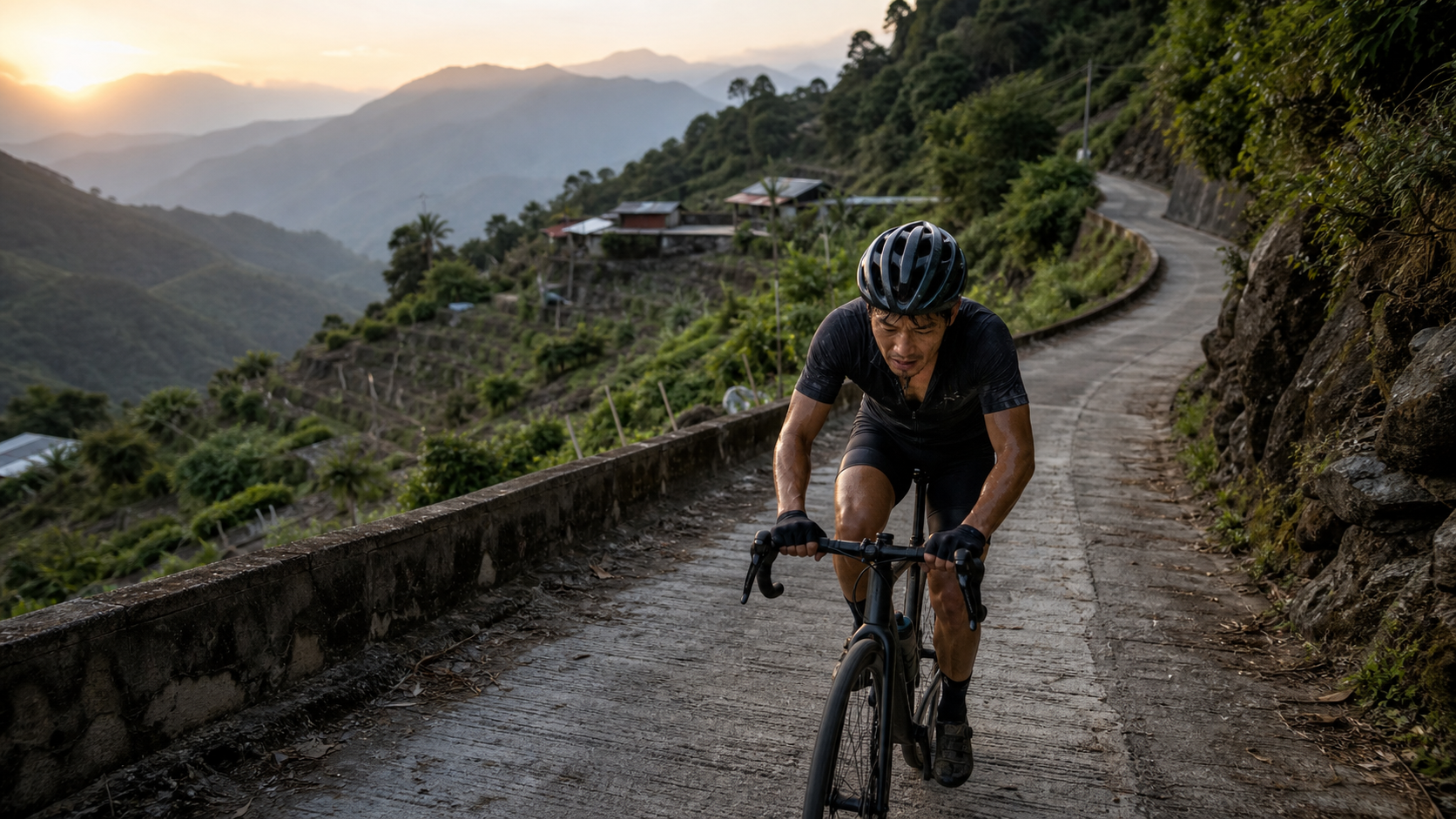
Departure: Taiwu Township at Dawn
The sky was just beginning to lighten as I set off by bike from the Pingtung plains, heading toward Taiwu Township, ready to embark on this journey deep into the Paiwan indigenous mountain homeland. I carried a mix of anticipation and a hint of uncertainty about the unknown ahead.
An Unassuming “Back Door”
“Back Door” — what a plain and unpretentious name. When I first saw “Taiwu Back Door” on the route list, I couldn’t help but smile — among the many climbs named after mountains and places, this nickname, carrying a sense of everyday life and casualness, felt especially warm and intriguing. It doesn’t have the grandeur of North Dawu, nor does it carry the clear landmark reference of Dewen Mountain. It’s simply “Back Door” — an industrial road named in the most straightforward way by the local cycling community or residents.
Taiwu Township, an indigenous mountain township where the Paiwan people make up as much as 94% of the population, has its administrative seat in Jiaping Village — which also happens to be the starting point of North Dawu Jiaping, another route in this series. Taiwu Back Door, meanwhile, stands as a relatively low-key yet equally solid presence on this land — just 5.18 kilometers long, yet requiring 413.8 meters of climbing, with an average gradient of nearly 8%. It is a solid challenge not to be underestimated.
Resilient Life on Rugged Land
The terrain of Taiwu Township is often described as “rugged” and “with poor soil.” At first glance, such descriptions might carry a hint of hardship, but as I actually rode along the industrial roads of this mountain area, I felt a completely different kind of vitality — precisely because the terrain conditions of this land are unforgiving, the Paiwan people who have lived here for generations developed a wisdom of life that coexists deeply with these mountains and adapts to the topography.
As I climbed the steep slopes, gasping for breath, I tried to imagine how the residents of this land managed to build their homes and livelihoods under such rugged terrain conditions. Every piece of cultivated farmland, every winding industrial road climbing upward, embodies the accumulated wisdom of countless generations through repeated negotiation and adaptation with these mountains. This resilience deeply rooted in the land is something that any experience of life on the plains can hardly fully comprehend.
Breathing and Struggling on the Steep Slope
To be honest, riding the Taiwu Back Door route proved far more grueling than I had originally expected. With an average gradient of nearly 8%, spread over a distance of just over 5 kilometers, there was virtually no meaningful room to catch one’s breath throughout the entire climb. I struggled to maintain my pedaling rhythm while trying to regulate my breathing. Sweat kept dripping from my forehead, blurring my vision and making the edges of the world around me feel somewhat hazy.
There were moments when I almost wanted to stop and catch my breath before continuing. But every time I looked ahead at the road winding upward, and caught glimpses of tribal settlements along the way, I found renewed motivation to keep going. This process of struggling at the edge of physical limits while being continually inspired by the scenery ahead and inner conviction — in a way, this is what makes mountain riding most fascinating and addictive. It offers no room for luck, yet it always provides unexpected encouragement and comfort exactly when you need it most.
Echoes of Morakot’s Memory
Riding through these mountains, it was hard not to think of Typhoon Morakot in 2009, which changed the fate of Taiwan’s indigenous mountain townships. During that typhoon, Taiwu Township recorded a staggering single-day rainfall of 1,145 millimeters — a figure that, even in the context of Taiwan’s meteorological history, stands as an extremely alarming extreme event. Facing such an unprecedented onslaught of natural forces, how did the residents of this land rebuild their homes and lives step by step from the devastation? Even though I didn’t experience it firsthand, I could still feel the weight of that history through this relatively calm road that seems to be “just an industrial road.”
As I complained breathlessly about the difficulty of the gradient, I also carried a sense of gratitude in my heart — gratitude that this road, after enduring such violent natural impacts, remains well-maintained and safe to traverse, allowing outside riders like me to personally experience the resilience and beauty of this land.
Echoes of Jiaping Village
Since Taiwu Back Door and North Dawu Jiaping are both located within Taiwu Township, with starting points geographically connected to the administrative seat of Jiaping Village, images and feelings from my earlier visit to Jiaping Tribe kept surfacing in my mind as I rode Taiwu Back Door. North Dawu Mountain, standing in the distance and revered as a sacred mountain by both the Paiwan and Rukai peoples, seemed to be watching over my journey from another angle within the views along this route.
I think that whether it’s Jiaping Tribe itself or this industrial road named “Back Door,” both are indispensable parts of the rich and diverse fabric of life in Taiwu Township. They may not have grand tourist fame, but they carry the life memories and cultural heritage of generations in the most authentic, most grounded way.
Slices of Daily Tribal Life
The settlements I passed along the way, though modest in scale, displayed the unique warmth and groundedness of Paiwan tribal life. Crops drying in courtyards, occasional rooster crows and dog barks, and the sound of indigenous language conversations in the distance — these seemingly ordinary slices of life formed the unique, human-filled landscape of this mountain area.
I didn’t deliberately linger too long, afraid of disturbing the residents’ daily rhythm. I simply rode past quietly, using my eyes, my ears, and my heart to absorb the relatively slow yet steady way people interact with nature and with each other on this land. This pace of life stood in sharp and profound contrast to the fast tempo I’m accustomed to in the city, and it made me reconsider how “living” can take on such diverse and rich forms.
The Visual Reward After Sweat and Exertion
Finally completing this short yet extremely steep climb, I turned to look back at the road I had come from. That complex emotion mixing fatigue and accomplishment welled up in my heart once again. Layer upon layer of mountain ridges displayed varying shades of green under the sunlight, and in the distance, higher ridgelines were faintly visible — perhaps part of North Dawu Mountain’s silhouette.
At that moment, all the hardship seemed to find a reasonable and worthwhile outlet. Sweat and heavy breathing had transformed into the most solid sense of satisfaction deep within. I sat by the roadside to rest, gazing at this vast yet story-filled mountain forest, and a profound emotion I could hardly put into words surged within me — this was not just a physical challenge, but a precious journey of deeply understanding this land and this people of Taiwu Township.
Words to the Next Challenger
If you’re also planning to take on the Taiwu Back Door route, I want to tell you: don’t be misled by the surface number of “just 5 kilometers.” This is a genuinely hardcore challenge. Make sure you have your gearing properly configured and your fitness adequately prepared. But at the same time, I’d also like to invite you, during your ride, to slow down a bit, pay attention to the tribal settlement landscapes and traces of life along the way, and experience this land carrying profound history and cultural heritage with respect and humility.
Taiwu Back Door — this seemingly unremarkable industrial road with its casually chosen name — actually encapsulates the deep life wisdom of the Paiwan tribes in Taiwu Township, as well as the unyielding, ever-renewing vitality that has endured the test of Typhoon Morakot. If I ever have the chance to visit again, I would spend more time and ride at a slower pace to discover the stories of this land that have yet to be told.
An Unexpected Encounter
On the way back, at a wide-open curve, I met an elderly farmer tending his fields. Seeing me ride by breathless and drenched in sweat, he gave me a knowing, friendly smile and gestured simply for me to be careful and ride slowly. This kind of wordless goodwill unique to mountain tribes always feels especially warm to me. I didn’t linger to disturb him — I simply nodded in thanks and continued on my way. But that image left a deep impression on my heart — more than any grand scenery, this kind of simple and sincere human interaction is the most precious and unforgettable moment of this journey.
In Closing: On Resilience and Humility
On the road leaving Taiwu Township, I kept mulling over the many feelings this journey had given me. What Taiwu Back Door taught me wasn’t just how to configure gearing or adjust breathing rhythm to tackle steep slopes — more importantly, it taught me how to understand, with humility, a land and a people that endured catastrophic natural disaster yet continued to move forward with resilience. This road, though barely over 5 kilometers long, gave me a far deeper and more three-dimensional understanding of the words “perseverance” and “resilience” than I had before setting out, and left me with an indescribable sense of respect and attachment for this indigenous mountain homeland of Pingtung.
A Dialogue with Myself on the Steep Slope
The most captivating and intimate aspect of riding a high-intensity climbing route is that it always forces you into an unfiltered inner dialogue with yourself. When muscles begin to burn and breathing turns rapid, the tug-of-war between reason and willpower becomes strikingly clear and real. On the steepest section of the road behind Taiwu, I experienced just such a merciless self-conversation—“Should I stop?” “How much longer can I hold on?” “Is this worth it?” These questions surfaced in my mind, one after another.
In the end, what kept me pedaling forward was rarely some grand conviction, but rather small, concrete thoughts—recalling the anticipation I had for this journey before setting out, remembering the trials and reconstruction this land had endured, and thinking that if I gave up now, I might never muster the courage to try again. These fragmented yet genuine thoughts, when accumulated, proved enough to carry me, pushing the pedals down again and again, until I finally rode through that most difficult stretch.
A Beauty That Is Underrated
The route behind Taiwu may be overlooked by the outside world—perhaps because of its casual name, or its lack of prominent landmarks or tourist attractions—and is often not even regarded as a route worth a dedicated visit. But after riding it myself, I came to feel deeply that this state of being “underrated” has, in a way, preserved its most precious and original character—no endless streams of tourists, no overly commercialized packaging, only the most authentic terrain, the most unpretentious tribal life, and the most honest test of gradient.
I often think that perhaps it is precisely these corners that mainstream tourism discourse overlooks that allow a traveler who genuinely loves riding and the stories of the land to find that pure and profound sense of wonder. The road behind Taiwu is exactly such a place—one that deserves to be seen anew and taken seriously.
The Mountain Forest Amid Shifting Light and Shadow
Along the ride, sunlight filtered through the sparse canopy, casting dappled, dancing shadows on the road surface. As I gradually climbed, the surrounding vegetation quietly transformed—from the relatively dense broadleaf forest at the foot of the mountain, gradually transitioning to the mixed coniferous and broadleaf forest typical of mid-elevations. This dual shift in light and vegetation, in a sense, served as a visual metaphor, reminding me that I was continuously moving upward and deeper—both in terms of elevation and in my understanding of this land.
I deliberately stopped at several sections with wider views, quietly taking in the sound of wind rustling through the treetops and the warm sensation of sunlight on my skin. These brief pauses, though short, were especially precious moments of respite and recharging during the entire high-intensity climb.
A Reminder to My Future Self
As I write this article, I am also leaving a reminder in my heart for my future self: do not casually overlook a route simply because its name is ordinary or it lacks fame, for it may hold profound meaning and challenge worth discovering. The road behind Taiwu taught me that the most moving scenery and stories often lie in corners unnoticed by the mainstream gaze, and only by setting foot on them and experiencing them firsthand can one truly uncover and understand them.
If I ever have the chance to return to Taiwu Township in the future, I would want to use more ample time to explore just how many places like the road behind Taiwu exist on this land—low-key yet solid, ordinary yet profound—waiting for travelers willing to slow down and feel with their hearts to come and discover them.
A Roadside Conversation with a Fellow Rider
At a slightly gentler bend during the climb, I encountered another rider resting there. He was from Kaohsiung, and this was his third time tackling the road behind Taiwu. He shared with a smile that on his first ride up this road, he spent nearly the entire time cursing the steepness in his mind, but after finishing, he inexplicably fell in love with that feeling of being pushed to the limit and yet managing to grit his teeth and push through. Since then, he had returned again and again to re-experience that sensation of being physically and mentally drained yet extraordinarily real and precious.
Listening to his story, I couldn’t help but smile—it turned out that this contradictory emotion of “painful yet joyful” was not something I alone felt, but a peculiar and wonderful sentiment shared by many who love mountain riding. We simply encouraged each other, exchanged our views on the route, and then each continued on our own journey. This kind of fleeting yet tacit understanding, born from jointly challenging the same difficult route, is a particularly moving part of cycling culture.
Imagined Scenes of Tribal Life
During the ride, I tried to imagine what life was like for the people of this land in the era before paved industrial roads—how they traveled on foot between mountain settlements and the outside world. No gear systems, no lightweight frames, only their own two feet and carrying poles, bearing the necessities of daily life back and forth across these rugged mountain paths. This imagination filled me with a sense of reverence for the seemingly ordinary industrial road before me—it is not merely a route for modern riders to test their climbing ability, but a tangible vessel carrying the living and working memories of generations of tribal people on this land.
Modern paved surfaces and relatively convenient transportation infrastructure have, to some extent, allowed us outsiders to approach and experience this mountain forest with relative ease. But I always remind myself not to forget that behind this convenience lies the result of long-term effort and adaptation by this land and its generations of residents—a legacy that every traveler who benefits from it should appreciate with gratitude.
Whispers in the Wind
As I neared the end of the climb, the mountain wind grew noticeably stronger, carrying a chill that contrasted sharply with the stifling heat I had felt moments before. I closed my eyes, took a deep breath, and let the mountain breeze gently soothe my breathing rhythm, which had become somewhat erratic from the high-intensity effort. In that moment, I seemed to hear this mountain forest, in its own way, quietly telling its story—a story of resilience, of rebirth, of the deep and enduring emotional bond between generations of tribal people and this land.
Such moments may carry a touch of romantic imagination, but I have always believed that when a person is willing to slow down and open their heart to a piece of land, that land will always respond in its own unique way to that sincerity and attentiveness. The road behind Taiwu, this seemingly ordinary industrial road, taught me this lesson through its steep gradients and its humble roadside scenery.
A Final Look Back Before the Summit
At the last bend before reaching the summit, I deliberately stopped my bike and looked back at the path I had traveled. From the nervous anticipation at the foot of the mountain, to the struggle and gasping on the mid-section slopes, to the relief and emotion of nearly completing the challenge at this moment—a distance of just over five kilometers, yet it condensed such a rich and complete arc of emotional fluctuation and life insight. This layering of emotions is a unique experience that no long-distance flat cruise can provide.
I think this is precisely what makes short, high-intensity routes so captivating—they use the most streamlined, concentrated form to put a rider through a complete and profound physical and mental trial in an extremely short time. With little room for respite or buffer, all the struggle, persistence, and breakthrough must occur rapidly within a brief window. This highly condensed experience makes every moment of completing the challenge feel especially profound and unforgettable.
The Shift in Mindset on the Descent
On the way down the mountain, my speed increased noticeably, the wind whistling past my ears. Every meter I had fought so hard to climb now took only a few minutes to descend. This stark contrast between climbing and descending always gives me a sense of temporal dislocation, as if the sweat-soaked, breathless struggle moments ago had been nothing more than a brief, intense dream.
But I know that the sense of accomplishment and insight gained from that struggle and persistence is by no means an illusory dream—it is genuinely etched into my physical memory and emotional being. After reaching the bottom, I turned to look back at the layered mountain ridges, knowing that I had truly conquered this short but far-from-simple mountain road with my legs and willpower, and in the process, forged a deep and personal connection with the resilient, vibrant land of Taiwu Township.
As I left Taiwu Township, the glow of the setting sun spilled across the distant ridgelines, painting the entire sky in warm shades of orange. Silently, I made a promise to myself: this would absolutely not be my last visit to this land. In the future, I would return with more preparation and deeper understanding, to once again experience the road behind Taiwu and the endless stories and emotions hidden in the other mountain indigenous routes of Pingtung. What this land taught me far exceeds any set of gradient or elevation numbers—it is a precious gift about resilience, about humility, and about the sincere dialogue between land and people, one that I will continue to savor, reflect upon, and share through many more rides to come.
Related Reading
- Taiwu Back Door Guide: A 5.2 km Hard Climb with an Average 7.9% Gradient in Pingtung
- Inquire at the Gate of the Holy Mountain: Riding into Pingtung Taiwu, Paying Respect to the Paiwan’s Kavulungan
- Riding to the Foot of North Dawu Mountain: A Cycling Dialogue with Pingtung’s Taiwu Township Jiapu Tribe and the Holy Mountain
- The Rebirth of Dewen Tribe: A Cycling Journey of Migration, Resilience, and Land Memory
大武山後門26%歡樂陡坡!JJSC南台灣單車行Day2 / 被颱風追著跑 / 公路車 / CT Yeh
2 年前
大武山20%魔王陡坡【JJSC南台灣遊騎Day2】!屁股真的要裂開了...凡士林抹滿也沒用?神秘金教堂還有超便宜夜市
3 個月前
台北闊瀨陡坡 騎旅 / 日本單車雜誌編輯車友臨時加入!/ 髮香才是最強的 / feat. 北迴歸線小隊 / 公路車 CT Yeh
6 個月前
觀霧 變好騎了! | 北高車友爆笑大會師 | 公路車 | 單車旅遊 Taiwan Cycling Route GuanWu
6 年前
嘉義大埔、阿婆灣挑戰賽,美到以為在日本!ft. 環騎5 Cool 西拉雅188 / 公路車 / CT Yeh
7 個月前
#北橫 + #北進武嶺 最硬的員工旅遊 EP1 | #公路車 #拉拉山 | 明池 | 武嶺 | 武陵農場 | 雲海 | Taiwan Cycling Route Wulin
6 年前
一定要騎一次!阿里山最深處:里佳部落!單車旅行 | 2800m爬升 | 深度部落體驗:嗨翻晚會、螢火蟲、銀河 | feat. JJSC & 廢物伙伴 | 公路車 CT Yeh
9 個月前
新竹白蘭部落! 爬陡坡還能講笑話...? 廢物伙伴の約騎 | 公路車 | CT Yeh
4 年前