Life After Ironman Retirement: When the Finish Line Is No Longer the Goal
Sixty-two-year-old Coach Huang stands on the shore of Taitung’s Living Water Lake, watching his students jump into the water one by one. Twenty years ago, he was the one standing at the starting line—carrying dreams of Kona, obsessed with every single second. Today, he has two titanium screws in his knee and has undergone rotator cuff surgery on his left shoulder, yet something still burns in his eyes.
“I no longer race,” he says, “but I have never left triathlon. I just continue in a different way.”
Every triathlete, no matter how much they love the sport, will eventually face a moment—when the body no longer allows you to train and race the way you used to. Perhaps it’s a serious injury, perhaps it’s the age-related decline in performance, or perhaps it’s simply waking up one morning and suddenly realizing: it’s time.
The days after that moment may be the most important chapter of a triathlete’s life. Because how a person ends a journey often defines who they are more than the journey itself.
The Many Faces of Retirement
Gradual Retirement: From Full Distance to Short Course
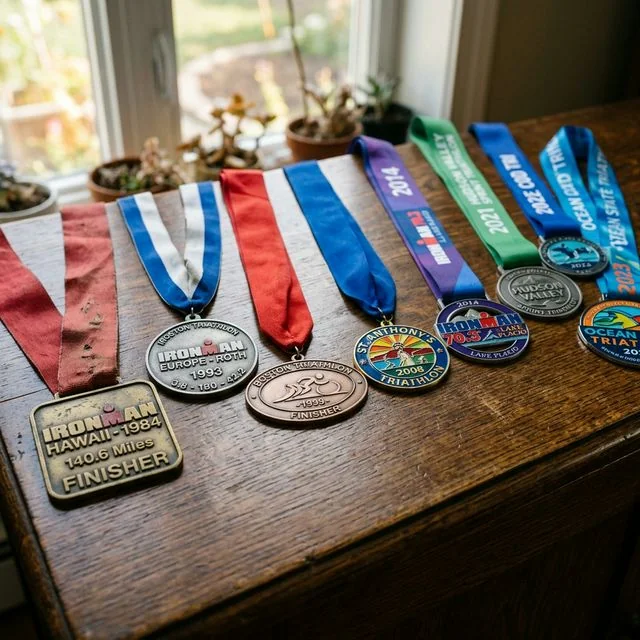
The most common form of retirement is a gradual step-down in distance. After their bodies can no longer support a full Ironman, many veteran triathletes transition to half-distance, then Olympic distance, and finally Sprint. The distance shortens, but the love for the sport remains unchanged.
Seventy-year-old Uncle Chen is such an example. Between the ages of 45 and 60, he completed 12 full Ironman races; from 60 to 65, he moved to half-distance; and after 65, he focused on Olympic distance and Sprint. “Speed is for the young,” he says with a smile, “but the smile at the finish line is just as bright at 70 as it is at 30.”
Event Transition: From Triathlon to a Single Discipline
Some athletes, after retiring, focus on one of the three triathlon disciplines. A former triathlete whose knees can no longer handle running might transition to cycling or open-water swimming. An athlete plagued by shoulder injuries might focus on ultramarathons or long-distance trail running.
Event transition allows retired triathletes to preserve the core of the sport—challenging oneself, connecting with peers, maintaining health—while avoiding further injury.
Role Shift: From Athlete to Coach
This may be one of the most meaningful transitions in triathlon retirement. Veteran athletes possess years of racing experience and training knowledge. If these invaluable insights can be passed on to the next generation, they won’t disappear with retirement.
In Taiwan, many excellent triathlon coaches are retired athletes. They have personally experienced the pain of training, the pressure of racing, and the frustration of injury, which gives them a level of empathy and insight in coaching that cannot be learned from books.
The Psychological Challenges Faced by Retired Triathletes
Retirement is not just a physical transition; it is also a profound psychological adjustment.
Loss of Identity
When you’ve identified yourself as a “triathlete” for ten or twenty years, and suddenly one day you no longer race—who are you? This sense of lost identity is a challenge shared by many retired athletes. It is not limited to professionals—even for amateur triathletes, when triathlon training and racing occupy most of your social life and self-identity, losing it can bring an unexpected sense of emptiness.
Coping advice: Recognize that “triathlete” is not what you do, but who you are. Your discipline, perseverance, determination, and courage do not disappear because you no longer race. They simply need a new outlet.
Changes in Social Circle
The triathlon community is the most important social circle for many triathletes. After retirement, if you no longer participate in group training and races, you may gradually drift away from this circle.
Coping advice: Stay in the community in a different role—as a coach, volunteer, race organizer, or club officer. The way you participate changes, but the connection doesn’t need to be severed.
Making Peace with Your Body
For many retired triathletes, the hardest thing is accepting that their bodies no longer function the way they used to. Watching your pace get slower, your power output drop, and your recovery time lengthen can trigger frustration and discouragement.
Coping advice: Shift your metric from “performance” to “health.” Stop chasing PBs; instead, chase “today’s training made me feel good.” Become friends with your body, not adversaries.
| Psychological Challenge | Symptoms | Healthy Coping Strategies |
|---|---|---|
| Loss of identity | Feeling empty, losing direction | Find a new self-definition and goals |
| Social isolation | Drifting away from the triathlon circle | Stay in the community in a new role |
| Body anxiety | Frustration over declining fitness | Shift metrics to health rather than performance |
| Competitive void | Missing the adrenaline of competition | Seek new challenges (e.g., mountaineering, travel) |
| Time vacuum | Not knowing how to fill training hours | Develop new interests or engage in community service |
Legacy: Carrying the Triathlon Spirit Forward
The most precious assets of retired triathletes are not medals and results, but their experience and spirit. Here are several ways to pass on the triathlon spirit.
Becoming a Coach or Mentor
Formally or informally guide new triathletes. You don’t need a coaching certification (though that’s great)—even simply sharing your experience and advice during club group training can be immensely helpful to beginners.
One retired triathlete shared: “My coach was once an Ironman finisher. Before my first half-distance race, he told me: ‘There will be a moment in the race when you want to give up. When that moment comes, remember why you started.’ I remembered those words at kilometer 15 of the run, and I finished the race. Now I tell the same words to my students.”
Writing and Documenting
Write down your triathlon story. It can be a blog post, a self-published memoir, or simply a letter to your future self. Your story doesn’t need to be extraordinary—every person who completes a triathlon has a story worth recording.
Giving Back to the Community
- Volunteer at races: You understand better than anyone what athletes need
- Participate in race organization: Your racing experience is invaluable reference for event planning
- Promote grassroots sports: Promote swimming, cycling, or running in your community
- Support young athletes: Sponsor, mentor, or encourage promising young athletes
Leading the Next Generation
If you have children, the triathlon spirit can be the best family education. Not by forcing them to race, but by letting them see how you face challenges, how you get back up after failure, and how you maintain grace through pain.
Many triathletes’ children later go on to pursue sports—not necessarily triathlon, but they inherit their parents’ love for sport and their “never give up” attitude.
Forever a Triathlete
Japan has a legendary figure named Hiromu Inada. He started triathlon at age 70, completed his first Ironman at 85—becoming the oldest Ironman finisher at the time. At 88, he was still standing on the starting line at Kona.
When a reporter asked him, “When do you plan to retire?” he replied with a smile: “On the day I can no longer swim, bike, or run. But today is not that day.”
Perhaps the word “retirement” doesn’t quite apply in the world of triathlon. Because the triathlete spirit—challenging yourself, pushing beyond limits, never giving up—is not a sport; it’s a way of life. You may no longer race, but you will always be a triathlete.
For Those Considering Retirement
If you are standing at the crossroads of retirement, please remember a few things:
- Retirement is not failure—it is the natural evolution of the journey
- Your worth is not defined by your finish time, but by the person you have become along the way
- The best days are not necessarily behind you—life after retirement can be filled with wonders you never imagined
- Your story matters—speak it, write it down, pass it on
- The finish line is not the end—it is the starting point of another journey
In the language of triathlon, when the race ends, the announcer says: “You are an Ironman.” Notice, he uses the present tense. Not “You were an Ironman,” but “You ARE an Ironman.”
Once an Ironman, always an Ironman. This is not a title—it is your DNA.
No matter what stage of life you are in, no matter how fast or slow your legs can carry you, no matter whether you stand on the starting line or in the spectator stands—you will always be an Ironman. And the story of an Ironman never has a final page.
Related Reading
- From the First Race to the Hundredth: Celebrating Triathlon Milestones and Their Meaning
- Retirement, Transition, and Redefinition: An Athletic Life Beyond Chasing Results
- Senior Triathletes: Training Priorities and Time Allocation for Completing a 70.3
- The Grassroots Popularization of Triathlon: How Age Group Athletes Achieve Great Results as Amateurs
福隆鐵人團練隨拍
8 年前
小野田真的存在!日本赤城山爬坡公路賽 台灣首發團完全實錄 | 頭文字D真實賽道! | 看完東奧自行車賽後好想再去騎一次啊! | 公路車 | CT Yeh
4 年前
[防寒衣體驗] 鐵人魂 三鐵 防寒衣試穿會 於松運 深水游泳池 鯨魚池
8 年前
靠單車減肥35公斤 心得分享與整理
7 年前
2019 柯P 超越北高 第一集團實錄 (11小時實錄請參考另一部影片) 一日雙城 一日北高 NeverStop Taiwan Long Distance Cycling Challenge
7 年前
日本公路最高登山賽,台灣首位YT挑戰實錄,乘鞍登山賽40週年,賽前篇完整版,請到我的YT收看 #公路車 #cycling
10 個月前
近視雷射三個月後悔嗎?單車族/工程師必看,Smart TransPRK 術後血淚史與後遺症全公開 / CT Yeh
4 個月前
彰化經典百K 多視角衝刺實錄 | 范老師高鐵 NEKO's Fun Eva | 公路車
5 年前