GuanYin Mountain Lingyun Road Practical Guide: How to Ride a 4.73 km Volcanic Climb with 409.7 m of Elevation Gain and 6.2% Average Gradient
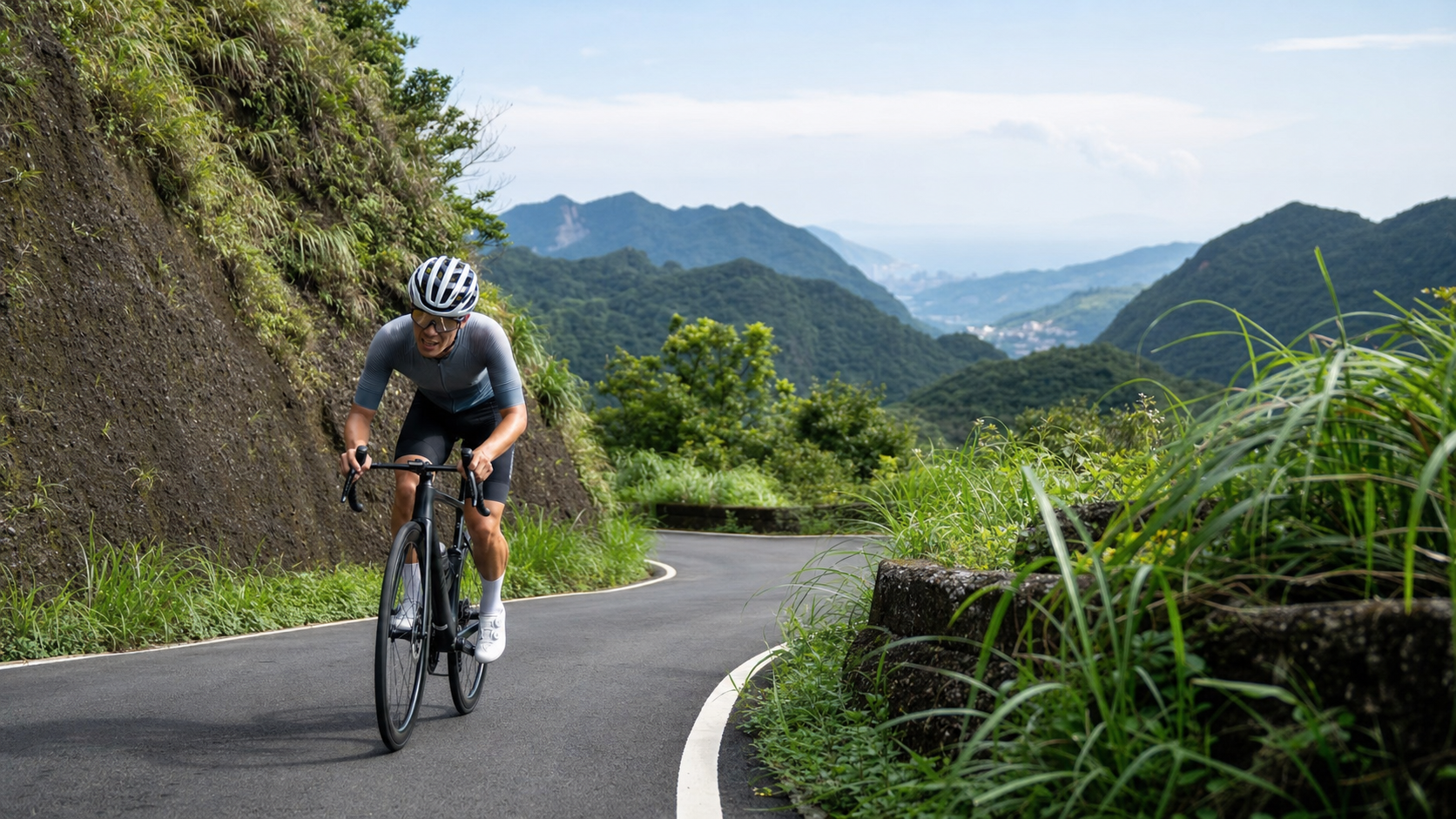
If Zhuzihu Road is a gentle rhythm lesson, then the upper section of Lingyun Road on Guanyin Mountain is a solid test of strength and willpower. In less than 5 kilometers, this route packs in over 400 meters of climbing, and behind the 6.2% average gradient lies the punch of numerous steep sections. This article takes a data-driven approach to break down every aspect of this route—from gradient distribution and gear selection to fueling and risk management—clarifying what this route means for riders of different levels.
Route Overview and Key Data
The upper section of Lingyun Road, commonly known as the Guanyin Mountain climbing route, spans 4.73 kilometers with a total elevation gain of 409.7 meters and an average gradient of 6.2%. It is located in Wugu District, New Taipei City. At first glance, the 6.2% average gradient already makes it significantly harder than the previously mentioned Zhuzihu Road (4.9% average), and it achieves this over a shorter distance (4.73 km vs. 5.16 km) while packing in more elevation gain (409.7 m vs. 253.6 m). This means that in terms of average climbing intensity per kilometer, the upper section of Lingyun Road is nearly 1.6 times harder than Zhuzihu Road.
From a geological perspective, Guanyin Mountain is a composite volcano terrain, formed by alternating layers of volcanic debris, tuff, and lava flows. This geological structure gives the mountain an especially rugged and three-dimensional profile, often revealing multi-layered, intersecting ridgelines when viewed from a distance—striking and clearly defined. One common misconception needs to be clarified here: Guanyin Mountain is not an independent mountain range but rather part of the westernmost end of the Datun Volcano Group, belonging to the same volcanic system as Datun Mountain and Qixing Mountain. It is only because of its relatively isolated and prominent geographic position (standing near the mouth of the Tamsui River) that many people mistakenly believe it is a standalone mountain range. The geological characteristics of this composite volcano terrain are directly reflected in the riding experience—gradient changes are more abrupt, and some sections feature sharp turns, requiring riders to constantly adjust their pedaling rhythm.
At 6.2% average gradient, this route falls into the “medium-to-high intensity” category on the spectrum of Taiwan’s climbing routes. In terms of power output, a rider with an FTP around 200 watts would need to sustain roughly 85-95% of FTP to maintain a steady climb on this gradient, noticeably heavier than the 75-85% required on Zhuzihu Road. This also means the upper section of Lingyun Road is better suited to riders who already have a solid climbing foundation and can handle higher intensity output. Beginners attempting it without adequate preparation risk significant slowdowns or even having to dismount and walk in the latter half.
Section-by-Section Strategy: Gradient Tactics from Start to Finish
Although the upper section of Lingyun Road is not long, the gradient distribution is far from uniform—it features distinct alternations between hard and easier stretches. Below, the route is conceptually divided into phases based on climbing rhythm; for actual mileage and turn locations, riders should rely on their own bike computer GPS readings.
Section 1 (Initial Observation Phase): With an overall average gradient of 6.2%, this route has virtually no true “warm-up gentle slope”—you feel the pressure of the gradient almost immediately from the start. In this phase, it is recommended to start at an intensity slightly higher than your usual warm-up (while still holding back some reserve), because Lingyun Road’s upper section gives you little breathing room. Rather than starting too conservatively and being forced to chase the pace later, it is better to push a steady output close to your target intensity from the beginning.
Section 2 (Core Steep Climb Phase): This is the most intense stretch of the entire route, and a large portion of that 6.2% average gradient comes from the consecutive steep pitches in this section. The key here is “don’t panic-shift”—when you see the gradient steepening noticeably, shift down to an appropriate gear well in advance, maintaining a cadence between 70-85 rpm, rather than waiting until you can no longer turn the pedals before making an emergency shift, which can put excessive strain on the chain or even cause it to skip. It is also advisable to deliberately slow and deepen your breathing in this section, avoiding the short, shallow breaths that gradient pressure can trigger, which compromise oxygen uptake efficiency.
Section 3 (Final Stretch Phase): Near the summit, the gradient may ease locally in places—a rare chance to catch your breath, but also where many riders let their guard down too much and are caught off guard by a final steep pitch. It is recommended that even on gentler sections, you do not completely ease off the power; instead, use them to regulate your breathing and heart rate, preparing for the possible steep finish. Because the elevation gain on Lingyun Road’s upper section is concentrated within a relatively short distance, there is virtually no true “rest zone” throughout the entire route—energy and pace management are the biggest keys to completing this climb.
Gear Ratio and Equipment Recommendations
With a 6.2% average gradient and pronounced steep sections, the upper section of Lingyun Road demands more from your gear setup than Zhuzihu Road. Here are the recommended configurations:
| Rider Level | Recommended Gear Setup | Notes |
|---|---|---|
| Advanced/Racing | 50/34 with 11-30 | Keep a wider low gear available for the steep sections |
| General Recreational Rider | 50/34 with 11-32 or 11-34 | Prioritize maintaining cadence to avoid excessive knee strain |
| Beginner/Returning from Injury | Compact crank with 11-34 or wider, or consider mountain bike wide-range gearing | This route is quite intense for beginners; be sure to leave ample low gears |
The short-distance, high-intensity nature of Lingyun Road’s upper section means riders can hardly rely on a “suffer first, enjoy later” strategy—it keeps you in a relatively high intensity zone almost the entire way. Therefore, it is better to gear one step easier than you think you need, avoiding the temptation to grind at an undesirably low cadence with too-heavy gears, which over time significantly increases the load on the knees (especially the patellar tendon and iliotibial band).
For tire pressure and wheel selection, since the climbing on this route is concentrated and the composite volcano terrain occasionally makes the road surface uneven, it is advisable to choose tires with a bit more cushioning and run slightly lower pressure to balance grip and comfort. If you plan to descend the same way, also make sure your braking system is in good condition beforehand, because speed control on the continuous steep descents places a higher load on the brakes than on typical routes.
Fueling and Hydration Strategy
Although the upper section of Lingyun Road is only 4.73 kilometers long, with a theoretical completion time of 15-30 minutes, the concentrated intensity and lack of recovery sections mean the actual physiological toll is no less than that of a longer route with moderate gradient.
Before the Ride: Given the overall high intensity, make sure you are well-rested and well-fed before setting out, avoiding attempts at this kind of short, high-intensity climb when your body has not fully recovered. The demands on muscular power and lactate tolerance are closer to the physiological load pattern of interval training than to long, gentle climbs.
During the Ride: Due to the short distance and high intensity, most riders do not need to eat during the climb, but hydration remains important. Make sure your bottle is full before starting; if the gradient is too steep to free a hand for drinking, use brief easier sections to take a sip, avoiding distractions on the steep pitches.
Post-Ride Recovery: After completing the climb, because the intensity of this route hovers near the anaerobic and lactate threshold zones, muscle soreness and fatigue will typically be more pronounced than on a gentle route of equal distance. It is recommended to include ample cool-down pedaling and stretching after finishing, along with adequate carbohydrate and protein intake to speed up muscle recovery.
Weather and Terrain Considerations
Guanyin Mountain faces the mouth of the Tamsui River, and on clear days the views are expansive. Many riders choose to tackle this route in the late afternoon, both to avoid the daytime heat and to enjoy the open river-mouth scenery after completing the climb. One note of caution: whether you can clearly see the sunset or specific views depends on the day’s weather, cloud cover, and air quality. It is best not to head out with the expectation of a “guaranteed sunset,” but rather to plan with the conservative mindset that “the views are open when the weather is good,” avoiding disappointment that could detract from the riding experience.
Due to the composite volcano terrain, some sections of the Guanyin Mountain area feature abrupt gradient and direction changes. Additionally, since Wugu District is near the mouth of the Tamsui River, winds can sometimes be stronger than on typical mountain routes, especially on open stretches where crosswinds are more noticeable. Extra caution is needed when handling the bike, particularly for lighter riders or those on deep-section wheels—when hit by strong crosswinds, it is advisable to moderate your speed and keep the handlebars steady.
Common Mistakes and DNF Risk Points
Mistake 1: Underestimating the physiological cost of short, high-intensity climbing. Many riders see “only 4.73 km” and let their guard down, overlooking the sustained high-intensity output demanded by an average gradient of 6.2%, leading to exhaustion midway through.
Mistake 2: Keeping the same gear ratios used on gentler routes. If a rider’s usual training routes are milder, directly using the same gearing to tackle the upper section of Lingyun Road can easily force them into grinding at extremely low cadence on steeper sections—a common cause of blown-up legs and even being forced to dismount and walk.
Mistake 3: Ignoring brake management on the descents. Continuous climbing means corresponding continuous descents. If significant energy has already been spent on the way up, reaction speed and brake modulation on the descent may be compromised. It is recommended to let heart rate and breathing settle slightly before starting the descent.
Mistake 4: Being unprepared for crosswinds and terrain transitions. As mentioned earlier, the Guanyin Mountain area features abrupt terrain transitions and potentially strong winds. Riders unfamiliar with handling or using unsuitable wheel setups are more prone to control errors in critical corners.
Target Time References for Riders of Different Levels
| Rider Level | Estimated Completion Time | Average Speed |
|---|---|---|
| Competitive (FTP above 4W/kg) | Approximately 13-16 minutes | Approximately 18-22km/h |
| Advanced recreational rider | Approximately 18-23 minutes | Approximately 12-16km/h |
| General fitness rider | Approximately 24-32 minutes | Approximately 9-12km/h |
| Beginner / rebuilding fitness | 32+ minutes, may require分段休息 depending on conditions | Below approximately 9km/h |
The 6.2% average gradient and concentrated elevation gain of the upper Lingyun Road section make it better suited as a “short-distance, high-intensity interval” training route rather than a venue for longer tempo work. If your goal is to improve anaerobic threshold or short-duration explosive power, the training benefits of this route are significant. However, if you are new to climbing, it is advisable to build a foundation on gentler routes before taking on this challenge.
Practical Heart Rate and Power Reference
The 6.2% average gradient and concentrated climbing profile of the upper Lingyun Road section make it an ideal short-distance test of “anaerobic tolerance” and “lactate threshold power.” For riders with a power meter, this route is well suited for a near-maximal 15-20 minute power test—because there is virtually no true recovery section, output must be sustained at or slightly above threshold power to maintain speed. This logic is completely different from long, gentle climbs where “finding a sustainable pace” is the goal.
For riders without a power meter, heart rate is a reasonable substitute, but be prepared: since this route enters the high-intensity zone from the very start, heart rate rises much faster than on gentler climbs, potentially approaching 90% of maximum within just a few minutes. In this situation, rather than fixating on the heart rate number and grinding through, it is better to rely on perceived exertion (RPE)—if the effort feels like “barely able to hold a conversation” and there is still a considerable distance to the summit, consider easing output slightly to avoid blowing up mid-climb.
Cadence management is especially critical on this route. With dense steep sections, cadence can easily drop to 60 rpm or lower without notice, sharply increasing the torque load on the thigh muscles—a primary cause of late-stage muscular failure and even cramping. Riders are advised to develop the habit of monitoring cadence data; once cadence consistently stays below 65 rpm for an extended period, downshifting should be considered. Even if it costs some speed, it is far better than grinding until the muscles completely shut down.
Group Riding vs. Solo Riding Strategy Differences
Because the upper Lingyun Road section is intense and offers almost no breathing room, the group will split much faster and more visibly on this route than on gentler climbs when fitness levels differ. If the group has significant ability gaps, it is recommended to discuss regrouping points before starting—typically at a flatter section or near the summit—so stronger riders have a chance to wait, preventing weaker riders from struggling alone on the steep sections without psychological support.
For riders looking to improve their climbing ability on this route, repeated solo efforts are a more efficient approach. Given the short distance and concentrated intensity, it is well suited for interval sessions of “two to three ascents with full recovery between efforts.” On the first ascent, use 70-80% effort to get a feel for the road and the rhythm of gradient changes; on the second, attempt to raise intensity and record power or heart rate data; the third can serve as a test of recovery status and sustained output stability. For riders preparing for longer, steeper climbing events, this type of repeated training is a highly efficient investment.
Extended Equipment Checklist Recommendations
Brake system check: The upper Lingyun Road section is steep; whether stopping temporarily on the climb or descending afterward, brake reliability is critical. Before riding, check brake pad wear and, for hydraulic disc brakes, confirm fluid levels and function to avoid dangerous brake fade or failure.
Reserve low gearing: As noted, this route demands more from your gearing than typical gentler climbs. Even if you consider yourself fit, it is better to have one extra low gear in reserve—the actual feel of steep local pitches is often more oppressive than the numbers on paper suggest.
Weight considerations: On a short, high-intensity climb, bike weight has a disproportionately larger impact on overall performance than on longer routes. If there is an opportunity to adjust equipment (e.g., avoiding unnecessary carried weight), it will yield tangible performance benefits on this type of route.
Aerodynamics and crosswind response: The Guanyin Mountain area is near the Tamsui River estuary, and winds can be noticeable at times. If using deep-section wheels, assess the day’s wind conditions before deciding whether to switch to lower-profile, more crosswind-stable wheels.
Difficulty Comparison with Other New Taipei Mountain Routes
Placing the upper Lingyun Road section within the spectrum of climbing routes around New Taipei City, its 6.2% average gradient and concentrated climbing profile make it a representative short-distance route of medium-high intensity. Compared with the mid-distance, gentler climbs of the Yangmingshan area, the upper Lingyun Road section is closer in nature to “interval training” than “tempo training”—short ride time, but with more concentrated intensity and closer to limit output.
For riders planning a training cycle, pairing the upper Lingyun Road section with longer, gentler climbs is recommended—for example, one high-intensity interval session on Lingyun Road per week, combined with another long, gentle tempo ride, forming a complementary training combination that develops both anaerobic threshold and long-duration aerobic endurance. This training logic is also a common approach many coaches recommend to amateur riders when planning periodized training.
Recovery and Follow-up Arrangements
After completing the upper Lingyun Road climb, recovery requires more careful attention than after gentler routes. Because the intensity is concentrated around anaerobic and lactate threshold levels, the concentration of accumulated metabolic waste in the muscles will be noticeably higher than after a long, gentle climb. It is recommended to maintain at least 5-10 minutes of easy spinning after finishing, allowing heart rate and breathing to gradually settle, and avoiding an immediate stop that could impede venous return.
If the day’s plan includes only this climb and you will descend the same way, pay special attention to the early descent—legs that have just completed a high-intensity climb may not respond or modulate force as well as usual, and the Guanyin Mountain area has abrupt terrain transitions. Allow your body to return to a relatively stable state before descending, rather than immediately charging downhill at high speed after the summit sprint.
For nutrition, the golden recovery window after riding the upper Lingyun Road section is likewise within 30 minutes post-ride: consume moderate carbohydrates with protein to accelerate muscle glycogen replenishment and micro-damage repair. Given the higher intensity of this route, muscle soreness may appear earlier and be more pronounced than after gentler climbs. Plan appropriate stretching after the ride, particularly targeting the quadriceps and calf muscles, to reduce the severity of delayed onset muscle soreness (DOMS) the next day.
Frequently Asked Questions for Beginners
Q: I have no climbing experience at all. Can I directly challenge the upper section of Lingyun Road?
Not recommended. With an average gradient of 6.2%, concentrated elevation gain, and almost no recovery sections, the intensity is too high for beginners with no climbing foundation, which can easily lead to frustration or even injury. It is recommended to first build foundational strength and climbing experience on routes with gentler gradients and longer distances (such as routes with an average gradient below 5% like Zhuzihu Road), then come back to challenge the upper section of Lingyun Road.
Q: What level of fitness is considered a reasonable challenge for this route?
For riders who can ride continuously for more than one hour and have a regular habit of climbing training, challenging the upper section of Lingyun Road would be a reasonable and beneficial training choice. If your usual training is mainly on flat roads, it is recommended to accumulate at least one to two months of climbing training experience before taking on the challenge.
Q: What time of day is ideal for riding this route?
Considering temperature and wind conditions, early morning or evening hours are usually more ideal, as they avoid the additional physiological burden caused by daytime heat. Riders heading out in the evening can also enjoy the open view toward the Tamsui River estuary after completing the climb, provided the weather is good. However, as mentioned earlier, the actual visibility will still be affected by the day’s weather, so it is recommended to keep a flexible mindset when planning your trip.
Conclusion: A Short, Hard Climb for Testing Your Mettle
The upper section of Lingyun Road packs over 400 meters of solid elevation gain with an average gradient of 6.2% in less than 5 kilometers, making it one of the most representative training routes in Wugu District. It is unforgiving, with almost no true recovery sections, yet precisely for this reason it serves as an excellent benchmark for testing a rider’s climbing ability and training short-duration, high-intensity power output. Before preparing to challenge this route, be sure to honestly assess your fitness and gear ratio setup, approach it with a conservative and steady strategy, and pair it with adequate recovery and nutrition planning. Only then can you truly enjoy the sense of accomplishment from completing this hardcore route and turn this training experience into a solid foundation for future challenges on longer and tougher climbs.
Related Reading
- Lingyun Temple and Yinghan Ridge: A Climbing Route Where a Century of Faith Meets the Tamsui River Estuary
- Zhuzihu Road Practical Guide: 5.16 km, 253.6 m of Elevation Gain, a Pacing Lesson on a Yangmingshan Valley Climb
- Lushan Yunlong Bridge to Provincial Highway 14 Finish at 12.23K Practical Guide: Pacing Discipline and Gear Ratio Breakdown on a 4.4% Average Gradient
- Yueshan Park Route Climbing Guide: Data Analysis of a Short, Steep 4.84 km Climb at 7.8% Average Gradient
台北闊瀨陡坡 騎旅 / 日本單車雜誌編輯車友臨時加入!/ 髮香才是最強的 / feat. 北迴歸線小隊 / 公路車 CT Yeh
6 個月前
萬年峽谷! 30% 超激陡坡 里佳部落DAY2 還是很硬! | 公路車 | CT Yeh
3 年前
半日 小台灣 極限單車路線挑戰實錄
7 年前
單車 梅山36灣 坡度介紹 路段介紹 空拍 (相關遊記影片,請參考說明或我的頻道喔,歡迎訂閱)
6 年前
觀霧 變好騎了! | 北高車友爆笑大會師 | 公路車 | 單車旅遊 Taiwan Cycling Route GuanWu
6 年前
大武山後門26%歡樂陡坡!JJSC南台灣單車行Day2 / 被颱風追著跑 / 公路車 / CT Yeh
2 年前
#公路車 #西進武嶺 配速配瓦實驗 坡度分析 四小時內攻略 建大盃 NeverStop #西進武嶺攻略
6 年前
嘉義單車路線推薦:碧湖山茶園超陡坡挑戰!里佳部落-奮起湖-瑞峰 (附路線)
7 個月前