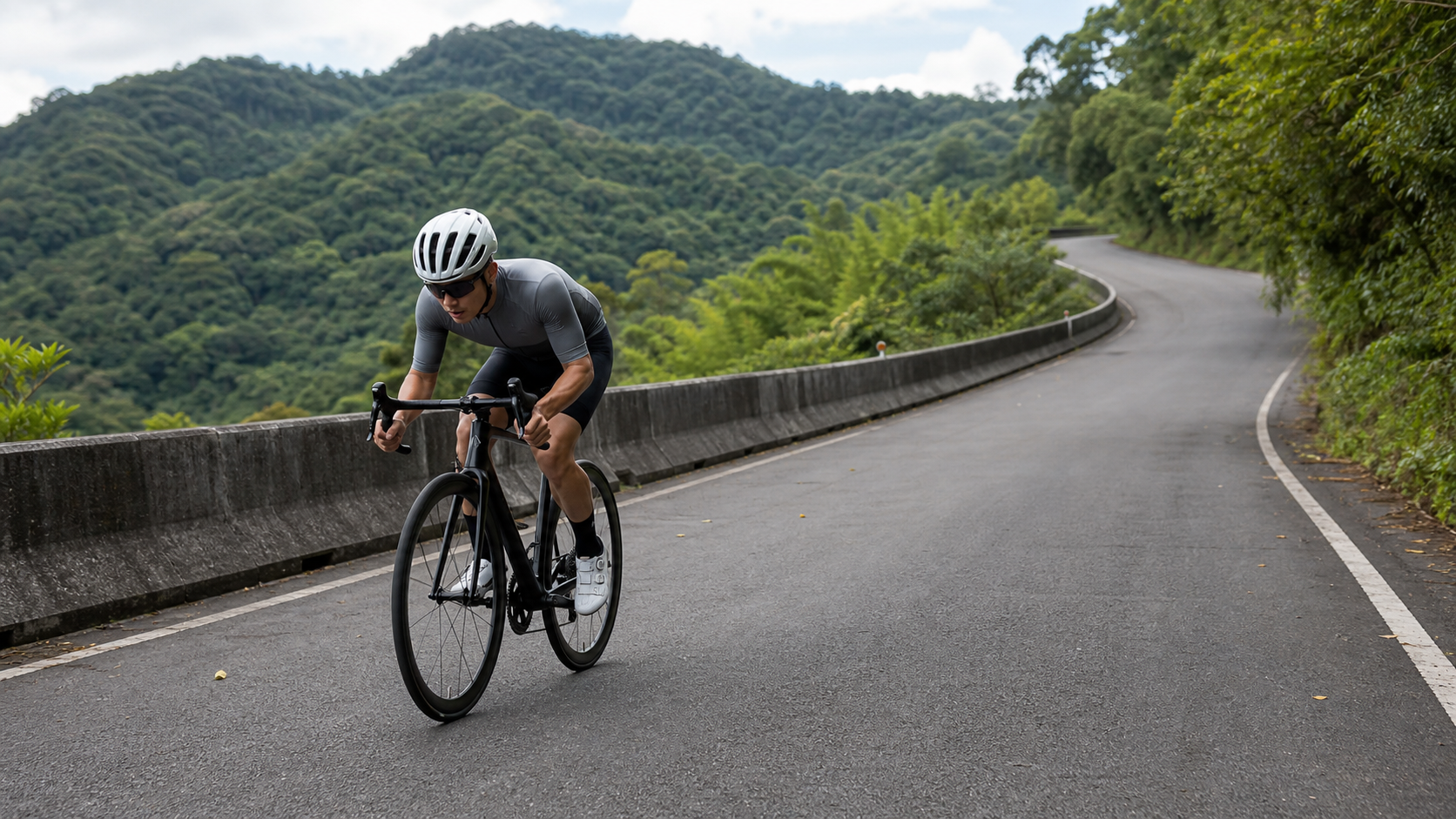
Buddha World-TT Practical Guide: A 7.3km Time Trial Course for Taoyuan Riders
Summary: Buddha World-TT is a well-known Time Trial (TT) segment located in Guanxi Township, Hsinchu County. Spanning 7.3 kilometers with an average gradient of 4.9%, it is a mountain road frequently tackled by Taoyuan riders during weekend extra training sessions. This article breaks down the route’s gradient characteristics, TT pacing strategies, and gear ratio recommendations to help riders conquer this course in the most efficient way.
“Buddha World-TT,” as the name suggests, is a segment classified by the cycling community as a Time Trial (TT) course, with its finish point located near “Buddha World,” a Buddhist-themed park in Guanxi Township, Hsinchu County. Spanning 7.3 kilometers with an average gradient of 4.9%, it is a well-known testing ground for riders in the Taoyuan-Hsinchu area, featured in segment records on Strava and various cycling communities. It should be noted that the “TT” designation in the route name indicates that the cycling community generally treats it as a standard segment for time trial challenges—meaning riders typically push at near-maximal effort from start to finish, pursuing the shortest completion time, rather than adopting a conservative pace like on typical long-distance climbing routes.
To be transparent, the route’s current recorded elevation gain data shows zero, which usually means the climbing data has not been fully recorded or archived, rather than indicating the route has no elevation gain. Based on the 7.3-kilometer distance and 4.9% average gradient, the theoretical elevation gain is approximately 358 meters. Riders can use this estimate as a reference baseline when planning their physical effort and nutrition strategy, but it is recommended to rely on actual on-site conditions and real-time data from personal cycling devices for the actual climbing situation.
Route Overview and Real Data Analysis
Let’s start with the known hard data. Buddha World-TT spans 7.3 kilometers with an average gradient of 4.9%, classified as moderate difficulty (Category 3). Based on distance and average gradient, the theoretical total elevation gain is approximately 358 meters, making it a short-to-medium distance climb with a moderately hard gradient—well suited as a time trial course for a single all-out effort challenge.
| Item | Data |
|---|---|
| Total Distance | 7.3 km |
| Average Gradient | 4.9% |
| Theoretical Elevation Gain Estimate | Approx. 358 m (calculated from distance × average gradient; actual figures depend on on-site and personal device records) |
| Classification | Category 3 (moderate difficulty) |
| Route Nature | Time Trial (TT) segment; riders often challenge it with all-out efforts |
| Location | Guanxi Township, Hsinchu County, around the Buddha World park |
At 4.9% average gradient, this route is steeper than the previously introduced Yangjin Highway Xiaoyoukeng section (4.4%) or Machao section (4.3%). Combined with the cycling community’s general practice of treating this route as a time trial challenge, the overall intensity is higher than typical cruising climbs. This “explicitly designated as a TT segment” characteristic also means Buddha World-TT is particularly suitable for testing your threshold power and short-duration high-intensity output capability.
Section-by-Section Guide: Start Sprint and Rhythm Building (0-2.5 km)
As a segment designated for TT purposes, the pacing strategy at Buddha World differs completely from a typical recreational climb. In the first 2.5 kilometers after the start, it is recommended to quickly establish a steady and aggressive pedaling rhythm, keeping power output at approximately 95-100% of threshold power, with heart rate rapidly rising to the 85-90% zone of maximum heart rate. Since the total challenge time is estimated at only 15-25 minutes (depending on fitness level), this relatively aggressive opening strategy is what fully realizes the efficiency-and-speed spirit of a TT segment.
For gear ratio configuration, it is recommended to adjust flexibly based on the gradient of the early section. If the early part is relatively gentle, you can maintain a heavier gear with a higher cadence to produce high power output; if noticeable gradients appear early on, you should immediately shift to a lighter gear suitable for climbing, avoiding wasted energy and time from poor gear selection.
Section-by-Section Guide: Mid-Section Core Climb and Breathing Control (2.5-5 km)
The middle section, from 2.5 to 5 kilometers, is typically the core interval where the gradient is most demanding along the entire route. The 4.9% average gradient figure means instantaneous gradients here often exceed 6-7%. For riders employing a TT pacing strategy who have already expended considerable energy in the early section, this stretch is a dual test of willpower and energy management. It is recommended to maintain output near threshold power, allowing brief surges but not sustained overexertion, to avoid prematurely depleting the anaerobic energy system and completely running out of steam in the later section.
Breathing control is especially critical at this stage. It is recommended to adopt a fixed breathing rhythm (e.g., two pedal strokes per inhale and two per exhale), combined with core stability and upper-body relaxation to reduce unnecessary energy loss. Because this is a time trial challenge segment, many riders experience overexertion and erratic breathing here, which ironically reduces efficiency. It is advisable to stay rational and use data (power, heart rate) rather than sheer willpower to guide pacing decisions.
Section-by-Section Guide: Sprint Finish and the Endpoint (5-7.3 km)
The final 2.3 kilometers are the decisive stage that determines the success of the entire TT challenge. If pacing was well managed in the early and middle sections, you should still have some energy reserve for a sprint here; however, if you pushed too hard early on, this stretch often becomes the most painful struggle. It is recommended to make rational judgments based on your current perceived exertion and power readings—if you have ample reserve, you can begin gradually increasing output around the last 1 kilometer to pursue a better finish time; if you are clearly exhausted, you should moderately ease off the pace to avoid cramping or physical discomfort and safely complete the entire challenge.
After reaching the finish point near Buddha World, it is recommended to cool down with at least 5-10 minutes of easy riding or stretching to allow heart rate and breathing to gradually stabilize, avoiding discomfort from stopping immediately after intense exercise. Since Buddha World is a well-known religious and cultural park, if time permits, you can also visit and appreciate this unique space that blends Buddhist architectural art with natural landscapes.
Gear Ratio and Equipment Recommendations
Since Buddha World-TT is a high-intensity time trial segment, gear ratio configuration should prioritize efficiency. Road bikes with a compact crankset (50/34T) paired with an 11-25T or 11-28T cassette are recommended, with the cassette range adjusted based on individual climbing ability. Advanced riders pursuing the best times can even consider a tighter cassette configuration (such as 11-23T), completing the challenge with higher pedaling efficiency; general riders, on the other hand, are advised to choose a cassette with a wider range to ensure sufficient leeway to maintain a stable cadence on the steeper core section.
Since this is a short-duration, high-intensity challenge segment, tire pressure and wheelset selection can lean slightly toward road feel feedback and rolling efficiency. A mid-profile wheelset paired with 25C tires and slightly higher tire pressure than recreational riding settings can provide more direct pedaling feedback through gradient changes.
Nutrition, Hydration, and Weather/Season Considerations
Because Buddha World-TT is only 7.3 kilometers in total with an estimated completion time of 20-30 minutes, nutrition needs are relatively simple. Ensuring adequate hydration before departure is sufficient; no mid-ride refueling is necessary. Summer weather in the Taoyuan-Hsinchu area is hot and humid, and even short-duration high-intensity riding can lead to electrolyte imbalance from heavy sweating. It is recommended to pay attention to fluid and electrolyte replenishment before and after the ride.
Due to the terrain around Guanxi, Hsinchu, the area is prone to the influence of the “Hsinchu wind.” Especially during autumn and winter when the northeast monsoon strengthens, wind speeds in the mountainous area can increase noticeably, adding extra impact on riding stability and perceived exertion. It is recommended to check the day’s wind forecast and carefully assess whether conditions are suitable for an all-out TT sprint challenge on strong-wind days.
Common Mistakes and DNF Risks
The most common mistake on Buddha World-TT is starting too aggressively, leading to a loss of steam in the mid-section core climb. Because this is a time trial challenge segment, many riders are driven by a “go fast” mentality and overlook proper pacing distribution. It is recommended that even for an all-out TT challenge, you should have a basic understanding of your threshold power and determine pacing strategy based on physiological data rather than sheer willpower.
Another common issue is underestimating the impact of the Hsinchu wind on riding. The strong wind characteristics of the Taoyuan-Hsinchu area are well known. If you ride into a headwind while still expecting the same pacing as in calm conditions, the extra aerodynamic drag can cause premature energy depletion. It is recommended to flexibly adjust your expected target time based on the day’s wind conditions.
Target Time Reference for Riders of Different Levels
| Rider Level | Estimated Finish Time | Average Power Reference (% of FTP) |
|---|---|---|
| Advanced / Race Level | 15-19 minutes | FTP 100-110% |
| Intermediate / Regular Training | 20-26 minutes | FTP 85-95% |
| General Recreational Rider | 27-35 minutes | FTP 70-80% |
| Beginner / First Attempt | 35+ minutes | Pace by feel |
Training Application: A Bonus Training Segment for Taoyuan Riders
Buddha World-TT is particularly well-known among Taoyuan cycling circles due to its location and intensity profile. Weekend group rides for Taoyuan riders frequently pass through the Guanxi area of Hsinchu. Because of its moderate distance and well-defined intensity, Buddha World-TT is often arranged by teams as a “bonus challenge” beyond the main itinerary—after completing the day’s scheduled cruising ride, riders take on an additional all-out effort up Buddha World-TT, capping off the entire ride with a full-power sprint. This accumulates threshold-intensity training volume while also testing one’s true fitness level under a state of accumulated fatigue.
This “long ride first, sprint later” training combination closely mirrors real road race scenarios—riders often need to retain the ability to sprint or attack climbs even after fatigue has built up from hours in the saddle. Placing Buddha World-TT after the scheduled route as a bonus challenge allows for a more realistic simulation of energy management demands in race situations, and is a training philosophy endorsed by many coaches in the Taoyuan-Hsinchu region.
In summary, Buddha World-TT, with its moderate distance, solid gradient, and clearly defined TT segment positioning, has become an important benchmark for riders in the Taoyuan-Hsinchu area to assess their own capabilities. Whether tackling it solo in pursuit of a personal best, or using it as a bonus test after a long ride, this route delivers just the right amount of intensity and training value.
Standardized Protocol Recommendations for Power-Based Time Trials
For riders who wish to use Buddha World-TT as a fixed test segment for long-term progress tracking, it is recommended to establish a standardized testing protocol to ensure data comparability across sessions. First is consistency in the warm-up routine—before each test, perform at least 15-20 minutes of progressive warm-up, including low-intensity spinning combined with 2-3 short high-intensity surges, to bring the body into a state close to threshold effort in advance. This avoids inaccurate data or increased injury risk from going all-out from a cold state.
Second is recording environmental conditions, including temperature, wind speed and direction, and road surface wetness. These variables should be logged as important reference context for future data comparisons. After all, a time completed under strong headwinds will differ noticeably from one completed in calm or tailwind conditions, even with similar power output. Without factoring in environmental variables, it is easy to misjudge one’s actual rate of improvement.
Finally, it is recommended to use a power meter or at least a heart rate monitor during the test. Relying solely on elapsed time from the bike computer, while intuitive, cannot reflect the actual physiological load the body endures. Especially in outdoor tests where environmental conditions vary considerably, power and heart rate data provide a more objective and more valuable basis for measuring progress.
Extended Riding Around the Buddha World Road Network
The Guanxi area of Hsinchu, where Buddha World is located, offers a number of surrounding country roads and mountain routes worth exploring, making it possible to incorporate the TT challenge into a more complete full-day ride. The rural roads within Guanxi Township feature rolling terrain with rich gradient variation. After completing the core Buddha World-TT challenge, riders can continue exploring the surrounding secondary roads to experience the pastoral scenery and rolling hills characteristic of this Hakka township.
For advanced riders familiar with the Hsinchu mountain road network, it is also worth considering linking Buddha World-TT with other well-known climbs in the Jianshi and Guanxi area (such as the Bashan Mountain ITT and Yulao, introduced later in this series) to design a single training tour covering multiple gradient intensities across the Taoyuan-Hsinchu mountain region. This route-combination approach maximizes the training value of a single outing while allowing riders to experience the rich and varied terrain resources of the Hsinchu mountains more comprehensively.
Application in Team Time Trial (TTT) Scenarios
Beyond individual time trial challenges, Buddha World-TT is also suitable as a venue for Team Time Trial (TTT) tactical drills, thanks to its moderate gradient and relatively straightforward road conditions. Teams can use this route to practice rotating pulls, pacing and windbreak rhythm control, and how to accommodate fitness differences among teammates while maintaining overall pacing efficiency. This team-oriented training application extends the value of Buddha World-TT beyond individual intensity testing into the realm of team tactical rehearsal—particularly meaningful for teams preparing for category-based time trial events or team challenge races.
Advanced Equipment Considerations: TT Bike vs. Road Bike
For seasoned riders who treat Buddha World-TT as an important performance benchmark and pursue maximum efficiency, the question arises of whether to use a dedicated TT bike to tackle this segment. TT bikes, with their aerodynamic design and low-profile riding position, effectively reduce wind resistance and offer clear speed advantages on flat or gently sloping sections. However, on steeper sections where frequent position adjustments are needed to respond to terrain changes, the handling agility of a TT bike is inferior to that of a standard road bike.
Given Buddha World-TT’s average gradient of 4.9% and mid-section gradients that may reach 6-7%, unless the core climbing sections are relatively gentle and road conditions are stable, most riders are still advised to use a standard road bike with aerodynamic accessories (such as an aero helmet and tight-fitting jersey) to challenge this route—this offers a more balanced choice between efficiency and handling. Riders who genuinely wish to test a TT bike in real conditions should practice the low-profile position and gradient adaptation on flatter sections beforehand, to avoid compromising overall performance due to unfamiliarity with the equipment.
Mental Toughness: Pain Management on All-Out Climbing Segments
TT-style challenge segments place high demands on mental toughness, as there is almost no room for recovery or conservative pacing throughout the effort. Riders must sustain intensity at or even above their personal threshold, and the continuous physical discomfort must be managed through psychological techniques. Before the ride, it is recommended to use visualization exercises—mentally simulating the gradient changes and pacing rhythm of the entire route in advance—so that both body and mind are psychologically prepared for the level of pain ahead before the official attempt begins, reducing the additional mental burden caused by fear of the unknown during the actual ride.
During the ride, short and forceful self-talk (such as repeating a fixed motivational phrase) can help, or breaking the route down into smaller mental milestones, overcoming them one by one rather than thinking about the entire 7.3-kilometer distance all at once. Many veteran time trialists will tell you that the ultimate determinant of performance is often not who has the higher VO2max, but who can maintain steady, rational pacing decisions when pain arrives.
Positioning Within Season Planning: A Regular Threshold Power Testing Station
When incorporating Buddha World-TT into season training planning, it is recommended to position it as a regular threshold power testing station, scheduling an all-out attempt every 4 to 8 weeks, with detailed recording of power, heart rate, finish time, and environmental conditions. Through the long-term accumulated data curve, one can more objectively track fitness trends across different training cycle phases, adjust training intensity and recovery arrangements in a timely manner, and ensure the overall training plan progresses in the right direction.
This approach of tightly integrating a specific segment with periodized training makes Buddha World-TT more than just a route for people to challenge and break records—it becomes an important tool for many Taoyuan-Hsinchu riders to track their long-term improvement trajectory and verify training effectiveness. This is also the fundamental reason why this route, despite its modest length, has accumulated deep training significance and emotional value in the minds of local riders.
Common Equipment Checks and Pre-Ride Preparation Checklist
Before an all-out TT-style challenge, equipment reliability is especially critical—under high-intensity output, any equipment failure can directly impact performance or even create safety risks. Before departure, confirm that the drivetrain shifts responsively, braking performance is normal, tire pressure matches the day’s road conditions and rider weight, and check that quick releases or thru-axles are properly secured. Carry basic puncture repair tools and CO2 cartridges—even for a short challenge, you should be capable of independently handling unexpected mechanical issues.
For clothing, choose a tight-fitting aerodynamic jersey to reduce unnecessary drag. If weather permits, consider skipping a windbreaker and riding in just the jersey to further lower air resistance. For helmets, select a model that balances ventilation and aerodynamics, ensuring adequate head cooling under high-intensity output without sacrificing too much aerodynamic performance.
The Community Culture and Healthy Competition of a Race-Oriented Route
The Buddha World-TT has gradually fostered a culture of healthy competition within the cycling community of Taoyuan and Hsinchu. Many teams regularly share their latest results on community platforms, motivating one another and progressing together. This interactive model—tinged with a competitive edge yet filled with camaraderie—has added a significant layer of community connection and belonging to what was once a simple training route. For newcomers just getting into road cycling and still exploring the boundaries of their own abilities, observing and participating in this community interaction is also an effective way to quickly understand where they stand among their peers and to set reasonable training goals. At the same time, they can gain valuable real-world experience and reference points from other riders’ pacing insights and equipment choices, gradually building their own training methodology that is backed by verifiable data. This makes every attempt at the Buddha World-TT a concrete testament to steadily accumulated strength, and ensures that this route continues to hold an irreplaceable place on the training map of Taoyuan and Hsinchu riders. It remains a fixed battleground worth revisiting and surpassing each season, witnessing the genuine growth trajectory of every rider from novice to expert, built step by step. It also serves as a constant reminder to all who visit that only disciplined data habits and an honest approach to one’s own training are the most reliable and solid paths to improvement.
Related Reading
- The Bell and the Sound of Gears at Buddha World: A Time Trial as Spiritual Practice on the Guansi Mountain Road
- Flat TT Time Trial Training Plan: The Dual Discipline of FTP and Aerodynamics
- The Complete Cycling Time Trial (TT) Race Preparation Guide: Position Wind Tunnel, Pacing Strategy, and Equipment Selection
- Time Trial-Specific Training: Building Your Personal Fastest TT Performance
台北闊瀨陡坡 騎旅 / 日本單車雜誌編輯車友臨時加入!/ 髮香才是最強的 / feat. 北迴歸線小隊 / 公路車 CT Yeh
6 個月前
#公路車 台北 #風櫃嘴 23:47 全台單車實境請訂閱鎖定
7 年前
西進武嶺 8000名單車友數據分析 PART1 | 從新手到高手數量/瓦數/推力比/FTP推力比/功率計使用率 大解析 | 公路車 | CTYeh
5 年前
半日 小台灣 極限單車路線挑戰實錄
7 年前
微雨戰! 2022桃園市長盃錦標賽 無敵交管 沒來玩太可惜了! 羅馬公路太可怕 差點成佛! 公路車 | CT Yeh
4 年前
備戰 戀戀197 賽前關門點分析 西濱團練 #公路車 4K高畫質
6 年前
風櫃嘴時間 預測西進武嶺時間?13000名車友統計數據分析告訴你 !
5 年前
2024 如來神掌 百人約騎挑戰!feat. 秘境單車社團 / 神人們太可怕 / 全程錄影 x 完整坡度解析 / 公路車 / CT Yeh
2 年前