The Complete Guide to Wireless Electronic Shifting Battery Management: SRAM AXS, Shimano Di2, and Campagnolo EPS Maintenance
文章導覽
The Complete Guide to Wireless Electronic Shifting Battery Management: SRAM AXS, Shimano Di2, and Campagnolo EPS Maintenance
Electronic shifting has moved from a pro-only luxury to everyday gear for many amateur riders. Unlike mechanical shifting, however, electronic systems add one more thing you need to keep an eye on — battery management. Running out of juice mid-ride and losing the ability to shift is no laughing matter.
Comparing the Battery Architecture of the Three Major Systems
SRAM AXS Series
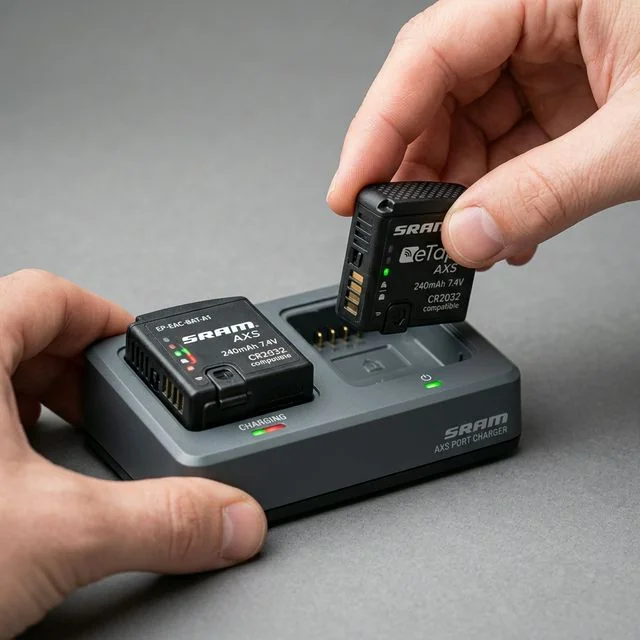
SRAM’s wireless electronic shifting uses a fully wireless architecture, with the front and rear derailleurs each operating independently with no wiring between them at all.
Battery configuration:
- Front derailleur: independent, removable battery (a rechargeable version of the CR2032-style coin cell format)
- Rear derailleur: independent, removable rechargeable battery
- Battery model: SRAM eTap Battery (interchangeable between front and rear)
- Spare battery strategy: front and rear batteries are interchangeable and can be shared in an emergency
Range:
- A single battery lasts roughly 60 hours of riding time (about 1,000–1,500 km)
- Charging takes about 45 minutes (from 0 to 100%)
- Battery lifespan is about 2 years (roughly 500 charge/discharge cycles)
Shimano Di2 Series
Shimano Di2 originally used a wired architecture. The latest 12-speed Dura-Ace R9200 and Ultegra R8100 groupsets have since switched to a semi-wireless design.
Battery configuration:
- 12-speed system: battery built into the front and rear derailleurs (non-removable)
- 11-speed system (older): a single central battery (internal DN-300 or external SM-BTR2)
- Charging method: magnetic charging cable connects to the rear derailleur
Range:
- The 12-speed system covers over 1,000 km of riding
- The 11-speed system’s central battery covers roughly 1,500–2,000 km
- Charging takes about 1.5 hours
- Battery lifespan theoretically exceeds 3 years
Campagnolo EPS Series
Campagnolo’s EPS system uses a wired architecture paired with a central battery.
Battery configuration:
- A central rechargeable battery, mounted inside the seatpost or frame
- Front and rear derailleurs connect to the central battery via wiring
- Charging method: a dedicated charging dock
Range:
- About 1,500 km or more
- Charging takes about 2 hours
- Battery lifespan is about 3–5 years
Battery Specification Summary
| Item | SRAM AXS | Shimano Di2 12s | Campagnolo EPS |
|---|---|---|---|
| Architecture | Fully wireless | Semi-wireless | Wired |
| Number of batteries | 2 (one front, one rear) | 2 (built-in) | 1 (central) |
| Removable | Yes | No | No (tools required) |
| Range | ~1,200 km | ~1,000 km | ~1,500 km |
| Charging time | 45 minutes | 1.5 hours | 2 hours |
| Battery interchangeable | Front/rear interchangeable | No | Not applicable |
| Replacement cost | NT$1,500/unit | Requires service center | Requires service center |
Best Practices for Everyday Battery Management
Charging Habits
Recommended practices:
- Don’t charge after every single ride: lithium batteries have a limited number of charge/discharge cycles, and frequent charging accelerates aging
- Charge when the battery drops to 20–30%: this is the ideal charging point for lithium batteries
- Don’t leave the battery sitting at 100% for long periods: if you won’t be riding for the next few days, charging to 70–80% is enough
- Avoid complete discharge: charge immediately once the level drops below 5% — deep discharge does the most damage to battery lifespan
SRAM AXS-specific tips:
- Carry a third spare battery for long-distance rides
- If front and rear battery levels get out of sync, you can swap them to balance usage
- If you won’t be riding for an extended period, remove the batteries from the derailleurs for storage
Shimano Di2-specific tips:
- Make it a habit to check battery level via the E-Tube app before heading out
- The 12-speed system’s magnetic charging cable — make sure it’s disconnected before you ride
- Cold winter temperatures affect battery performance, so ensure a full charge before setting out
Temperature Management
Lithium batteries are highly sensitive to temperature:
- Optimal operating temperature: 15–25°C
- Acceptable range: 0–45°C
- High-temperature risk: temperatures above 45°C can cause permanent damage — avoid prolonged exposure to direct sun
- Low-temperature impact: below 0°C, battery capacity drops noticeably, and range can decrease by 30–50%
Practical tips:
- In summer, don’t leave your bike in a closed car — interior temperatures can exceed 60°C
- In winter, let the derailleur warm up to room temperature before heading out
- For long-distance transport, SRAM AXS batteries can be removed and stored separately
Firmware Updates
Firmware updates for electronic shifting systems frequently include battery management optimizations:
- SRAM AXS: update via the SRAM AXS app (iOS/Android)
- Shimano Di2: update via E-Tube Project (computer) or E-Tube Ride (mobile)
- Campagnolo EPS: update via the MyCampy app
We recommend checking for firmware updates every 2–3 months — this can optimize battery performance and may also fix shifting logic or add new features.
Assessing Battery Aging and Replacement Timing
Signs of Aging
The following signs suggest your battery may need replacing:
- Noticeably shorter range on a full charge: if it used to last 60 hours and now only lasts 30
- Abnormally fast charging: this can indicate reduced battery capacity
- Erratic battery level readings: the display jumps from 50% straight down to 10%
- Sharply worse performance in cold weather: a naturally aging battery degrades more noticeably in low temperatures
- Slower shift response: insufficient voltage can cause sluggish motor movement
Replacement Process
SRAM AXS: the simplest — just buy a new battery and swap it in. Please recycle the old battery responsibly rather than throwing it away.
Shimano Di2 12-speed: the battery is built into the derailleur, so it needs to be sent to an authorized dealer for service. The cost is higher, but it’s covered under manufacturer warranty.
Campagnolo EPS: the central battery must be replaced by an authorized technician, and it’s a good idea to have the overall wiring checked at the same time.
Battery Planning for Long-Distance Rides
Battery management strategy for long-distance rides (round-island trips, multi-day events, etc.):
Before Departure
- Charge all batteries to 100%
- SRAM users should carry a spare battery
- Bring a charger and a power bank
During the Ride
- Regularly check battery level via your bike computer or app
- SRAM gives an LED warning when the battery drops below 25%
- Shimano displays the battery percentage on your bike computer
- Avoid unnecessary, frequent shifting (especially on the front derailleur)
At the End of Each Day
- Check the battery status
- If it’s below 50%, charge it at your accommodation
- SRAM users can charge the front and rear batteries on alternating days
Frequently Asked Questions
Q: Can I still ride if my electronic derailleur runs out of battery?
A: Yes, you can still ride, but you won’t be able to shift — the bike will stay locked in whatever gear it was last in. Both SRAM and Shimano are designed to prioritize keeping the rear derailleur powered when the battery is critically low.
Q: Can I charge with a power bank?
A: Yes. SRAM AXS’s charging dock accepts USB input, so it works with a power bank. Shimano Di2’s magnetic charging cable also supports USB input.
Q: Can I bring the batteries on a plane?
A: Yes. The battery capacity in bicycle electronic shifting systems is far below airline restrictions (generally under 100Wh can be carried on board).
Put these battery management tips to good use, and your electronic shifting system will keep delivering precise, smooth shifting performance for the long run.
Related Reading
- Electronic Shifting Battery Lifespan and Charging Management: Di2 vs eTap vs EPS
- Maintaining Electronic Shifting Systems: Key Points on Battery Management and Firmware Updates
- Electronic Shifting System Maintenance: Daily Care for Di2 and AXS
- The Big Three of Electronic Shifting: Shimano Di2, Campagnolo EPS, SRAM AXS