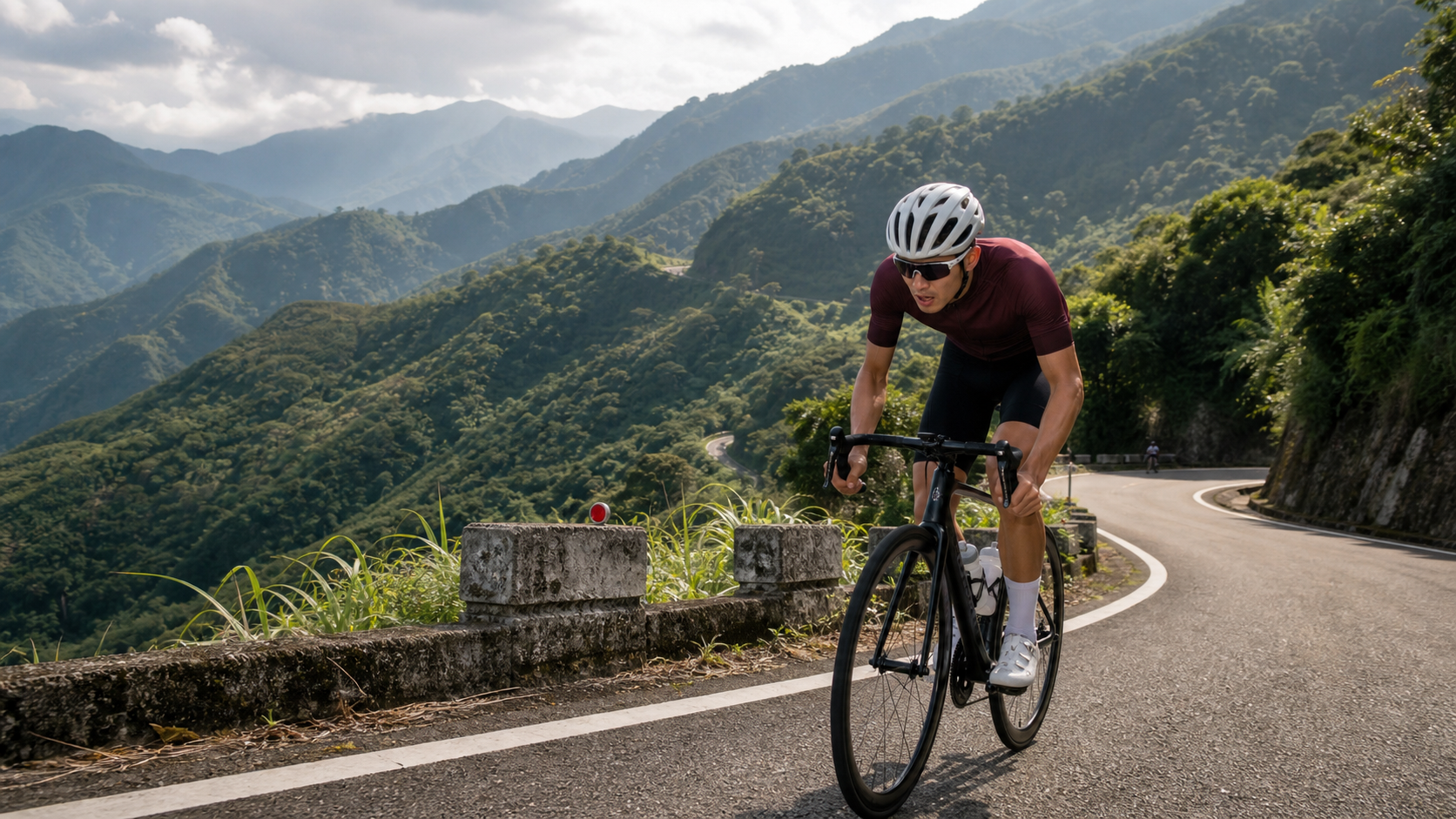
Yulao Practical Guide: 20 km HC-Climb, the Grand Slam Trial of Jianshi, Hsinchu
Summary: Yulao is a well-known HC-class (beyond-category) climb in Jianshi Township, Hsinchu. Spanning 20 km with 1,208.8 m of elevation gain and an average gradient of 5.7%, it is a key stage in the “Grand Slam” series of climbing challenges and a widely recognized benchmark route among cyclists in the Hsinchu–Miaoli area. This article breaks down the gradient profile segment by segment, offers gear-ratio and nutrition strategies, and provides target time references for riders of different levels.
In Taiwan’s road-cycling climbing culture, the “Grand Slam” is a long-standing challenge concept among advanced riders, referring to a milestone goal of tackling and conquering a collection of the country’s classic, highly difficult climbs one by one. Yulao is precisely one of the most representative stages of this “Grand Slam” series in the Taoyuan–Hsinchu–Miaoli region. The route spans 20 km in total, with 1,208.8 m of cumulative elevation gain and an average gradient of 5.7%, placing it in the HC category (Hors Catégorie, beyond-category climb). It is a household name among cyclists in Jianshi Township, Hsinchu, and a renowned mountain road that riders from elsewhere make a point of visiting to challenge themselves.
Based on a 20 km distance and a 5.7% average gradient, the theoretical elevation gain works out to roughly 1,141 m, which is quite close to the recorded 1,208.8 m—a discrepancy of only about 6%. This means Yulao’s gradient distribution is relatively “honest,” with few undulations to disrupt pacing judgment. Essentially, it is a sustained climb that demands long-duration, highly focused, steady power output. An average gradient of 5.7% places it at the medium-to-high difficulty level among Taiwan’s classic climbs, and combined with the 20 km length, the overall challenge intensity is far greater than that of the other routes covered in this series—a true HC-class proving ground.
Route Overview and Real Data Analysis
Let’s start with the hard numbers. Yulao is 20 km long, with 1,208.8 m of total elevation gain and an average gradient of 5.7%, classified as HC grade. This combination of gradient and distance means completing the full challenge typically takes over 70 minutes (varying by ability; beginners may even exceed two hours), making it a long-duration endurance test that requires ample physical reserves and a sound pacing strategy.
| Item | Data |
|---|---|
| Total Distance | 20 km |
| Total Elevation Gain | 1,208.8 m |
| Average Gradient | 5.7% |
| Classification | HC grade (beyond-category climb) |
| Terrain Characteristics | Relatively stable gradient distribution; discrepancy between theoretical and actual elevation gain is only about 6% |
| Location | Jianshi Township, Hsinchu County |
| Cultural Standing | One stage of Taiwan’s cycling “Grand Slam” challenge series; the representative route of the Jianshi Grand Slam |
Beyond the dual difficulty of gradient and distance, Yulao’s fame among cyclists also stems from its role as a transportation hub in the Jianshi mountain area. The Yulao Observation Deck at the summit is a renowned vantage point overlooking the entire Jianshi mountain region and even the distant ridgeline of the Snow Mountain Range. The visual reward upon reaching the top is a major motivation for many riders to take on this demanding route again and again.
Segment Guide: Warm-Up and Rhythm Building (0–6 km)
In the first 6 km after departure, the gradient is relatively gentle, hovering around 3–4%, making it the rare warm-up section of the entire challenge. It is strongly recommended to restrain any urge to push hard here—many riders unconsciously start with overly high power or heart rate because the early gradient is easier, only to burn through their reserves prematurely in the steeper core climb ahead. Keep your output around 70–75% of threshold power, maintain heart rate between Zone 2 and Zone 3, and let your body gradually settle into the rhythm of a long climb while preserving ample energy for the more than 12 km of sustained effort to come.
For gearing, a medium-to-light combination (such as 34x19 or 34x21) works well on this section, keeping cadence at 80–90 rpm to establish a steady, sustainable pedaling rhythm. This stretch also serves as an important window for assessing your physical condition on the day—if you already feel noticeably strained during the warm-up, it is wise to reconsider whether a full attempt is appropriate today, or to adjust your expected finish time accordingly.
Segment Guide: The Core Climb Zone (6–14 km)
The section from 6 to 14 km is the most demanding core climb of the entire Yulao route, with instantaneous gradients frequently reaching 7–9%, and some hairpin turns possibly exceeding 10% briefly. This is the decisive zone that determines the success of the whole challenge. It is recommended to keep output stable at around 80–88% of threshold power, avoiding prolonged time above threshold to prevent excessive lactate accumulation that could compromise performance on the later sections.
For gearing, switch to 34x25 or 34x28. If you have limited climbing experience or carry more body weight, you should go straight to a mountain cassette configuration of 34x30 or even 34x32, maintaining cadence at 70–80 rpm to reduce the load per muscle contraction through higher pedaling efficiency and slow the rate of fatigue buildup. Because this section is steep and long, it poses a particularly severe test of mental toughness. A segmented psychological anchoring strategy is recommended—break the 8 km core climb into several smaller mental milestones and overcome them one by one, rather than thinking about the entire distance at once.
Breath control is especially critical at this stage. A fixed-rhythm deep-breathing method is recommended, combined with a stable core and relaxed upper body to minimize unnecessary energy expenditure. Many riders experience significant slowdowns or are even forced to dismount and push on Yulao’s core climb, usually the result of overly optimistic pacing in the early section or insufficient hydration—so pace yourself carefully.
Segment Guide: Approaching the Summit and Final Push (14–20 km)
After passing the 14 km mark, the elevation is already quite high, and mountain temperatures will be noticeably lower than at the base, changing how you feel physically. The gradient on this stretch remains at medium-to-high intensity, but since the Yulao Observation Deck at the finish is not far off, it is advisable to adjust your mental focus and direct attention toward the summit view reward ahead, boosting your motivation to keep going.
Keep the mountain gearing from the core section, and try to maintain a steady cadence, avoiding the temptation to surge output too early out of excitement near the end, which could trigger cramping or a sudden cliff-like drop in energy in the final stage. In the last 2–3 km, if your legs allow, you can gradually increase output to finish the challenge in a more spirited manner; if you are clearly spent, prioritize safe completion and maintaining a steady cadence.
Upon reaching the Yulao Observation Deck, the view before you is the best reward for the entire arduous effort—a 360-degree panorama of surrounding mountain ridges, and on clear days, even the majestic ridgeline of the Snow Mountain Range in the distance. That awe-inspiring sense of looking out from on high is enough to instantly transform all the soreness and fatigue of the climb into a profound sense of accomplishment.
Gear Ratio and Equipment Recommendations
As an HC-grade climb, the importance of gear-ratio selection on Yulao cannot be overstated. For road bikes, a compact crankset (50/34T) paired with at least an 11–30T, or even an 11–32T, wide-range cassette is recommended to ensure ample gearing headroom on the core climb. Advanced riders with excellent fitness and a regular regimen of high-intensity climbing training may consider a tighter 11–28T setup for greater pedaling efficiency; recreational riders, however, are strongly advised to choose a wider mountain cassette to avoid excessive knee joint strain from insufficient gearing.
Given the long challenge duration (over 70 minutes, and possibly more than two hours for beginners) and the significant temperature variation in the mountains, it is recommended to carry a lightweight windbreaker or arm warmers to cope with the sudden temperature drop after reaching the summit. For tire pressure and tire choice, balancing grip and rolling efficiency is key—25–28C tires with pressure adjusted to your body weight are a solid choice for long climbs.
Nutrition, Hydration, and Weather/Season Considerations
With Yulao’s 20 km length and typical completion times exceeding 70 minutes, a nutrition strategy is crucial. Be sure to fill your bottles before departure and carry at least one energy gel or portable snack, consuming it before the core climb to avoid depleting your glycogen reserves prematurely. If you pass any rest stops or shops along the way, take the opportunity to replenish water—supply points are relatively scarce on some sections of the Jianshi mountain roads, so thorough preparation is essential.
Seasonally, spring and autumn are the best times to take on Yulao, with moderate temperatures and higher visibility, offering the best chance to enjoy the fullest, most spectacular summit views. Summer is hot and humid, and the physical toll of a long, high-intensity climb raises the risk of heatstroke significantly—an early-morning start and enhanced fluid and electrolyte replenishment are recommended. In winter, under the influence of the northeast monsoon, the mountains are prone to fog and rain, and with the sharp temperature drop at altitude, warm clothing and careful weather assessment are especially important.
Common Mistakes and DNF Risks
The most common failure mode on Yulao is underestimating how demanding a 20 km, 1,208.8 m climb is on energy distribution over such a long, high-intensity effort. Many riders pace too optimistically in the relatively gentle warm-up section at the start, causing them to burn through their reserves prematurely on the core climbing section, eventually forcing them to dismount and push their bikes or abandon the challenge altogether in the latter half. It is strongly recommended to adopt a conservative start and a pacing strategy based on gradually assessing how you feel, rather than going all-out from the very beginning.
Another common issue is insufficient supplies. With a 20 km long-distance challenge combined with hot, humid summer weather, fluid and electrolyte loss can be considerable. It is strongly recommended to carry ample supplies and complete the main energy and hydration intake before the core climbing section, to avoid facing the double hardship of depleted energy and inadequate supplies on the most demanding stretch of road.
Target Time References for Riders of Different Levels
| Rider Level | Estimated Completion Time | Average Power Reference (% of FTP) |
|---|---|---|
| Advanced / Race level | 65-80 minutes | 80-90% of FTP |
| Intermediate / Regular training | 85-110 minutes | 70-80% of FTP |
| General recreational rider | 115-150 minutes | 60-70% of FTP |
| Beginner / First attempt | 150+ minutes | Pace by feel; rest stops recommended |
Grand Slam Culture and Training Significance
As an important stop in Taiwan’s cycling “Grand Slam” challenge series, Yulao carries not just the difficulty of its gradient statistics, but also serves as a mutually recognized benchmark of ability and a cultural symbol among cyclists. Many advanced riders list “completing the Grand Slam” as a major milestone in their cycling careers, and Yulao, given its HC-rated difficulty and the unique geographical and cultural backdrop of the Jianshi mountain area, is often regarded as one of the most representative routes in the Grand Slam series—and one that truly tests overall capability.
For riders preparing to take on higher-difficulty mountain roads such as Wuling or Hehuanshan, Yulao is an excellent staged training benchmark—being able to complete the Yulao challenge consistently within a reasonable time usually indicates that you already possess the foundational fitness to take on longer, higher-difficulty climbs. It is recommended to incorporate Yulao into your pre-race training cycle as a regular test, tracking your completion time and power data progress curves over time, as an important basis for assessing whether you are ready for more difficult challenges.
In summary, with its solid 20 km distance, a substantial 1,208.8 m of climbing, and HC-rated difficulty, Yulao has become one of the most iconic climbing proving grounds in the Jianshi mountain area of Hsinchu and the broader Taoyuan-Hsinchu-Miaoli region. Master a sound long-distance pacing strategy and come fully prepared with supplies, and this route will serve as the ultimate touchstone for testing and elevating your overall climbing ability.
Power Analysis: Normalized Power Management for Long Climbs
A long HC-rated climb like Yulao, lasting over 70 minutes, demands a completely different approach to power management than a short TT segment. Short efforts can tolerate greater power fluctuations, but a 20 km sustained climb calls for a steady, sustainable output pattern. It is recommended to keep your normalized power at approximately 78-85% of your threshold power throughout the ride (adjusted according to your individual fitness level), and to avoid any single segment deviating too far from this range. This ensures even energy distribution to support the full 20 km challenge.
For riders equipped with a power meter, it is recommended to break the route into three to four power management zones, set a reasonable target power range for each, and monitor in real time during the ride. If you notice output running noticeably high in any section, adjust proactively immediately, rather than reacting passively only once fatigue becomes obvious. This forward-looking power management strategy effectively prevents the most common failure mode on long climbs like Yulao: “too aggressive at the start, collapse at the end.”
Mental Toughness: Managing Willpower on Long Climbs
Facing a 20 km sustained climb lasting over 70 minutes, mental toughness often matters just as much as physical fitness. Before the ride, it is recommended to use mental rehearsal to simulate the gradient changes of the entire route and the difficult moments you may encounter, so that both mind and body are already prepared for the long ordeal ahead before the challenge officially begins. During the ride, make good use of segmented goal-setting: break the 20 km into several psychological blocks of around 5 km each, completing and celebrating each small milestone one by one, rather than fixating on the distant, abstract finish line.
Many veteran riders who have completed the Yulao challenge share that the most dangerous psychological trap on a long climb is not the intense pain of the core climbing section, but the “willpower valley” that can appear in the middle—a mental state somewhere between fatigue and numbness that can easily drain your motivation to keep going. It is recommended to prepare a few short self-motivational phrases before the ride, to use when the willpower valley hits, to help you refocus and rekindle your determination to push forward.
Difficulty Comparison with Other Routes in the Grand Slam Series
Within Taiwan’s cycling “Grand Slam” challenge series, Yulao may not reach the extreme altitudes of 2,000-3,000 meters found on routes like Wuling or Hehuanshan, but with its combination of 20 km, 1,208.8 m of climbing, and an average gradient of 5.7%, it remains a solid challenge that advanced riders must prepare for seriously to complete successfully. Compared to high mountain roads that simply chase extreme altitude, Yulao’s difficulty comes more from the sustained, steady mid-to-high intensity output it demands. In some ways, its test of pacing discipline and mental resilience is even closer to the real-world conditions of long climbing segments in actual road races.
For riders planning to take on the full Grand Slam series, it is recommended to schedule Yulao in the middle phase of your training cycle—after building a foundation on the shorter routes introduced earlier in this series, such as Yangjin Highway, Machao Section, Shuangxi Buyanting, Macao Mountain Road, Buddha World-TT, and Bashan Mountain ITT—before advancing to a long-distance HC-rated route like Yulao. This progressive approach builds the endurance and pacing management experience needed for long climbs, laying a solid foundation for ultimately tackling higher-difficulty routes such as Wuling and Hehuanshan.
Strategic Differences Between Group Riding and Solo Challenges
For a long HC-rated climb like Yulao, riders can choose to ride in a group or take on the challenge solo, and each approach has its own strategic considerations. The advantage of group riding lies in mutual encouragement and looking out for one another, which reduces the psychological pressure of facing difficult stretches alone for extended periods. This is especially valuable for first-time challengers, as riding with others provides additional safety and psychological support. However, group pacing also requires attention to fitness differences among members. It is recommended to communicate the pacing strategy in advance, to avoid making pacing decisions that exceed your own capabilities by deliberately following a stronger teammate’s rhythm, which can increase the risk of premature energy depletion.
A solo challenge, on the other hand, allows the rider to make pacing decisions entirely based on personal feel and data, without being influenced by others’ rhythms. However, tackling a relatively remote mountain route like Yulao solo also means that in the event of a mechanical failure or physical discomfort, the chance of receiving immediate assistance is relatively limited. It is strongly recommended that solo riders inform family or friends of their itinerary, and carry complete emergency contact information and basic repair tools to ensure safety.
Pre-Race Preparation Cycle Recommendations
To prepare for an HC-rated long climb like Yulao, it is recommended to begin targeted training at least four to six weeks in advance. Training focus should be on improving your ability to sustain mid-to-high intensity output over extended periods. This can be achieved by repeatedly climbing the shorter routes introduced earlier in this series (such as Bashan Mountain ITT), combined with structured threshold power interval workouts, gradually building your body’s ability to adapt to prolonged climbing loads.
In the week before the event, it is recommended to taper appropriately, allowing your body to fully recover from prior training fatigue, while also completing thorough equipment checks and route plan confirmation. Diet and sleep preparation on challenge day are equally important. It is recommended to consume sufficient carbohydrates the night before to store glycogen, and to ensure adequate sleep, so that both mind and body are in optimal condition to take on this hard-core challenge of 20 km and over 1,200 m of climbing.
Summary: Proving Your Mettle in the Jianshi Mountains
With its solid distance, substantial climbing, and HC-rated difficulty, Yulao has earned its place as the definitive benchmark challenge route in the Jianshi mountain area of Hsinchu. It tests not only a rider’s cardiovascular capacity and muscular endurance, but also the mental toughness and willpower required to maintain rational pacing decisions over a long duration. Whether you are an advanced rider working toward completing Taiwan’s cycling Grand Slam, or simply a challenger looking to push past your own limits and conquer this renowned HC-rated mountain, Yulao will honestly reflect every ounce of effort and preparation you bring, through its solid and unrelenting gradients.
Common Equipment Troubleshooting and Pre-Ride Checklist
Long-distance HC-category climbs place extremely high demands on equipment reliability. Any minor mechanical issue can be magnified into serious energy loss or safety risks during the core climbing sections. Before departure, it is recommended to carefully check that the shifting system responds crisply—especially since the entire Yulao route requires frequent switching between different gear ratios, and any shift delay will directly affect pacing efficiency. The braking system also needs to be confirmed to have normal stopping power, because the long descent after completing the challenge places considerable demands on brake pad durability.
Tire pressure and tread wear must be confirmed before departure, and you should carry spare inner tubes, a multi-tool, and CO2 cartridges. Supply and repair resources are limited on some sections of the Jianshi mountain area, so having the ability to independently handle basic mechanical failures is a fundamental requirement for safely completing this long-distance challenge. It is also recommended to carry a portable phone power bank to ensure communication and navigation devices remain operational after extended riding. In the event of an unexpected situation, you can also call for help immediately, ensuring that every aspect of the challenge—from start to finish—is fully safeguarded, allowing you to focus on pacing and energy management without worrying about unexpected equipment issues. With the most complete and solid preparation, face this HC-level hardcore trial in the Jianshi mountain area, and carry with you a full sense of accomplishment and valuable real-world experience as you safely and smoothly complete this meaningful HC-level challenge journey—one worth revisiting and cherishing in detail.
Additional Reminder: Descent Safety After Reaching the Summit
After completing the 20 km climb to Yulao, most riders choose to descend back along the same route. The demands that a long descent places on the braking system and bike-handling skills should not be underestimated. It is recommended to let your body adapt to the sense of speed early in the descent, using intermittent braking rather than continuous braking to avoid overheating the brake pads and losing stopping power from sustained braking. Be sure to slow down well in advance on cornering sections. Especially after a high-intensity climb, muscle and reaction capabilities may be diminished due to fatigue, so riding conservatively and ensuring safety should always take priority over the thrill of chasing descent speed.
Related Reading
- Yulao, Gazing at the Mountain Summit: A Cycling Epic of Perseverance and Vastness
- Yufeng to Yulao Practical Guide: An 8.3 km, 8.2% Average Grade Hardman Test in Jianshi Township
- Hsinchu Jianshi Township Mountain Routes: Climbing Training Route Guide Through Indigenous Tribal Mountain Areas
- Hsinchu Jianshi Naluo and the Front Section of Smangus: Mid-Elevation Forest Gravel Riding in Northern Taiwan
宇老大滿貫 拉拉山 員工旅遊 有如爬了一座東進武嶺 #公路車 4K高畫質
6 年前
宇老大滿貫(改)/ UBike神人 / 太離譜了!出大景 差點被擊落 / feat. 神秘密境單車團 / 公路車 / CT Yeh
2 年前
台北闊瀨陡坡 騎旅 / 日本單車雜誌編輯車友臨時加入!/ 髮香才是最強的 / feat. 北迴歸線小隊 / 公路車 CT Yeh
6 個月前
半日 小台灣 極限單車路線挑戰實錄
7 年前
新竹羅平 x 天湖部落 大禹嶺級變態陡坡! 4K超高畫質 空拍 | 公路車
5 年前
大武山後門26%歡樂陡坡!JJSC南台灣單車行Day2 / 被颱風追著跑 / 公路車 / CT Yeh
2 年前
西進武嶺 世界紀錄挑戰!破2:30 ?!一群人推著一個夢上山 直播精華版 / ft. 張翰允 & 台視主播魏于恬 & KPLUS / #cycling 公路車 CT Yeh
2 個月前
#北橫 + #北進武嶺 最硬的員工旅遊 EP1 | #公路車 #拉拉山 | 明池 | 武嶺 | 武陵農場 | 雲海 | Taiwan Cycling Route Wulin
6 年前