文章導覽
The Journey and the Destination: A Philosophy of Process in Endurance Sports
We’ve All Been Focused on the Wrong Thing
Open any cycling forum and you’ll find endless discussions: What’s your FTP now? How long did it take you to climb Wuling last time? Did you get the KOM? We define our cycling careers with numbers, just as we define our professional careers with salaries.
These numbers certainly have their meaning. Goals give us direction, and data helps us improve. But if you think about it carefully, do you remember your finishing time from a race five years ago? Do you remember the average power from a training ride last month?
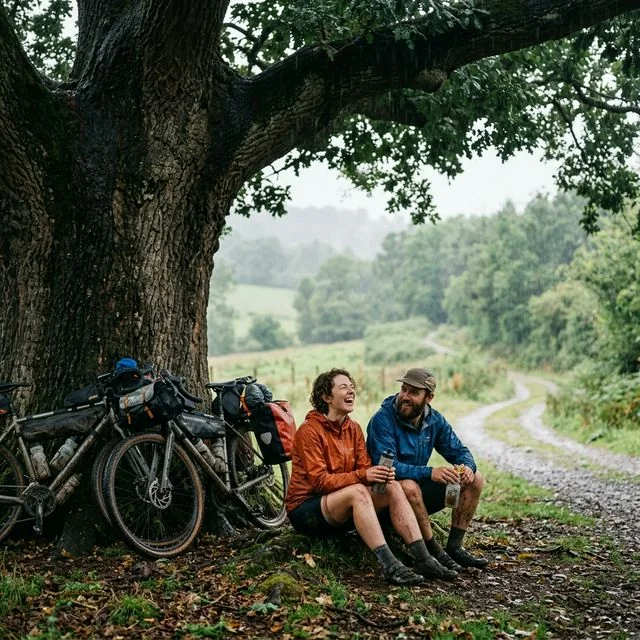
More likely, what you remember is this: the color of the sky when you set off at five in the morning. The laughter you shared with a riding buddy under a big tree when rain suddenly started mid-climb. That moment on a solo ride along a coastal road when the sunset painted the entire road gold.
What you remember is the journey, not the destination.
The Trap of Being “Outcome-Oriented”
The Dilemma of Never Enough
When you place all your meaning on outcomes, you fall into a cycle of never enough:
Finish your first century ride → Happy for three days → Want to ride the Twin Towers
Complete the Twin Towers → Happy for a week → Want to challenge Wuling
Complete Wuling → Happy for two days → Want to break three hours
Break three hours → Happy for one day → Want to break 2:50
Each achieved goal brings only a brief moment of satisfaction, immediately replaced by the next goal. This is what psychology calls “Hedonic Adaptation”—our sense of happiness quickly returns to a baseline, no matter what we achieve.
If your happiness only exists in the moment you achieve a goal, then you’re unhappy 364 days a year.
The Fragility of Identity
When you define yourself by outcomes (“I’m a rider who can finish Wuling in under three hours”), your self-identity becomes very fragile. Once you get injured, decline, or one day simply can’t ride under three hours anymore, your entire identity collapses.
But if you define yourself by process (“I’m someone who loves cycling, keeps learning, and enjoys challenges”), then your identity is solid—regardless of what your FTP is, regardless of how fast or slow you ride today.
The Core Ideas of Process Philosophy
Enjoy Every Turn of the Pedal
If you’ll turn the pedals ten million times in your life, and you only feel satisfied at the moment you reach the finish line, then you’ve wasted 9,999,999 opportunities to feel joy.
The core of process philosophy is simple: shift your attention from “where am I going” to “what am I doing right now.” Every pedal stroke can be a complete experience—feeling power transfer from your legs to the pedals, feeling subtle changes in speed, feeling the wind in your ears.
This isn’t to say you shouldn’t have goals. Goals are markers on a map; they help you plan your route. But the joy of travel isn’t in the markers—it’s in every step of the road between them.
Small Victories in the Process
When you focus on the process, you begin to notice a wealth of “small victories”:
- Today’s warm-up felt smoother than yesterday’s
- You took that corner more fluidly than last time
- You successfully maintained a steady cadence on the climb
- You made a smart fueling decision while fatigued
- You chose to keep going when you wanted to quit
These small victories won’t show up on Strava, and no one will give you a thumbs-up for them, but they are the bricks that truly build you as an athlete.
Intrinsic Motivation vs. Extrinsic Motivation
Psychology’s Self-Determination Theory tells us that the most enduring motivation comes from three intrinsic needs: autonomy, competence, and relatedness.
- Autonomy: “I choose to ride because I enjoy it.”
- Competence: “I feel myself improving.”
- Relatedness: “I am part of this community.”
All three of these needs are process-oriented, not outcome-oriented. You don’t need to win a race to satisfy them—you just need to participate in the process consistently and consciously.
How to Shift from “Outcome-Oriented” to “Process-Oriented”
Redesign Your Training Log
Beyond recording power, heart rate, and distance, try adding some process-oriented entries:
- How today’s ride felt: Not physical fatigue, but the overall quality of the experience
- One new discovery: Maybe a new road, a new skill, or a new insight about yourself
- One thing to be grateful for: What was there to appreciate during today’s ride?
Looking back at these entries three years from now will mean far more than any power data.
Schedule Regular “Goal-Free Rides”
At least once a month, schedule a ride with absolutely no training goal. Don’t look at the computer, don’t worry about pace, don’t plan a route. Just head out and see where the road takes you.
You’ll find that these “goal-free rides” are often the ones you enjoy most. Because when you remove the pressure to accomplish something, you can truly be “present.”
Redefine a “Good Day”
The common definition: Today I rode fast / broke a record / had high power → a good day.
The process-oriented definition: Today I gave my full attention / I made good decisions under difficulty / I enjoyed the entire process → a good day.
By the latter definition, you’ll have many more “good days.” And more good days mean a better cycling career, and a better life.
The True Meaning of the Destination
Process philosophy doesn’t deny the value of goals. Goals matter—they provide direction, create challenge, and give structure to the process.
But the true value of a goal isn’t in the moment of achievement; it’s in the direction it gives to the process. The meaning of reaching the top of Wuling isn’t the minute you spend taking a photo in front of the sign at 3,275 meters. Its meaning lies in the three months of training beforehand, in every morning you chose to get up early instead of sleeping in, and in every moment on the climb when you chose to persevere instead of giving up.
The sign is just a period. The entire text is the story.
“Life is not a problem to be solved, but a reality to be experienced.” —Soren Kierkegaard
Your cycling career is the same. It’s not a series of goals to be achieved, but a journey to be fully experienced.
Next time you head out for a ride, try this: look at your computer one less time, and look at the sky one more time.
Related Reading
- The Joyful Philosophy of Cycling Training: Why Enjoying the Process Matters More Than Chasing Results
- The Endgame of Data-Driven Training: Translating Power Files into the Ability to Predict “What Will Happen in a Race”
- Retirement, Transition, and Redefinition: An Athletic Life After You Stop Chasing Results
- Type 2 Fun: The Things That Only Feel Enjoyable After the Suffering Is Over