Finding Your Why: Exploring Motivation in Endurance Sports
The Shelf Life of Motivation
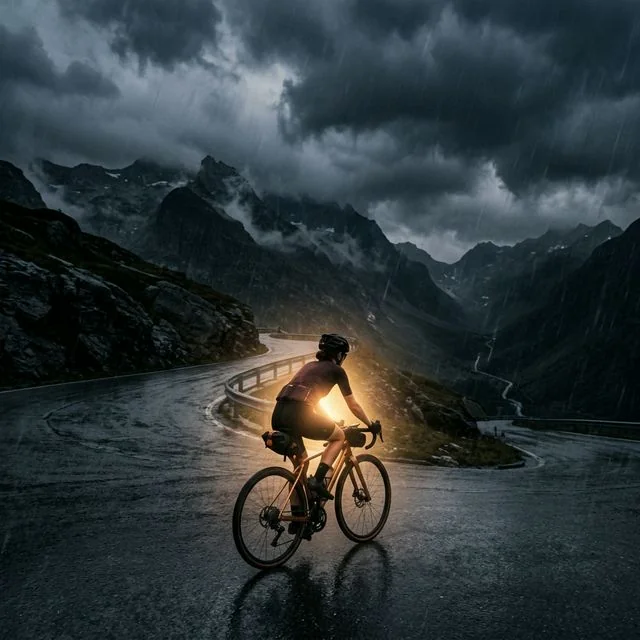
Do you remember the first time you felt passionate about cycling? Maybe it was watching a Tour de France documentary, maybe a friend dragged you out for a mountain ride, or maybe it was discovering a long-lost sense of freedom along the riverside one early morning.
Back then, motivation was abundant. You didn’t need an alarm clock to get up early, you didn’t need anyone to push you to head out for a ride, and you didn’t need any reason to enjoy all of it.
But that honeymoon-phase motivation has a shelf life. After a few months, maybe a year or two, the initial novelty fades. You start needing more willpower just to get out the door. Training starts to feel like an obligation rather than a joy. You begin to think: “Why am I putting myself through this?”
If that question doesn’t get a good answer, you’ll stop. And most people do stop.
Surface Motivation vs. Deep Motivation
Surface Motivation (It works, but it doesn’t last)
- Weight loss: Once you hit your target weight (or give up), the motivation disappears
- Social pressure: “All my friends are riding” — once your social circle changes, the motivation is gone
- Showing off: You bought an expensive bike, so you have to ride it to justify the cost — once the novelty wears off, it’s not enough
- Race results: If you only ride to win, then most of the time you’re losing
- Strava data: The thrill of chasing numbers diminishes over time
These motivations aren’t bad. They can be a starting point, a catalyst. But they don’t make a good foundation, because they depend on external conditions, and external conditions are unstable.
Deep Motivation (It can last a lifetime)
Deep motivation touches on who you are, who you want to become, and what you believe matters. It doesn’t depend on external outcomes, so it doesn’t disappear when results fluctuate.
- Identity-based: “I am someone who values physical health and self-challenge. Cycling is an expression of that identity.”
- Values-based: “I believe in the value of discipline and perseverance. Every ride is me putting my beliefs into practice.”
- Growth-oriented: “I enjoy the process of becoming better. Not to beat others, but to explore my own limits.”
- Connection-based: “Cycling connects me deeply with nature, with myself, and with community.”
- Meaning-based: “In an increasingly virtual world, cycling is one of the few completely real experiences I have left.”
Finding Your Why: Five Methods of Exploration
Method One: The Five Whys
This is the classic problem-solving technique from the Toyota Production System, and it works just as well for self-exploration:
Why do I ride? → Because I want to be healthier.
Why do you want to be healthier? → Because I don’t want my body to fall apart when I get older.
Why do you care about your body’s condition in old age? → Because I want a good quality of life in my later years.
Why do you care about the quality of your later years? → Because I want to keep doing the things I love.
So what do you truly love? → Freedom. The freedom to use my body to go anywhere I want.
See — after digging five levels down from “I want to be healthy,” the real answer is “freedom.” That’s your Why.
Method Two: The Subtraction Method
Imagine you lost every external reward of cycling: no Strava, no races, no riding buddies who know you ride, no social media to share, no one who will ever see your training data.
Under those conditions, would you still ride? If yes, why? That “why” is your deep motivation. If no, it means your current motivation is mostly external, and you may need to re-explore.
Method Three: Peak Experience Recall
Think back to the most profound moment of your cycling life — not necessarily the fastest one, but the most meaningful one.
Where were you in that moment? What were you doing? What did you feel? Why was that moment so special?
The reason it was special usually points to your deepest motivation. Maybe it was the sense of self-transcendence when you conquered a climb you thought you couldn’t make. Maybe it was finding unprecedented inner peace during a long solo ride. Maybe it was the sense of connection when you finished a grueling race with your best friend.
Method Four: Write a Letter to Your Future Self
Imagine you’re eighty years old, sitting in a rocking chair, looking back on your cycling life. What would you hope to remember? What role would you want cycling to have played in your life?
Write it down. That letter will reveal your most honest expectations for cycling, and that expectation is your Why.
Method Five: An Honest Conversation in Moments of Pain
Your Why is vague when you’re comfortable and clear when you’re suffering. The next time you’re climbing and want to give up, don’t just grit your teeth — ask yourself: “What is actually carrying me forward right now?”
The answer that surfaces in that most vulnerable moment is often the most truthful one.
Maintaining Your Why
Finding your Why isn’t a one-time event; it’s an ongoing process. People change, values evolve, and life stages shift. The Why that fired you up in your twenties may no longer fit when you’re forty.
Periodically (maybe once a year), re-examine your Why: Is it still true? Can it still pull you out of bed at 5 a.m.? Can it still give you strength when you’re suffering the most?
If it can’t anymore, don’t be afraid. That doesn’t mean you’ve lost something — it means you’ve grown, and your Why needs to grow with you.
Days Without a Why
Finally, I want to say something counterintuitive: some days, you just can’t find your Why. The alarm goes off, and you don’t want to get up. You know all the reasons, but none of them work today.
That’s normal. It doesn’t mean your Why has disappeared; it just means you’re human.
On those days, the best strategy isn’t to desperately search for motivation — it’s to rely on habit. Put on your jersey, wheel the bike out, and start pedaling. You don’t need to feel motivated — you just need to act. Motivation usually shows up after action, not before.
There’s a saying: “Amateurs wait for inspiration; professionals show up every day.”
Your Why is your lighthouse. But on foggy days when the lighthouse can’t be seen, you still have a compass — and that’s your habits and discipline.
“He who has a why to live for can bear almost any how.” — Friedrich Nietzsche
Find your Why. Then, even on the coldest winter morning, you’ll have a reason to crawl out from under the covers.
Related Reading
- Maintaining Motivation in Cycling Training: Psychological Techniques and Strategies for Long-Term Commitment
- The Science of Motivation: Intrinsic vs. Extrinsic Motivation, and Why Rewards Can Sometimes Make You Stop Riding
- Maintaining Running Motivation: Psychological Strategies to Avoid Burnout in Long-Term Training
- Running Motivation Maintenance Strategies: How to Persevere Through Training Slumps
2025 自行車錶排行榜 兩萬車友大數據 / Garmin Bryton 排名會大洗牌嗎? / 全新的碼表前身分析 /公路車 / CT Yeh
1 年前
2023自行車展!與環台賽選手一同表演賽 / 全自動AI Fitting?/ TIME新車發表/神秘充電桌等 精華分享 VLOG | CT Yeh | 公路車
3 年前
大家都在開箱的...單車用藍芽對講耳機真的有幫助嗎? SENA BiKom 20 長距離旅遊 & 海鷗繞圈賽 實際體驗心得 / 公路車 / CT Yeh
9 個月前
一日北高/長距離團騎 常見問題補充篇 / 組團或跟團的眉角 / 壯車友容易被瘦車友慢性拉爆 / 原來屁股痛可能是這個原因...? / 風場配速法 / 公路車 / CT Yeh
2 年前
下次拍照前要查清楚啦🤣 #cycling
7 個月前
一個測試有沒有認真練車的方法😂 #公路車
10 個月前
單車 一日北高 ( 雙城 ) 肥宅雙人瘋狂行 紀錄片 REACTO
10 年前
五指山約騎,居然包場海倫咖啡無料吃喝! 牽車都比我快...大羞辱QQ | CHPT3 x 曜越單車活動小記錄 | 全程iPhone 14 Pro 4K電影級 拍攝| 公路車 | CT Yeh
3 年前