文章導覽
The Zen of Long Distance: Philosophical Meditation on a Road Bike
The World After Four Hours
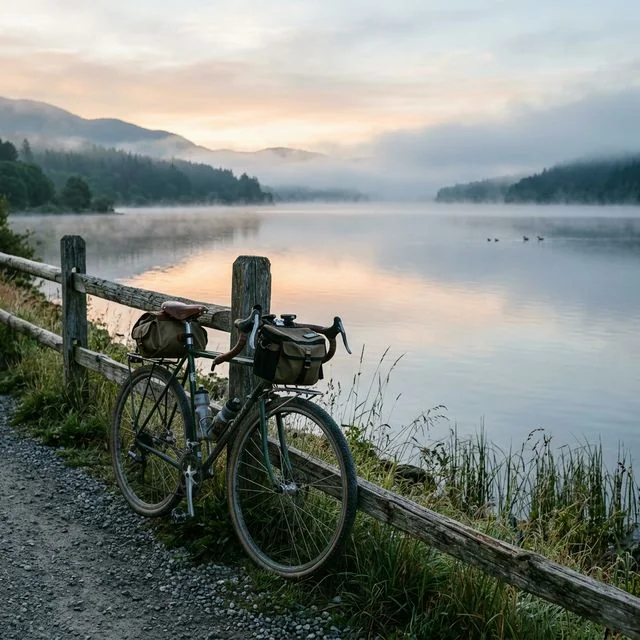
A short ride is like a conversation—back and forth, question and answer, with a clear rhythm. But a long ride is more like meditation—at some point, the conversation stops, and you enter a different state of consciousness.
Most people who have ridden truly long distances know what I’m talking about. Around the fourth or fifth hour, something “loosens.” Your mind stops its habitual chattering—stops calculating, comparing, worrying, planning. In its place comes a strange clarity, like a lake surface smoothed by the wind.
The Japanese have a word, “mu” (無), which Zen uses to describe a state that transcends affirmation and negation. On a long ride, you have the opportunity to experience something close to “mu”: you are not thinking, but you are not unconscious either. You are… present. Purely, completely, present.
How Long Distance Alters Consciousness
The Distortion of Time
In daily life, we are chased by time. Every minute is assigned a purpose, every hour has a deadline. But on a long ride, the texture of time changes.
For the first two hours, you still perceive time in the conventional way: “I’ve been riding for an hour,” “three hours to go,” “it’s ten in the morning.” But past a certain threshold, you stop calculating. You exist in a continuous “now,” and this “now” is expansive, unhurried, self-sufficient.
This shift in the sense of time closely resembles experiences reported in deep meditation. It is not something you can deliberately manufacture—it is a natural byproduct of prolonged physical activity.
The Dissolution of Self
In a normal state, we have a strong sense of “self”—who I am, what I’m doing, how others see me. But in the sustained motion of long distance, the mental energy required to maintain this “self” image is reallocated to more fundamental functions: maintaining cadence, controlling breath, holding direction.
The result is a temporary “dissolution of self”—you no longer care so much about who you are; you are simply riding. This feeling is what psychologist Mihaly Csikszentmihalyi called “Flow,” but in the context of long distance, it has a softer, more enduring quality, distinct from the flow induced by short, high-intensity activity.
The Transformation of Inner Dialogue
It is fascinating to observe the changes in your inner dialogue during a long ride:
Phase 1 (0–1 hour): Daily noise. Work matters, household matters, to-do lists. Your mind processes the most recent information.
Phase 2 (1–2 hours): The noise begins to diminish. Deeper thoughts surface—perhaps a decision you’ve been avoiding, or an emotion you haven’t properly processed.
Phase 3 (2–4 hours): Thoughts become simpler, more intuitive. You no longer “think through problems” but “see answers.” Things that wouldn’t resolve no matter how hard you racked your brain at a desk suddenly become clear here.
Phase 4 (4+ hours): Language begins to disappear. Your inner experience no longer takes the form of words but exists as sensations, images, and intuitions. This is the state closest to “meditative absorption.”
Philosophical Questions on a Road Bike
Long-distance riding provides a unique environment where you can naturally confront questions you normally lack the time or courage to face:
On Simplicity
On the bike, your needs are reduced to the most basic level: water, food, direction, the normal functioning of your body. No emails to reply to, no meetings to attend, no social feeds to update.
In this minimalist state, you begin to reflect: how much of my daily life is truly necessary, and how much has been added on? What is necessary complexity, and what is unnecessary noise?
Thoreau wrote in Walden: “Simplify, simplify.” On a long ride, you experience the beauty of simplification—and this experience seeps back into your daily life.
On Pace
Long distance teaches you one thing: finding a sustainable pace matters more than chasing momentary speed. You cannot ride 200 kilometers at sprint pace. You must find a rhythm that “can be maintained indefinitely.”
The same principle applies to life. Our culture glorifies the “sprint”—meeting deadlines, working overtime, hitting targets. But life is a long-distance event, not a short sprint. Finding a pace you can sustain for decades is worth more than any short-term burst.
On Independence and Connection
Long-distance solo riding lets you experience complete independence—you move through the world relying on your own legs and judgment. This sense of independence is strengthening and empowering.
But at the same time, it makes you feel the preciousness of connection more deeply. When you encounter another rider on a remote mountain road, that wordless smile and nod contains all the sense of belonging you need. When you meet a stranger at a rest stop willing to share food with you, that kindness is more real than any social pleasantry.
On Impermanence
Throughout a long ride, everything changes: the weather changes, the wind direction changes, your physical condition changes, the road conditions change. You must constantly adapt, constantly adjust.
One of the core concepts of Buddhist philosophy is “impermanence” (Anicca)—all things are in continuous change. In daily life, it’s easy to forget this because the pace of change is so slow. But on a long ride, impermanence can be directly experienced: the tailwind of one minute becomes the headwind of the next; the sunshine of one hour becomes the storm clouds of the next.
Learning to remain calm amid impermanence is the core practice of meditation. And long-distance riding is one of the best training grounds for it.
What You Bring Along and What You Bring Back
What you bring on a long-distance journey is only yourself and a bike. But what you bring back is always more than what you took with you.
You bring back a washed-clean clarity. It doesn’t feel like you “gained” something; it feels more like you “let go” of something. In those five or six hours, your mind underwent a deep reorganization—not a deliberate one, but one that happened automatically when you stopped interfering with it.
You bring back gratitude for your body. Your legs carried you over a hundred kilometers, your heart beat tens of thousands of times, your lungs performed countless exchanges of gas. In daily life you take all of this for granted, but after a long ride, you no longer do.
You bring back a recalibrated set of values. On the bike you discover that you actually need very little: a sip of water, an energy bar, an open road. And many of the things you normally fret about no longer seem so important in that state.
The Insight of the Final Kilometer
The final kilometer of a long ride carries a peculiar feeling. Fatigue has surpassed the threshold of pain, and the body enters a transcendent state of automatic operation. As you look at the road about to end, two contradictory feelings arise simultaneously: one is the relief of “it’s finally ending,” the other is the reluctance of “I don’t want to go back yet.”
This contradiction itself is very Zen. It reminds you that the best state often exists in the tension between two extremes. Not complete comfort, nor complete pain. Not complete silence, nor complete clamor. Rather, in that middle ground—that space of being both here and not quite here—you find something close to the real.
“The Way is in everyday life.” —Ancient Zen saying
For the long-distance rider, the Way is also in the turning of the pedals, in the rise and fall of the breath, in the line that stretches endlessly between the road and the sky.
Related Reading
- Solo Riding Meditation: The Spiritual Practice of Riding Alone
- The Philosophy of Riding Solo: The Freedom and Solitude That Solo Riding Gives Me
- The Spiritual World of Long-Distance Riding: States of Consciousness and Psychological Phenomena Beyond 200 Kilometers
- The 30-Day Consecutive Riding Challenge: A Record of Physical and Psychological Changes