Long-Distance Triathlon: A Complete Guide to Finishing Strategy
The IRONMAN-distance triathlon — a 3.8km swim, 180km bike, and 42.195km marathon — is known as the crown jewel of endurance sports. Within a 17-hour cutoff, you must integrate the technique and fitness of three disciplines while precisely managing energy, fueling, and mental state.
Pre-Race Preparation: More Than Just Training
Setting a Finish Goal
In the world of IRONMAN, finishing itself is a great achievement. Set a realistic goal based on your training background:
- First-timer goal: Finish safely within the cutoff and enjoy the process
- Advanced goal: Set split-time targets for each discipline (e.g., swim 1:20 / bike 6:00 / run 5:30)
- Elite goal: Chase an age-group podium or a KQ (Kona Qualifier) slot
Special Training: Brick Workouts
The most unique training element in triathlon is the brick workout — two disciplines performed back to back, most commonly bike followed by run. This type of training serves several key purposes:
- Physiological adaptation: Helping the body adjust from the cycling motion to a running gait
- Mental preparation: Experiencing “brick legs” and learning how to find your running rhythm through it
- Fueling simulation: Practicing how your stomach reacts to running after fueling on the bike
The Swim (3.8km): Energy Conservation First
Core Strategy
Swimming is the discipline that drains the most energy and most easily affects performance in the later legs. The core strategy is conserving energy, not chasing speed.
Choosing your starting position:
- If your technique is strong: start near the buoy line to save distance
- If your technique is weak: start on the outside or toward the back of the pack to avoid the chaos and collisions at the start
Pacing principle: Swim at the comfortable pace you tested before the race, keeping your heart rate under 75% of max.
Open-Water Technique
- Sighting: Lift your head every 6-8 strokes to confirm direction and avoid wasting energy by swimming off course
- Drafting: Where legal, drafting 15-30cm behind another swimmer’s feet can save 15-25% of your energy
- Exit rhythm: Don’t stop after exiting the water — jog toward T1 while removing your cap and goggles
T1 Transition: The Art of Efficiency
Goal: complete your transition in 3-5 minutes.
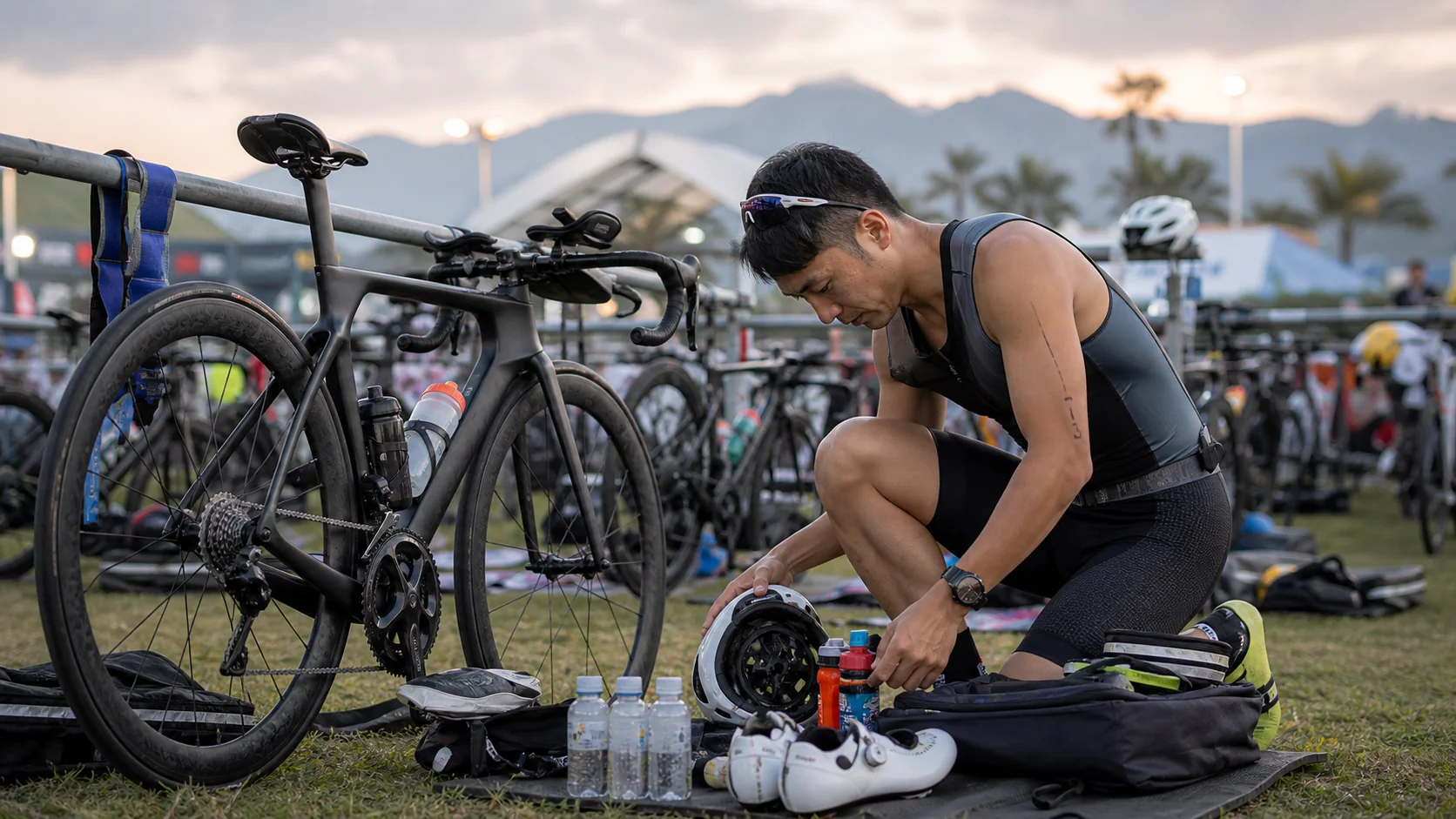
Rehearse your transition routine in advance, laying out your helmet, bike shoes, sunglasses, and other gear in the order you’ll use them. Familiarize yourself with every movement ahead of time so you can stay calm and unhurried even when fatigued on race day.
The Bike (180km): Controlling Your Output Is Key
Power Targets
Athletes with a power meter can set target power based on FTP:
- General finisher: 55-65% FTP
- Advanced athlete: 65-75% FTP
- Elite athlete: 75-80% FTP
The golden rule: your average power for the first 90km should not exceed the second 90km — meaning you must hold back in the first half and resist the urge to chase other riders.
Fueling Plan
The bike leg is prime time for fueling:
- Consume 60-90g of carbohydrate per hour
- Consume 500-750ml of fluid per hour (adjust for body size and temperature)
- Take at least one salt tablet per hour (to prevent hyponatremia)
T2 Transition: The Moment of Mental Switching
Moving from the bike to the run, T2 is not just a physical change of gear — it’s a mental shift in mode.
Swap out your bike shoes for running shoes, and shift yourself from “bike mode” into “marathon mode.” Many athletes take a sip of cola or a caffeinated drink at T2, using the sugar and caffeine to sharpen their focus for the final challenge.
The Run (42.195km): Don’t Run — Strategize
The First 10km: Resist the Urge to Run
Coming out of T2, your body often feels light from the transition off the bike, and many athletes start running at a pace far beyond what they can sustain. This is the most common blow-up trap in IRONMAN.
It’s recommended to run conservatively for the first 10km, keeping your heart rate in the aerobic zone, giving your stomach time to digest the fuel taken in on the bike leg.
Walk/Run Strategy
For most finish-focused athletes, a planned walk/run strategy (such as walking for 1 minute at every aid station) improves finish time more than running the entire distance:
- Reduces the risk of a late-race blow-up
- Makes fueling more effective
- Is mentally easier to sustain
Mental Strength in the Second Half
In the final 10-15km, your body is often at its limit, but the finish line is also near. This is when you need mental strength:
- Recall every early morning of your training
- Think of the family and friends waiting for you
- Feel the moment when you’re about to hear “You are an IRONMAN!”
Conclusion
IRONMAN isn’t a one-day race — it’s the culmination of months of accumulated training. From conserving energy in the swim, to strategic power output on the bike, to willpower on the run, every segment is interconnected. Master this strategy, and you’ve already taken a critical step toward the IRONMAN finish line.
Related Reading
Live) 備戰2019彰化經典百K 賽前攻略 (已完賽請看新影片
7 年前
西進武嶺 免費訓練分析服務 Intervals | 練不夠還是練過頭?你哪一種類型選手?AI模型告訴你! | 備戰神器 | 公路車 訓練 | CT Yeh
4 年前
2019 夏季KOM 5小 完賽心得 準備攻略 東進武嶺 夏季登山王之路 Taiwan KOM Challenge
7 年前
福隆鐵人團練隨拍
8 年前
半日 小台灣 極限單車路線挑戰實錄
7 年前
[防寒衣體驗] 鐵人魂 三鐵 防寒衣試穿會 於松運 深水游泳池 鯨魚池
8 年前
一日北高前的高裝檢 | 北高 360 | 挑戰11小時的裝備 | 一日雙塔 | 補給
6 年前
2019 柯P 超越北高 第一集團實錄 (11小時實錄請參考另一部影片) 一日雙城 一日北高 NeverStop Taiwan Long Distance Cycling Challenge
7 年前