Jump Rope and Agility Training: Auxiliary Training to Enhance Neuromuscular Coordination
When most cyclists discuss auxiliary training, they typically think of weight training or yoga. But there is a category of training that is often overlooked, yet offers unique benefits for improving riding performance: neuromuscular coordination training, represented by jump rope. This type of training has an extremely low cost of entry (a jump rope costs only a few hundred dollars), yet delivers adaptive effects that other training methods struggle to replicate.
Neuromuscular Coordination and Cycling Performance
What Is Neuromuscular Coordination?
Neuromuscular coordination refers to the nervous system’s ability to precisely control the timing and intensity of muscle contractions. In cycling, this manifests in:
- Pedaling smoothness: Whether the force distribution of each pedal stroke is even
- Efficiency at high cadence: The ability to maintain fluid pedaling above 100rpm
- Explosive power release speed: How quickly muscles go from zero to full effort during a sprint
- Movement maintenance under fatigue: The ability to sustain proper pedaling technique in the latter half of long rides
Why Do Cyclists Lack This Type of Training?
Cycling is a relatively “fixed-path” sport—the movement pattern of each pedal stroke is nearly identical. This means the nervous system only needs to master one movement pattern. Compared to ball sport athletes or martial artists, cyclists’ neuromuscular systems lack diverse stimulation and are generally weaker in rapid reaction ability and movement variation.
Jump rope and agility training provide rich movement variety, stimulating the nervous system’s development with low training load—a highly efficient “system upgrade” investment.
Benefits of Jump Rope Training
Developing Pedaling Rhythm
Jump rope requires continuous, rhythmic coordination of lower-limb movements, which is highly correlated with the rhythmic demands of pedaling. Research shows that athletes who regularly practice jump rope perform more consistently in riding segments that require maintaining high cadence.
Strengthening Calves and Ankles
Jump rope lands on the forefoot, highly activating the calf muscles and ankle elasticity. This is particularly beneficial for cyclists because the final phase of the pedal stroke (from the 3 o’clock to 5 o’clock position) relies on ankle extension strength.
An Efficient Alternative for Cardiorespiratory Training
10 minutes of high-intensity jump rope is equivalent to 30 minutes of moderate-intensity running (in terms of heart rate and calorie expenditure), with far less impact on the joints than running. For cyclists who are not accustomed to running, jump rope is a low-risk option for obtaining high-intensity cardiorespiratory stimulation.
Jump Rope Training Program
Beginner (Weeks 1–2): Building Basic Technique
For adults who have never practiced jump rope, building technique is the first step:
Practice protocol:
- March in place while swinging the rope (without jumping, to feel the rope speed and landing rhythm)
- Jump with both feet, pausing briefly after each jump to let the rope pass
- Continuous two-foot jumps, goal: 30 consecutive jumps without stopping
- Rest 1–2 minutes between sets, repeat 5–8 sets
Intermediate Training: Interval Jump Rope
Once technique is stable, begin structured interval training:
Tabata Jump Rope (8 rounds):
- 20 seconds of maximal jumping → 10 seconds rest
- 8 rounds total (4 minutes)
- Can repeat 2–3 cycles (rest 2 minutes between cycles)
Aerobic Base Jump Rope:
- 5 minutes of continuous steady-rhythm jump rope
- Rest 2 minutes
- Repeat 3–4 sets
Advanced Techniques: Increasing Nervous System Stimulation
Once skilled, add movement variations to maximize neuromuscular benefits:
- Cross Jump: Cross arms in front, increasing movement complexity
- Single-Leg Jump: Alternate left and right legs, 10–15 consecutive jumps per side
- Side-to-Side Jump: Move laterally while jumping rope
- Double Under: The rope rotates twice per jump, maximizing explosive power demands
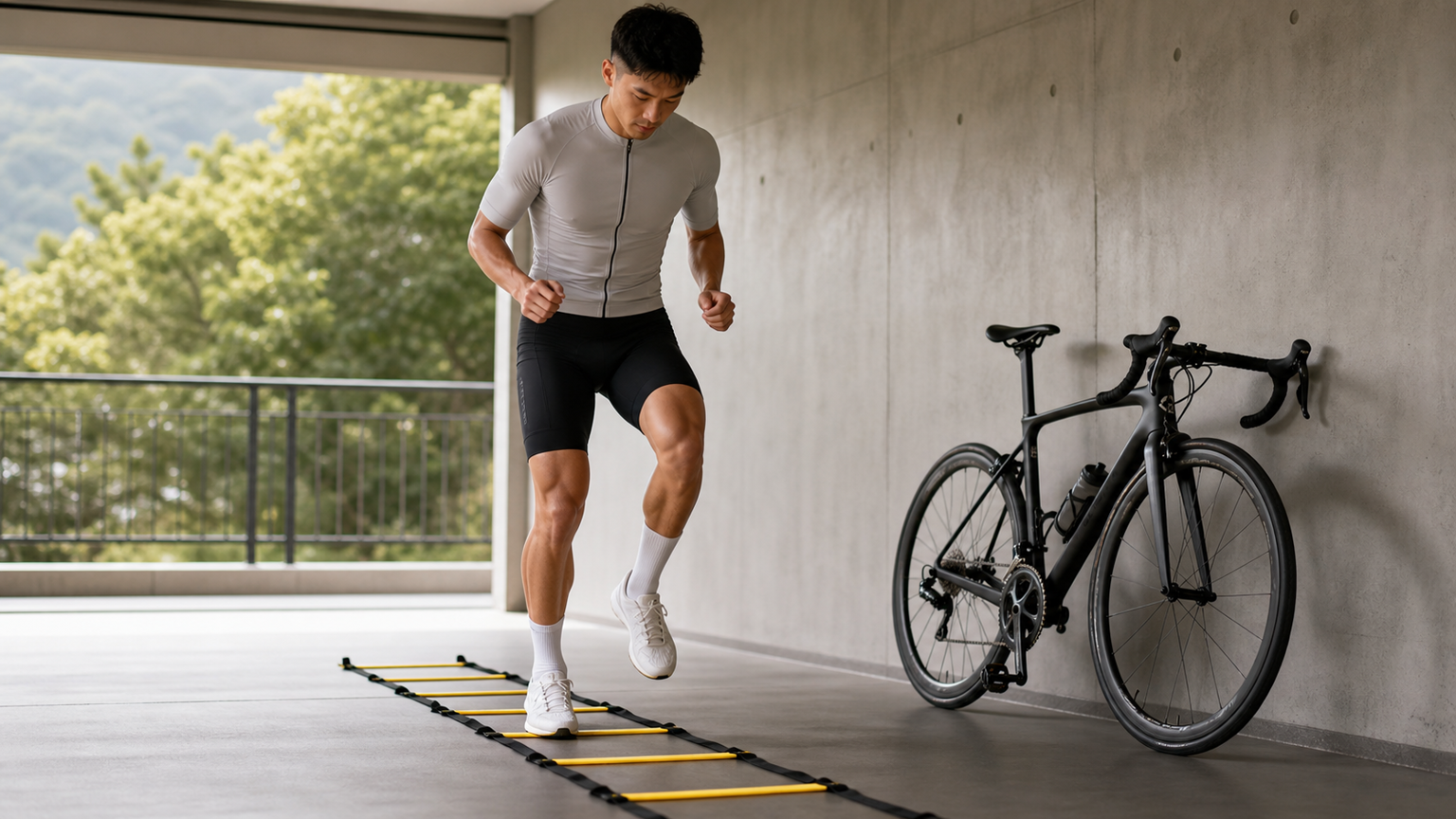
Agility Ladder Training
The agility ladder is another excellent neuromuscular training tool that directly improves foot speed and coordination.
Basic Movements
1. One-In
One foot in each square, moving forward quickly. Emphasizes light footwork and even rhythm.
2. Two-In
Both feet step into each square before advancing, training rapid weight shifting.
3. Lateral Crossover
Move sideways with one foot crossing into the square, training hip rotation and coordination.
4. Ickey Shuffle
Alternate stepping into squares left and right—a more complex footwork pattern that highly trains the nervous system’s movement planning ability.
Transfer Benefits of Agility Training to Cycling
- Improved neural recruitment speed during pedaling: Faster neural signal transmission makes explosive pedal strokes more powerful
- Improved balance: More precise body control on rough terrain or during high-speed cornering
- Injury prevention: Enhanced rapid reaction ability on descending mountain roads
Integrating into Your Training Plan
Suggested schedule:
| Timing | Jump Rope/Agility Training | Duration |
|---|---|---|
| Pre-ride warm-up | Light jump rope | 5 minutes |
| Non-riding days (cross-training) | Jump rope intervals + agility ladder | 20–30 minutes |
| Post-weight-training supplement | Jump rope Tabata | 10 minutes |
Weekly frequency: 2–3 sessions are sufficient to achieve significant benefits
Precautions
- Start on hardwood floors or grass; avoid extensive practice on concrete (higher impact)
- Wear athletic shoes with arch support (running shoes or training shoes, not cycling shoes)
- If you have a history of ankle injuries, start at low intensity and gradually increase training volume
- Heavier individuals should shorten training duration initially to allow the ankles and calf tendons to adapt
Conclusion
Jump rope and agility training are the “hidden weapons” of cycling training—low training cost, short training time, yet they precisely target and strengthen the neuromuscular coordination weaknesses of cyclists. Spend 20–30 minutes per week on this type of training, and you will feel genuine neurological-level progress on your next high-intensity climb or final sprint.
Related Reading
- Neuromuscular Training for Cyclists: Scientific Methods to Enhance Explosive Power and Pedaling Efficiency
- Sprint Power Training for Cyclists: Neuromuscular Activation and Workout Design
- The Impact of Muscle Coordination Training on Riding Efficiency: Neural Control Research on Multi-Joint Movements
- Dance Training: An Unexpected Shortcut to Improving Coordination and Flexibility
#公路車 #Fitting 靠人工智慧APP 幫你調整單車
6 年前
西進武嶺 免費訓練分析服務 Intervals | 練不夠還是練過頭?你哪一種類型選手?AI模型告訴你! | 備戰神器 | 公路車 訓練 | CT Yeh
4 年前
訓練台體驗) 2019台北自行車展 三大家 訓練台體驗 Tacx Neo Flux 2 Xepdo Apx Wahoo Kickr
7 年前
[教學] Premiere 影片 手震 修正 教學 防抖 單眼 影像 GoPro 穩定 Video Stabilization
8 年前
#PUSHBIKE 原來這麼好玩! 小朋友 滑步車 初體驗 超可愛
6 年前
ThinkRider 智騎 XXPRO 訓練台,高階機種功能 只要 1/3價格!? 實測功率對比、噪音實測 / 公路車 / CT Yeh
1 年前
白沙屯媽祖進香在家走!UREVO 坡度自調走步機 / 可連接訓練遊戲APP MyWhoosh / 邊看直播邊走起來 / CT Yeh
11 個月前
單車AI教練!全新 ChatGPT4o 幫你分析訓練成果!排武嶺課表,分析騎車姿勢! 太神了! / 公路車 / CT Yeh / feat. 緯緯
2 年前