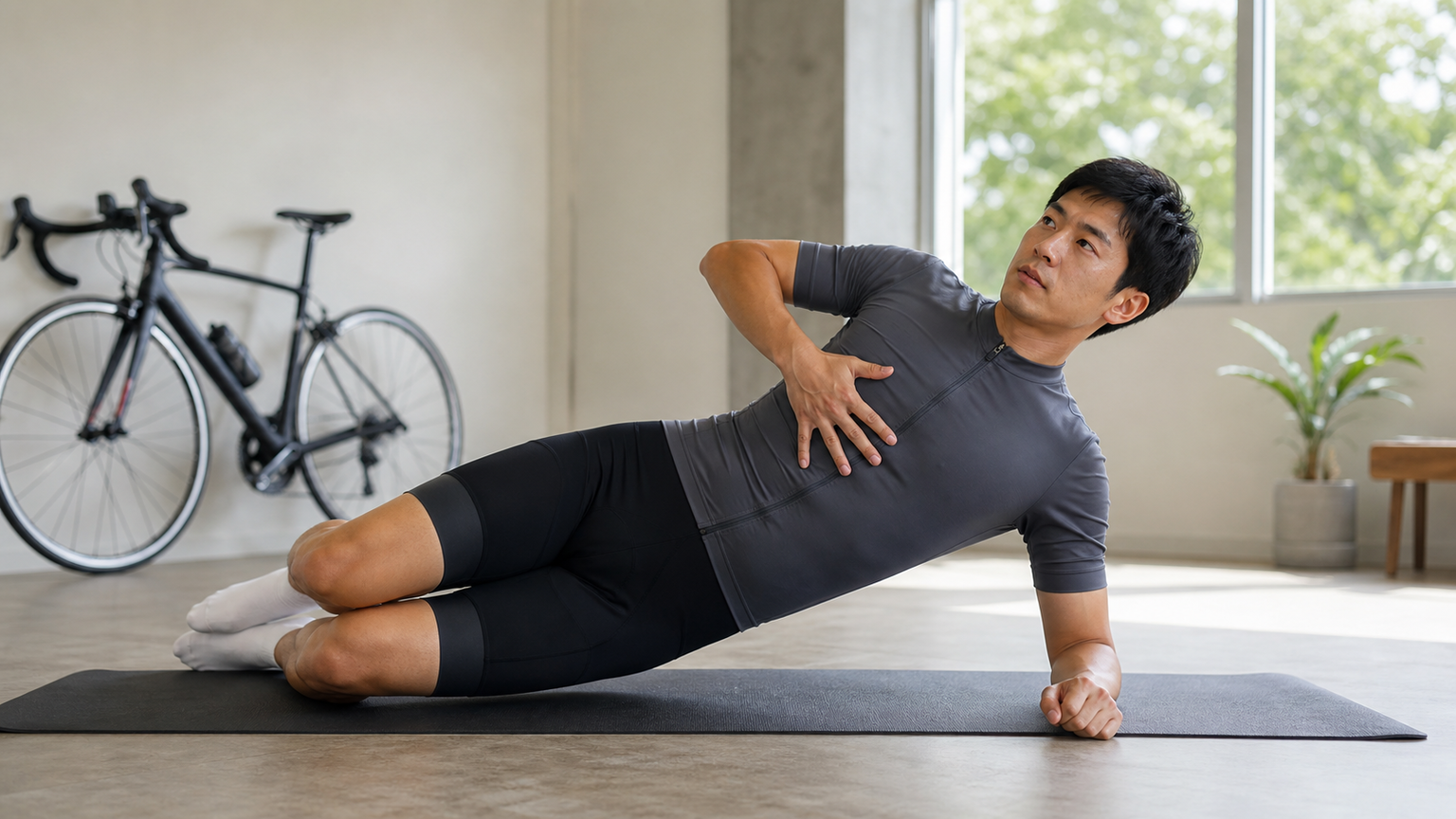
Benefits of Pilates for Cyclists: Breathing Control and Posture Correction
Pilates was developed by German physical educator Joseph Pilates in the early 20th century, originally designed to help dancers and athletes recover from injuries and prevent them. Its core philosophy is to strengthen deep muscle groups and improve posture through precise movement control and coordinated breathing. These goals align closely with the training needs of cyclists, making Pilates an increasingly popular supplementary training option for both professional and amateur riders.
The Six Principles of Pilates
Before looking at specific exercises, it’s important to understand the core principles of Pilates training, which explain why it is particularly effective for cyclists:
- Concentration: Each movement requires full focus, training the mind-body connection
- Control: Movement quality takes priority over quantity, avoiding compensatory movements
- Centre/Powerhouse: All movements originate from the core
- Flow: Movements are连贯 and fluid, not isolated muscle contractions
- Precision: Precise movement positioning matters more than repetition count
- Breathing: Each movement is coordinated with a specific breathing rhythm
The Most Valuable Pilates Benefits for Cyclists
Benefit 1: Deep Core Muscle Activation
General weight training and fitness routines tend to engage the superficial large muscles, but the most critical muscles for spinal stability are actually the deep multifidus and transversus abdominis. Pilates exercises are precisely designed to target these deep muscle groups, strengthening them in isolation without activating the superficial muscles.
The significance for riding: better segmental spinal stability, meaning less power loss with every pedal stroke.
Benefit 2: Restoring Thoracic Spine Mobility
The forward-leaning riding position gradually reduces thoracic spine mobility (fixed thoracic kyphosis). The spinal extension, rotation, and lateral flexion movements in Pilates can progressively restore the thoracic spine’s range of motion in multiple directions, improving upper-body comfort and control while riding.
Benefit 3: Pelvic Position Correction
Both anterior and posterior pelvic tilt while riding can affect pedaling efficiency and lower back health. Pilates pelvic neutral training helps cyclists find the optimal pelvic position and trains the muscle memory to maintain this position during dynamic movement.
Benefit 4: Improved Breathing Efficiency
Pilates breathing training emphasizes lateral rib breathing—where the ribs expand sideways on inhalation rather than just the abdomen rising. This breathing method allows for deep breathing while the core remains contracted (maintaining spinal stability), which is highly relevant to the need to simultaneously stabilize the core and take in large volumes of air during high-intensity riding.
The Best Pilates Exercises for Cyclists
1. The Hundred
Training Focus: Core isometric contraction, breathing rhythm training
Lie on your back with legs extended or knees bent at 90 degrees lifted off the floor, lift the head and shoulders, and pump the arms rapidly up and down (small range) at your sides. Inhale for 5 counts and exhale for 5 counts as one set, completing 10 sets (100 pumps total).
This exercise simultaneously trains core isometric contraction and rhythmic breathing, making it the most classic Pilates exercise.
2. Spine Stretch Forward
Training Focus: Spinal flexibility, hamstring stretch
Sitting position, legs extended and spread apart. Inhale to sit tall, then exhale as you flex forward vertebra by vertebra starting from the head (not bending at the waist), reaching the arms forward. The emphasis is on sequential spinal flexion rather than folding forward as one unit.
3. Rolling Like a Ball
Training Focus: Segmental spinal mobility, deep abdominal muscles
Sit on the mat, hug the knees into a ball shape, and roll back and forth along the axis of the spine. The contact sensation of each vertebra allows you to feel which segment of the spine has restricted mobility, while also massaging the muscles alongside the spine.
4. Swan Dive
Training Focus: Spinal extension, back muscle control
Lie face down with hands placed beside the shoulders. Lift the upper body using back strength (not arm pushing), with eyes looking forward. Hold for 5–8 seconds, then lower slowly. This is a direct countermeasure to the thoracic kyphosis caused by the forward-leaning riding position.
5. Side-Lying Leg Circles
Training Focus: Hip joint mobility, pelvic stability
Lie on your side with the lower leg extended, lift the upper leg forward to hip height, and draw circles (8 times forward, 8 times backward). The pelvis must remain completely still—only the leg moves. This exercise trains full-range hip joint mobility and strengthens the pelvic stabilizer muscles.
6. Shoulder Bridge
Training Focus: Glutes and hamstrings, segmental spinal control
Lie on your back with knees bent and feet on the floor. Lift the spine vertebra by vertebra into a shoulder bridge position. Advanced version: at the top of the bridge, lift one leg and extend it. The emphasis on lifting segment by segment (rather than the entire spine leaving the floor at once) makes this Pilates’ most representative spinal control exercise.
Mat Pilates vs. Reformer Pilates
Mat Pilates: Requires no equipment and can be done at home, making it suitable for cyclists as a daily supplementary training.
Reformer Pilates: Uses equipment such as the Reformer spring bed, offering more resistance and assistance options, allowing for a wider variety of exercises, but requires professional facilities.
It is recommended that beginners take a few one-on-one sessions with a qualified Pilates instructor to ensure movement quality before transitioning to self-directed mat training.
Recommended Training Frequency
- Beginners: 2 sessions per week, 45 minutes each, with instructor guidance recommended for the first 4–6 sessions
- Advanced trainees: 1–2 sessions per week as a supplement to riding training
- Best timing: On non-high-intensity riding days, or as recovery activity after rides
Conclusion
Pilates provides three key elements that cycling training lacks: deep core activation, posture correction, and breathing control. Improvements in these three areas directly translate to greater stability, comfort, and efficiency on the bike. Compared to other supplementary training methods, Pilates has a steeper learning curve, but once you master the basic principles, you will have a body maintenance toolkit that can accompany you throughout your entire athletic career.
Related Reading
- Respiratory Muscle Training: The Scientific Benefits of Inspiratory Muscle Training (IMT) for Cycling Performance
- Breathing Efficiency Training for Cyclists: Nasal Breathing, Rhythmic Breathing, and Diaphragmatic Breathing
- Flexibility Training for Cyclists: How Yoga Improves Riding Posture
- Breathing Techniques While Riding: The Efficiency Secret Most Cyclists Don’t Know
#公路車 #Fitting 靠人工智慧APP 幫你調整單車
6 年前
靠單車減肥35公斤 心得分享與整理
7 年前
公路車 爬坡 破PR 紀錄 小技巧 分享
6 年前
Insta 360 One 超級防手震技術實測
7 年前
[教學] Dashware 教學 如何製作有 速度 功率 心律的 騎車影片 Guages Video
8 年前
#PUSHBIKE 原來這麼好玩! 小朋友 滑步車 初體驗 超可愛
6 年前
單車AI教練!全新 ChatGPT4o 幫你分析訓練成果!排武嶺課表,分析騎車姿勢! 太神了! / 公路車 / CT Yeh / feat. 緯緯
2 年前
西進武嶺 免費訓練分析服務 Intervals | 練不夠還是練過頭?你哪一種類型選手?AI模型告訴你! | 備戰神器 | 公路車 訓練 | CT Yeh
4 年前