Application of Functional Movement Screen (FMS) in Cycling
The Functional Movement Screen (FMS) was developed by physical therapists Gray Cook and Lee Burton in 1997, originally designed to assess whether athletes possess sufficient foundational movement capacity to safely engage in high-intensity training. In recent years, FMS has seen increasingly widespread application in professional cycling, with multiple pro teams incorporating it into their annual physical assessment systems to identify potential injury risks and develop individualized corrective training programs.
Core Philosophy of FMS
The fundamental premise of FMS is that all complex athletic performance is built upon foundational movement patterns. If deficiencies exist in basic movements (such as restricted hip mobility on one side or insufficient spinal stability), high-intensity training layered on top of these deficiencies not only yields limited benefits but also accelerates the onset of injury.
In other words: Ensure movement quality first, then pursue movement intensity.
The Seven FMS Movement Patterns
FMS comprises seven test movements, each scored 0–3 (0 = pain, 1 = incomplete movement, 2 = complete movement with compensation, 3 = perfect movement), for a total score of 21.
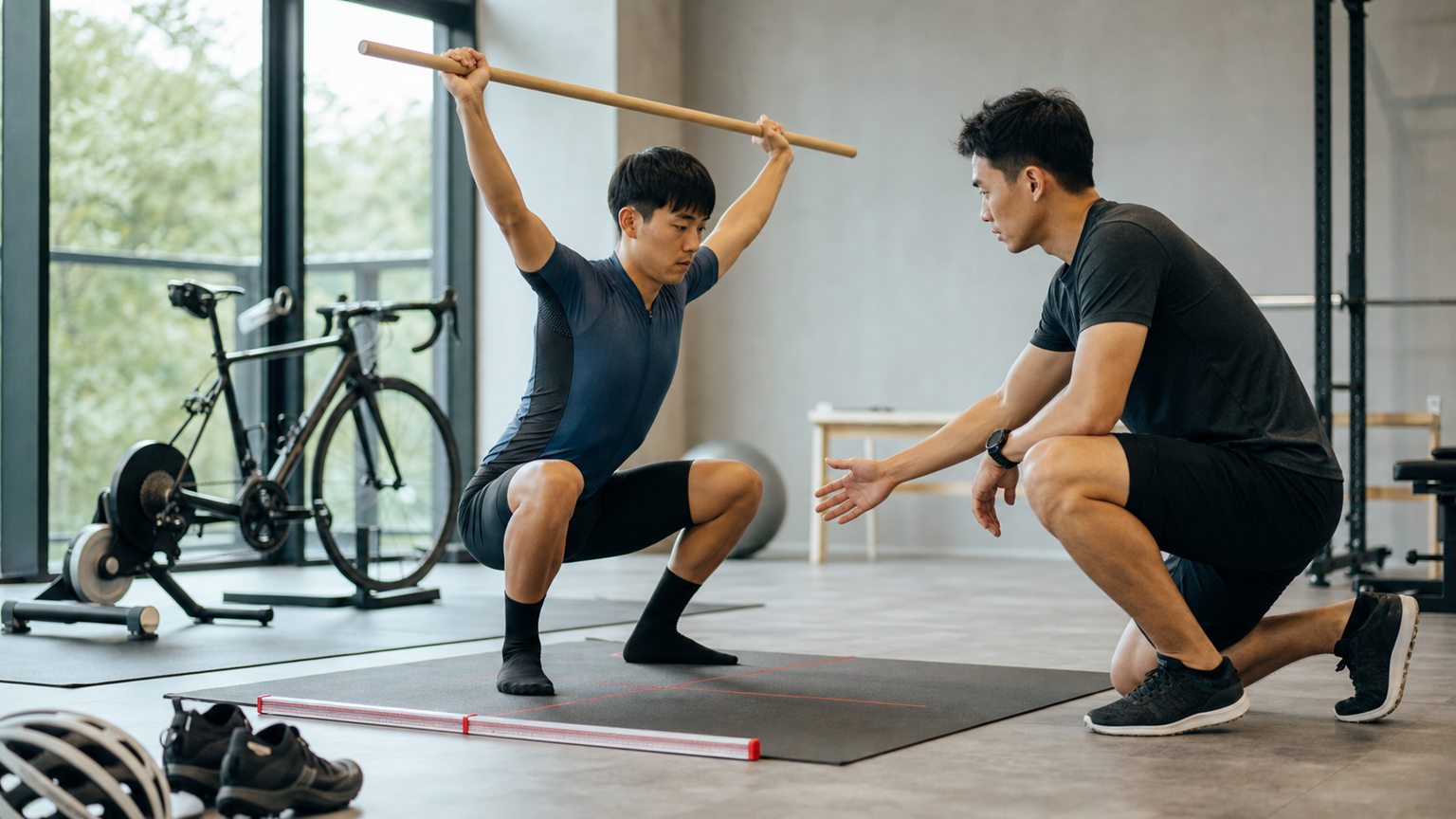
1. Deep Squat
Test Purpose: Assess whole-body bilateral symmetrical functional mobility, including coordinated movement of the ankles, knees, hips, thoracic spine, and shoulders.
Cycling Relevance: The deep squat movement pattern directly reflects joint coordination during the pedaling motion. A low deep squat score (1–2) typically indicates insufficient ankle dorsiflexion or hip mobility, which particularly affects power output during climbing efforts.
Common Deficiencies:
- Insufficient ankle dorsiflexion (heels lifting off the ground) → Correction: ankle mobility training
- Thoracic kyphosis (rounded upper back) → Correction: thoracic extension training
- Knee valgus (knees caving inward) → Correction: gluteus medius strengthening
2. Hurdle Step
Test Purpose: Assess single-leg stance stability and functional hip mobility during the stepping motion.
Cycling Relevance: Mimics the single-leg support phase of pedaling, evaluating the supporting leg’s stability during each pedal stroke. Asymmetrical scores (left-right differences) directly indicate left-right imbalances in pedaling force.
Common Deficiencies:
- Pelvic shift (excessive lateral deviation of the stepping leg’s knee) → Correction: hip abductor strengthening
- Insufficient ankle dorsiflexion → Correction: calf stretching
3. In-Line Lunge
Test Purpose: Assess hip, knee, and ankle coordination while maintaining single-leg stability in the sagittal plane.
Cycling Relevance: Evaluates sagittal plane stability during the pedaling motion and coordination between the front and rear legs. Asymmetrical scores are commonly associated with tight hamstrings or tight hip flexors.
4. Shoulder Mobility
Test Purpose: Assess composite shoulder joint mobility (combination of external rotation + extension and internal rotation + flexion).
Cycling Relevance: Affects handlebar grip comfort and neck-shoulder fatigue. Cyclists with insufficient shoulder mobility often exhibit excessive shoulder shrugging or spinal compensation, leading to neck and shoulder pain during long rides.
5. Active Straight-Leg Raise
Test Purpose: Assess active hamstring flexibility and contralateral hip stability.
Cycling Relevance: Directly tests the hip flexion flexibility required for the upstroke phase of pedaling (from the 12 o’clock to 3 o’clock position). A low score (1–2) indicates an inability to fully utilize the complete pedal stroke, limiting the effective pedaling range.
6. Trunk Stability Push-Up
Test Purpose: Assess spinal stability during dynamic upper extremity movements.
Cycling Relevance: Evaluates the core’s ability to maintain spinal stability during upper-body weight support while riding. Low scores are common in riders with insufficient deep core musculature, manifesting as excessive lumbar flexion or pain while riding.
7. Rotary Stability
Test Purpose: Assess trunk stability during multiplanar movements; it is the most complex FMS test.
Cycling Relevance: Although cycling itself is a linear sport, the neuromuscular coordination assessed by this test directly influences the body’s stability responses on uneven surfaces (bumpy roads, heavy-gear climbing).
Developing Corrective Training Based on FMS Results
Interpretation Principles
- Total score < 14: Significantly higher injury risk; corrective training should take priority, and high-intensity training should be postponed
- Any component scoring 0 (with pain): Seek evaluation from a physical therapist; do not continue training until the pain resolves
- Left-right asymmetry (score difference between sides on the same movement): Asymmetry warrants more urgent correction than an absolute low score
- Total score > 14 but with a 1-point component: Correct the 1-point component without affecting overall training progression
Corrective Exercises for the Most Common Deficiencies in Cyclists
Insufficient ankle dorsiflexion (affects Deep Squat/Hurdle Step):
- Wall lunge ankle mobility drill: toes 10–15 cm from the wall, drive the knee forward to touch the wall (without letting the heel lift), 2 minutes per side
- Calf stretches (gastrocnemius + soleus)
Tight hip flexors (affects In-Line Lunge/Active Straight-Leg Raise):
- Low lunge hip flexor stretch (60–90 seconds per side)
- Glute Bridge to activate the glutes as primary hip extensors
Weak gluteus medius (affects pelvic stability in Hurdle Step):
- Banded Clam Shell
- Side-lying leg raises
- Single-leg squats (slow tempo, focusing on knee tracking)
Insufficient thoracic mobility (affects Deep Squat):
- Foam roller thoracic extension
- Cat-Cow
- Thread the Needle rotational stretch
Practical Application Process of FMS for Cyclists
- Annual baseline assessment: Perform FMS scoring before the season begins and record baseline values
- Targeted correction: Schedule corrective training 2–3 times per week (15–20 minutes per session) based on low-scoring and asymmetrical components
- Reassessment after 6 weeks: Confirm whether corrective training has effectively improved deficient movement patterns
- Integrate into warm-up: Gradually incorporate corrective movements into the dynamic warm-up before every ride
- Ongoing monitoring: Reassess every 8–12 weeks during the season
Where to Get an FMS Assessment?
- Certified FMS assessors (searchable on the official FMS website)
- Sports physical therapy clinics
- Professional bike fitting studios (some offer FMS assessment services)
Conclusion
FMS brings an important paradigm shift to cycling training: from “train more, ride faster” to “ensure movement quality before pursuing intensity.” Through systematic movement assessment and targeted corrective training, cyclists can more effectively prevent chronic injuries and ensure that every high-intensity session is built on a more solid movement foundation. Whether you are a recreational enthusiast or a competitive athlete, investing in a professional FMS assessment provides valuable directional guidance for your training program.
Related Reading
- Application of Functional Movement Screen (FMS) in Road Running Training
- Running-Specific Fitness Testing: Application of FMS Functional Movement Screening for Runners
- Functional Strength Training: The Scientific Approach to Enhancing Endurance Performance
- Beginner’s Guide to Weight Training for Cyclists: Proper Form for Squats, Deadlifts, and Single-Leg Exercises
#公路車 #Fitting 靠人工智慧APP 幫你調整單車
6 年前
西進武嶺 免費訓練分析服務 Intervals | 練不夠還是練過頭?你哪一種類型選手?AI模型告訴你! | 備戰神器 | 公路車 訓練 | CT Yeh
4 年前
DJI Osmo Action 6 / 單車運動拍攝實用技巧 公路車 CT Yeh
7 個月前
Fitting訓練兩用功率車 ! Thinkrider ST900 完整實測!/ 坡度升降 / 鄰居測試/ smart bike/公路車/ CT Yeh
2 年前
西進武嶺配速器 3.0更新 / NEW 免功率FTP估算! / 大數據xAI體能模型 / 如何模擬人止關前集團效應 / 配速儲存功能 / AI全台自行車賽事行事曆 / 公路車 / CT Yeh
1 年前
多機位拍片神器 DJI Action 2 拍出速度張力感 | 類空拍機視角 4陣列麥克風超強降風噪 實測! | 公路車 | CT Yeh
3 年前
[教學] Dashware 教學 如何製作有 速度 功率 心律的 騎車影片 Guages Video
8 年前
DJI Osmo Action 4 / 單車運動攝影最佳選擇!比賽 2.5 H 續航測試 / 超強夜拍 / 墾丁&日本實地拍攝測試! GoPero / 公路車 / CT Yeh
3 年前