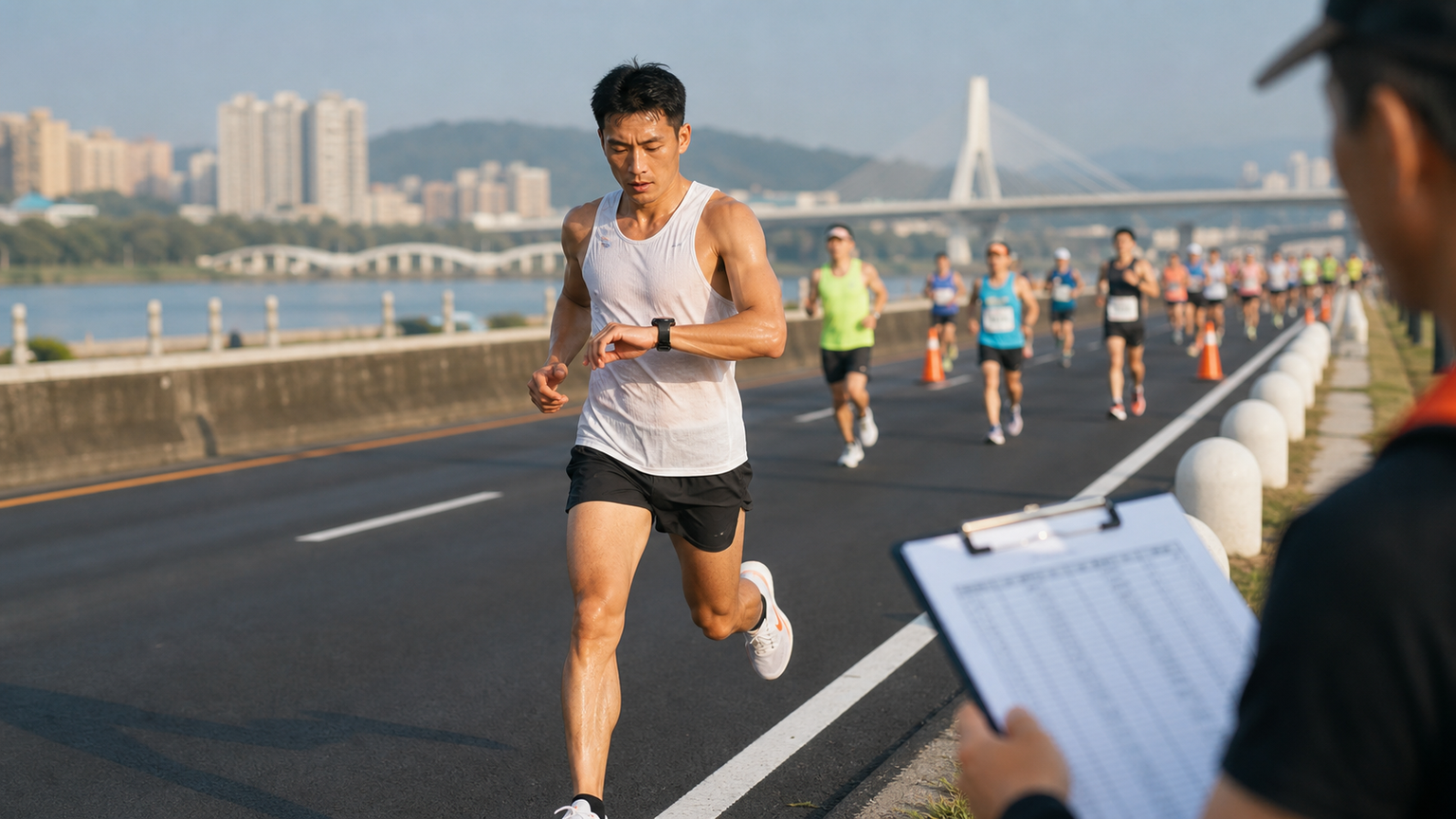
Marathon Pacing Strategy: How to Calculate and Maintain an Even Pace
The most common reason for failing a marathon is not a lack of endurance, but poor pacing. Many runners get caught up in the excitement and start too fast, only to crash in the second half—commonly known as “hitting the wall.” This article will help you build a scientific pacing system to carry you from start to finish across the 42.195-kilometer race.
1. Why Pacing Matters So Much
A marathon is an aerobic endurance event, with glycogen as its primary fuel source. The body stores enough glycogen to support 90 to 120 minutes of high-intensity exercise. If you run the first half too fast, glycogen is depleted prematurely, and the latter half forces you to rely on fat metabolism, causing a significant drop in speed.
Research shows that runners who finish with a negative split (faster second half) or an even pace finish 8 to 12 minutes faster on average than those with a positive split.
2. How to Calculate Your Target Pace
Step 1: Confirm Your Goal Finish Time
Estimate a realistic finish time based on your training data from the last 3 months. You can use the reference table below:
| Recent 10K Time | Estimated Half Marathon Time | Estimated Full Marathon Time |
|---|---|---|
| 45 minutes | 1:40 | 3:30 |
| 50 minutes | 1:52 | 3:55 |
| 55 minutes | 2:04 | 4:20 |
| 60 minutes | 2:16 | 4:45 |
| 65 minutes | 2:28 | 5:10 |
Note: A full marathon is not simply double a half marathon; you typically need to add a 10 to 15% buffer.
Step 2: Convert to Per-Kilometer Pace
Formula: Goal finish time (minutes) ÷ 42.195 = per-kilometer pace (min/km)
Example: Goal finish time of 4 hours
- 4 hours = 240 minutes
- 240 ÷ 42.195 ≈ 5:41 /km
Step 3: Adjust for Terrain
If the course has elevation changes, adjust according to these principles:
- Uphill: Slow down by about 30 to 45 seconds for every 100 meters of climbing
- Downhill: Do not deliberately speed up; keep your legs relaxed
3. Race Pacing Execution Strategy
First 10 Kilometers: Start Conservatively
Most runners are advised to run the first 10 kilometers 5 to 10 seconds slower than target pace, for these reasons:
- The starting crowd is congested, making it unwise to force acceleration
- Body temperature and muscles are not yet fully warmed up
- Mental excitement can easily make you run too fast
Kilometers 11 to 30: The Steady Rhythm Zone
This is the “main battleground” of the marathon, where you need to:
- Maintain target pace within ±5 seconds
- Check your average pace every 5 kilometers
- Hydrate and fuel normally
Kilometers 31 to 42: Strategic Finish
- If you feel good, you can gradually accelerate after kilometer 35
- If you experience muscle pain or heaviness, simply hold your pace
- Give it everything you have in the final 3 kilometers
4. Using a GPS Watch to Assist Pacing
Modern GPS watches (Garmin, COROS, Apple Watch) all feature a “target pace alert” function. Here’s how to set it up:
- Set your target pace (e.g., 5:40/km)
- Enable the upper and lower deviation alerts (±10 seconds)
- The watch vibrates to prompt you to adjust your stride
5. Pacing Notes for Taiwan Marathon Courses
Characteristics of common races in Taiwan:
| Race | Course Characteristics | Pacing Advice |
|---|---|---|
| Taipei Marathon | Flat, affected by easterly winds | Even pace strategy is viable |
| Taroko Marathon | Canyon terrain, slightly rolling | Be conservative in the first half |
| Wan Jin Shi Marathon | Flat along the coast but windy | Watch out for headwind sections |
| Tianzhong Marathon | Flat rural roads, extremely flat | Suitable for a PB attempt |
6. How to Recover from Pacing Mistakes
If you find you’ve run the first 10 kilometers too fast, don’t panic:
- Slow down immediately: Drop to 10 to 15 seconds slower than target
- Increase fueling frequency: Take water and electrolytes at every aid station
- Shorten your stride: Reduce energy expenditure per step
- Adjust your breathing: Slow your breathing rhythm to lower your heart rate
7. Mental Pacing Techniques
- Segment goals: Break the 42 kilometers into four 10-kilometer segments, setting a small goal for each
- Don’t compare: Don’t follow the runners next to you; trust your own pacing plan
- Positive self-talk: When fatigued, motivate yourself with phrases like “I can hold this pace”
Conclusion
Pacing is one of the most important skills in the marathon, and it requires repeated calibration through tune-up races and long runs. Before your goal race, complete at least 2 to 3 “pace-training long runs” (running 25 to 30 kilometers at your target pace) so your body becomes familiar with the rhythm. Remember: Slow down, and you’ll run faster.
Related Reading
- Marathon Race Tactics: Pace Management from the Start to the Final 10K
- Marathon Pace Training: Precisely Mastering Your Target Pace
- The Science of Marathon Pacing Strategies: Comparing Even Splits, Negative Splits, and Positive Splits
- Pacing Consistency and Finish Time: The Physiological Basis of Starting Slow and Finishing Fast
西進武嶺 免費訓練分析服務 Intervals | 練不夠還是練過頭?你哪一種類型選手?AI模型告訴你! | 備戰神器 | 公路車 訓練 | CT Yeh
4 年前
西進武嶺 自製新版AI配速表產生器 x 賽前攻略 抱佛腳! 沒有功率計也可以產生配速表嗎?有什麼其他眉角賽前要注意的呢? | 西進武嶺 / 東進武嶺 KOM 攻略 | 公路車 | CT Yeh
4 年前
西進武嶺各路段 前8000名 大數據分析 配速攻略/功率/心律/推力比/維持率/踏頻/踏瓦比/牽車率 大公開 | 建大盃 NeverStop 可參考 | 公路車 | CT Yeh
5 年前
#公路車 #西進武嶺 配速配瓦實驗 坡度分析 四小時內攻略 建大盃 NeverStop #西進武嶺攻略
6 年前
武嶺配速表最佳使用方式 #bike
1 年前
Live) 備戰2019彰化經典百K 賽前攻略 (已完賽請看新影片
7 年前
西進武嶺配速器 3.0更新 / NEW 免功率FTP估算! / 大數據xAI體能模型 / 如何模擬人止關前集團效應 / 配速儲存功能 / AI全台自行車賽事行事曆 / 公路車 / CT Yeh
1 年前
#公路車 #Fitting 靠人工智慧APP 幫你調整單車
6 年前