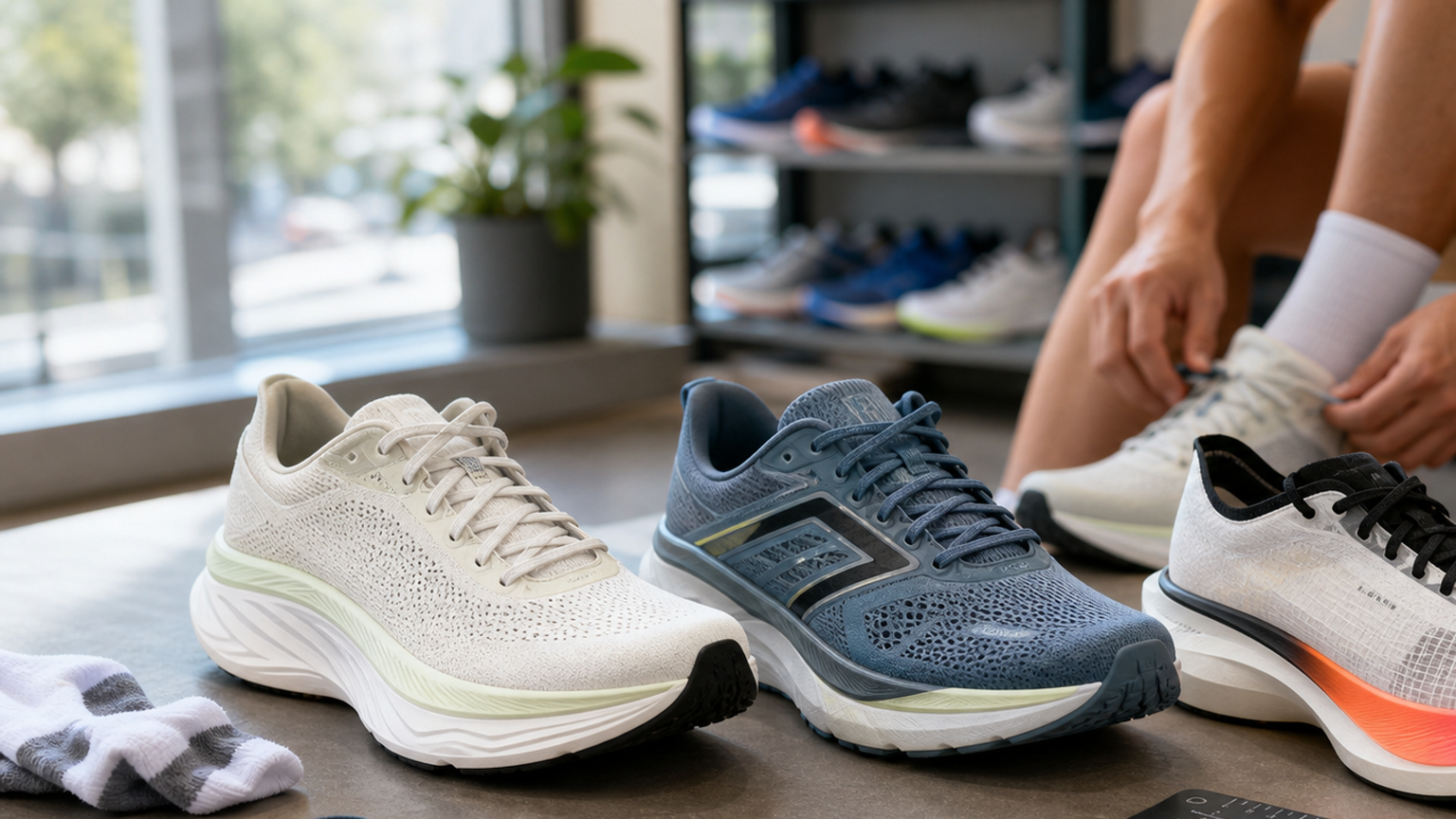
Running Shoe Buying Guide: Cushioning, Stability, and Racing — How to Choose
Running shoes are a runner’s most important piece of equipment. Choosing correctly can improve performance and prevent injury. However, the running shoe market is packed with options, which can be overwhelming. This article walks you through functional categories, foot type analysis, and model recommendations to help you find the shoe that’s right for you.
1. Basic Running Shoe Structure
Understanding shoe structure helps you understand the differences between shoe types:
| Part | Function |
|---|---|
| Upper | Coverage and breathability |
| Midsole | Cushioning and energy return (most important) |
| Outsole | Traction and durability |
| Heel-to-toe Drop | Height difference between heel and forefoot |
| Toe Box | Forefoot width |
2. Three Main Types of Running Shoes
Type 1: Cushioned/Neutral Shoes
Best for:
- Runners with normal or high arches
- Light forefoot strikers
- Casual runners prioritizing comfort
Features:
- Generous midsole cushioning
- Thicker soles (30-40mm or more)
- Relatively heavier (260-300g)
Recommended models:
- HOKA Clifton series
- New Balance 1080 series
- Brooks Ghost series
- ASICS Gel-Nimbus series
Type 2: Stability Shoes
Best for:
- Mild to moderate overpronators (flat feet)
- Runners whose knees tend to cave inward while running
- Runners with runner’s knee or IT band issues
Features:
- Reinforced support material on the medial side
- More structured than cushioned shoes
- Can help correct gait
Recommended models:
- ASICS GT series
- Brooks Adrenaline GTS series
- New Balance 860 series
- Saucony Guide series
Type 3: Racing Shoes
Best for:
- Intermediate to advanced runners chasing a PB
- Runners with an already stable running form
- Race day use
Features:
- Carbon or nylon plate for enhanced energy return
- Ultra-lightweight design (180-220g)
- High-rebound super foam (PEBA material)
Recommended models:
- Nike Vaporfly series
- ASICS Metaspeed series
- Adidas Adizero Adios Pro series
- HOKA Rocket X series
3. How to Determine Your Foot Type
Wet Footprint Test
- Wet your feet and stand on a piece of paper
- Observe the shape of the footprint
| Footprint type | Foot type | Recommended shoe |
|---|---|---|
| Full footprint visible | Flat feet (overpronation) | Stability |
| Clear gap in the middle | Normal arch | Cushioned or neutral |
| Almost no print in the middle | High arch (supination) | High-cushion cushioned shoes |
Checking Wear Patterns on Existing Shoes
- More wear on the inner sole: Overpronation → choose stability shoes
- More wear on the outer sole: Supination → choose cushioned shoes
- Even wear at the heel: Normal gait
4. Important Buying Parameters
Heel-to-Toe Drop
| Drop value | Characteristics | Suitable running style |
|---|---|---|
| 0-4mm (minimalist) | Emphasizes natural gait | Forefoot strike |
| 5-8mm (low drop) | Neutral, leaning natural | Midfoot strike |
| 9-12mm (standard) | Traditional design | Heel strike |
| Above 12mm | Emphasizes cushioned protection | Beginners, heel strikers |
If switching from a high-drop to a low-drop shoe, transition gradually — otherwise you risk Achilles tendon injury.
Toe Box Width
Taiwanese feet tend to be wider on average, so consider:
- New Balance and ASICS often offer 2E (wide) width options
- Altra is known for a wide toe box
- European brands (Salomon, ON) tend to run narrower
5. Fitting Tips
- Try shoes on in the afternoon: Feet swell slightly in the afternoon, giving you the most accurate sizing
- Wear thick running socks: Don’t test with thin cotton socks
- Leave room in the toe box: There should be about 1cm of space between your big toe and the front of the shoe
- Jog in place to test: Take a few light jogging steps in the store to check comfort
- Measure both feet: Most people’s feet differ slightly in size
6. When to Replace Your Running Shoes
| Indicator | Replacement condition |
|---|---|
| Mileage | After 500-800km (depending on material) |
| Appearance | Midsole shows creasing or compression deformation |
| Feel | Noticeable decline in cushioning |
| Time | Even with low mileage, replace after 2 years |
7. Where to Buy in Taiwan
- Physical stores: Bodo Sports, ParkourSports, ASICS stores (professional staff can analyze your foot type)
- Online: MOMO, PChome, official brand websites (recommended to try shoes on in person before buying online)
- Japan proxy purchasing: Some models have Taiwan-unreleased versions in Japan, sometimes at better prices
Conclusion
No single shoe suits everyone. Only by understanding your own foot type, running form, and training goals can you find the running shoe that’s right for you. It’s recommended to own two pairs of running shoes and rotate between them, which extends their lifespan and gives the midsole time to rebound and recover. Investing in a good pair of running shoes is one of the most cost-effective ways to prevent injury.
Related Reading
再快都跟的上!? 單車跟隨攝影機之王 HOVERAir X1 PROMAX 全面實測 / 唯一!8K畫質&自行車專用模式和跟蹤信標&前後避障 / DJI Neo 可參考/ 公路車 / CT Yeh
1 年前
單車 一日北高 ( 雙城 ) 肥宅雙人瘋狂行 紀錄片 REACTO
10 年前
車錶新黑馬? / 超狂續航 / 超好用錶冠 / 無敵準定位 / Dash圖表合成!?/ COROS DURA 評測!/ 公路車 / CT Yeh
2 年前
Nepest NOVA 碳條輪組:輕量、空力、舒適一次滿足!/ 公路車 / CT Yeh
7 個月前
[教學] Premiere 影片 手震 修正 教學 防抖 單眼 影像 GoPro 穩定 Video Stabilization
8 年前
白沙屯媽祖進香在家走!UREVO 坡度自調走步機 / 可連接訓練遊戲APP MyWhoosh / 邊看直播邊走起來 / CT Yeh
11 個月前
2025 自行車錶排行榜 兩萬車友大數據 / Garmin Bryton 排名會大洗牌嗎? / 全新的碼表前身分析 /公路車 / CT Yeh
1 年前
2026 車錶排行榜!誰是最多車友正在使用?練家子最愛哪款?🏆 (2萬名車友數據) / 公路車 / CT Yeh
5 個月前