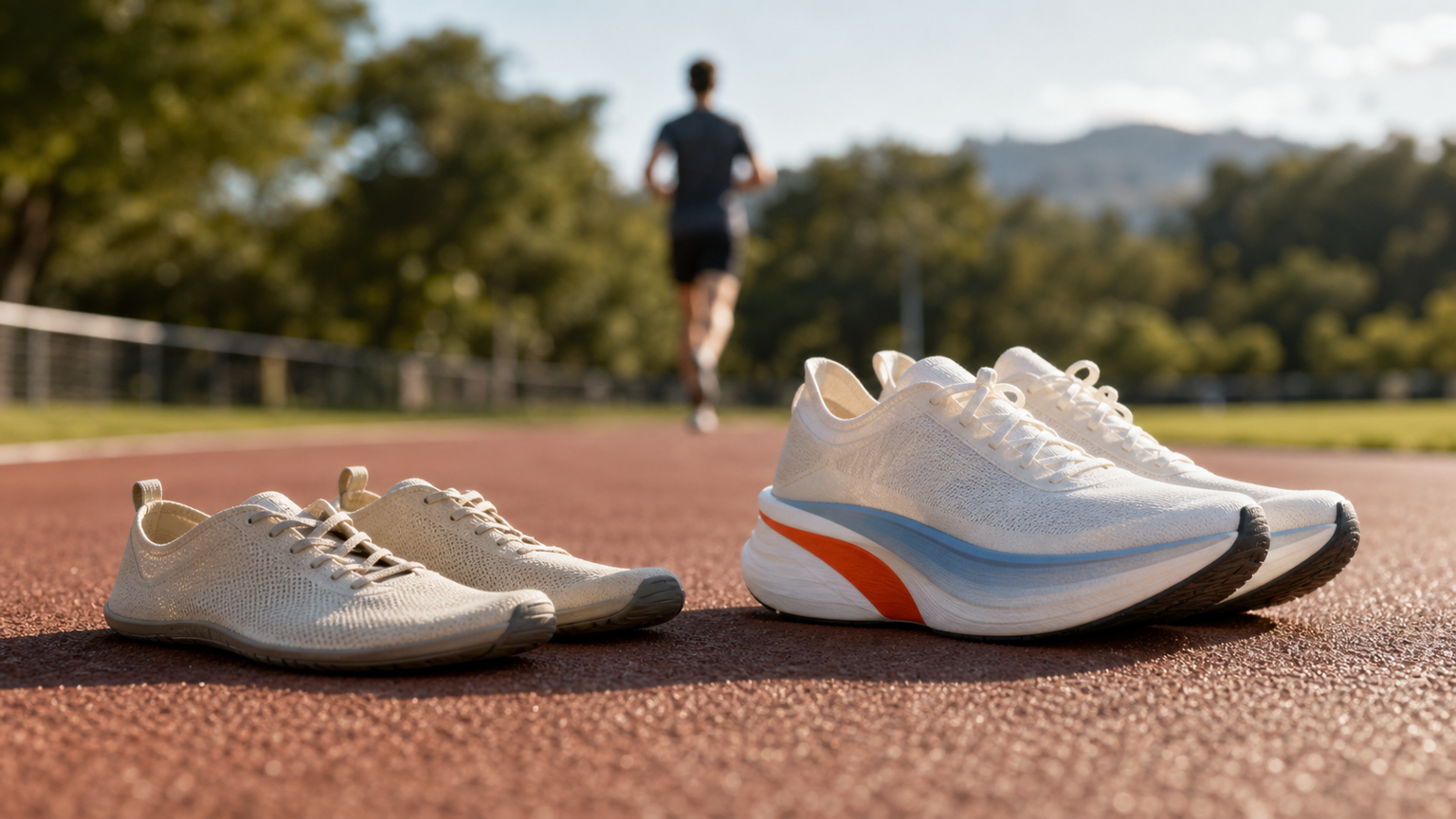
Minimalist Running Shoes vs. Thick-Soled Carbon-Plated Shoes: Which Is Right for You
In recent years, two opposing trends have emerged in the running shoe market: on one side, minimalist running shoes that emphasize a return to natural gait; on the other, thick-soled carbon-plated shoes built on cutting-edge technology. Both design philosophies have scientific backing, but they suit very different runners.
1. The Philosophy of Minimalist Running Shoes
Origins
In 2009, Christopher McDougall’s book Born to Run sparked the minimalist running movement. The book describes the Tarahumara people running ultramarathons in simple sandals, inspiring the argument that “humans are naturally built for barefoot running.”
Design Features of Minimalist Shoes
| Feature | Description |
|---|---|
| Sole thickness | Extremely thin (3-15mm) |
| Heel-to-toe drop | 0-4mm (close to barefoot) |
| Weight | Very light (100-180g) |
| Cushioning material | Minimal |
| Sole stiffness | Firmer, close to ground feel |
Representative brands: Vibram FiveFingers, Merrell Vapor Glove, Altra (0mm Drop), New Balance Minimus
Theoretical Advantages of Minimalist Shoes
- Strengthens small foot muscles: naturally stimulates development of the arch and plantar muscles
- Improves proprioception: direct feedback between foot and ground enhances balance
- Encourages forefoot/midfoot strike: low drop forces a more natural landing pattern
- Lightweight advantage: reduced weight per kilogram has a significant impact on speed
Scientific Findings
- Barefoot running does improve running economy (in the short term)
- However, injury rates rise sharply during the initial transition period (plantar fasciitis, stress fractures)
- Long-term outcomes vary widely and depend heavily on individual differences
2. The Revolution of Thick-Soled Carbon-Plated Shoes
Milestone: Nike’s Breaking2 Project
In 2017, Nike released the Vaporfly. In 2019, Eliud Kipchoge wore a prototype to run 1:59:40, breaking the psychological two-hour marathon barrier. This shoe transformed the entire industry.
Core Technology of Thick-Soled Carbon-Plated Shoes
| Technology | Description | Effect |
|---|---|---|
| Ultra-thick PEBA foam | Highly elastic, lightweight midsole material | 85-90% energy return |
| Carbon fiber plate | Runs the full length of the sole, adding stiffness | Improves propulsion efficiency |
| High heel-to-toe drop | 8-12mm | Assists rolling propulsion |
Representative products: Nike Vaporfly Next%, ASICS Metaspeed Sky, Adidas Adizero Adios Pro, HOKA Rocket X
Scientific Research Results
- Multiple studies confirm carbon-plated shoes can improve running economy by 4 to 8%
- Translated to marathon time: roughly a 7 to 15 minute improvement
- The effect is more pronounced in faster runners
- Even recreational runners see significant benefits
Potential Drawbacks
- Prolonged heavy use may weaken calf and foot muscles
- Some runners find the running feel doesn’t suit their gait
- High price (NT$5,000-7,000 or more)
- Lower durability (400-600 km lifespan)
3. A Full Comparison of the Two Shoe Types
| Comparison | Minimalist Shoes | Thick-Soled Carbon-Plated Shoes |
|---|---|---|
| Price | NT$2,000-5,000 | NT$5,000-8,000 |
| Durable mileage | 500-800 km | 300-500 km |
| Training effect | Strengthens foot muscles | Improves race performance |
| Injury risk | High during transition | Low for experienced users |
| Suitable pace | No restriction | Racing/speed training |
| Suitable surface | Soft ground, trail | Paved roads |
| Learning curve | High (requires adaptation period) | Low (ready to use) |
4. Which One Is Right for You
When to Choose Minimalist Shoes
- You want to strengthen foot strength and proprioception
- You have 4 to 6 months for a gradual transition
- Your running injuries are related to weak arches
- You enjoy trail running and a natural gait
- Your training is mainly light, easy runs
When to Choose Thick-Soled Carbon-Plated Shoes
- You already have a stable running form (running consistently for over a year)
- You’re chasing a PB with a clear time goal
- Your half-marathon pace is under 6 min/km (the faster you are, the more benefit you see)
- Your budget allows for it (and you accept the lower durability)
A Hybrid Strategy (The Best Approach)
For many runners, the best approach is to have both:
- Daily training runs: standard mid-thickness shoes (neither the thickest nor thinnest)
- Long-run training: training shoes with moderate cushioning
- Race day: carbon-plated racing shoes
- Strength training days: barefoot or minimalist shoes for foot strengthening
5. A Safe Transition Plan for Minimalist Shoes
If you decide to try minimalist shoes, never simply swap out your regular running shoes overnight:
| Week | Minimalist shoe usage | Notes |
|---|---|---|
| Weeks 1-2 | 10% (e.g., once a week, 2-3km) | Mild soreness in the ankles and arches is normal |
| Weeks 3-4 | 20% | Stop immediately if pain persists |
| Weeks 5-8 | 30-40% | Add foot-strengthening exercises |
| After 2-3 months | 50% or more | Depending on individual adaptation |
6. Conclusion
No running shoe is inherently “better” — only better suited to your body, goals, and training stage. Beginners should start with mid-thickness cushioned running shoes and consider transitioning once their running form is stable. For runners chasing performance, carbon-plated shoes can genuinely help, but only if you already have a solid running foundation.
Related Reading
- Minimalist vs. Thick-Soled Shoes: How Different Running Shoe Designs Affect Running Biomechanics
- The Minimalist vs. Maximalist Running Shoe Debate: Scientific Truth and Recommendations
- The Science of Choosing Running Shoes: Carbon-Plated, Stability, and Cushioned Shoes
- The Relationship Between Running Shoes and Injuries: A Complete Analysis of Over-Support Shoes, Minimalist Shoes, and the Latest Shoe Science
Nepest NOVA 碳條輪組:輕量、空力、舒適一次滿足!/ 公路車 / CT Yeh
7 個月前
#公路車 #Fitting 靠人工智慧APP 幫你調整單車
6 年前
Unaas X50 全碳纖幅條輪 數據實測對比PK | Lun Hyper 的高階版 | 板輪爬坡也可以很厲害? ! 武嶺2小時大師一起親測! CP值超高 | 公路車 | CT Yeh
4 年前
靠單車減肥35公斤 心得分享與整理
7 年前
Fitting訓練兩用功率車 ! Thinkrider ST900 完整實測!/ 坡度升降 / 鄰居測試/ smart bike/公路車/ CT Yeh
2 年前
單車 重低音 藍芽喇叭 音質實測 SoundBot SB525 Real Sound Test
8 年前
多到選擇障礙... 換個單車把帶想一個小時 / BTP / 編織&軟木特有材質超吸睛! / 公路車 / CT Yeh
1 年前
CT 喇低賽) 單車 比賽總是沒照片? 攝影師的觀點大公開 姿勢就是力量! 請加速1.25倍收看
7 年前