The Complete Guide to FTP Testing: 20-Minute Test vs. Ramp Test — Which Is More Accurate?
FTP (Functional Threshold Power) is the core benchmark for power-based training. It represents the maximum average power you can sustain for roughly one hour. An accurate FTP test is essential for setting training zones and tracking fitness progress.
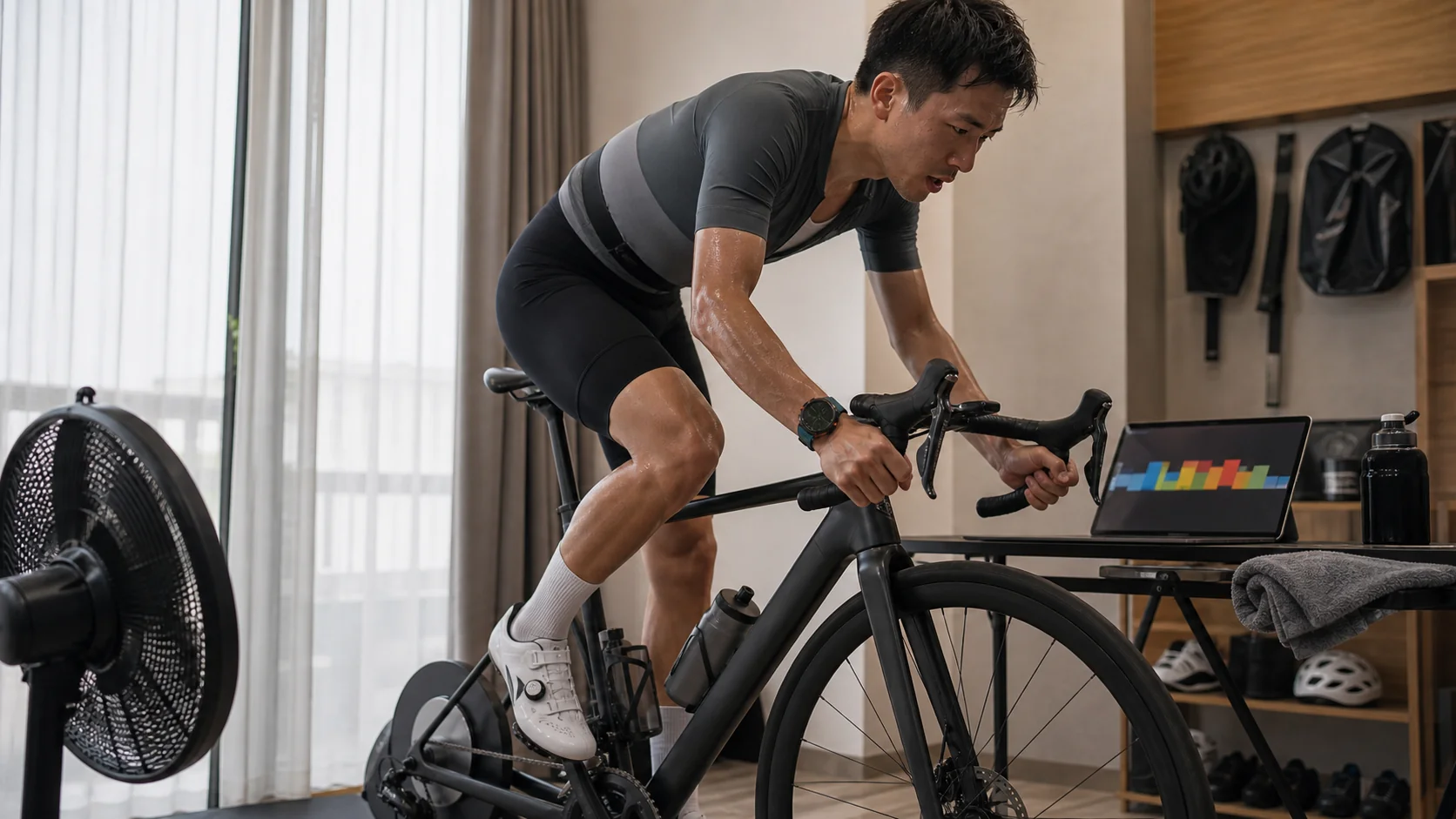
What Is FTP?
FTP is a concept introduced by exercise scientist Andrew Coggan. In simple terms, FTP represents your “aerobic-anaerobic threshold” — below this power output you can sustain effort for a long time, but above it, lactate begins to accumulate rapidly and fatigue sets in fast.
FTP is typically expressed in watts per kilogram (W/kg), which makes it easy to compare riders of different body weights:
| Level | W/kg (Male) | W/kg (Female) |
|---|---|---|
| Beginner | Below 2.0 | Below 1.5 |
| Amateur | 2.0–3.0 | 1.5–2.5 |
| Advanced | 3.0–4.0 | 2.5–3.5 |
| Elite | 4.0–5.0 | 3.5–4.5 |
| Professional | Above 5.0 | Above 4.5 |
The 20-Minute Test
Test Protocol
- Thorough warm-up: 20 minutes of easy riding, with a few 5-second all-out sprints mixed in
- 5-minute all-out effort: Near the end of the warm-up, complete one 5-minute maximal effort to deplete glycogen stores
- 5-minute recovery: Easy spinning to recover
- 20-minute all-out test: Sustain the highest steady power output you can, and record the average power
- Calculate FTP: 20-minute average power × 0.95 = FTP
Things to Watch Out For
- Don’t go out too hard in the first few minutes — start at a slightly conservative pace and build gradually
- Ideally, you should slightly increase power in the second half (a negative-split pacing strategy)
- Rest thoroughly the day before the test and avoid hard training
- Perform the test on a fixed trainer or a flat stretch of road
Pros and Cons
Pros:
- Results are closer to your true one-hour maximum power
- Backed by extensive research validating its accuracy
- Psychological demand is relatively manageable (20 minutes vs. 60 minutes)
Cons:
- Pacing strategy heavily affects the result — beginners often go out too fast and end up underestimating their FTP
- Requires significant mental toughness to sustain an all-out effort for 20 minutes
- Fatigue and stress levels can skew the test result
The Ramp Test
Test Protocol
- Warm-up: 10 minutes of easy riding
- Power increases every minute: Start at a low power (typically around 150W) and increase by 20W every minute
- Continue to exhaustion: Keep pedaling until you can no longer hold cadence
- Calculate FTP: The highest power completed in the final full minute × 0.75 = FTP
Pros and Cons
Pros:
- Pacing strategy doesn’t affect the result (power is controlled by the program)
- Short test duration (typically 15–25 minutes including warm-up)
- Beginner-friendly, doesn’t require a high degree of mental toughness
- Highly repeatable
Cons:
- May underestimate FTP for “endurance-type” riders (their 20-minute power is often well above 75% of VO2max)
- May overestimate FTP for “sprinter-type” riders
- Results are influenced by the rider’s individual physiological profile
Which Test Is More Accurate?
Based on research and real-world use, there is no single test that is universally most accurate. What matters is:
- Your physiological type: Endurance-type riders tend to get more accurate results from the 20-minute test; sprinter-type riders may find the Ramp Test more suitable.
- Testing consistency: Using the same method every time matters more than the absolute number — what you’re really tracking is progress.
- Training purpose: Platforms like Zwift and TrainerRoad natively support the Ramp Test, making it more convenient to use alongside those tools.
Practical Tips for Taiwanese Riders
Taiwan’s roads vary widely, so here are some good outdoor FTP testing options:
- North: Yangmingshan’s Yangde Boulevard (steady climb)
- Central: The straight section near the entrance to Dongshi Forest Farm in Taichung
- South: The gentle section of Tengzhi Highway in Kaohsiung
If you’re using an indoor trainer, pairing the Ramp Test with Zwift or TrainerRoad is the most convenient option and tends to produce more stable data.
What to Do After the Test
Once your test is complete, immediately set up your seven training zones:
| Zone | Name | Power Range (%FTP) |
|---|---|---|
| Z1 | Active Recovery | <55% |
| Z2 | Endurance | 56–75% |
| Z3 | Tempo | 76–90% |
| Z4 | Threshold | 91–105% |
| Z5 | VO2max | 106–120% |
| Z6 | Anaerobic Capacity | 121–150% |
| Z7 | Neuromuscular Power | >150% |
Conclusion
It’s recommended to retest your FTP every 8–12 weeks to track changes in your fitness. For beginners, the Ramp Test is a great low-frustration option that’s easy to get started with; more advanced riders may prefer the 20-minute test for a more precise benchmark. Most importantly, the test itself is a high-intensity workout — plan for 1–2 days of easy recovery riding afterward.
Further Reading
- The Complete FTP Testing Guide: How to Choose Between the 20-Minute Test and the Ramp Test
- A Full Comparison of FTP Testing Methods: Accuracy and Use Cases for the 20-Minute Test vs. the Ramp Test
- The Complete Guide to FTP Testing: Comparing the 20-Minute Test, the 8-Minute Test, and the Ramp Test
- A Full Comparison of FTP Testing Methods: Accuracy and Suitable Scenarios for the 20-Minute, 8-Minute, and Ramp Tests
RAMP FTP Test 直播 究竟能撐到幾瓦 訓練台 Gravat Zwift
6 年前
西進武嶺 8000名單車友數據分析 PART1 | 從新手到高手數量/瓦數/推力比/FTP推力比/功率計使用率 大解析 | 公路車 | CTYeh
5 年前
西進武嶺配速器 3.0更新 / NEW 免功率FTP估算! / 大數據xAI體能模型 / 如何模擬人止關前集團效應 / 配速儲存功能 / AI全台自行車賽事行事曆 / 公路車 / CT Yeh
1 年前
#公路車 台北 #風櫃嘴 23:47 全台單車實境請訂閱鎖定
7 年前
西進武嶺 免費訓練分析服務 Intervals | 練不夠還是練過頭?你哪一種類型選手?AI模型告訴你! | 備戰神器 | 公路車 訓練 | CT Yeh
4 年前
單車AI教練!全新 ChatGPT4o 幫你分析訓練成果!排武嶺課表,分析騎車姿勢! 太神了! / 公路車 / CT Yeh / feat. 緯緯
2 年前
車友來我家測FTP...好硬啊🤣 #cycling #公路車
2 年前
FTL 與 SYB 車隊專訪 西進武嶺 實用攻略分享! 2小時 如何練?!你不知道的眉角!新手準備武嶺必看 EP1 | 實力派女車友 | 精華版 | 公路車 | CTYeh
4 年前