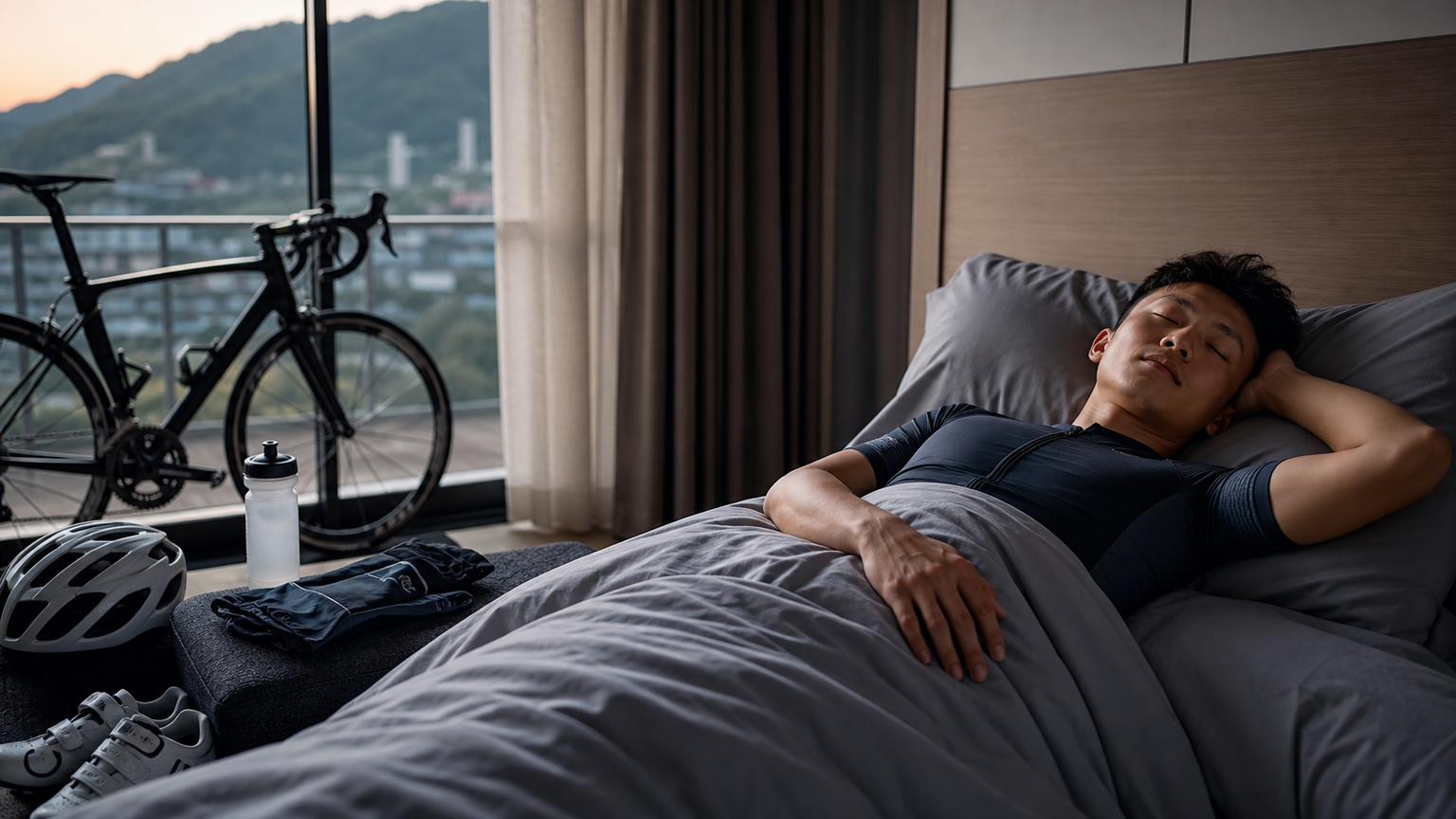
Cyclist’s Sleep Management: Why Sleep Is the Best Recovery Tool
Among all recovery methods—massage, ice baths, supplements, stretching—sleep is the most effective, the cheapest, and the most underestimated. A pro rider’s training day typically includes 2–4 hours of “planned napping,” and top Zwift athletes also treat sleep quality as part of their training.
What Happens During Sleep?
Growth Hormone Secretion
During deep sleep (NREM Stage 3/4), the body secretes 70–80% of its total daily growth hormone. Growth hormone is responsible for:
- Muscle repair: Repairing micro-damage caused by training
- Glycogen synthesis: Converting dietary carbohydrates into muscle glycogen
- Fat metabolism: Promoting fat breakdown, which supports weight management
Key point: Growth hormone is mainly secreted during deep sleep 1–3 hours after falling asleep. If sleep quality is poor or total sleep time is insufficient, growth hormone secretion drops significantly, reducing recovery efficiency.
Nervous System Recovery
High-intensity training doesn’t just affect muscles; it also heavily depletes the central nervous system (CNS). During sleep:
- Neural connections are strengthened (the “consolidation” of technical movements)
- Cerebrospinal fluid clears metabolic waste (including proteins that affect cognitive function)
- The emotional regulation center (amygdala) returns to normal function
Immune System Strengthening
Sleep deprivation significantly impairs immune function:
- People who sleep less than 6 hours are 4 times more likely to catch a cold than those who sleep 8 hours
- High-intensity training itself temporarily suppresses immunity; sleep is key to restoring immune function
How Much Sleep Do Cyclists Need?
General Recommendations vs. Athlete Needs
| Population | Recommended Sleep Duration |
|---|---|
| General adults | 7–9 hours |
| Amateur athletes | 8–9 hours |
| Seriously training amateur riders | 8–10 hours |
| Professional cyclists | 9–11 hours (including naps) |
Research findings: A study on the Stanford University swim team showed that increasing sleep to 10 hours per day improved athletes’ 50-meter freestyle times by 1 second (nearly a 2% improvement), and reaction times also significantly improved.
The Relationship Between Training Load and Sleep Needs
The higher the training load, the more sleep you need:
- Easy training week (TSS < 300): 7–8 hours
- Normal training week (TSS 300–500): 8–9 hours
- High-intensity training week (TSS > 500): 9–10 hours
Strategies for Optimizing Sleep
Environmental Optimization
Temperature: A drop in core body temperature is the physiological signal for falling asleep. Ideal sleep temperature: 18–20°C. In Taiwan’s summer, set the air conditioning below 25°C; in winter, keep warm.
Light: A dark environment promotes melatonin secretion. Recommendations:
- Use blackout curtains
- Reduce blue light exposure 1 hour before bed (phone, TV)
- Consider blue light blocking glasses
Noise: A quiet environment or white noise (fan sound, rain sound) helps with falling asleep.
Wind-down Routine
Establish a fixed 1-hour pre-bed routine:
- Turn off screens or use night mode
- Light stretching or yoga (10–15 minutes)
- Warm shower (helps core body temperature drop quickly)
- Reading (paper books)
- Consistent bedtime
Diet and Sleep
- 3 hours before bed: Avoid heavy meals
- 1 hour before bed: Avoid caffeine (caffeine half-life is 5–6 hours)
- Can consume before bed: Foods containing tryptophan (milk, bananas, nuts) aid sleep
- Moderate carbohydrates: A small amount of carbs before bed (about 20–30g) can help with sleep
Common Sleep Challenges for Taiwanese Riders
Challenge 1: Summer Heat
Taiwan’s summer nighttime temperatures are high (28–30°C), which is unfavorable for deep sleep.
Solutions:
- Set the air conditioning to 25°C (or lower)
- Use moisture-wicking bedding
- Ride during the coolest times (early morning) to avoid elevated body temperature after evening rides
Challenge 2: Too Wired After Riding
After high-intensity rides, cortisol and adrenaline take several hours to return to normal levels.
Solutions:
- Avoid high-intensity training after 8 PM
- Do stretching and meditation for 30 minutes after riding
- Take a warm shower (not a hot one)
Challenge 3: Pre-Race Anxiety and Insomnia
It’s often hard to fall asleep the night before a race, and this is completely normal.
Important insight: Research shows that even if you only sleep 5–6 hours the night before a race, as long as you’ve had sufficient sleep over the past week, race performance is usually unaffected.
Solutions:
- Accept that pre-race insomnia is normal
- Don’t stress about “I must fall asleep”
- Still lie in bed and rest, even if you don’t fall asleep
- Sleep quality 2 nights before the race matters more
The Application of Power Naps
When training load is high, a midday nap can significantly improve recovery speed and afternoon training quality.
| Nap Duration | Effect | Notes |
|---|---|---|
| 10–20 minutes | Restores alertness, doesn’t affect nighttime sleep | Most recommended |
| 30–45 minutes | Deep recovery, brief grogginess upon waking | Suitable for recovery days |
| 60–90 minutes | Full sleep cycle, maximum recovery | Commonly used by pro cyclists |
Ideal nap timing: 1–3 PM (aligns with the natural circadian dip in alertness).
Tools for Monitoring Sleep Quality
- Garmin/Wahoo: Built-in sleep tracking, providing sleep stages and HRV (heart rate variability)
- Whoop: Sleep and recovery tracking designed specifically for athletes
- Oura Ring: More precise sleep analysis (more expensive)
- Free options: Daily logging of sleep duration, morning resting heart rate, and subjective recovery feeling
HRV (heart rate variability) is a key metric for assessing recovery status: HRV above your personal baseline indicates good recovery and readiness for high-intensity training; below baseline, consider reducing volume and resting.
Conclusion
Sleep is a completely free recovery tool, yet it’s the aspect many riders most easily overlook. Before investing in expensive supplements and training equipment, make sure you’re getting enough high-quality sleep every day. That is the most effective strategy for improving training results.
Related Reading
- Cyclist’s Sleep Optimization: The Strongest Weapon for Recovery
- The Science of Sleep for Cyclists: The Key Role of Deep Sleep in Recovery
- Cyclist’s Sleep Management: A Complete Guide to Improving Recovery Efficiency
- The Science of Sleep Optimization for Cyclists: Evidence-Based Methods to Improve Recovery Quality
CT暗黑廚房) 車友必備 宇宙無敵鮮蚵湯 幫助訓練恢復 天然食補 好市多 超肥鮮蚵 破PR
7 年前
2026 車錶排行榜!誰是最多車友正在使用?練家子最愛哪款?🏆 (2萬名車友數據) / 公路車 / CT Yeh
5 個月前
西進武嶺 免費訓練分析服務 Intervals | 練不夠還是練過頭?你哪一種類型選手?AI模型告訴你! | 備戰神器 | 公路車 訓練 | CT Yeh
4 年前
#公路車 #Fitting 靠人工智慧APP 幫你調整單車
6 年前
摔車後補裝備: 好市多新款單車安全帽& Specialized Romin 北高整路屁股都不痛的坐墊 | 一千元居然有MIPS | CT Yeh | 公路車
4 年前
碟煞公路車 銑面器 !? 原來銑完差這麼多! 降低蹭碟機率! | TIME 公路車 保養小記錄 | CT Yeh
3 年前
ThinkRider 智騎 XXPRO 訓練台,高階機種功能 只要 1/3價格!? 實測功率對比、噪音實測 / 公路車 / CT Yeh
1 年前
單車AI教練!全新 ChatGPT4o 幫你分析訓練成果!排武嶺課表,分析騎車姿勢! 太神了! / 公路車 / CT Yeh / feat. 緯緯
2 年前