Carbon Fiber Frame Care and How to Check for Carbon Cracks
Carbon fiber road bikes are popular for their light weight and high stiffness, but carbon fiber behaves very differently from aluminum alloy and needs more careful maintenance and inspection. This article walks you through the correct way to care for a carbon fiber frame and how to identify dangerous cracks.
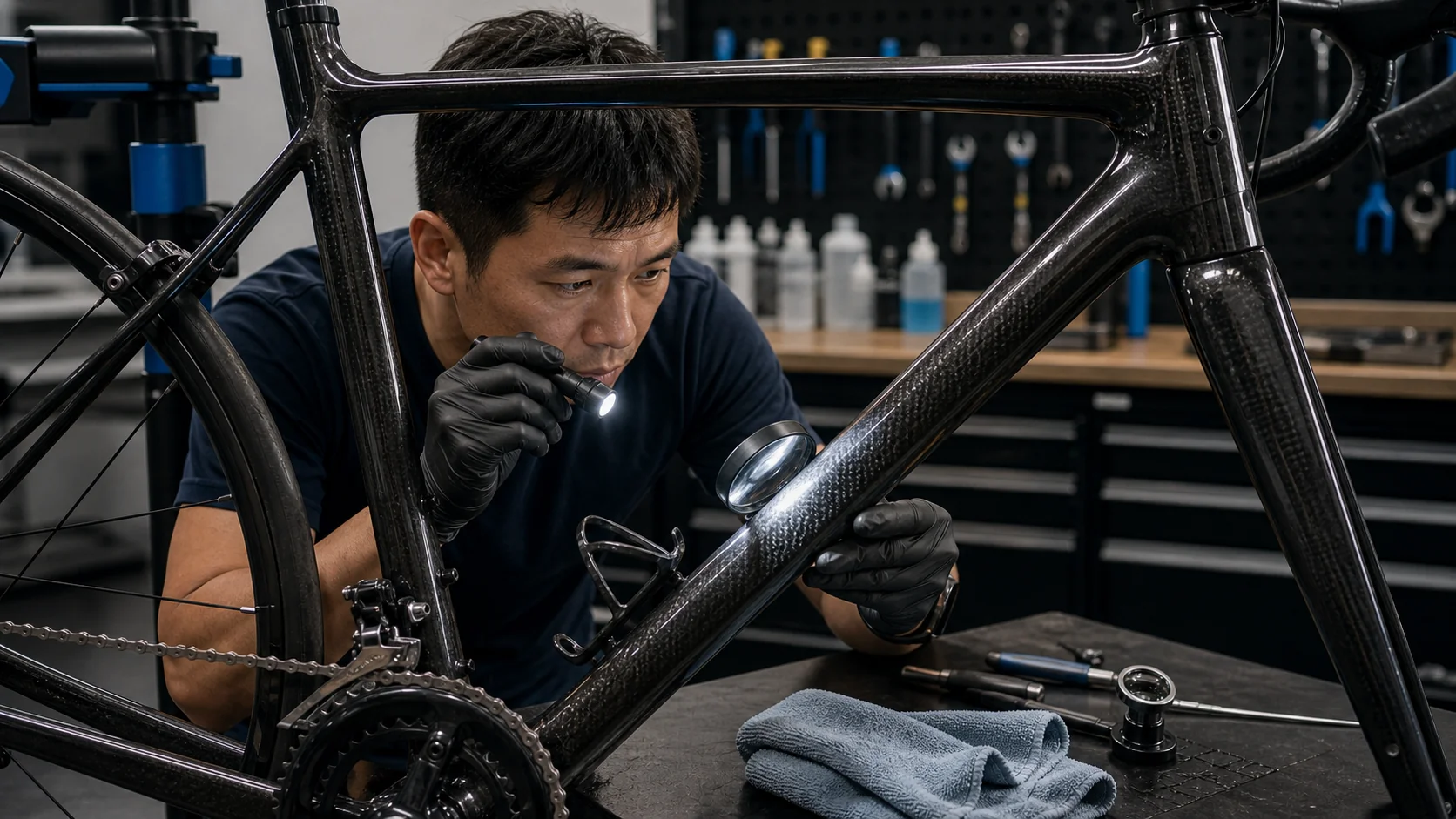
Carbon Fiber Basics
A carbon fiber frame is built from layers of carbon fiber cloth laminated together. The advantages are low weight (top-tier frames weigh only 700-900g), good vibration absorption, and high stiffness. But carbon fiber has one weakness: it cannot withstand point impacts well (such as a rock strike or a crash), and carbon fiber damage is often hard to judge from the outside.
Key Points for Daily Maintenance
Cleaning
- Use a neutral cleaner and a soft cloth; avoid strong acid or alkaline cleaners
- Never blast the frame directly with a high-pressure hose — water pressure can seep into frame joints
- Suggested cleaning order: rinse with water → apply cleaner → wipe with a soft cloth → rinse with clean water → dry
Cockpit and Seatpost Setup
Torque settings for carbon stems and seatposts are extremely important!
| Component | Max Tightening Torque | Recommended Tool |
|---|---|---|
| Seatpost clamp | 5-8 Nm | Torque wrench |
| Stem faceplate bolts | 4-6 Nm | Torque wrench |
| Seatpost | Below the minimum insertion line | Carbon assembly paste |
Never tighten bolts by feel — over-tightening is one of the leading causes of carbon fiber failure. It’s worth buying a torque wrench rated up to 20 Nm (roughly NT$500-1,500).
Using Carbon Assembly Paste
Contact surfaces between carbon components (seatpost, stem) and carbon or aluminum surfaces should use carbon assembly paste (Carbon Paste), not regular grease. Carbon paste contains fine particles that increase friction, allowing you to secure the part firmly at a lower tightening torque.
Parking Precautions
- Avoid leaning the frame against hard objects (a railing edge can create a point load)
- Use a frame protection film (clear tape) to protect the down tube and drivetrain side
- Be careful not to knock the frame against hard objects when carrying it
How to Check for Carbon Cracks
Visual Inspection
Do a thorough visual inspection at least once a month, paying special attention to these high-risk areas:
- Around the bottom bracket shell: where pedaling forces concentrate
- Top tube to head tube junction: takes the load in a frontal impact
- Down tube to head tube junction: same as above
- Around the seat tube clamp area: where clamping force concentrates
- Rear triangle (seatstays, chainstays): where road impacts concentrate
Coin Tap Test
Lightly tap different areas of the frame with a coin and listen for differences in sound:
- A crisp, clear tap → normal, carbon fiber is intact
- A dull or hollow sound → possible delamination or crack, needs professional inspection
This method is simple but takes some experience to judge accurately. It’s best to “calibrate” your ear on a known-good area first, then test the area in question.
Professional Ultrasonic Inspection
If you have concerns, it’s best to have a bike shop with ultrasonic equipment do a professional check. Ultrasound can detect internal delamination invisible to the naked eye, typically costing around NT$500-1,500.
Common Damage Scenarios and How to Handle Them
Surface Paint Cracking (No Structural Damage)
If only the paint has cracked and the carbon fiber itself is intact, you can keep riding, but it’s best to seal the crack with clear nail polish or frame-specific touch-up paint to prevent moisture intrusion.
Carbon Fiber Delamination
When the carbon layers separate from each other, you must stop riding and send the frame to a professional carbon repair shop for evaluation. Some minor delamination can be repaired; severe cases require frame replacement.
Complete Fracture
Stop riding immediately and retire the frame. Do not attempt a DIY repair and continue riding — the risk is extremely high.
Is Carbon Fiber Repair Feasible?
Taiwan has a small number of professional carbon fiber repair workshops that can fix localized damage. However, a repaired frame’s strength usually cannot be restored to factory levels, so it’s best to use a repaired frame only for light riding or training, not for racing.
Warranty and Insurance
- Most brands offer a lifetime warranty against carbon cracking (excluding damage from misuse)
- Consider adding bicycle insurance when you buy a carbon frame
- Keep your proof of purchase and original warranty card
Conclusion
The core of carbon fiber frame maintenance is “correct torque, regular inspection, avoid point impacts.” Build a habit of checking your frame monthly, and stop riding immediately if you have any doubts. A good carbon frame can be with you for decades, as long as you take good care of it.
Related Reading
碟煞公路車 銑面器 !? 原來銑完差這麼多! 降低蹭碟機率! | TIME 公路車 保養小記錄 | CT Yeh
3 年前
再一組! 全碳幅條 碟煞/無內胎輪組 開箱! 到底好騎嗎? UNAAS X40 | 公路車 | CT Yeh
4 年前
洗單車神器 吹水機! 實際洗車用用看 暴力洗鍊條大法 | 公路車 | CT Yeh
4 年前
Canyon 公路車斷把手 五年老車特規還能修嗎? 維修保養全記錄 feat. 501單車監理站 | 公路車 | CT Yeh
4 年前
鉅齒紋輪組!? ControlTech MEG-T50 EVO 碳纖維幅條輪組/ 功率對比實驗 / 公路車 / CT Yeh
2 年前
Nepest NOVA 碳條輪組:輕量、空力、舒適一次滿足!/ 公路車 / CT Yeh
7 個月前
一日北高/長距離團騎 常見問題補充篇 / 組團或跟團的眉角 / 壯車友容易被瘦車友慢性拉爆 / 原來屁股痛可能是這個原因...? / 風場配速法 / 公路車 / CT Yeh
2 年前
Unaas X50 全碳纖幅條輪 數據實測對比PK | Lun Hyper 的高階版 | 板輪爬坡也可以很厲害? ! 武嶺2小時大師一起親測! CP值超高 | 公路車 | CT Yeh
4 年前