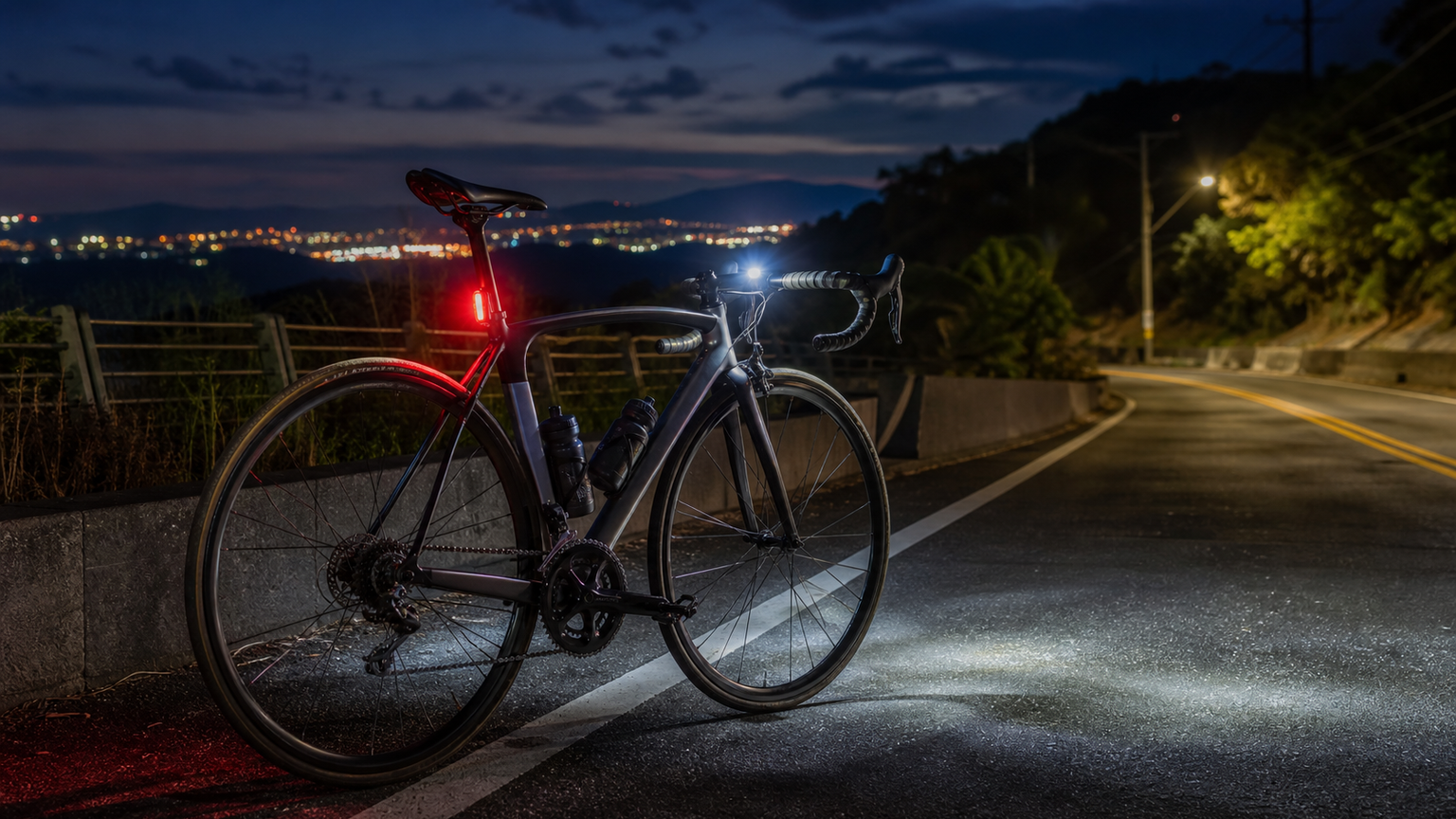
Choosing Bike Lights: Front Light Lumens and Rear Light Visibility Standards
Bike lights are core safety equipment for night riding, but the market is flooded with products ranging from a few hundred to several thousand NT dollars, and it’s easy to assume “the higher the lumens, the better.” Does the rear light always need to be as bright as possible? This article explains what light specifications actually mean and how to choose the right light for your riding scenario.
Taiwan’s Legal Requirements
Under Taiwan’s Road Traffic Safety Rules, bicycles ridden at night must be equipped with:
- A white front light: visible from 150 meters ahead
- A red rear light or reflector: visible from 150 meters behind
Although the regulations don’t specify a lumen count, in practice a front light of at least 200 lumens and a rear light of at least 20 lumens is recommended.
What Lumens Actually Mean
Lumens are a unit of luminous flux, representing the amount of light energy a source emits per second. But more lumens isn’t always better — beam angle and throw distance matter just as much.
Front Light Use Cases by Lumen Range
| Lumen Range | Suitable Scenario | Beam Throw |
|---|---|---|
| 200-400 lm | Urban riding with street lighting | 30-50m |
| 400-800 lm | Typical rural roads | 50-100m |
| 800-1,500 lm | Unlit mountain roads | 100-150m |
| 1,500-3,000 lm | High-speed mountain descents, very dark conditions | 150m+ |
Important reminder: When using a high-lumen front light in the city, switch to a low-brightness mode or angle the beam downward to avoid blinding oncoming traffic.
Beam Angle and Light Distribution
Spot Beam
Light is concentrated and thrown far ahead, ideal for high-speed mountain descents where you need to see the road well in advance. The downside is a bright center with dim periphery, leaving blind spots in corners.
Flood Beam
Light is spread evenly for a wide field of view, ideal for urban and slow-speed riding. It makes it easier for oncoming pedestrians and vehicles to see you, and helps you spot obstacles at the roadside.
Hybrid Beam
Combines spot and flood characteristics. Most mid-to-high-end lights today use this design to provide the best overall visibility.
Key Considerations for Rear Lights
The purpose of a rear light is to make you visible to vehicles behind you, not to illuminate the road behind you. So lumens aren’t the only factor — visibility and flash pattern matter more.
Research on Flash Frequency
Studies show that a flash frequency of 1-2 Hz (1-2 times per second) is most effective at catching drivers’ attention. Some top-tier rear lights (such as the Garmin Varia) offer a “pulse” mode that simulates irregular flashing to further increase driver awareness of cyclists.
Garmin Varia RTL515 Radar Tail Light
This is currently the most recommended rear light, combining a tail light with radar detection:
- Detects approaching vehicles up to 140 meters behind you
- Displays vehicle speed and distance on your bike computer or watch
- Gives you advance warning as a vehicle approaches from behind
- Priced at approximately NT$5,500 in Taiwan
Charging Method Comparison
| Charging Type | Pros | Cons |
|---|---|---|
| USB-C charging | Convenient, universal cable | Must remember to charge |
| Micro USB | Common but being phased out | Average port durability |
| Magnetic charging | Convenient and waterproof | Requires proprietary charging dock |
| Replaceable batteries (AA/18650) | Spare batteries for long tours | Heavier |
For long-distance touring, a light with replaceable 18650 batteries or one that can be charged via a power bank is recommended.
Recommendations by Budget
Front Lights
Entry level (NT$500-1,500)
- Cateye Ampp 500: 500 lumens, lightweight, sufficient for commuting
- Lezyne Hecto Drive 500XL: Stable performance, good battery life
Mid-range (NT$1,500-3,000)
- Exposure Trace: Made in the UK, excellent light distribution
- Lezyne Mega Drive 1800i: 1,800 lumens, suitable for mountain roads
High-end (NT$3,000+)
- Sigma Buster 2000: 2,000 lumens, outstanding light distribution
- Lupine SL SF: Made in Germany, top-tier light distribution design
Rear Lights
Entry level (NT$300-800)
- Cateye Rapid X3: Extremely high visibility, a must for urban commuting
- Lezyne Femto USB Drive: Compact and easy to carry
Advanced (NT$1,000+)
- Garmin Varia RTL515: Radar plus tail light in one, essential for mountain riding
Mounting Position Recommendations
- Front light: Centered on the handlebar, angled slightly 5-10 degrees downward to avoid shining directly at oncoming traffic
- Rear light: Under the saddle or at the end of the seatpost, making sure nothing blocks it
- Extra tip: Mount a small additional rear light on the back of your helmet — the extra height makes you easier for drivers to see
Conclusion
Investing in bike lights is directly tied to your personal safety, so don’t choose based on price alone. Taiwan has seen a rise in nighttime cycling accidents in recent years. A good lighting system (front light plus radar tail light) may cost NT$6,000-8,000, but the peace of mind it provides is priceless. At minimum, make sure your front light is 400+ lumens, your rear light has a flash mode, and build the habit of fully charging your lights before every night ride.
Related Reading
再快都跟的上!? 單車跟隨攝影機之王 HOVERAir X1 PROMAX 全面實測 / 唯一!8K畫質&自行車專用模式和跟蹤信標&前後避障 / DJI Neo 可參考/ 公路車 / CT Yeh
1 年前
趣味單車配件:多功能智慧尾燈 / 有方向燈 可app編輯圖案!? / GRC x Lumii 聯名款 / 公路車 CT Yeh
9 個月前
雷達尾燈 雷不雷? 邁金L508 智慧雷達尾燈 情境考驗實測 | 同場加映 2千元等級的專業車錶 C406 Pro | 公路車 | CT Yeh
3 年前
2025 自行車錶排行榜 兩萬車友大數據 / Garmin Bryton 排名會大洗牌嗎? / 全新的碼表前身分析 /公路車 / CT Yeh
1 年前
大家都在開箱的...單車用藍芽對講耳機真的有幫助嗎? SENA BiKom 20 長距離旅遊 & 海鷗繞圈賽 實際體驗心得 / 公路車 / CT Yeh
9 個月前
#公路車 #Fitting 靠人工智慧APP 幫你調整單車
6 年前
4K單車實境) 舊陽金P字道 第1P 仰德大道至小油坑 誤跟武嶺神人們 被拉爆爽飛天 Taiwan Cycling Climb Route Recommend
7 年前
下次拍照前要查清楚啦🤣 #cycling
7 個月前