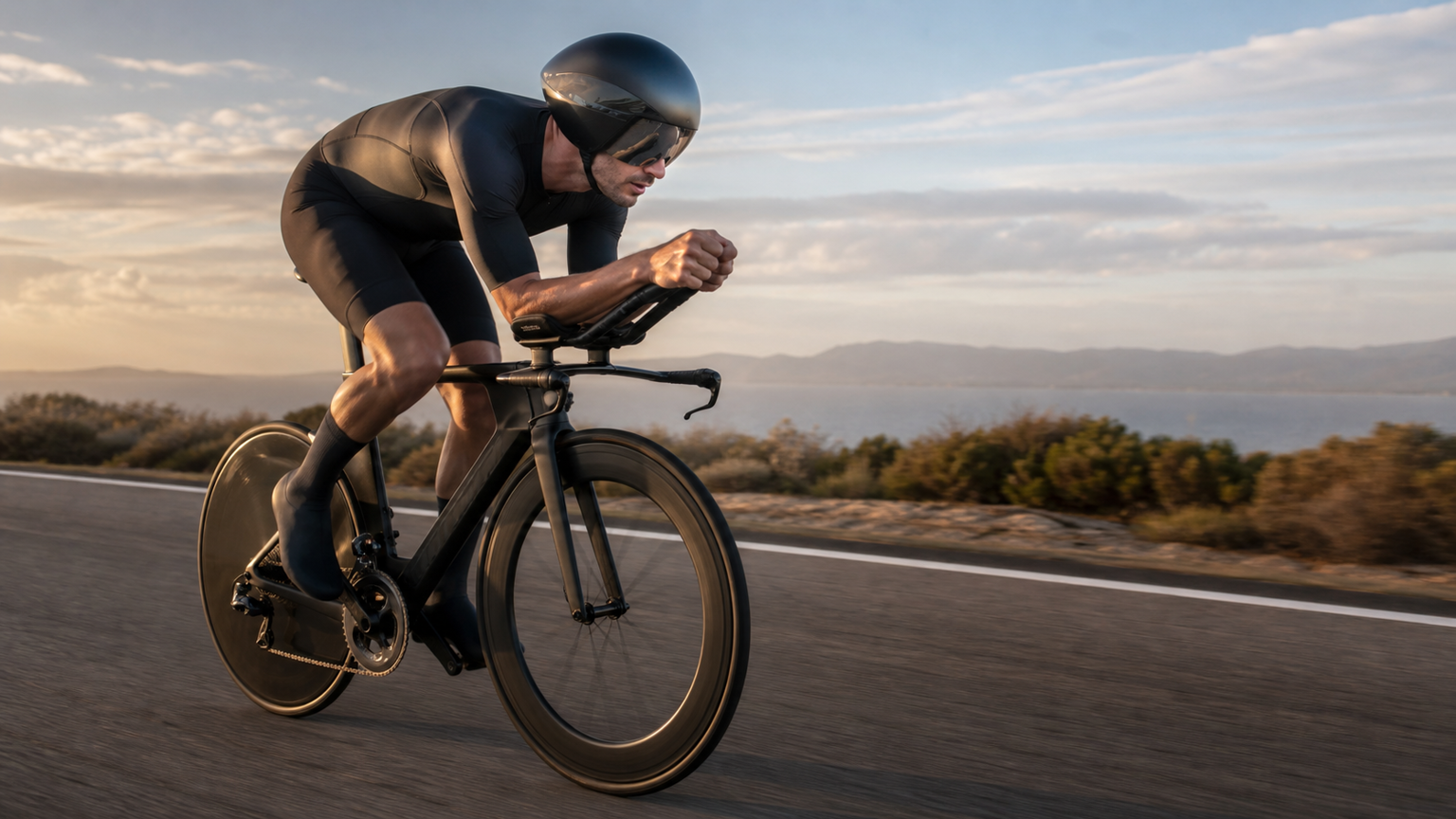
Road Bike Time Trial (ITT) Technical Analysis: Aero Position and Pacing Strategy
The Individual Time Trial (ITT) is road cycling’s “race of truth”—no peloton protection, no tactical maneuvers, each rider against the clock and themselves. This article provides an in-depth analysis of ITT aero science, equipment selection, and precise pacing strategy.
The Physics Fundamentals of Time Trialing
In a time trial, three main forces affect speed:
Aerodynamic Drag (Approximately 80% of Total Resistance)
Aerodynamic drag formula: F_drag = 0.5 × ρ × CdA × V²
- ρ (air density): determined by altitude and temperature
- CdA (drag coefficient × frontal area): the most critical variable a rider can control
- V (speed): drag increases proportionally to the square of speed
Conclusion: The faster you go, the exponentially greater aerodynamic drag becomes. The return on lowering CdA far exceeds increasing power.
CdA Value Reference
| Riding Position | CdA Value | Description |
|---|---|---|
| Upright riding | 0.40–0.45 | Recreational riding |
| Drop bar hold | 0.32–0.38 | General racing position |
| Standard TT bar position | 0.24–0.28 | Time trial bike position |
| World-class riders | 0.19–0.22 | Ultimate aero optimization |
Detailed Aero Riding Position
Standard TT Position Elements
Upper body:
- Forearms parallel to the ground, placed horizontally on the TT bar pads
- Elbow spacing approximately 50–60cm (narrower is better, but bike control must be maintained)
- Back as flat as possible (horizontal line), head slightly raised to see the road
- Shoulders relaxed, avoid shrugging
Lower body:
- Pedaling efficiency takes priority (do not compromise pedaling power due to excessive forward lean)
- Saddle height: with heel on the pedal, leg slightly bent 5–10 degrees
- Seat tube angle: TT bikes typically 74–78 degrees, helping engage the hip flexors
Three Levels of Position Optimization
- Foundation level: Find a comfortable TT bar position that can be sustained for the entire race distance
- Efficiency level: Ensure pedaling efficiency does not decline due to position (power monitoring)
- Aero level: On top of efficiency, further reduce CdA (wind tunnel testing or aero testing devices)
Equipment Aero Impact
Helmets (Highest Importance)
| Helmet Type | Aero Difference | Time Saved (40km) |
|---|---|---|
| Standard road helmet | Baseline | 0 seconds |
| Standard TT helmet | -15% CdA | Approximately 60 seconds |
| High-end TT helmet (long tail) | -20% CdA | Approximately 90 seconds |
Note: Long-tail TT helmets can be counterproductive when head position is incorrect; proper head position is required.
Frames and Wheels
| Equipment | Aero Improvement | Cost |
|---|---|---|
| TT bike vs road bike | Large | High |
| Disc wheel vs standard deep-section | Medium | High |
| Aero skinsuit vs loose jersey | Medium-high | Low |
| Aero shoe covers | Low-medium | Low |
Best value aero investment: Aero tight-fitting skinsuit (around a few thousand NTD, can save 30–60 seconds)
Pacing Science
Basic Principles of Power Pacing
The optimal pacing strategy for a time trial is to maintain the closest possible constant power throughout:
- First 100 meters from the start: may slightly exceed target power by 5–10%
- Main segment: maintain target power within ±5% fluctuation
- Final 500 meters to the finish: may gradually increase to maximum power
Power Target Setting
Recommended power for different time trial distances:
| Distance | Recommended Power (Percentage of FTP) |
|---|---|
| 10 km | 105–115% FTP |
| 20 km | 100–105% FTP |
| 40 km | 95–100% FTP |
| 50 km+ | 92–97% FTP |
Uphill and Downhill Pacing Adjustments
Undulating terrain in a time trial requires dynamic power adjustments:
- Uphill: Maintain or slightly increase power (but not exceeding 10%); reduced speed is normal
- Downhill: Power can be reduced; focus on aero position and let gravity do the work
- Overall principle: Overall average power matters more than local power peaks
Pre-Race Preparation
The Day Before
- Pre-ride the course (if possible), noting key climbs and wind direction
- Prepare all equipment (TT helmet, skinsuit, shoe covers)
- Adequate carbohydrate intake
Race Day Warm-Up
- Time trials require a thorough warm-up because you go all-out from the start
- Recommended warm-up: 20–30 minutes of easy riding plus 2–3 × 30-second sprints (at race pace)
- Complete the final sprint 10 minutes before the start
Taiwan Time Trial Information
- National Cycling Championships (Individual Time Trial): Held annually, featuring elite and age-group categories
- Wuling KOM Time Challenge: Although a climbing race, it embodies the spirit of a time trial
- Strava Personal Time Segments (Virtual TT): Self-challenges on well-known segments
Master aero science and pacing strategy, and in time trials you will discover the true power of efficiency!
Related Reading
- The Complete Guide to Individual Time Trial Position and Pacing: Triple Optimization of Wind Resistance, Power, and Psychology
- In-Depth Time Trial Technical Analysis: The Art of Speed in ITT and TTT
- Aerodynamic Position in Road Bike Time Trials: Forward Lean Angle and Elbow Support
- Optimizing Road Bike Time Trial (TT) Training: An Aerodynamic Study of Power Output Strategy
Zwift跨國線上追逐賽 第二站 台灣 TTR vs. 日本 JETT 第二場 (台灣追日本) | 數百位國內外公路車高手,同場較勁 | 多視角賽事直播
4 年前
西進武嶺 免費訓練分析服務 Intervals | 練不夠還是練過頭?你哪一種類型選手?AI模型告訴你! | 備戰神器 | 公路車 訓練 | CT Yeh
4 年前
西進武嶺 自製新版AI配速表產生器 x 賽前攻略 抱佛腳! 沒有功率計也可以產生配速表嗎?有什麼其他眉角賽前要注意的呢? | 西進武嶺 / 東進武嶺 KOM 攻略 | 公路車 | CT Yeh
4 年前
西進武嶺各路段 前8000名 大數據分析 配速攻略/功率/心律/推力比/維持率/踏頻/踏瓦比/牽車率 大公開 | 建大盃 NeverStop 可參考 | 公路車 | CT Yeh
5 年前
單車AI教練!全新 ChatGPT4o 幫你分析訓練成果!排武嶺課表,分析騎車姿勢! 太神了! / 公路車 / CT Yeh / feat. 緯緯
2 年前
東進武嶺 西進武嶺 AI 配速 上線囉 公路車
5 年前
#公路車 #西進武嶺 配速配瓦實驗 坡度分析 四小時內攻略 建大盃 NeverStop #西進武嶺攻略
6 年前
CT 喇低賽) 武嶺牽車 才是王道 西進牽車四小時內秘訣 攝手位置 如何判斷 防抽筋小秘訣
7 年前