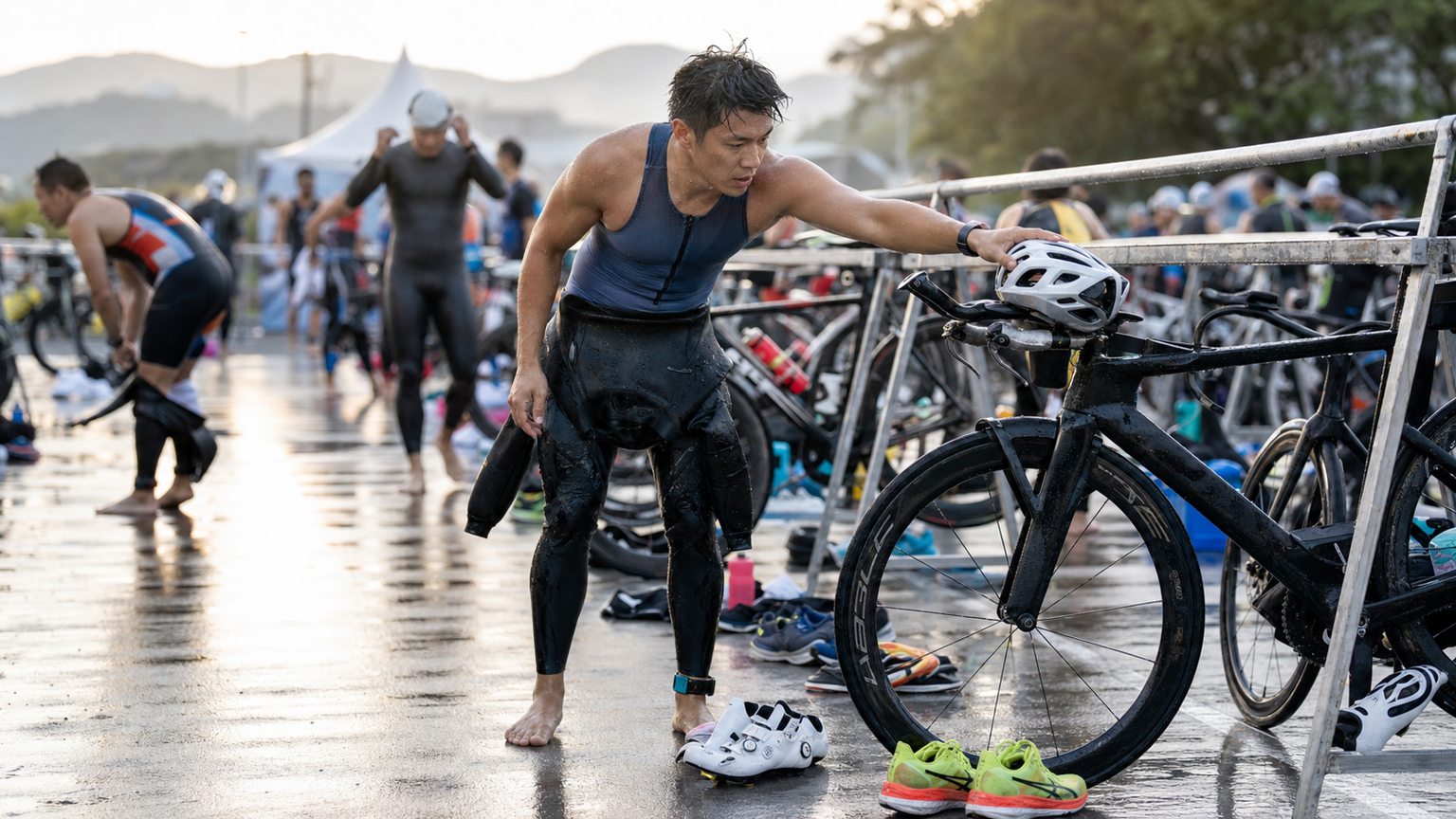
Triathlon Transition Strategy: How to Save Every Second in T1 and T2
Triathlon is often called a “fourth discipline” sport — that fourth discipline being the transition area. Many athletes pour enormous training hours into swimming, cycling, and running, yet overlook the transitions that can cost tens of seconds or even minutes. This article breaks down every detail of T1 (swim-to-bike) and T2 (bike-to-run).
Transition Basics
Why Transition Time Matters
In an Olympic-distance race (51.5 km), transition times vary widely by level:
| Level | T1 Time | T2 Time | Total |
|---|---|---|---|
| Elite | 30–60 sec | 15–30 sec | 45–90 sec |
| Intermediate amateur | 2–4 min | 1–3 min | 3–7 min |
| Beginner finisher | 4–8 min | 3–5 min | 7–13 min |
Takeaway: The gap between elite and amateur athletes in transitions can exceed 5–10 minutes — at the same fitness level, that gap comes purely from technique and preparation.
T1: Swim to Bike
The Critical 15 Seconds After Exiting the Water
Step 1: Stand up immediately, don’t hesitate
- Switch into “running mode” the instant you leave the water
- Pull off your goggles and hold them in your hand (don’t run with them on)
- Start unzipping your wetsuit (if wearing one)
Step 2: Move to the transition area
- Know your rack position cold (confirm it repeatedly before the race)
- Finish pulling the wetsuit down to your waist while running
- Goal: reach your rack within 1 minute of leaving the water
The Fastest Way to Remove a Wetsuit
The wetsuit is the most time-consuming part of T1. Practicing proper removal can save 30–90 seconds:
- In the water: Unzip the back
- Running toward T1: Push the wetsuit down below your waist
- At your rack: Sit or stand, step on the ankle of the wetsuit, and pull each leg out
- Pro tip: Apply lubricant (Bodyglide or baby powder) to the inside of your ankles — this can cut removal time by 50%
T1 Rack Setup
The ideal order for laying out your gear before the race (outside to inside):
Helmet (already unbuckled, face-down on the handlebars)
   ↓
Sunglasses (tucked inside the helmet)
   ↓
Race belt (if needed)
   ↓
Bike shoes (if using the flying mount method)
   ↓
Energy food/gels (on the bike)
T1 Speed Sequence (Target: 60 seconds)
15 sec: Remove swim cap and goggles
15 sec: Remove wetsuit (if worn)
10 sec: Put on helmet and buckle it
10 sec: Put on sunglasses
10 sec: Run bike out of transition
Flying Mount
Advanced technique: pre-clip your bike shoes onto the pedals, then clip in while moving after exiting transition:
- Time saved: 30–45 seconds (skips putting shoes on while stationary)
- Requires practice: running with the bike → jumping onto the saddle → getting your feet into the shoes all need repeated drilling
- Safety note: only attempt this once you’ve mastered it, or you’ll lose more time than you save
T2: Bike to Run
Final Prep on the Bike Before Entering T2
400–500 meters before entering the T2 zone:
- Unclip your feet (if using the flying dismount)
- Rest your feet on top of the shoes (touching the pedal with the top of your foot)
- Mentally shift into “running mode”
Flying Dismount
Advanced technique: dismount while still moving (without stopping), then run straight into transition and to your rack:
- Time saved: 15–30 seconds
- Risk: dangerous at high speed or on wet ground
T2 Rack Setup
Running shoes (laces loosened, opening widened for quick entry)
   ↓
Race belt (if not already worn)
   ↓
Hat or visor
   ↓
Energy gels (in pocket)
T2 Speed Sequence (Target: 45 seconds)
10 sec: Rack the bike properly
10 sec: Remove helmet
15 sec: Put on running shoes (elastic laces, just step in)
10 sec: Put on hat/race belt
Go run!
Why Elastic Laces Matter
Elastic laces are the simplest time-saving tool for T2:
- Cost: roughly $3–10 USD
- Time saved: 20–40 seconds (skips tying laces)
- Recommendation: swap the laces on all your triathlon running shoes for elastic ones
How to Practice Transitions
Weekly Training Plan
- After brick workouts: Every brick session (bike immediately followed by run) doubles as T2 practice
- After swim sessions: Time yourself running from the water’s edge to the parking area (simulates T1’s run)
- Dedicated transition drills: Once a week, run through the full gear setup and practice T1 and T2 five times each
Time Yourself
Grab a stopwatch and time:
- Goggles off to helmet buckled
- Wetsuit from your waist to fully removed
- Running shoes on to starting your run
These numbers will tell you exactly where to focus your practice.
Race-Day Transition Prep
Arrive Early
- Get to the transition area at least 90 minutes before the start
- Confirm your rack position and walk the entire route (entry, exit, T1 turn, T2 turn)
- Set up your rack and physically walk through the full sequence
Mental Rehearsal
Run through the sequence in your head while standing in transition: “I exit the water → run to my rack → pull off goggles → put on helmet → run with the bike → flying mount…”
Replaying this quickly in your mind, over and over, turns it into muscle memory.
Transitions are the most overlooked yet most impactful part of triathlon. With systematic practice and careful preparation, shaving a minute off your transition time is far easier than shaving 10 seconds off your swim!
Related Reading
- Triathlon Transition Strategy: A Complete Guide to World-Class T1/T2 Time-Saving Techniques
- Triathlon Transition (T1/T2) Guide: Techniques Where Every Second Counts
- Triathlon Transition Training: Speed Drills for T1 (Swim-to-Bike) and T2 (Bike-to-Run)
- Mastering Triathlon Transitions: Techniques and Tactics for T1 and T2
西進武嶺 免費訓練分析服務 Intervals | 練不夠還是練過頭?你哪一種類型選手?AI模型告訴你! | 備戰神器 | 公路車 訓練 | CT Yeh
4 年前
Live) 備戰2019彰化經典百K 賽前攻略 (已完賽請看新影片
7 年前
FTL 與 SYB 車隊專訪 西進武嶺 實用攻略分享! 2小時 如何練?!你不知道的眉角!新手準備武嶺必看 EP1 | 實力派女車友 | 精華版 | 公路車 | CTYeh
4 年前
2019 夏季KOM 5小 完賽心得 準備攻略 東進武嶺 夏季登山王之路 Taiwan KOM Challenge
7 年前
#東進武嶺 全程實況錄影 5小時半 #夏季KOM #太魯閣 Taiwan KOM Challenge Reality Video Taroko scenery
7 年前
CT 喇低賽) 武嶺牽車 才是王道 西進牽車四小時內秘訣 攝手位置 如何判斷 防抽筋小秘訣
7 年前
靠單車減肥35公斤 心得分享與整理
7 年前
備戰 戀戀197 賽前關門點分析 西濱團練 #公路車 4K高畫質
6 年前