Sports Performance Enhancement Technology: Lactate Testing and Heart Rate Variability in Race Preparation
Modern endurance training has become increasingly scientific. Lactate Threshold Testing and Heart Rate Variability (HRV) monitoring are two major technological tools used by both elite and amateur athletes today. This article provides an in-depth analysis of their principles and practical applications.
Lactate Threshold Testing
What is the Lactate Threshold?
During aerobic exercise, muscles use oxygen to burn glucose (aerobic metabolism). When intensity exceeds a certain level, anaerobic metabolism kicks in, producing lactate (lactate salt).
Key Concepts:
- LT1 (First Lactate Threshold): The point where lactate begins to accumulate slightly (approximately 2mmol/L), corresponding to the “aerobic threshold”
- LT2 (Second Lactate Threshold): Lactate accumulates rapidly and can no longer be cleared and balanced (approximately 4mmol/L), i.e., the “lactate threshold” or an approximation of “FTP (Functional Threshold Power)”
Why It Matters: LT2 determines the highest intensity you can sustain long-term—raising your LT2 will significantly improve your endurance performance.
Lactate Testing Procedure
Location: Sports medicine clinics, university sports science departments (in Taiwan: relevant institutions are available in Taipei, Taichung, and Kaohsiung)
Testing Procedure (using cycling as an example):
- Warm up for 10–15 minutes
- Begin riding at low intensity (approximately 100W) for 5 minutes
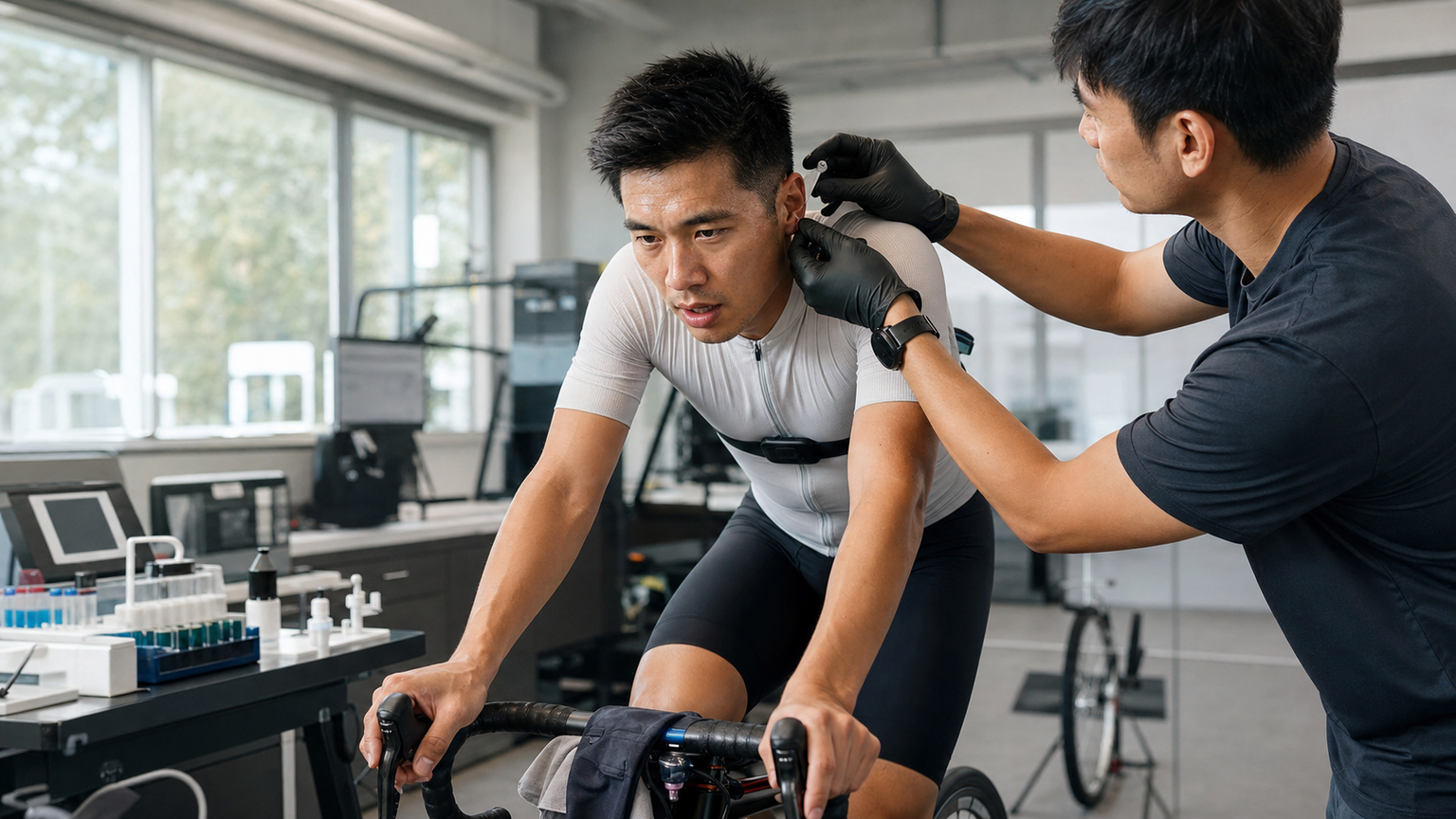
- The tester uses a lancet to take a small blood sample from the earlobe (approximately 25 microliters)
- The analyzer displays blood lactate concentration in real time (mmol/L)
- Power increases every 3–5 minutes (by approximately 25–30W), with blood sampling before each increase
- The test ends when the athlete can no longer sustain the power output
Output Data: A “lactate-power curve” that clearly shows the power outputs corresponding to LT1 and LT2.
Lactate Testing Resources in Taiwan
| Institution | City | Cost (Estimated) |
|---|---|---|
| National Taiwan University of Sport | Taichung | NT$3,000–5,000 |
| Sports Medicine Centers at Major Hospitals | Nationwide | NT$4,000–8,000 |
| Private Sports Science Consultants | Taipei/Taichung | NT$5,000–10,000 |
How to Apply Lactate Test Results
Once you have the power (or speed) corresponding to LT1 and LT2, you can precisely set your training zones:
Training Zone Setup (using LT2 = 250W as an example):
| Zone | Power Range | Training Effect |
|---|---|---|
| Z1 (Recovery) | <150W (<60% LT2) | Recovery riding |
| Z2 (Aerobic) | 150–210W (60–84%) | Aerobic base building |
| Z3 (Tempo) | 210–240W (84–96%) | Lactate threshold improvement |
| Z4 (Threshold) | 240–265W (96–106%) | Race pace strengthening |
| Z5 (Anaerobic) | >265W (>106%) | Short-duration high intensity |
Best Value Training: Two Z3–Z4 intensity sessions per week (Tempo/Threshold Runs) are the most effective way to raise LT2.
Heart Rate Variability (HRV) Monitoring
What is HRV?
Heart Rate Variability (HRV) is the variation in time intervals between heartbeats. Even if your resting heart rate is 60 beats per minute, the intervals between consecutive heartbeats are not precisely 1 second, but rather show slight variations (e.g., 990ms, 1010ms, 980ms…).
High HRV: Large variation in heartbeat intervals indicates that the autonomic nervous system (parasympathetic dominance) is in good condition and the body is fully recovered.
Low HRV: Small variation in heartbeat intervals indicates that the body is under stress (training fatigue, lack of sleep, illness).
Why is HRV Important for Athletes?
Traditional training plans are fixed: “Do intervals today, long run tomorrow.” But the body’s recovery state varies from day to day—whether you slept 5 hours or 8 hours last night makes a huge difference in today’s training capacity.
HRV monitoring allows you to adjust training based on your actual recovery state on that day:
- High HRV (>baseline): High-intensity training can be performed
- Low HRV (<baseline by 10–15%): Intensity should be reduced or rest taken
HRV Measurement Methods
Most Reliable Method: Chest strap heart rate monitor (e.g., Polar H10) + HRV4Training or Elite HRV App
Measurement Timing: Every morning after waking up, lie still for 1–3 minutes and take an HRV measurement.
Common Tools in Taiwan:
- Garmin HRV Status (select watch models)
- Apple Watch heart rate data
- WHOOP wearable device
Interpreting HRV Trends
A single HRV reading is not very meaningful; you need to observe the trend over 7–14 days:
| Trend | Interpretation | Recommended Action |
|---|---|---|
| HRV consistently high | Good recovery, supercompensation state | High-intensity training can be added |
| HRV slightly decreased | Normal training adaptation | Continue the plan |
| HRV low for 3 consecutive days | Excessive training stress or pre-illness | Reduce intensity, increase rest |
| HRV suddenly drops significantly | Illness or severe overtraining | Rest immediately, assess health |
Integrated Application of Both Technologies
Training Periodization Integration
Lactate test once per year:
- Set precise training zones for current ability
- Track annual LT2 progress
- Serve as the foundation for the season’s training plan
Daily HRV monitoring:
- Determine whether high-intensity training is appropriate for that day
- Prevent overtraining syndrome
- Maximize the benefit of each high-intensity session (perform them when the body is most ready)
Practical Recommendations for Amateur Athletes in Taiwan
Budget-Friendly Version:
- Get a lactate test once a year (within NT$5,000)
- Use a mobile app (HRV4Training, free) and a Bluetooth-enabled heart rate strap
Advanced Version:
- Lactate testing every six months
- Daily tracking with WHOOP or Garmin HRV Status
- Work with a professional sports science coach to interpret the data
Technological advances have made training more precise, but what ultimately determines performance is still the right training at the right time, along with adequate recovery. Lactate testing and HRV monitoring are tools—your perception of your body’s signals is the most fundamental wisdom.
Related Reading
- Cycling Biofeedback: Optimizing Training with HRV and Lactate Testing
- Portable Lactate Analyzers: Practical Operation and Training Applications for Running Lactate Threshold Testing
- Running Lactate Threshold Training: Scientific Methods to Break Through the LT Speed Wall
- Cycling Lactate Testing: Application of Blood Lactate Concentration in Training Zone Setup
西進武嶺 免費訓練分析服務 Intervals | 練不夠還是練過頭?你哪一種類型選手?AI模型告訴你! | 備戰神器 | 公路車 訓練 | CT Yeh
4 年前
#公路車 #Vo2Max #最大攝氧量 測驗 體驗 | 心肺測試
6 年前
FTL 與 SYB 車隊專訪 西進武嶺 實用攻略分享! 2小時 如何練?!你不知道的眉角!新手準備武嶺必看 EP1 | 實力派女車友 | 精華版 | 公路車 | CTYeh
4 年前
[教學] Premiere 影片 手震 修正 教學 防抖 單眼 影像 GoPro 穩定 Video Stabilization
8 年前
2021 96聯賽 桃園市長盃 4K多視角實況 當天選手瓦數/推力比/均速/時間 即時數據分析 | 公路車 | CT Yeh
5 年前
單車AI教練!全新 ChatGPT4o 幫你分析訓練成果!排武嶺課表,分析騎車姿勢! 太神了! / 公路車 / CT Yeh / feat. 緯緯
2 年前
西進武嶺 自製新版AI配速表產生器 x 賽前攻略 抱佛腳! 沒有功率計也可以產生配速表嗎?有什麼其他眉角賽前要注意的呢? | 西進武嶺 / 東進武嶺 KOM 攻略 | 公路車 | CT Yeh
4 年前
一起升級!海鷗盃LSD團練...JJSC Zone2招待 騎到手抖 / 公路車 / CT Yeh
1 天前