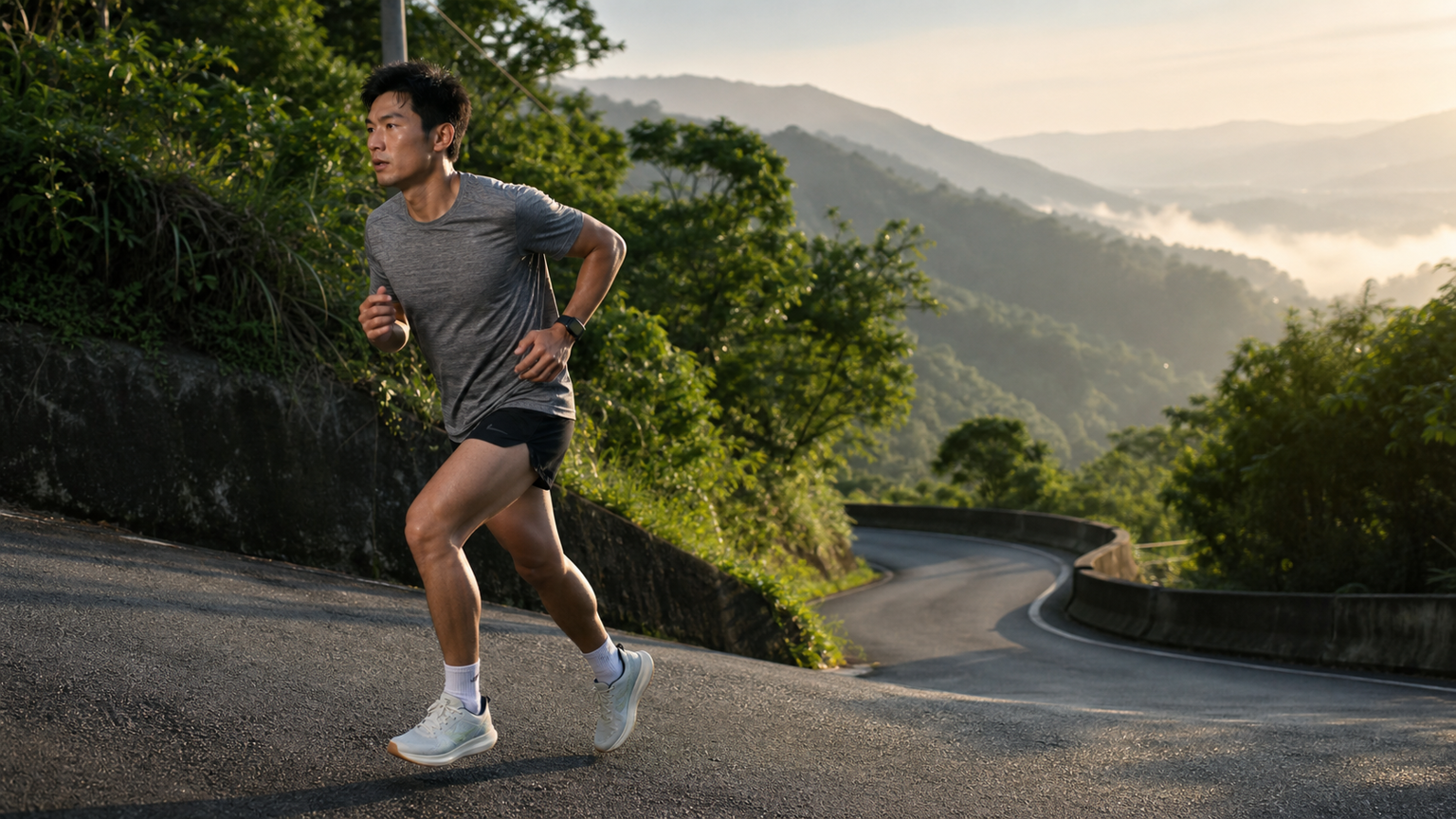
Why Runners Need Hill Training
Flat-road running is certainly important, but hill training provides stimuli that flat roads cannot. Trail running champions, elite marathoners, and middle-distance track runners all include hill training as a core part of their schedules. Taiwan’s terrain is diverse, from Taipei’s Zhinan Mountain to Yangmingshan, from Taichung’s Dakeng Trails to Jiji in Nantou—hill training resources are extremely abundant.
Uphill Running: Building the Running Engine
Physiological Benefits of Uphill Running
Uphill running demands far more from the body than flat running:
| Physiological Metric | Flat Running | 6% Grade Uphill | Increase |
|---|---|---|---|
| Heart Rate | Baseline | +15-20 bpm | ↑High |
| Muscle Effort | Baseline | +30% | ↑High |
| Ground Impact | Baseline | -25% | ↓Low |
| Calorie Burn | Baseline | +50% | ↑High |
Key Benefits:
- Strengthens Glutes and Hamstrings: Uphill running activates the gluteus maximus 2-3 times more than flat running
- Improves VO2 Max: High heart rate stimulates the upper limit of the aerobic system
- Reduces Injury Risk: Impact forces are lower than on flat ground, making it joint-friendly
- Improves Running Mechanics: Forces high knee lift and shorter stride, improving running form
Types of Uphill Training
Hill Sprints
- Distance: 80-150 meters
- Grade: 6-10%
- Intensity: 90-95% maximum effort
- Recovery: Jog down slowly, recover fully
- Sets: 6-12 reps
- Benefits: Explosive power, cadence, neuromuscular adaptation
Hill Intervals
- Distance: 400-800 meters
- Grade: 4-8%
- Intensity: 10K race pace feel
- Recovery: Easy jog downhill
- Sets: 4-8 reps
- Benefits: Strength endurance, aerobic capacity
Long Hill Climbs
- Distance: 1-5 kilometers
- Grade: 3-6%
- Intensity: Tempo run feel (comfortably hard)
- Recovery: None, continuous climbing
- Benefits: Lactate threshold, cardiorespiratory endurance
Recommended Uphill Training Routes in Taiwan
Taipei Area:
- Yangmingshan Front Mountain Park Road (4-8% grade, suitable for all types of uphill training)
- Zhinan Road to Maokong (long climb, 4-5 km continuous ascent)
- Beitou to Yangmingshan Zhuzihu (long-distance climbing route)
Taichung Area:
- Dakeng Trails No. 1-10 (various grades, be mindful of tourists)
- Huisun Forest Area Road (steeper, suitable for hill sprints)
Downhill Running: The Overlooked Training Gem
Physiological Benefits of Downhill Running
Many runners fear downhill running, believing it is bad for the knees. In fact, trained downhill running strengthens the body’s ability to adapt to impact, and is especially important for the latter half of a marathon (the downhill-style wall after 32 km) and trail running.
Muscle Demands of Downhill Running:
- Quadriceps: Brake via eccentric contractions, providing the strongest muscular adaptation stimulus
- Calf muscles: Control ankle stability
- Core muscles: Maintain torso stability and prevent the body from pitching forward
Benefits of Downhill Training
- Improved Eccentric Strength: Specifically strengthens the braking capacity of the quadriceps
- Neuromuscular Coordination: High-speed downhill running requires precise foot placement control
- Psychological Adaptation: Overcoming the fear of high-speed downhill running
- Race Strategy: Downhill sections in marathons and trail races allow for significant speed gains
Downhill Running Technique
Proper Form:
- Lean slightly forward (do not lean back)
- Shorten stride, increase cadence
- Extend arms backward to balance the center of gravity
- Land with feet beneath the body, avoid overstriding
- Look 2-3 meters ahead to anticipate the terrain
Common Mistakes:
- Leaning back to “brake” → actually increases knee stress
- Overstriding to speed up → drastically increases impact forces
- Slamming the heel down → vibration transmits to the knee joint
Progressive Downhill Training Plan
Beginner (Weeks 1-4):
- Once per week, choose a gentle slope (3-5%), 400 meters
- Pace: Easy, just focus on feeling the form
Intermediate (Weeks 5-10):
- Increase grade to 5-8%, distance 800 meters-1 km
- Pace: Faster than flat running but still controlled
Advanced (Week 11 onward):
- Grade 8% or more, distance 1-2 km
- Pace: Can approach race downhill pace
Combined Uphill and Downhill Training Schedule
Hill Circuit Training (The Most Effective Workout)
On a section of road with a noticeable grade, repeat running up and down.
Sample Workout:
- Warm-up: 15 minutes easy running on flat ground
- Main set: Choose a 400-meter hill
- Uphill: Run uphill at an effort of 7/10
- Downhill: Recover by running downhill under control
- Repeat 10-15 times
- Cool-down: 10 minutes easy running on flat ground
Hill Training Precautions
Injury Prevention:
- If you experience knee pain after downhill training, stop immediately and apply ice
- Significant delayed onset muscle soreness (DOMS) in the first week of hill training is normal
- Do not do hill training more than twice per week
Weather Considerations:
- Taiwan is rainy; hills on wet, slippery surfaces are exponentially more dangerous
- After typhoons, mountain roads may have falling rocks; extra caution is needed
Conclusion
Uphill and downhill running are complementary training modalities with different skill demands and benefits. Uphill builds strength and the aerobic engine; downhill strengthens braking capacity and tendon resilience. Taiwan’s abundant mountainous terrain gives us uniquely favorable conditions for hill training. Systematically incorporate hill training into your weekly plan, and in three months you will find significant improvements in both flat-ground speed and endurance.
Related Reading
公路車 爬坡 破PR 紀錄 小技巧 分享
6 年前
單車 梅山36灣 坡度介紹 路段介紹 空拍 (相關遊記影片,請參考說明或我的頻道喔,歡迎訂閱)
6 年前
靠單車減肥35公斤 心得分享與整理
7 年前
如果Pogačar騎西進武嶺可以多快?會破2嗎?各種情況深度推估探討 / 公路車 / CT Yeh
2 年前
白沙屯媽祖進香在家走!UREVO 坡度自調走步機 / 可連接訓練遊戲APP MyWhoosh / 邊看直播邊走起來 / CT Yeh
11 個月前
一日北高常見問題大集合 | 攻略 | 路線 | 訓練 | 補給 | 自行車 單車 | 一日雙城 | 雙塔 | TWB北高360 | 屁股痛
6 年前
一日北高/長距離團騎 常見問題補充篇 / 組團或跟團的眉角 / 壯車友容易被瘦車友慢性拉爆 / 原來屁股痛可能是這個原因...? / 風場配速法 / 公路車 / CT Yeh
2 年前
西進武嶺 8000名單車友數據分析 PART1 | 從新手到高手數量/瓦數/推力比/FTP推力比/功率計使用率 大解析 | 公路車 | CTYeh
5 年前