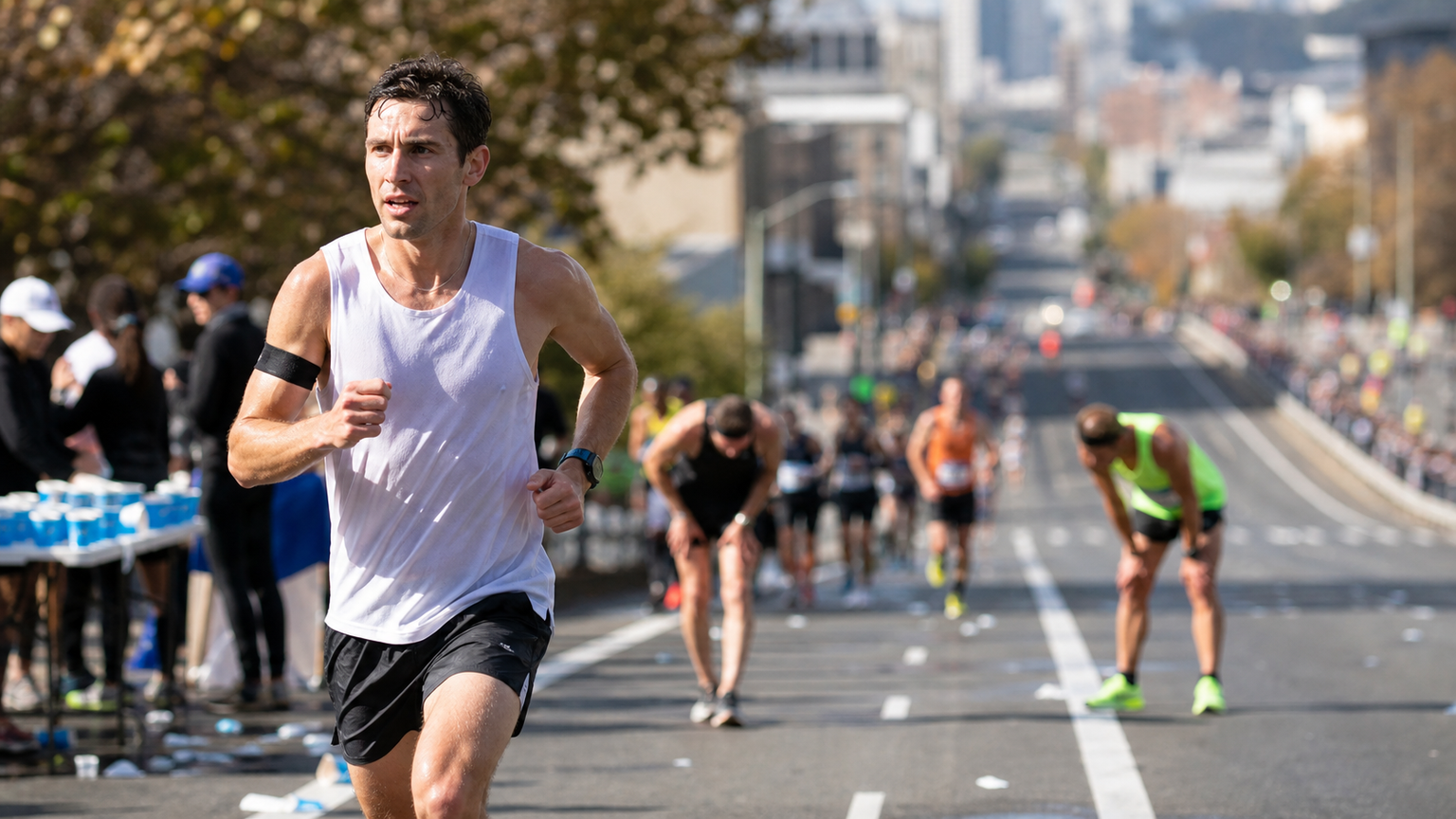
Why Do Most Runners Collapse in the Second Half?
Statistics show that over 90% of amateur marathon runners run the second half (21-42 km) slower than the first half, with an average gap of 5-15 minutes. In contrast, the world’s top marathoners typically finish within 1-2 minutes of their first-half split, and some even run the second half faster (negative splits).
This widespread second-half collapse can be significantly improved through training and race strategy.
Analysis of the Causes of Second-Half Collapse
Cause 1: Starting Too Fast (Most Common)
In the excitement of race day, the pace in the first 5 km is often 30-60 seconds/km faster than planned. This early overexertion depletes glycogen before the 30 km mark, making a late-race collapse almost inevitable.
Data support: A study analyzing data from 20,000 New York Marathon runners found that those who ran the first half more than 15 minutes faster than the second half finished an average of 32 minutes slower than their predicted goal.
Cause 2: Insufficient Fueling
Taking one energy gel (about 100 calories) every 45 minutes is a basic requirement, but many runners wait until they “feel hungry” to fuel—but by then glycogen is already depleted, and catch-up fueling has limited effect.
Cause 3: Insufficient Long-Distance Endurance in Training
If your longest training run is only 28-30 km, your body lacks adequate physiological memory for the 32-42 km stretch. The “unfamiliar distance” causes the brain to send fatigue signals sooner.
Cause 4: Electrolyte Imbalance
Mild hyponatremia caused by excessive sodium loss can lead to nausea, headaches, and reduced concentration, indirectly impairing running efficiency.
Negative Splits: The Secret of Elite Runners
Negative splits refer to a pacing strategy where the second half is run faster than the first half.
Famous examples:
- Eliud Kipchoge at the 2018 Berlin Marathon (2:01:39 world record): first half 1:01:06, second half 1:00:33
- Paula Radcliffe at the 2003 London Marathon: first half 1:08:02, second half 1:07:56
Why are negative splits faster?
- Optimal utilization of glycogen and fat for energy
- Psychological advantage: passing others in the second half rather than being passed
- Warm-up effect: the first half fully warms up the body
Race Strategies to Avoid Collapse
Strategy 1: GPS Pace Control
Set an upper-limit alert for your target pace on your watch before the start. If your pace exceeds the target, the watch vibrates as a warning. In the first 10 km, it’s better to run 2-5 seconds/km slower—you’ll thank yourself for the restraint over the final 30 km.
Strategy 2: Segmented Target Pacing
Don’t think of the marathon in terms of “average pace.” Instead, set segment targets:
| Distance Segment | Suggested Intensity | Relative to Target Pace |
|---|---|---|
| 0-10 | Easy | Target +5-10 sec/km |
| 10-21 | Steady | Target +0-5 sec/km |
| 21-32 | Target | Target pace |
| 32-38 | Slightly faster | Target -0-5 sec/km |
| 38-42 | All out | Based on feel |
Strategy 3: Fuel Early and Often
Golden rule: Don’t wait until you’re hungry to fuel
- 30-40 minutes after the start: first energy gel
- Then one gel every 40-45 minutes
- Take water (200 ml) or electrolyte drinks alongside
- Salt tablets: one every 90 minutes (even more important for Taiwan’s summer races)
Aid stations at Taiwan’s major marathons are typically spaced 2.5-5 km apart—don’t skip any of them.
Strategy 4: Mental Strategy for 32-35 km
This is the toughest stretch, so prepare mental tools in advance:
- Queue up a motivating playlist
- Repeat pre-prepared motivational phrases
- Pick a runner ahead as a “target to chase”
- Tell yourself: “There’s just one more 10 km training run left”
Training Methods to Avoid Second-Half Collapse
Marathon-Pace Long Runs
Add marathon goal pace to the latter portion (final 20-30%) of your weekend long runs.
Sample workout:
- First 60 minutes: easy pace (target +30-40 sec/km)
- Last 30 minutes: marathon goal pace
This trains the body to maintain fast running under fatigue—the so-called “fast running while tired” adaptation.
Ultra-Long Runs (38-40 km)
Complete 1-2 ultra-long runs of 38-40 km 12-14 weeks before the marathon. This prepares both body and mind for the full distance. However, recovery time must be carefully planned (10-14 days for full recovery).
Second-Half Simulation Training
During the final 10 km of a long run, imagine you are at the 35-42 km mark of the race, practicing maintaining form and pace while fatigued.
Common Second-Half Collapse Sections in Taiwan Marathons
| Race | Difficult Section | Cause |
|---|---|---|
| Taipei Marathon | 30-38 km (return stretch on Ren’ai Road) | Headwind, mental fatigue |
| Wan Jin Shi Marathon | 28-38 km (return stretch toward Keelung) | Sea headwind, mental fatigue |
| Taichung Marathon | 32-40 km (return stretch through the city) | Rising temperatures, fewer aid stations |
Conclusion
Nine times out of ten, a marathon second-half collapse is decided at the starting line. Restraint at the start, early fueling, and a solid long-distance training foundation—these three points are the core of avoiding the downhill wall. When you can still hold your rhythm past 30 km, and even accelerate to pass runners ahead of you, that is the most beautiful moment of the marathon.
Related Reading
- Marathon Pacing Strategies Fully Explained: How to Choose Even Pacing, Negative Splits, and Positive Splits, and How Hitting the Wall Happens
- The Negative Split Method for Marathons: Why Running the Second Half Faster Than the First Half Is the Correct Strategy
- Mental Segmentation Strategy for Marathons: Preventing Mental Collapse After 30 km
- Marathon Negative Split Pacing: The Discipline and Execution Details of Starting Slow and Finishing Fast
一日北高/長距離團騎 常見問題補充篇 / 組團或跟團的眉角 / 壯車友容易被瘦車友慢性拉爆 / 原來屁股痛可能是這個原因...? / 風場配速法 / 公路車 / CT Yeh
2 年前
公路車 爬坡 破PR 紀錄 小技巧 分享
6 年前
#公路車 #西進武嶺 配速配瓦實驗 坡度分析 四小時內攻略 建大盃 NeverStop #西進武嶺攻略
6 年前
CT 喇低賽) 武嶺牽車 才是王道 西進牽車四小時內秘訣 攝手位置 如何判斷 防抽筋小秘訣
7 年前
西進武嶺 免費訓練分析服務 Intervals | 練不夠還是練過頭?你哪一種類型選手?AI模型告訴你! | 備戰神器 | 公路車 訓練 | CT Yeh
4 年前
爬陡坡被爆胎的車友跑步超車 #cycling #里佳部落
9 個月前
2016 桐花飛舞 單車挑戰 精華片段
10 年前
2019 夏季KOM 5小 完賽心得 準備攻略 東進武嶺 夏季登山王之路 Taiwan KOM Challenge
7 年前