Running GPS Watch vs Heart Rate Monitor: Which Should Beginners Buy First?
文章導覽
- The Runner's Gear Dilemma
- First, Understand: What Data Do You Actually Need?
- Advantages of GPS Running Watches and Who They Suit
- Main Features of GPS Running Watches
- Runners Who Should Choose a GPS Running Watch
- Popular GPS Running Watches in Taiwan
- Types of Heart Rate Monitoring Devices
- Type 1: Chest Heart Rate Straps (Most Accurate)
The Runner’s Gear Dilemma
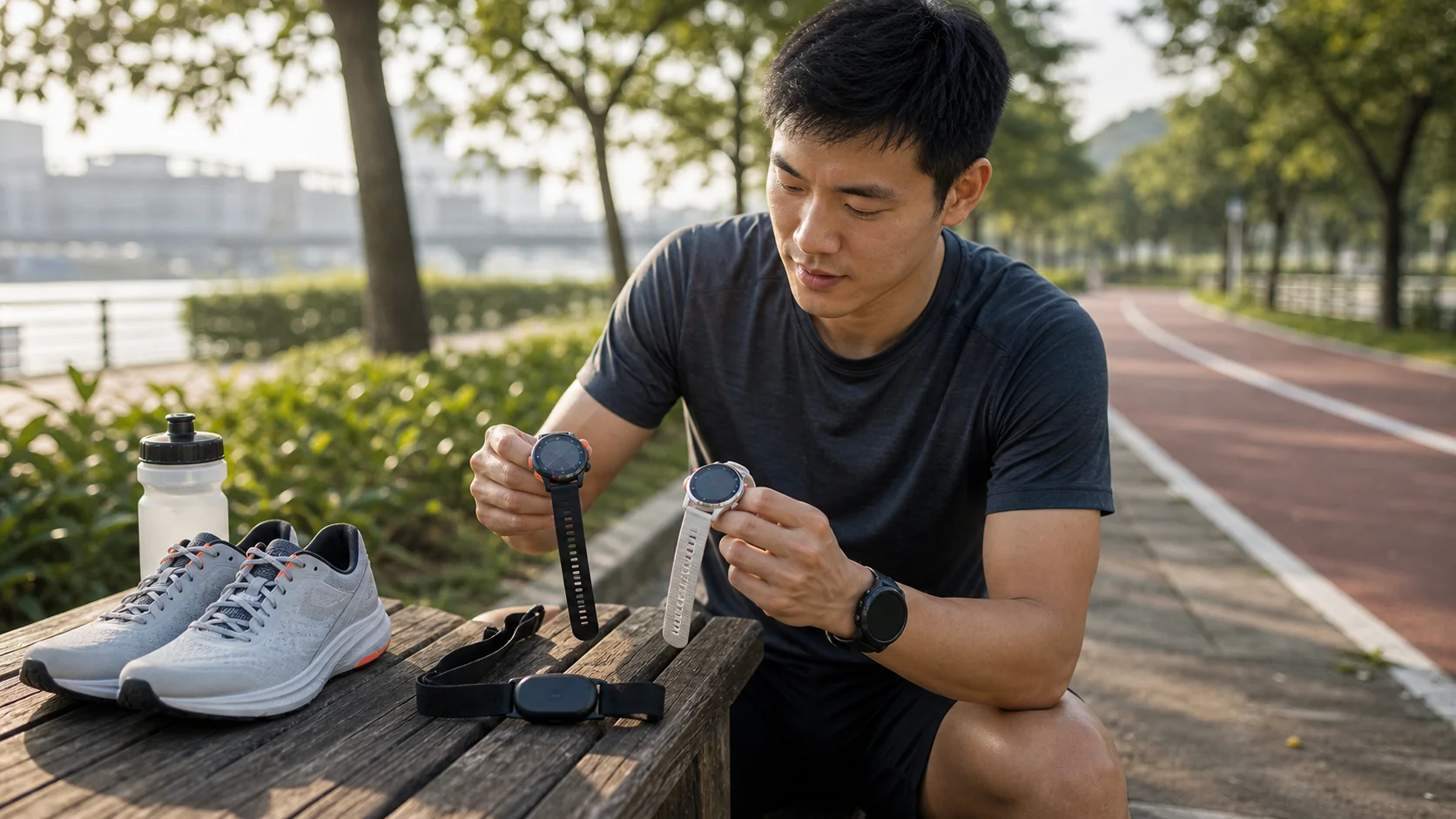
When you’re just starting to run, the sheer number of gear choices can be overwhelming. GPS running watches, chest heart rate straps, optical heart rate monitors, basic sports watches… the question beginners with a limited budget ask most often is: “Which one should I buy first?” This article will help you sort it out.
First, Understand: What Data Do You Actually Need?
Different devices provide different data, so first think clearly about your needs:
| Data | Purpose | Which Device? |
|---|---|---|
| Distance and pace | Know how far and how fast you’ve run | GPS watch |
| Real-time heart rate | Control training intensity | Heart rate monitor/chest strap |
| Cadence | Improve running efficiency | Most GPS running watches |
| Route tracking | Analyze your running routes | GPS watch |
| Heart rate variability (HRV) | Monitor recovery status | Advanced smartwatches |
Advantages of GPS Running Watches and Who They Suit
Main Features of GPS Running Watches
- Real-time display of distance, pace, and time
- GPS route tracking (viewable on Google Maps)
- Cadence detection (most models)
- Optical heart rate (most models, moderate accuracy)
- Training analysis (advanced models)
Runners Who Should Choose a GPS Running Watch
- Goal-oriented: You have specific pace or distance targets
- Race-focused: You need precise per-kilometer split pacing
- Route explorers: You enjoy recording the routes you’ve run
- Data analysts: You enjoy reviewing your training data afterward
Popular GPS Running Watches in Taiwan
Entry level (NT$3,000-6,000):
| Brand/Model | Battery Life | Key Features |
|---|---|---|
| Garmin Forerunner 55 | 20 hours | Lightweight, training suggestions feature |
| COROS PACE 3 | 38 hours | Excellent value, extra-long battery life |
| Polar Pacer | 35 hours | Excellent heart rate analysis |
Mid-range (NT$6,000-12,000):
| Brand/Model | Battery Life | Key Features |
|---|---|---|
| Garmin Forerunner 265 | 24 hours | AMOLED screen, training load analysis |
| COROS APEX 2 | 75 hours | Extra-long battery life, great for trail running |
| Apple Watch Series 9 | 18 hours | Multi-functional, best iOS integration |
Types of Heart Rate Monitoring Devices
Type 1: Chest Heart Rate Straps (Most Accurate)
Devices like the Garmin HRM-Run and Polar H10 detect the heart’s electrical signals via electrode pads (the same principle as an ECG).
Advantages:
- Highest accuracy (close to medical-grade ECG)
- Can provide advanced running metrics like cadence and vertical oscillation (HRM-Run model)
- Compatible with any GPS watch (ANT+ or Bluetooth connection)
Disadvantages:
- Inconvenient to wear (must be strapped around the chest)
- Electrode pads need to be moistened to work properly
- May slip during intense movement
Taiwan price: NT$1,500-3,500
Type 2: Wrist-Based Optical Heart Rate (Convenient, Moderate Accuracy)
Most mid-to-high-end GPS running watches have a built-in optical heart rate sensor (OHR) that detects blood flow changes beneath the skin of the wrist.
Advantages: No extra device needed, convenient
Disadvantages: Larger margin of error during high-intensity exercise, especially with significant arm movement while running
Type 3: Armband Heart Rate Sensors
Devices like the Polar Verity Sense and Wahoo TICKR FIT clip onto the upper arm, offering accuracy between chest straps and wrist-based monitors.
Advantages: More accurate than wrist-based, more convenient than chest straps
Taiwan price: NT$2,000-3,500
A Decision Tree for Beginners
Scenario 1: “I just want to know how far I’ve run”
→ Buy an entry-level GPS running watch first (Garmin Forerunner 55 or COROS PACE 3)
→ Both models include optical heart rate, which is more than enough functionality for a beginner
Scenario 2: “I have a heart-related condition and my doctor wants me to monitor my heart rate”
→ Buy a chest heart rate strap + a free heart rate monitoring app first
→ Chest straps offer the highest accuracy and can be paired with a phone app, so you don’t necessarily need a GPS watch right away
Scenario 3: “My budget is under NT$3,000”
→ Use your phone (free GPS app) + a heart rate strap first
→ Adidas Running, Nike Run Club, and the Garmin Connect app all offer free GPS tracking
→ Save up and upgrade to a GPS watch later
Scenario 4: “I already have an Apple Watch/Samsung Galaxy Watch”
→ Use what you already have for now — no need to buy anything else immediately
→ The running features on modern smartwatches are already sufficient for beginners
→ Once you start training seriously, consider upgrading to a dedicated running GPS watch
Feature Comparison: Which Features Actually Matter?
Features beginners use most (make sure your device has these):
- GPS distance tracking
- Real-time pace display
- Stopwatch/timer
- Heart rate (optical is fine)
Useful mid-level features:
- Cadence display
- Training plans (e.g., Garmin’s Coach feature)
- Post-workout analysis (VO2max estimation)
Advanced features (beginners don’t need these yet):
- Heart rate variability (HRV) analysis
- Running power
- Terrain navigation
- Sleep tracking (smartwatches only)
Purchase Priority Recommendation
Clear recommendation: beginners should buy a GPS running watch first — there’s no need to buy a separate heart rate strap.
Reasons:
- Distance and pace are the most important training data for beginners
- Entry-level GPS running watches already have built-in optical heart rate, which is accurate enough for beginners
- Chest straps are better suited to advanced runners who need more precise heart rate training data
Suggested budget allocation:
- NT$5,000-6,000: COROS PACE 3 (top value pick)
- NT$7,000-9,000: Garmin Forerunner 255
- NT$10,000+: Garmin Forerunner 265 or Polar Vantage V3
Conclusion
Gear is a tool — training is what actually matters. The most important thing for beginners is to “start running,” not to own the best equipment. An NT$5,000 entry-level GPS running watch paired with a serious training plan is far more effective than an NT$20,000 top-tier watch paired with irregular training. Choose equipment that fits your budget and has functionality that’s good enough, and put the money you save into a good pair of running shoes — that’s the investment that’s truly worth making.
Related Reading
- Running Heart Rate Strap vs Optical Heart Rate: Comparing Measurement Accuracy and Wearing Comfort
- Heart Rate Pacing vs GPS Pacing for Running: Which Is More Accurate
- Running Heart Rate Strap vs Optical Heart Rate: Choosing Based on Accuracy and Use Case
- Running Pace Watch Applications: Choosing Between Heart Rate, Pace, and Power Meter for Marathons