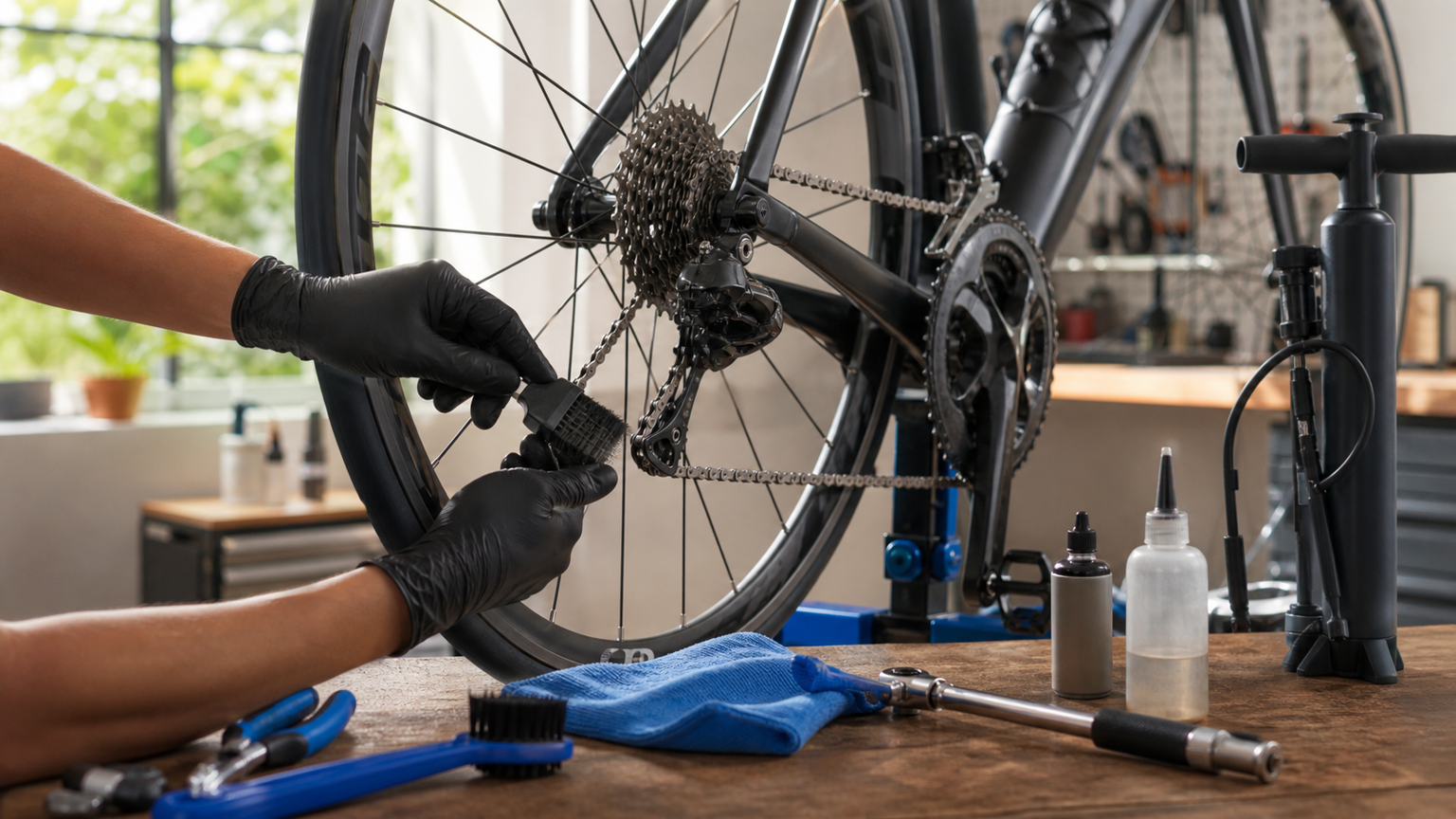
Bicycle Maintenance Calendar: What to Check Every Ride, Every Month, and Every Year
A bicycle is a piece of precision machinery. Regular maintenance doesn’t just keep performance at its peak — it extends the bike’s lifespan and helps you avoid a breakdown at the worst possible moment. Building a systematic maintenance calendar turns upkeep into a habit instead of a burden.
After Every Ride: A 5-Minute Quick Check
Right After You Get Off the Bike
1. Visual inspection
- Check tires for anything obviously embedded (glass shards, nails)
- Check the frame for scratches or cracks (carbon frames need extra attention)
- Check wheels for visible misalignment (after a bump or crash)
2. Drying and cleaning
- After a wet ride: dry the chain and drivetrain, then re-lube
- After a normal ride: wipe off dirt and sweat with a dry cloth
3. Chain lubrication (as needed)
- A squeaking chain means it needs oil
- Cleaning steps: wipe off the old oil with a dry cloth first, apply fresh lube, let it sit for 10 minutes, then wipe off the excess
Monthly Maintenance: 30–60 Minutes
Drivetrain Cleaning
The drivetrain (chain, cassette, chainrings, front and rear derailleurs) is the part of the bike that needs the most regular cleaning:
| Item | Frequency | Method |
|---|---|---|
| Chain wash | Monthly | Chain cleaning tool + chain degreaser |
| Cassette cleaning | Monthly | Old toothbrush to scrub off grime, a cloth strip threaded between the cogs |
| Front/rear derailleur cleaning | Monthly | Cloth and degreaser on the pivot points |
| Chainring cleaning | Monthly | Wipe grease off the chainring surfaces |
Chain washing steps:
- Clip the chain cleaning tool onto the chain
- Pour in degreaser (such as Simple Green or WD-40 Bike Chain Cleaner)
- Pedal to run the chain through the cleaner for 10–15 rotations
- Rinse with water (if available) or wipe dry with a cloth
- Once the chain is fully dry, apply fresh lubricant
Tires and Rims
- Tread wear check: Watch the wear indicator grooves in the center of the tire — replace once they disappear
- Sidewalls: Check for cracks or bulging
- Rims/rotors: Check the rim brake track for visible grooving (a badly grooved rim needs replacing)
Braking System
- Brake pad thickness: rim brake pads need at least 1–1.5mm of material
- Brake cables: check for slack when pulled tight, and for any fraying or cracking
- Brake feel: should be consistent, with no sticking or binding
Bolt Check (Torque Verification)
| Location | Standard torque (Nm) | Notes |
|---|---|---|
| Stem top cap bolt | 5–7 Nm | Do not over-tighten — it can snap |
| Handlebar clamp bolts | 4–6 Nm | |
| Seatpost clamp | 5–8 Nm | Adjust based on frame material |
| Pedals | 25–30 Nm | Left pedal has reverse threading |
| Wheel skewers | Hand-tight is enough | Confirm it’s secure |
Note: Torque limits on carbon components must be followed strictly — over-tightening can crack the carbon.
Every Three Months or 1,500 km
Cable Replacement Assessment
Brake and shift cables should generally be replaced every 1,500–3,000 km, depending on riding conditions. Taiwan’s hot, humid climate accelerates cable corrosion, so a shorter replacement interval is recommended.
Signs it’s time to replace:
- Cables feel rough or show resistance when pulled
- Shifting response is sluggish
- Any point on the brake cable shows fraying or rust
Bearing Condition Assessment
- Bottom bracket: Creaking or clicking while pedaling, or play when you rock the chainring side to side by hand — needs replacement
- Hubs: Resistance or grinding noise when spinning the wheel — needs adjustment or lubrication
- Headset: Grip the front brake and rock the fork back and forth — any looseness means it needs adjustment
Annual Full Service
Once a year, or every 5,000 km, a complete full-bike service is recommended, ideally done at a professional bike shop:
Annual Service Checklist
| Item | Description |
|---|---|
| Full teardown and cleaning | Includes frame wash and a thorough drivetrain clean |
| Chain replacement assessment | Use a chain wear tool; replace if worn beyond spec |
| Cassette assessment | Typically replace the cassette once for every three chain replacements (due to matched wear) |
| Tire replacement | If used over 5,000 km or showing significant aging |
| Bearing lubrication | Regrease the bottom bracket, hubs, and headset |
| Full cable replacement | Renew all brake and shift cables |
| Brake pad replacement | Based on wear condition |
| Frame structural inspection | Carbon frames need special attention for hidden cracks |
Special Maintenance Notes for Taiwan’s Climate
Hot and Humid Conditions
- Chains rust more easily — choose a wet-condition or wax-based chain lube
- Perform regular anti-rust treatment on metal parts
After a Typhoon
- Typhoons bring large amounts of sea salt and grit — clean the whole bike immediately once the storm passes
- Pay special attention to the drivetrain, brake pads, and rim brake track
After Mountain Rides
- Gravel and sand on mountain roads accelerate tire and drivetrain wear
- Clean the bike as soon as possible after descending
Think of maintenance as part of the ride itself, not a chore that comes after it. A well-maintained bicycle rewards you with a smoother ride and fewer breakdowns on the road.
Related Reading
- Bicycle Maintenance Schedule: A Complete Checklist from Daily to Yearly
- Annual Major Overhaul Checklist: 15 Essential Full-Bike Maintenance Tasks Every Year
- Road Bike Annual Maintenance Checklist: Monthly, Quarterly, and Yearly Upkeep
- E-Bike Maintenance Guide: Motor, Battery, and Electronics Care Essentials
碟煞公路車 銑面器 !? 原來銑完差這麼多! 降低蹭碟機率! | TIME 公路車 保養小記錄 | CT Yeh
3 年前
洗單車神器 吹水機! 實際洗車用用看 暴力洗鍊條大法 | 公路車 | CT Yeh
4 年前
2025 自行車錶排行榜 兩萬車友大數據 / Garmin Bryton 排名會大洗牌嗎? / 全新的碼表前身分析 /公路車 / CT Yeh
1 年前
#公路車 #Fitting 靠人工智慧APP 幫你調整單車
6 年前
靠單車減肥35公斤 心得分享與整理
7 年前
自助洗車場 洗單車 50元有找 清鍊條大法 居然還有小小兵
7 年前
高雄綠園道鐵路自行車道 / 外地人能輕鬆駕馭 還是整路崩潰? / 2025 全線開通 春節實地探索一次!(附GPS連結)/ 公路車 / CT Yeh
1 年前
單車賞雪 裝備準備及注意事項分享 | 公路車
5 年前