Road Bike Wheelset Basics: The Complete Guide to Tubeless Systems
Tubeless systems are one of the most talked-about technologies in the road cycling world in recent years. More and more road wheelsets and tires now support the tubeless standard, but many riders still find the system unfamiliar or intimidating. This article breaks down everything about tubeless.
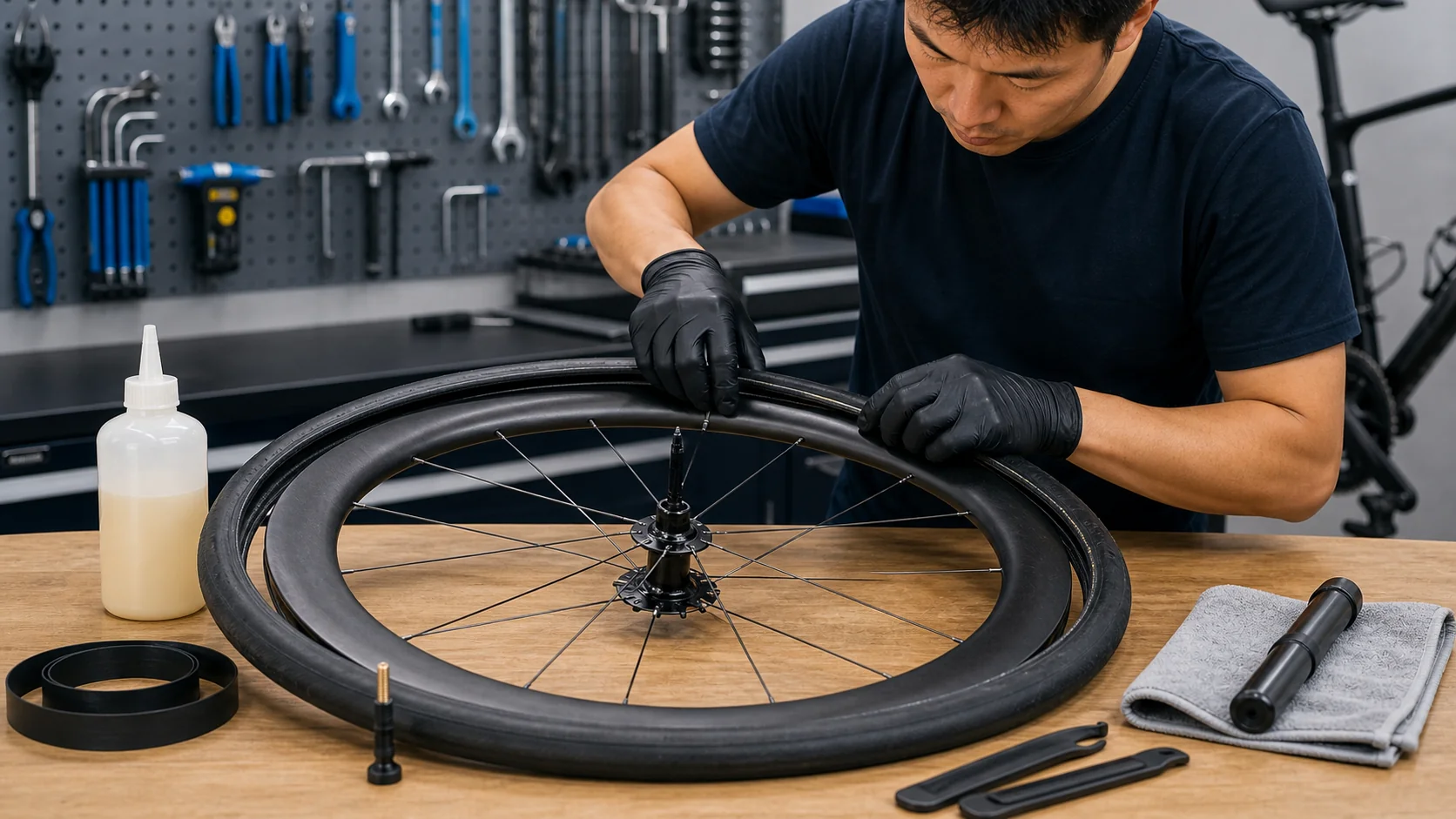
What Is Tubeless?
Traditional road bikes use a system with a separate tire and inner tube: Tire + Inner Tube. A tubeless system removes the inner tube, letting the tire seal directly against the rim, with sealant injected to automatically patch small punctures.
Comparing Three Rim-Tire Systems
| System | Inner Tube | Tire Sealing | Sealant | Common Use |
|---|---|---|---|---|
| Traditional (Clincher) | Required | Sealed by inner tube | Not required | Most common |
| Tubeless | Not required | Rim + tire sealing | Recommended | Increasingly popular |
| Tubular | Sewn inside the tire | Fixed with glue | Not applicable | Professional racing |
Advantages of Tubeless
1. Dramatically Improved Puncture Resistance
Sealant (such as Stan’s NoTubes or Orange Seal) can automatically seal punctures up to 3mm in diameter within seconds. On rough or debris-covered roads, this greatly reduces the number of times you have to stop to fix a flat.
2. Lower Tire Pressures Are Possible
Without an inner tube, the risk of a “pinch flat” is eliminated — this is when the inner tube gets pinched and torn between the rim and a hard object at low pressure.
Recommended Tubeless vs. Tubed Tire Pressure:
| Rider Weight | Recommended Tubed Pressure | Recommended Tubeless Pressure |
|---|---|---|
| 60kg | 90-100 PSI | 72-80 PSI |
| 70kg | 95-105 PSI | 78-85 PSI |
| 80kg | 100-110 PSI | 84-90 PSI |
Lower tire pressure delivers better cushioning and grip, which is especially noticeable on rough roads or gravel sections.
3. Lower Rolling Resistance
Multiple lab tests show that tubeless systems have 5-10% lower rolling resistance than tubed systems, which adds up to a considerable time savings over long rides.
Challenges of Tubeless
1. Higher Installation Difficulty
Tubeless tire beads are tighter, so getting a proper seal requires a more strenuous installation process. You typically need a pump that can deliver a fast burst of high-pressure air to seat the bead.
Recommended tools: A blast inflator (compressed-air canister) or a high-volume floor pump — a standard hand pump often doesn’t provide enough air volume.
2. Sealant Needs Periodic Refilling
Sealant evaporates over time. It’s recommended to refill it every 3-6 months (possibly faster during Taiwan’s summer), or its protective effect will decline.
3. Large Punctures Can’t Be Self-Repaired on the Road
If you encounter a large gash (over 3mm), sealant cannot repair it, and you’ll need to insert an inner tube to keep riding. That’s why you should still carry a spare inner tube as an emergency backup.
Installing a Tubeless System
Materials Needed
- Tubeless Ready rim (or a standard rim converted with tubeless tape)
- Tubeless Ready tire
- Tubeless valve
- Sealant (recommended 30-60ml per tire)
- Rubber mallet (to help seat the bead)
Installation Steps
- Clean the rim channel: Make sure it’s free of grease and debris
- Apply tubeless tape (if needed): Make sure all spoke holes are sealed
- Install the valve: The rubber grommet needs to fit snugly
- Mount the tire (don’t inflate yet)
- Inject sealant: Inject it through the valve
- Inflate to seat the bead: Requires a fast burst of high-volume air — a “pop” sound means the bead has seated
- Spin the wheel: To distribute the sealant evenly
Frequently Asked Questions
Q: My rim isn’t Tubeless Ready — can it be converted?
A: Some rims can be converted using tubeless tape (such as Effetto Mariposa Caffélatex tape), but results aren’t guaranteed — it’s best to consult a bike shop.
Q: Which sealant brand is better?
A: Stan’s NoTubes is the industry standard, and Orange Seal also performs well. There are also local Taiwanese brands available.
Q: What pressure should I run?
A: This depends on your weight and tire width. You can use online tire pressure calculators from SILCA or FLO Cycling for a personalized recommendation.
Tubeless systems require some initial investment of time and money, but once you get the hang of it, the improvements in puncture resistance and ride comfort are very real. For riders who often ride on rough road surfaces, it’s an upgrade worth considering.
Related Reading
再一組! 全碳幅條 碟煞/無內胎輪組 開箱! 到底好騎嗎? UNAAS X40 | 公路車 | CT Yeh
4 年前
碟煞公路車 優缺點?換車一年半實際經驗分享 / 公路車 / CT Yeh
2 年前
鉅齒紋輪組!? ControlTech MEG-T50 EVO 碳纖維幅條輪組/ 功率對比實驗 / 公路車 / CT Yeh
2 年前
單車胎壓觀察到的有趣現象,SRAM Quarq TyreWiz 2.0 無內胎胎壓計 / 裝了有哪些幫助? / Tubeless / 公路車 / CT Yeh
1 年前
公路車 BB培林大升級! / 備戰海鷗繞圈賽 Canyon Aerod & TIME 一起改 / MIT大廠 CEMA對鎖式陶瓷培林BB & 導輪 / 公路車 / CT Yeh
2 年前
Vision Metron RS 37碳幅條輪組 (非SL)官網沒有的 低調開箱 / 這重量太銷魂了 / 公路車 / CT Yeh
6 個月前
Nepest NOVA 碳條輪組:輕量、空力、舒適一次滿足!/ 公路車 / CT Yeh
7 個月前
碟煞公路車 銑面器 !? 原來銑完差這麼多! 降低蹭碟機率! | TIME 公路車 保養小記錄 | CT Yeh
3 年前