How to Attach a Race Number Bib: Aerodynamic Details That Cut Drag
In the preparation for a cycling race, handling the race number bib is often overlooked. But for riders chasing peak performance, how the bib is attached and folded can produce a measurable speed improvement without spending a single dollar.
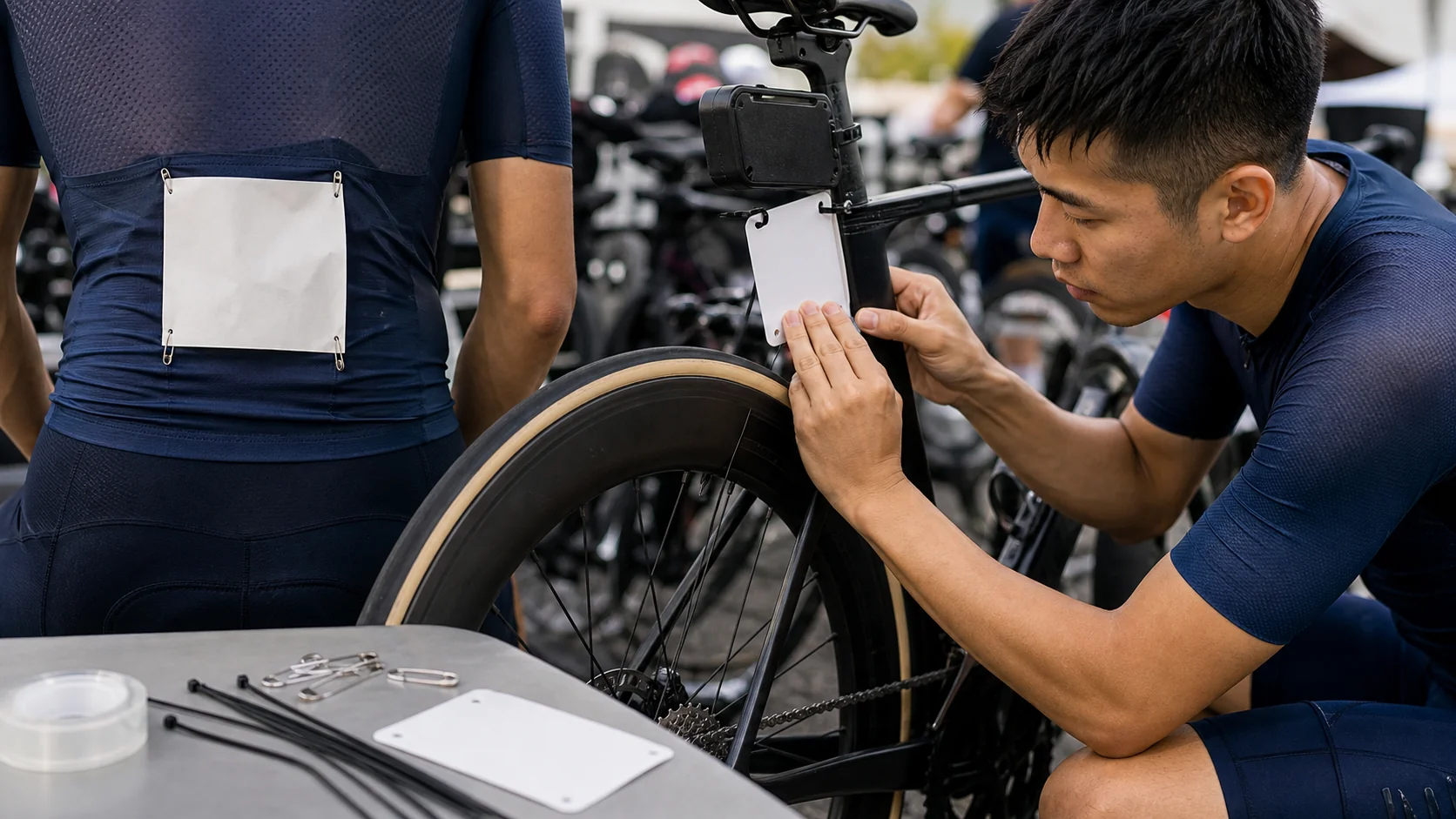
Why Does a Race Number Bib Affect Speed?
The Sail Effect
A standard-size race number bib (roughly 21x30cm, A4 size) can act like a sail while riding:
- Large surface area facing the wind
- Paper material is relatively stiff and tends to curl into a convex shape
- Fixed at the four corners but slack in the middle, so it billows in the wind
Wind tunnel data shows that an untreated, billowing bib can add roughly 3-5W of aerodynamic drag at 40km/h, and even more at 50km/h.
The Best Ways to Attach a Race Number Bib
Method 1: Multi-Point Fixing
Traditionally, only 4 safety pins are used at the corners, which lets the middle of the bib billow in the wind. Improved approach:
Steps:
- Fix the four corners (standard)
- Add 1 safety pin along each of the four edges (8 total)
- Add 1 pin along each diagonal in the middle (10 total)
The more safety pins used, the more closely the bib hugs the jersey, and the lower the drag.
Method 2: Folding (Most Effective)
Many professional cyclists and triathletes use folding to reduce the effective surface area of the bib:
Steps:
- Starting from the edge of the bib, fold inward (without covering the number itself)
- Reduce the surface area while keeping the number fully visible
- A folded bib is stiffer and less likely to billow
Note: The fold must never obscure the number, or you risk disqualification.
Method 3: High-Tack Double-Sided Tape
Use double-sided tape (especially fabric tape) on the back of the bib to attach it directly to the jersey:
Pros: Full, flush contact and minimal drag
Cons: May damage the jersey when peeled off — it’s best to remove it immediately after the race
Choosing Where to Place the Bib
Back vs. Waist
| Position | Aero Effect | Visibility | Common Use |
|---|---|---|---|
| Center back | Average | High | Road race group events |
| Side of back | Better | Moderate | Triathlon |
| Waist (helmet-shielded) | Best (shielded by the helmet) | Low | Time trials |
| Front chest (triathlon) | Poor (faces the wind head-on) | Highest | Required for the run leg |
Special Requirements for Triathlon
A triathlon race belt wraps around the waist and can be quickly rotated from back to front (back during the swim and bike legs, front during the run leg). This belt-style design offers more of an aerodynamic advantage than safety pins, and is also more practical.
Advanced Tips: Choosing the Right Bib Material
Some races allow or require specific bib materials:
| Material | Characteristics | Aero Effect |
|---|---|---|
| Paper bib | Most common, cheap | Worse (prone to billowing) |
| Tyvek | Waterproof and lightweight | Moderate |
| Aero bib (provided by sponsor) | Form-fitting design | Best |
Some sponsors or major events (such as IRONMAN) provide official form-fitting bib sleeves that fit directly over the jersey for the best result.
Special Notes for Time Trials
Individual time trials (TT) demand the most from aerodynamics, so here are recommendations for handling the bib:
- TT skinsuits: One-piece TT skinsuits usually have a built-in pocket-style slot for the bib, completely eliminating any flapping
- Bib on the side of the helmet: Some races allow the bib to be attached to the side of the helmet, keeping it off the body entirely
- Check the rules in advance: Every race has different rules for bib placement and size
Quick Summary
For most amateur cyclists, the most practical improvements are:
- Use multiple safety pins (not just the 4 corners)
- Keep the bib as flush against the jersey as possible, with no gaps
- Consider using a race number belt (for triathlon)
These zero-cost details can add up to more of an advantage than expected over a long-distance race. This attention to detail is part of what separates professional riders from amateurs.
Related Reading
- Race Belt and Number Clip Buying Guide: The Most Overlooked Gear in Transition
- Using Wind in Cycling Races: Tailwind and Crosswind Speed Optimization Strategies
- The Science of Aerodynamic Drag: A Complete Look at Wheel Technology and Peloton Efficiency
- Cycling Aerodynamics: The Science of Reducing Drag from Helmet to Riding Position
3D 列印車褲墊 / 舒適改善? / 無痕 x 分區壓縮 / ATK & Decider系列 / JE22黑科技 / #公路車 #CTYEH
11 個月前
CT 喇低賽) 單車 比賽總是沒照片? 攝影師的觀點大公開 姿勢就是力量! 請加速1.25倍收看
7 年前
公路車 爬坡 破PR 紀錄 小技巧 分享
6 年前
#公路車 #Fitting 靠人工智慧APP 幫你調整單車
6 年前
碟煞公路車 銑面器 !? 原來銑完差這麼多! 降低蹭碟機率! | TIME 公路車 保養小記錄 | CT Yeh
3 年前
鉅齒紋輪組!? ControlTech MEG-T50 EVO 碳纖維幅條輪組/ 功率對比實驗 / 公路車 / CT Yeh
2 年前
2025 自行車錶排行榜 兩萬車友大數據 / Garmin Bryton 排名會大洗牌嗎? / 全新的碼表前身分析 /公路車 / CT Yeh
1 年前
拍單車比賽能賺多少?一日Phomi攝影師實境測試| #公路車 | CT Yeh | 用科學分析賺錢!
3 年前