Road Bike Brake Upgrade: Mechanical vs. Hydraulic Disc Brakes
The rise of disc brake systems in road cycling has been the most important technology trend of the past decade. Traditional rim brakes are gradually being replaced by disc brakes, but within the disc brake camp there are two main types — mechanical disc brakes and hydraulic disc brakes — each with its own strengths and weaknesses.
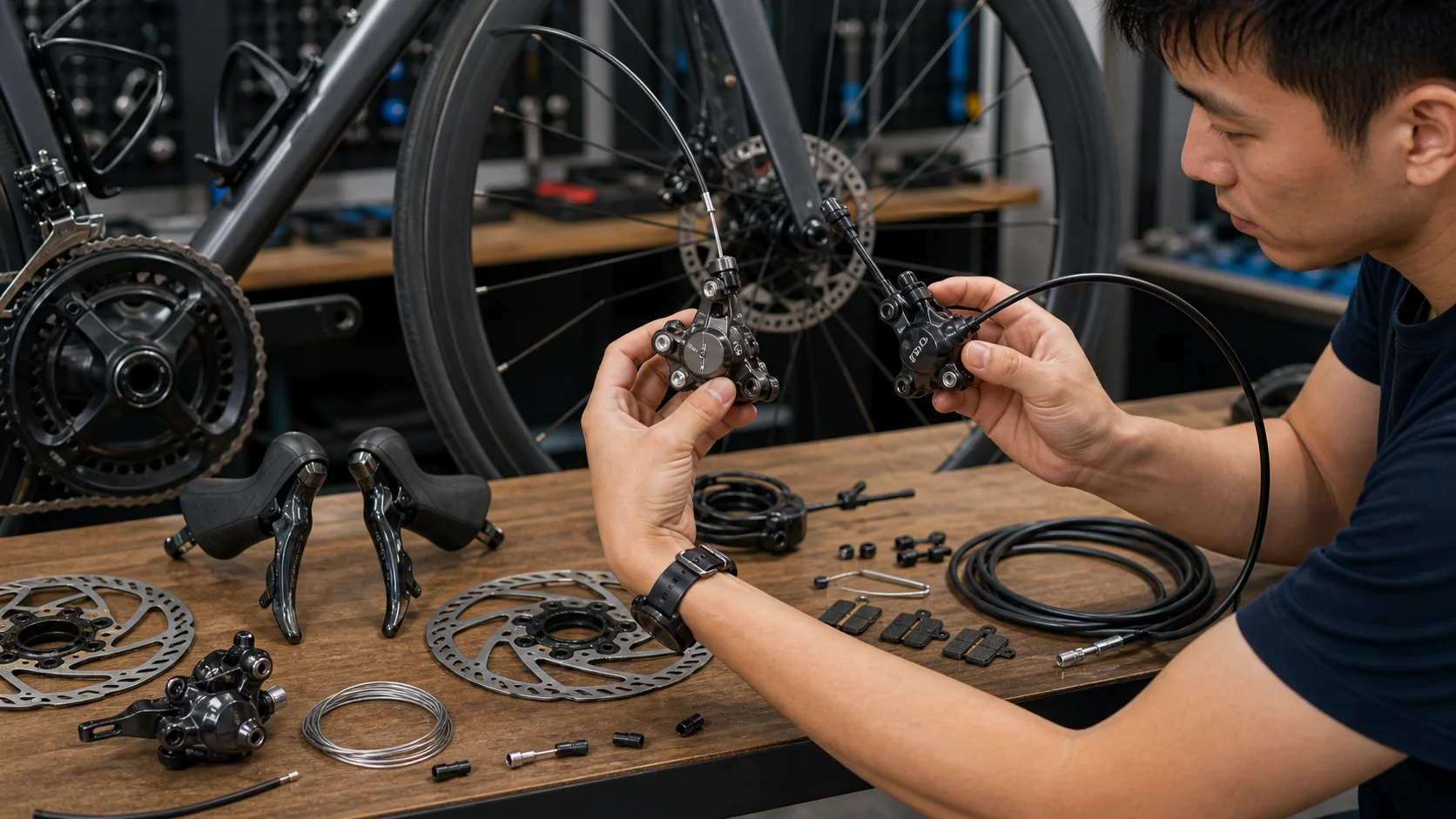
Disc Brakes vs. Rim Brakes: Why Go Disc?
| Feature | Rim Brake | Disc Brake |
|---|---|---|
| Wet weather performance | Poor (wet rim surface) | Excellent |
| Stopping power | Moderate | Excellent |
| Adjustment difficulty | Simple | Slightly more complex |
| Rim requirements | Needs a braking surface | No restrictions |
| Weight | Light | Slightly heavier (rotor included) |
| Heat buildup | Rim overheating | Rotor overheating (safer) |
How Mechanical Disc Brakes Work
Mechanical disc brakes use a traditional brake cable to transmit the pulling force from the lever, and a mechanical linkage pushes the pads to clamp the rotor.
Advantages of Mechanical Disc Brakes
- Simple maintenance: Uses standard brake cables, the same tools as traditional rim brakes
- Self-serviceable: Replacing cables and adjusting clearance are simple mechanical tasks
- Low cost: System cost and maintenance expenses are noticeably lower than hydraulic
- Emergency roadside repair: If a cable snaps, an emergency tool can provide a temporary fix
Disadvantages of Mechanical Disc Brakes
- Firmer lever feel: Requires more finger force at the lever than hydraulic systems
- More frequent adjustment: Cables stretch over time and need periodic re-adjustment
- Lower ceiling on stopping power: Even high-end mechanical disc brakes generally can’t match the feel and power of hydraulic systems
Representative Products
- Shimano BR-RS305 (entry-level road disc)
- TRP Spyre (performance-oriented mechanical disc)
- Avid BB7 Road (cyclocross/road mechanical disc)
How Hydraulic Disc Brakes Work
Hydraulic disc brakes use mineral oil or DOT fluid in a sealed hose to transmit pressure, with no mechanical linkage — the fluid pressure directly pushes the brake pistons.
Advantages of Hydraulic Disc Brakes
- Light, precise lever feel: Hydraulic pressure transmission is highly efficient — a gentle squeeze of the finger delivers strong braking force
- Automatic adjustment: As pads wear, the system automatically compensates for clearance (no manual adjustment needed)
- Stronger stopping power: Especially valuable on long descents or when strong braking is needed
- Greater consistency: Unaffected by cable stretch, performance stays consistent
Disadvantages of Hydraulic Disc Brakes
- More complex maintenance: Periodic bleeding and fluid changes require specialized tools
- Hard to self-repair on the road: If a hose ruptures or air gets into the line, it’s very difficult to fix on the road
- Higher cost: Both the system itself and maintenance costs are noticeably higher than mechanical
- Slightly heavier: Extra weight from hoses, master cylinders, etc.
Representative Products
- Shimano 105 R7070 (top-tier value for money)
- SRAM Force AXS (electronic wireless + hydraulic)
- Campagnolo Potenza Disc (traditional Italian brand)
Who Should Choose Which?
| Rider Type | Recommended Choice | Reason |
|---|---|---|
| Entry-level upgraders | Mechanical disc | Low cost, easy self-maintenance |
| Frequent Taiwan mountain riders | Hydraulic disc | Braking safety on long descents |
| Commuters | Mechanical disc | Convenient daily maintenance, low cost |
| Racers | Hydraulic disc | Best lever feel and reliability |
| Long-distance tourers | Mechanical disc | Easy to repair on the road |
Things to Consider When Switching to Disc Brakes
- Frame compatibility: Confirm the frame and fork have disc brake mounts (IS or Flat Mount)
- Hub replacement: Disc brakes require hubs with a rotor-mounting flange — rim brake wheelsets cannot be used directly
- Lever/shifter replacement needed: Hydraulic systems require hydraulic-compatible levers
Upgrading to disc brakes is a worthwhile investment, especially for riders who frequently ride Taiwan’s mountain roads. The improvement in braking safety is most noticeable in wet weather and on long descents.
Further Reading
- The Evolution of Road Bike Braking Systems: Mechanical Disc vs. Hydraulic Disc vs. Rim Brake Comparison
- Choosing a Road Bike Brake System: A Complete Disc vs. Rim Brake Comparison
- The Final Showdown: Disc vs. Rim Brakes — Which Should You Choose for Your 2026 Road Bike?
- The Complete Guide to Disc Brake Frames: From Caliper Mounts to Disc-Specific Frame Design
碟煞公路車 優缺點?換車一年半實際經驗分享 / 公路車 / CT Yeh
2 年前
碟煞公路車 銑面器 !? 原來銑完差這麼多! 降低蹭碟機率! | TIME 公路車 保養小記錄 | CT Yeh
3 年前
公路車 BB培林大升級! / 備戰海鷗繞圈賽 Canyon Aerod & TIME 一起改 / MIT大廠 CEMA對鎖式陶瓷培林BB & 導輪 / 公路車 / CT Yeh
2 年前
SRAM FORCE E1 首發!/ 改成短腿了 / 煞車升級有感嗎? / TIME ADH 變速大升級 / 公路車 / CT Yeh
1 年前
換車囉! TIME ADH 2023 全內線碟煞公路車 開箱實錄!/ Dyneema 碳纖維真的太猛了 / 曜越單車 / CT Yeh
3 年前
功率實測 Lun Hyper 2023 碳幅條輪組 D45 碟煞 | 公路車 | CT Yeh
3 年前
再一組! 全碳幅條 碟煞/無內胎輪組 開箱! 到底好騎嗎? UNAAS X40 | 公路車 | CT Yeh
4 年前
Wilier 盤爺車大升級! SRAM RED D1 升級到 RED E1 新版,爽度、重量有差嗎?/ 你以為只有改這樣嗎XD? / 鈔能力 / 公路車 / CT Yeh
1 年前