Optimizing Time Trial (TT) Equipment: The Benefits of Aero Helmets
The individual time trial (TT) is the purest speed showdown in cycling — everyone starts alone, with no tactics or teamwork, just you, your bike, and the clock. In this discipline, every gram of aerodynamic optimization on your equipment translates directly into time.
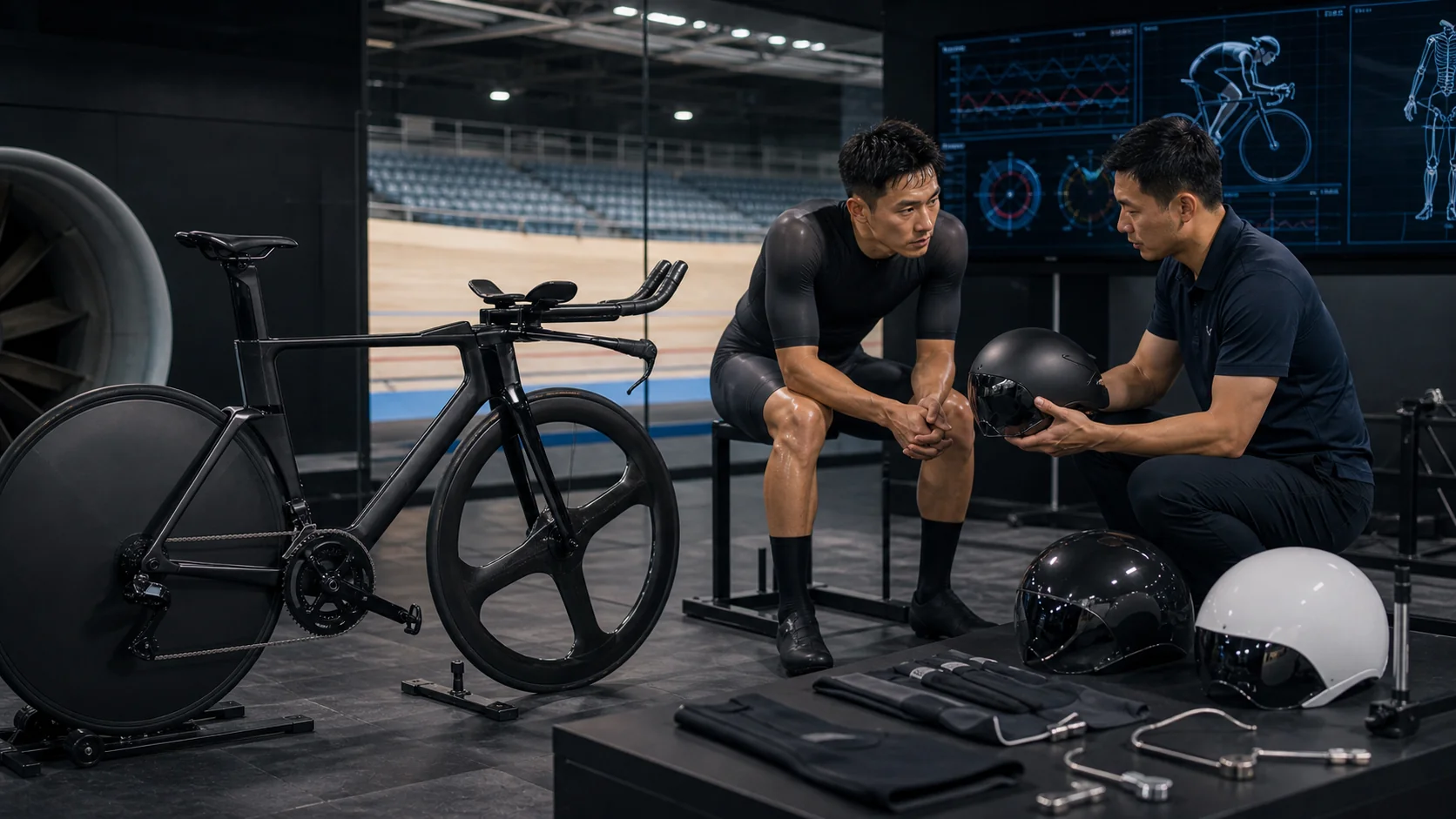
The TT Speed Equation
In an individual time trial, three main factors determine your speed:
- Power: your aerobic engine
- Aerodynamic drag (CdA): frontal area × drag coefficient
- Gravity (grade resistance): the effect of climbs
The importance of aerodynamic drag rises exponentially with speed. At a TT speed of around 40km/h, roughly 80-85% of total resistance comes from air drag.
The Science of Aero Helmets
Design Principles
Ordinary road helmets are designed primarily for ventilation (lots of vents), which is the right call for everyday riding. But in a TT, every vent is an extra source of airflow turbulence.
Key design features of aero TT helmets:
- Closed shell: fewer vents, sometimes fully sealed
- Streamlined tail: lets airflow pass smoothly off the back of the helmet
- Helmet-rider posture integration: in a correct TT position, the helmet’s tail forms a continuous streamlined line with the rider’s back
Real-World Data
Multiple wind-tunnel studies (including brand testing from Cervélo, Specialized, and Trek) show:
| Helmet Type | Drag at 40km/h | Savings vs. Regular Helmet |
|---|---|---|
| Standard road helmet | Baseline | — |
| Entry-level aero helmet | 3-5W less | About 30-50 seconds per 40km |
| High-end TT helmet | 6-10W less | About 60-90 seconds per 40km |
| Top-tier aero helmet | 8-12W less | About 80-120 seconds per 40km |
Over a 40km TT, a good aero helmet can save 60-120 seconds — in a competitive amateur TT, that can easily be the gap between finishing one or two places higher.
Helmet Orientation: The Overlooked Key
Aero helmets are designed around a specific head angle (typically looking down at the road roughly 10-15 meters ahead). If the helmet’s orientation is off — head tilted too far up or too far down — its performance can actually be worse than a standard helmet.
Real-world finding: At certain high head-up angles, a streamlined helmet can actually produce more drag than a regular helmet.
Recommendation: Use a mirror or ask a friend to check that your TT position and helmet combination are in the optimal aero configuration.
Ranking Other TT Aero Equipment
Ranked by return on investment:
| Equipment | Aero Savings (40km) | Cost (NTD) |
|---|---|---|
| Position optimization (free) | 3-5 minutes | NT$0 |
| TT skinsuit | 30-60 seconds | NT$5,000-15,000 |
| Aero helmet | 60-120 seconds | NT$8,000-25,000 |
| Deep-section wheels (80mm+) | 60-90 seconds | NT$30,000-100,000+ |
| TT frame | 60-120 seconds | NT$80,000-300,000+ |
The biggest aerodynamic gain is often free — optimizing your riding position (lowering your torso, reducing frontal area) usually delivers more benefit than any single piece of equipment.
TT Frame vs. Road Bike + Clip-On Bars
Many riders race TTs on a road bike fitted with aero extension bars (clip-on bars). How does that compare?
| Setup | CdA Savings | Drawbacks |
|---|---|---|
| Road bike (no extensions) | Baseline | Standard riding position |
| Road bike + clip-on bars | -0.03-0.05m² | Reduced handling control |
| Dedicated TT frame | -0.05-0.08m² | High cost, TT-only use |
For riders who only race the occasional TT, a road bike with clip-on bars is the most cost-effective option.
TT Race-Day Checklist
| Preparation Item | Timing |
|---|---|
| Confirm timer/computer function | One week before |
| Check tire pressure | The day before |
| Confirm aero position (verify on video) | One week before |
| Fueling plan (skip eating for short TTs) | Confirm the day before |
| Attach race number | Race morning |
The TT is a solitary event, but the preparation process can be full of scientific rigor and craft. Every optimized detail is an act of respect for yourself.
Related Reading
- Time Trial Technique Deep Dive: The Art of Speed in ITT and TTT
- The Complete Guide to Individual Time Trial Position and Pacing: Optimizing Drag, Power, and Mindset
- Time Trial-Specific Training: Building Your Personal Best TT Performance
- Taiwan Cycling Time Trials: Chasing Your Best Result While Riding Alone
CT 喇低賽) 武嶺牽車 才是王道 西進牽車四小時內秘訣 攝手位置 如何判斷 防抽筋小秘訣
7 年前
2023桃園團體繞圈賽 / 海鷗繞圈賽 | 全程空拍數據版 | 公路車 | CT Yeh
2 年前
風櫃嘴時間 預測西進武嶺時間?13000名車友統計數據分析告訴你 !
5 年前
西進武嶺 自製新版AI配速表產生器 x 賽前攻略 抱佛腳! 沒有功率計也可以產生配速表嗎?有什麼其他眉角賽前要注意的呢? | 西進武嶺 / 東進武嶺 KOM 攻略 | 公路車 | CT Yeh
4 年前
大家都在開箱的...單車用藍芽對講耳機真的有幫助嗎? SENA BiKom 20 長距離旅遊 & 海鷗繞圈賽 實際體驗心得 / 公路車 / CT Yeh
9 個月前
3D 列印車褲墊 / 舒適改善? / 無痕 x 分區壓縮 / ATK & Decider系列 / JE22黑科技 / #公路車 #CTYEH
11 個月前
TIME 公路車 Alpe d'Huez 21 開箱實錄! 購車/Fitting/組車/心得 | 新車入艙 | 時間的主人 CT Yeh
3 年前
2024 彰化經典百K 參賽直播 / 黃亭茵集團 / 公路車 / CT Yeh
2 年前