Post-Run Cool Down and Stretching: A Complete 15-Minute Routine
Many runners rush home right after finishing a training session, neglecting the importance of cooling down and static stretching. This habit may not cause obvious problems in the short term, but over the long run it is a major cause of chronic injuries and slow recovery.
Why Is Cooling Down So Important?
The Physiological Mechanism
After high-intensity running, your body is in the following state:
- Heart rate and blood pressure are still elevated: Stopping suddenly can cause blood to pool in the lower legs (insufficient venous return), leading to dizziness
- Body temperature is elevated: Muscle temperature can reach 38-39°C, which is the best window for static stretching
- Lactate has accumulated: Low-intensity activity accelerates lactate metabolism (30-40% faster than complete rest)
- Muscles are in a shortened state: Muscles that have just finished repeated contractions are shortened and need stretching to recover
The Complete 15-Minute Cool Down Routine
Minutes 1-5: Cool Down Walk
Method: After finishing your run, keep walking at a walking pace for 5 minutes. Do not sit down or stand still immediately.
Purpose:
- Allow heart rate to gradually return to normal range
- Keep blood pumping back up from the legs to prevent pooling
- Begin initial lactate metabolism
Minutes 6-15: Static Stretching
Hold each position for 30-60 seconds. Do not bounce (ballistic stretching can actually cause micro-tears)
Move 1: Calf Stretch
- Stand facing a wall with both hands against it
- Plant the back foot on the ground, bend the front leg slightly, and feel the stretch in the back of the rear calf
- Duration: 45 seconds per side
Move 2: Hamstring Stretch
- Stand with one leg extended forward, resting the heel on a low object (such as a curb)
- Lean your upper body forward until you feel tightness in the back of the thigh
- Duration: 45 seconds per side
- Alternative: Lying version — lie on your back, lift one leg, and hold the back of the thigh with both hands
Move 3: Quad Stretch
- Stand on one leg, bend the other leg backward so the ankle is near the buttocks
- Grab the ankle with the hand on the same side (not the top of the foot)
- Feel the stretch along the front of the thigh
- Duration: 40 seconds per side
Move 4: Glute Stretch
- Standing or seated, place one ankle on the knee of the other leg
- Gently press down on the raised knee and feel the deep stretch in the glutes
- Duration: 45 seconds per side
Move 5: IT Band Stretch
- Stand with one leg crossed behind the other
- Reach the opposite arm overhead and lean your body toward the side of the crossed leg
- Feel the stretch along the outside of the thigh
- Duration: 40 seconds per side
Move 6: Hip Flexor Stretch
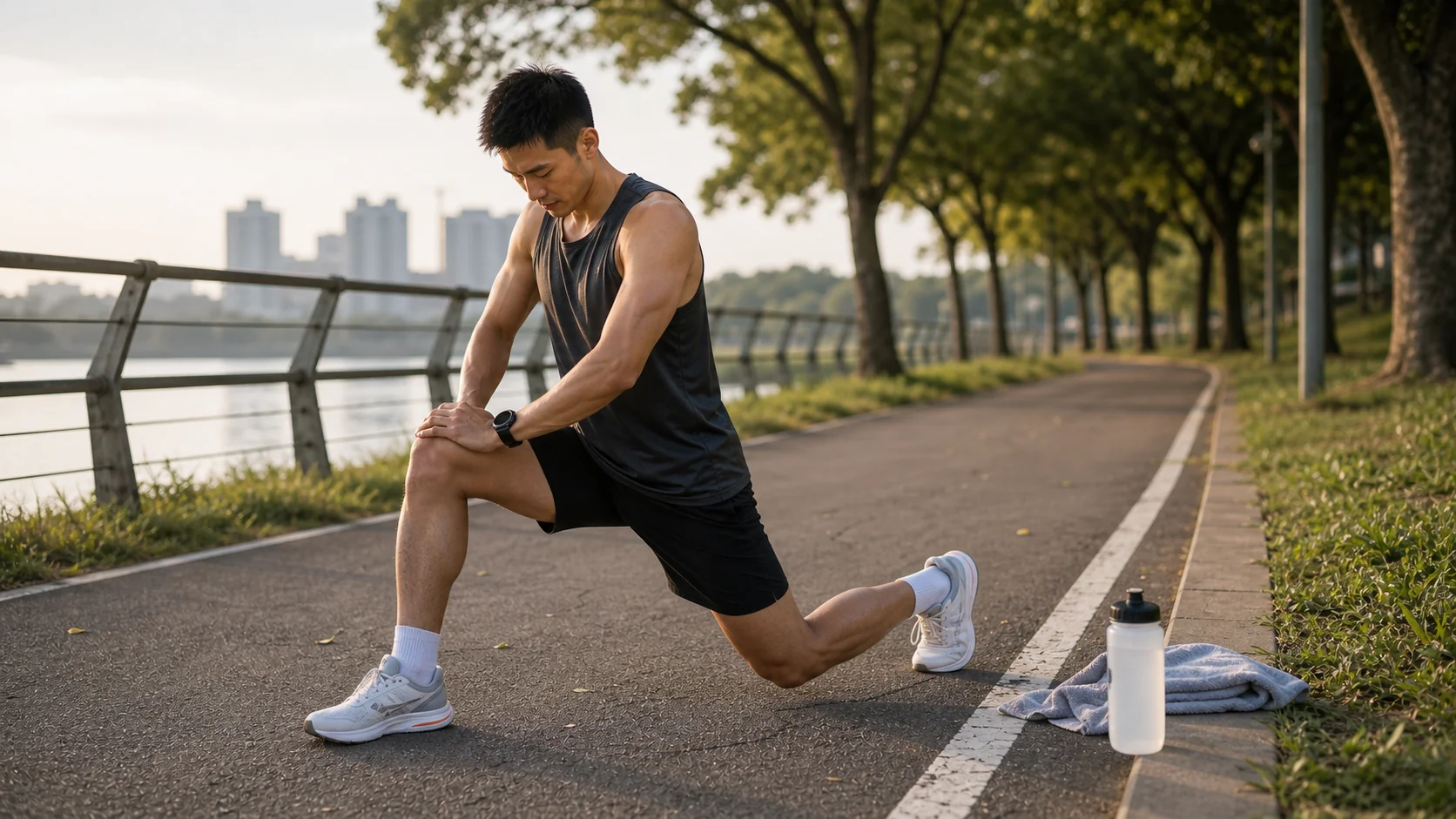
- Get into a low lunge position (back knee on the ground)
- Gently push your pelvis forward and feel the stretch at the front of the back leg’s hip
- Duration: 45 seconds per side
Stretching Priority by Body Part
| Body Part | Relevance to Running Injuries | Priority |
|---|---|---|
| Calves and Achilles tendon | Plantar fasciitis, Achilles tendinitis | ★★★★★ |
| Hamstrings | Hamstring tears, lower back issues | ★★★★★ |
| IT band | Lateral knee pain (IT Band Syndrome) | ★★★★☆ |
| Quadriceps | Patellar tendinitis (front knee pain) | ★★★★☆ |
| Hip flexors | Lower back pain, anterior pelvic tilt | ★★★☆☆ |
Supporting Tools
Foam Roller
A foam roller can further release fascia (the connective tissue surrounding muscles), helping prepare the body before static stretching:
- IT Band rolling: Lie on your side, place the roller against the outside of the thigh, and roll slowly from the knee to the hip
- Calf rolling: Sit on the ground with the calf resting on the roller, using your arms to support and apply body weight pressure
- Foot rolling (massage ball): Standing, roll a tennis ball or golf ball back and forth under the sole of your foot
Contrast Water Therapy
Alternating cold and hot water after training (if possible):
- Cold water (15-20°C): 1 minute → Hot water (37-40°C): 2 minutes
- Repeat 2-3 times, ending with cold water
- Effect: Accelerates lactate metabolism and reduces muscle inflammation
Investing 15 minutes in cooling down can bring you faster recovery and lower injury risk the next day. Treat it as part of your training, not an optional extra.
Related Reading
- Cooling Down After Speed Training: Static Stretching and a 10-Minute Jog Recovery Protocol
- Cooling Down After Running: Why You Can’t Just Stop Suddenly
- Post-Run Static Stretching SOP: Stretch the Right Places at the Right Time to Make It Effective
- Timing of Post-Run Stretching: The Best Time and Duration for Static Stretching
Live) 備戰2019彰化經典百K 賽前攻略 (已完賽請看新影片
7 年前
實景訓練台) 彰化經典百K 高強度喵團 90分鐘 跟著一起練功 2019 Indoor workout Changhua Classic 100 Taiwan
7 年前
FTL 與 SYB 車隊專訪 西進武嶺 實用攻略分享! 2小時 如何練?!你不知道的眉角!新手準備武嶺必看 EP1 | 實力派女車友 | 精華版 | 公路車 | CTYeh
4 年前
西進武嶺 免費訓練分析服務 Intervals | 練不夠還是練過頭?你哪一種類型選手?AI模型告訴你! | 備戰神器 | 公路車 訓練 | CT Yeh
4 年前
一日北高/長距離團騎 常見問題補充篇 / 組團或跟團的眉角 / 壯車友容易被瘦車友慢性拉爆 / 原來屁股痛可能是這個原因...? / 風場配速法 / 公路車 / CT Yeh
2 年前
2019 夏季KOM 5小 完賽心得 準備攻略 東進武嶺 夏季登山王之路 Taiwan KOM Challenge
7 年前
西進武嶺 自製新版AI配速表產生器 x 賽前攻略 抱佛腳! 沒有功率計也可以產生配速表嗎?有什麼其他眉角賽前要注意的呢? | 西進武嶺 / 東進武嶺 KOM 攻略 | 公路車 | CT Yeh
4 年前
[教學] Premiere 影片 手震 修正 教學 防抖 單眼 影像 GoPro 穩定 Video Stabilization
8 年前