How to Choose Carbon Wheels: Rim Depth, Width, and Internal Width Explained
Choosing gear is a rite of passage for every rider, and wheels are without question the upgrade with the “highest ROI.” Spend the same amount of money, and a wheel upgrade will feel three times more noticeable than a groupset upgrade. But the market is flooded with options — rim depths of 38 / 50 / 60 mm, external widths of 27 / 30 mm, internal widths of 19 / 21 / 25 mm — the specs can be dizzying. In this article, we’ll use physics and real-world test data to show you how to choose.
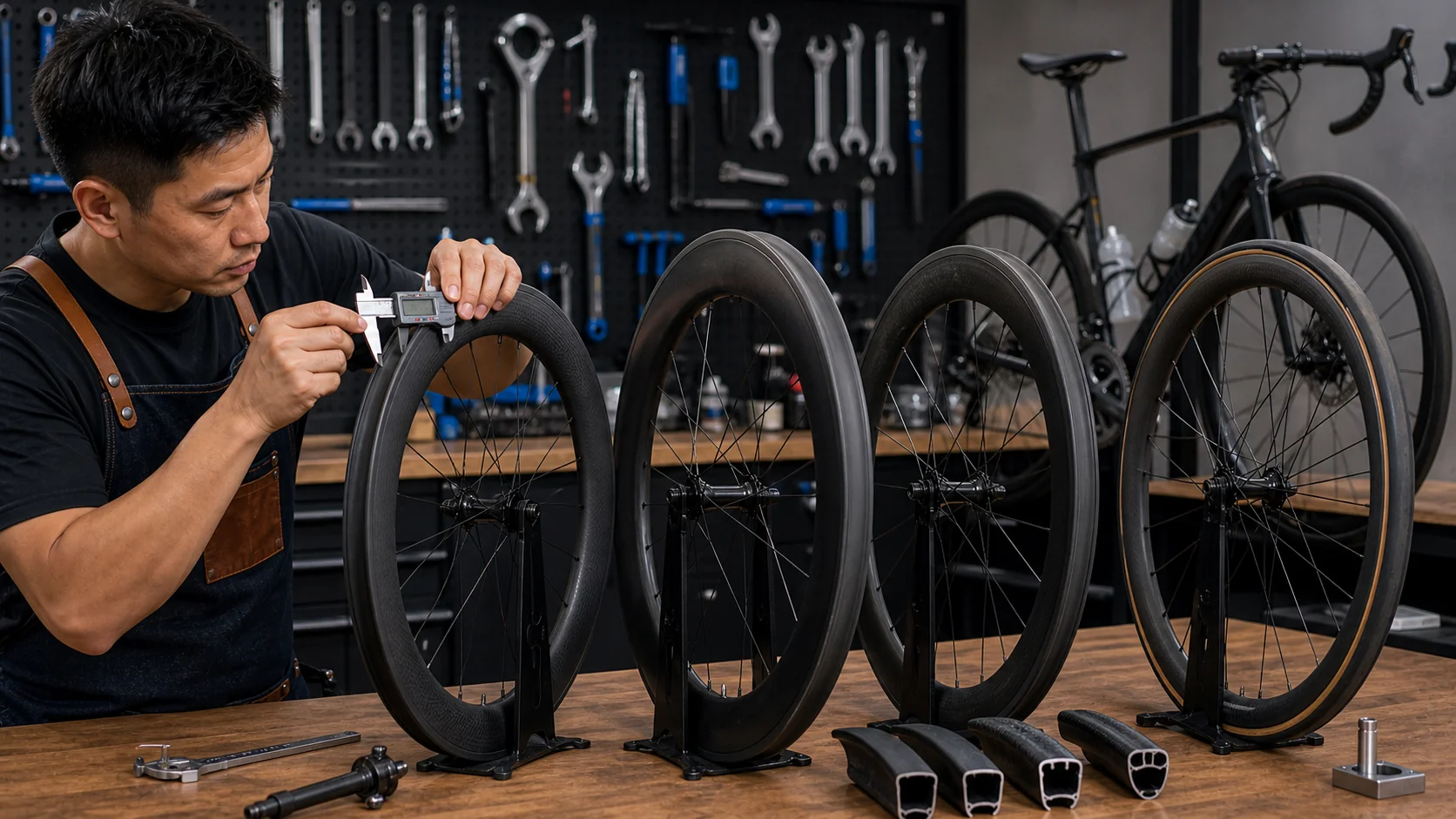
1. Three Key Numbers for Wheels
Rim Depth
Rim depth directly determines the balance between “aerodynamics vs. weight”:
| Rim Depth | Aero Benefit | Weight Increase | Crosswind Stability | Best For |
|---|---|---|---|---|
| 25-35 mm | Low | Lightest | Excellent | Mountain climbs, Wuling, Tataka |
| 38-45 mm | Medium | Medium | Good | Mixed routes, daily training |
| 50-60 mm | High | Medium-High | Average | Flat group rides, criteriums |
| 65 mm+ | Very High | Heavy | Prone to drift | Time trials, triathlons |
External Width
External width sets the ceiling for aerodynamic performance. Since 2024, the mainstream external width has shifted from 25 mm to 28-30 mm, because:
- External width should be ≥ tire width so airflow can “stick” to the rim (Rule 105)
- With a 28c tire, an external width of 29-30 mm is recommended
- With a 30c tire, an external width of 30-32 mm is recommended
Internal Width
Internal width affects tire shape and comfort:
| Internal Width | Recommended Tire Width | Actual Tire Width (mounted) | Characteristics |
|---|---|---|---|
| 19 mm | 25c | 26-27 mm | Traditional spec, fast |
| 21 mm | 28c | 29-30 mm | Current mainstream |
| 23 mm | 28-30c | 30-32 mm | Comfortable + excellent grip |
| 25 mm | 30-32c | 32-34 mm | Gravel / All-road |
2. Popular Carbon Wheelset Specs Compared
| Wheelset | Rim Depth | External / Internal Width | Weight (pair) | Taiwan Price | Positioning |
|---|---|---|---|---|---|
| Zipp 303 Firecrest | 40 mm | 30 / 25 mm | 1,355 g | NT$ 95,000 | All-round |
| Zipp 404 Firecrest | 58 mm | 27 / 23 mm | 1,550 g | NT$ 105,000 | Aero |
| ENVE SES 4.5 | 50/56 mm | 32/31 / 25 mm | 1,454 g | NT$ 135,000 | High-end aero |
| DT Swiss ERC 1100 Dicut | 45 mm | 27 / 20 mm | 1,485 g | NT$ 88,000 | Durable |
| Roval Rapide CLX II | 51/60 mm | 35/30 / 21 mm | 1,400 g | NT$ 95,000 | OEM spec upgrade |
| Giant SLR 0 42 | 42 mm | 30 / 22.4 mm | 1,380 g | NT$ 55,000 | Best value |
| Shimano Dura-Ace C50 | 50 mm | 28 / 21 mm | 1,461 g | NT$ 110,000 | Stable and durable |
| Mavic Cosmic SLR 45 | 45 mm | 28 / 19 mm | 1,390 g | NT$ 65,000 | Traditional spec |
3. Choosing by Riding Scenario
Scenario 1: Climbers (Wuling / Fenghuei Pass / Tataka)
- Priority: Rim depth 30-40 mm, weight under 1,350 g per pair
- Recommended: Giant SLR 0 42, Zipp 303, Roval Alpinist CLX
- Why: A 1,400 g vs. 1,600 g pair can save 2-3 minutes over a continuous 30 km climb
Scenario 2: Flat Group Rides (Beiyi Highway, North Coast)
- Priority: Rim depth 45-55 mm
- Recommended: Zipp 404, Roval Rapide, Shimano C50
- Why: Above 35 km/h, a deep-section rim’s aero advantage becomes most apparent
Scenario 3: Mixed Routes (One-day Taipei-Kaohsiung, Round Hualien-Taitung)
- Priority: Rim depth 40-50 mm (all-around type)
- Recommended: Zipp 303 Firecrest, ENVE SES 4.5, DT Swiss ERC 1100
- Why: Climbs don’t drain you, and it’s still fast enough on the flats
Scenario 4: Triathlon / Time Trial
- Priority: 60 mm front + rear disc wheel (or 80 mm)
- Recommended: Zipp 858 NSW, ENVE SES 7.8, Princeton CarbonWorks
- Why: Maximizes aero performance in low-yaw-angle crosswinds
4. Three Details Taiwanese Riders Often Overlook
1. Hub grade matters more than the rim itself
- DT Swiss 240 / Chris King / Industry Nine: Smooth rolling, durable, easy to maintain
- Cheap generic hubs: Bearings can start feeling gritty within a year, ratchets wear quickly
- Two wheelsets that look identical from the outside can have hubs that determine whether you’re “throwing it away in 3 years” or “still riding it in 10 years”
2. Hookless vs. Hooked
- Hookless: wider, lighter, limited to tubeless + specific tire models
- Hooked: traditional spec, broad compatibility
- Taiwan’s high temperatures and hot roads: pay special attention to the maximum tire pressure limit when using hookless rims in summer
3. Tubeless is now mainstream
- After 2025, almost all carbon wheelsets support tubeless
- Benefits: self-sealing punctures, lower pressure for more comfort, lower rolling resistance
- Drawbacks: messy tire mounting, sealant needs periodic top-ups (roughly every 3 months in Taiwan’s climate)
5. Budget vs. Buying Advice
Budget NT$30,000-50,000: Best value
- Giant SLR 1 / SLR 0 (strongest domestic option)
- Reynolds AR 41/46
- Superteam (found on Shopee, made in China but quality has improved rapidly in recent years)
Budget NT$50,000-100,000: Mainstream flagship
- Roval Rapide CLX II, Giant SLR 0
- Zipp 303 Firecrest
- DT Swiss ARC 1400 Dicut
Budget over NT$100,000: Top-tier
- ENVE SES series
- Zipp NSW series
- Princeton CarbonWorks (best aero performance)
- Lightweight Meilenstein (classic elegance)
6. Where to Buy in Taiwan
- Zipp: SRAM Taiwan distributor (Yun-Da Enterprise), authorized bike shops
- Roval: Specialized Taiwan dealer network
- Giant SLR: Giant dealers across Taiwan
- ENVE: Kaimeng Bicycle (Taipei), select bike shops
- Used wheelsets: PTT Bike_Shop, Facebook “Used Bicycle Buy & Sell” groups
Conclusion: Upgrade Your Wheels Before Your Frame
If you’re currently riding stock alloy wheels, the noticeable improvement from upgrading to a mid-range carbon wheelset (around NT$50,000) is far greater than swapping 105 for Ultegra. Every 100 g shaved off your wheels can save about 5-8 seconds over a 10 km climb, and also improve acceleration on flat roads.
One last reminder: wheels are a wear item. Carbon rims typically last 5-8 years, while well-maintained hubs can last 10+ years. When buying, put a bit more of your budget toward the hubs — it pays off in the long run.
Further Reading
再一組! 全碳幅條 碟煞/無內胎輪組 開箱! 到底好騎嗎? UNAAS X40 | 公路車 | CT Yeh
4 年前
Vision Metron RS 37碳幅條輪組 (非SL)官網沒有的 低調開箱 / 這重量太銷魂了 / 公路車 / CT Yeh
6 個月前
Unaas X50 全碳纖幅條輪 數據實測對比PK | Lun Hyper 的高階版 | 板輪爬坡也可以很厲害? ! 武嶺2小時大師一起親測! CP值超高 | 公路車 | CT Yeh
4 年前
首發!LUN HYPER 第五代 2025最新版 碳幅條x鈦合金 輪組 D40 開箱 / 居然開始捲高端輪組了 / 公路車 / CT Yeh
11 個月前
Nepest NOVA 碳條輪組:輕量、空力、舒適一次滿足!/ 公路車 / CT Yeh
7 個月前
功率實測 Lun Hyper 2023 碳幅條輪組 D45 碟煞 | 公路車 | CT Yeh
3 年前
鉅齒紋輪組!? ControlTech MEG-T50 EVO 碳纖維幅條輪組/ 功率對比實驗 / 公路車 / CT Yeh
2 年前
Lun HYPER 第三代 D45碳幅條輪組 功率對比實測 / 鈦合金行星齒輪,中高階的製造水準 / 公路車 / CT Yeh
1 年前