Emergency Handling for Failed Breathing in Open Water: The Essential Calm Technique for Triathletes in the Water
Emergency Handling for Failed Breathing in Open Water: The Essential Water Calm Technique for Triathletes
The most dangerous aspect of triathlon is not bicycle crashes, but panic drowning during the open water swim stage. According to USA Triathlon statistics on race fatalities from 2003-2020, 73% occurred during the swim stage, with 80% related to failed breathing or panic. This article organizes a graded handling process for errors in the water.
Root Causes of Failed Breathing
Cause 1: Cold Water Shock
When water temperature is below 18°C, the body enters a “cold shock response”:
- Unconscious inhalation reflex (Gasp Reflex): An instant gasp upon entering the water
- Hyperventilation: Heart rate accelerates, breathing frequency increases to 60-90 times/min (normal 12-16 times)
- Symptoms: Suddenly unable to breathe after swimming 100-200m
Cause 2: Waves Hitting Mouth and Nose
Open water swimming often involves waves hitting due to side winds:
- Laryngospasm after choking on water, temporarily unable to breathe
- Panic triggers hyperventilation or breath-holding
Cause 3: Goggles Filling with Water/Fogging
Cannot see direction + body kicked/collided → loss of spatial awareness → panic
Cause 4: Crowding and Collisions
Most common at the start and first buoy: kicked in the head, ribs, or abdomen, or held underwater
Cause 5: Hyperventilation
Some athletes deliberately hyperventilate before the start thinking they are “storing oxygen,” which instead lowers CO₂ triggering the breathing stimulus, making them prone to fainting in the water.
Graded Handling Process
Level 1: Mild Discomfort (Can Continue Race)
Symptoms: Disordered breathing rhythm, mild choking on water, accelerated but controllable heart rate
Handling Steps:
- Switch to breaststroke or float on back for 30-60 seconds
- Perform 4-7-8 breathing technique: Inhale for 4 seconds, hold for 7 seconds, exhale slowly for 8 seconds (repeat 3 rounds)
- Find a landmark: Look up and sight a clear target (buoy, coastal building)
- Readjust swimming style: Return to freestyle after restoring stroke rhythm
Level 2: Moderate Panic (Requires Rescue Alert)
Symptoms: Heart rate > 160 bpm, inability to swim steadily, nausea, numbness in limbs
Handling Steps:
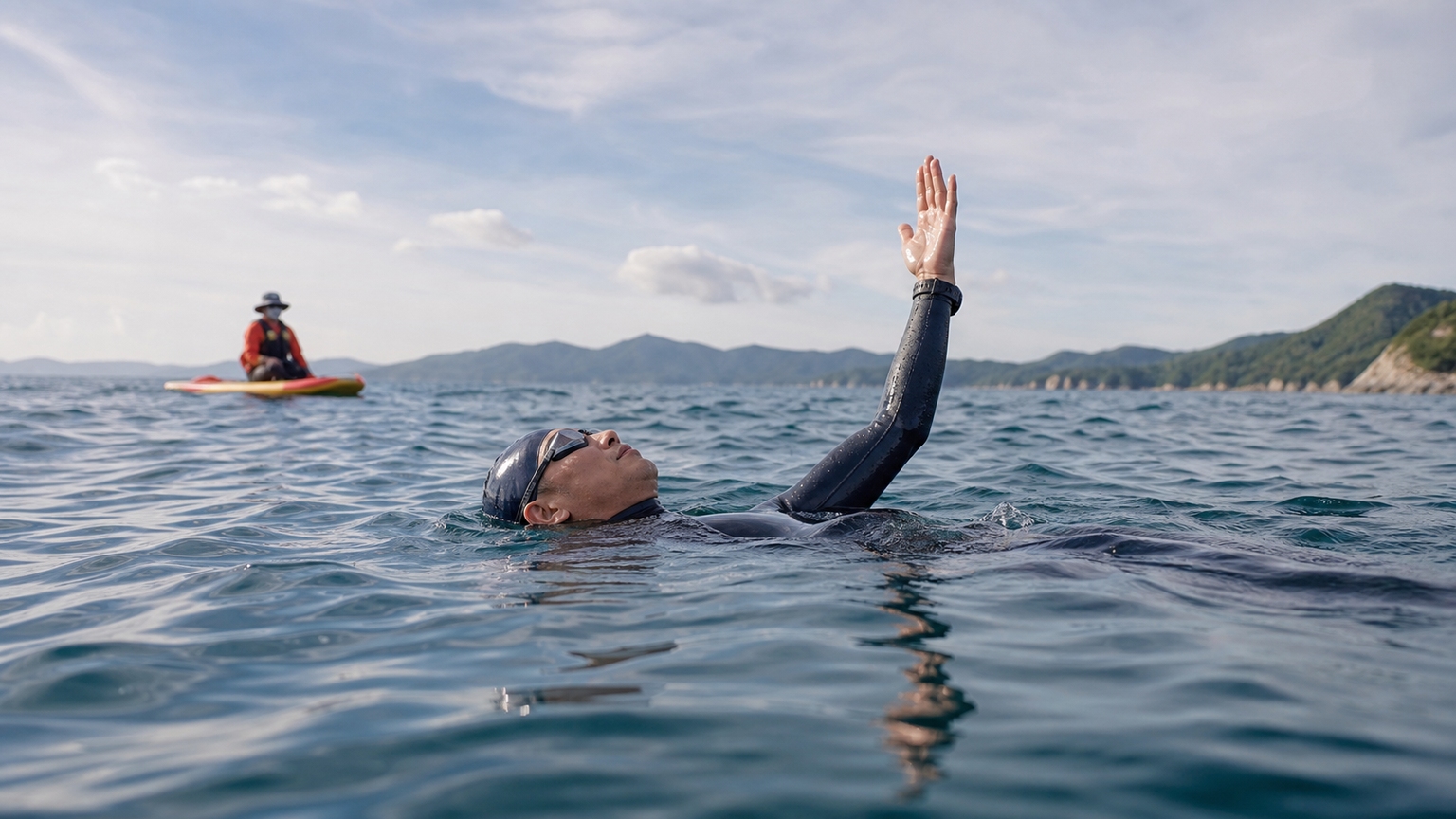
- Flip to float on back: Spread hands and feet in H-shape to maximize buoyancy (especially easy for athletes wearing wetsuits)
- Raise hand to signal rescue boat: Raise one hand high and wave (clear distress signal)
- Hold onto buoyancy bag between ankles (if self-carried)
- Reduce breathing frequency: Force yourself to “lengthen exhalation”, making exhalation twice as slow as inhalation
- Rest on rescue boat for 60-90 seconds before deciding whether to continue
USAT rules allow athletes to hold onto rescue boats or buoys to rest but not be pushed, and they may continue after resting.
Level 3: Severe Danger (Must Withdraw)
Symptoms: Confused consciousness, inability to control limbs, cyanotic skin, vomit entering airway
Handling Steps:
- Immediately board the boat: Rescue personnel will assess if emergency care is needed
- Keep airway clear: Turn head to side, clear vomit
- Keep warm: Cover with blanket if water temperature is below 20°C to prevent hypothermia
- Send to hospital for evaluation: Secondary drowning caused by swimming may occur hours later
Pre-Race Training: Water Calm Techniques
Training 1: Slow Breathing Practice in Water
Practice sitting on the pool bottom:
- After fully immersing in water, exhale slowly for 8-10 seconds
- Float up to surface and inhale quickly for 1 second
- Repeat 10 times for 1 set, practice 3 sets each time
- After 4 weeks of training, CO₂ tolerance significantly improves
Training 2: Simulating Panic Scenarios
Get swimming coach assistance:
- Splash water to disturb while you are breathing normally
- Gently touch your feet or waist intentionally
- Press head from behind without your knowledge for 1-2 seconds
- After each disturbance, practice “stop → float → deep breathe → restart” process
Training 3: Floating on Back for 5 Minutes
Twice weekly:
- Without any equipment, rely solely on breathing control for buoyancy
- Practice 4-7-8 breathing while floating on back
- Goal: Heart rate always < 100 bpm for 5 minutes
Training 4: Open Water Practical Drills
Conduct 3 open water training sessions at least 4 weeks before the race:
- First time: Wear wetsuit to familiarize with water temperature and buoyancy
- Second time: Simulate waves and interference from people nearby
- Third time: Wear full race gear, swim 1500m without stopping
Race Day Prevention Strategies
30 Minutes Before Start
- Goggle anti-fog: Apply small amount of baby shampoo then rinse
- Warm-up: Adapt to water temperature for 5-10 minutes to avoid cold shock
- Check wetsuit: Neck should not be too tight (avoid vagus nerve reflex)
5 Minutes Before Start
- Perform 30-second short breath-hold (30-40 seconds) to help CO₂ adaptation
- Do not hyperventilate
- Calm heart rate: Close eyes and deep breathe for 1 minute
Start Position Strategy
- Novices or those prone to panic: Stand in back row + outer side
- Go around outer side 5-10m when passing first buoy to avoid crowding
- Cut into regular course line after finding rhythm
Conclusion
Success in open water swimming is 50% technique and 50% psychological control and emergency response. The four-character mantra “Stop → Float → Breathe → Start” should be engraved in your mind—whenever breathing gets disordered, stop, float on back, deep breathe, and restart. No PR is worth exchanging with your life.
Related Reading
- Open Water Panic Response: Self-Rescue Process for Sudden Panic During Race
- Open Water Cold Water Adaptation: Training for “Cold Shock Response” Upon Entering Cold Water
- Open Water Swimming Techniques: Advanced Training from Pool to Ocean
- Triathlon Swim Training: Fear Overcoming and Efficiency Improvement in Open Water
[防寒衣體驗] 鐵人魂 三鐵 防寒衣試穿會 於松運 深水游泳池 鯨魚池
8 年前
CT 喇低賽) 武嶺牽車 才是王道 西進牽車四小時內秘訣 攝手位置 如何判斷 防抽筋小秘訣
7 年前
JE22 百里任務體驗,心跳不能過150,三小時內有可能...? 沒有天時地利難度有多高? / 公路車 / CT Yeh
1 年前
[教學] Premiere 影片 手震 修正 教學 防抖 單眼 影像 GoPro 穩定 Video Stabilization
8 年前
2016/05/13 單車 冷水坑下滑
10 年前
水金九不厭五分 10度寒流冷到不願停!feat. 卡卡 / 公路車 / CT Yeh
6 個月前
3D 列印車褲墊 / 舒適改善? / 無痕 x 分區壓縮 / ATK & Decider系列 / JE22黑科技 / #公路車 #CTYEH
11 個月前
2023桃園團體繞圈賽/環台賽等級拍攝/賽事精華/ 10人一隊缺一不可!50隊廝殺大場面 / 第三屆 海鷗繞圈賽 /公路車/CT Yeh
2 年前