Cyclist-Specific Strength Prescription: Transferring Peak Pedal Torque, Climbing Tolerance, and Sprint Explosiveness to the Gym
Understanding What Strength a Rider Needs from the Power Curve
Road cycling performance is a power-duration curve. The endurance zone relies on the aerobic engine, but sprints (5–15 seconds), attacks from a climb’s start, and acceleration while out of the saddle—these short, critical moments depend on the neuromuscular system’s maximal strength and explosive power. Strength training won’t increase your FTP much, but it can significantly raise the left end of the curve (short-duration, high power) and allow you to sustain the same output on long climbs with lower relative muscular effort (delaying muscle fatigue).
The Three Key Strength Goals for Riders
| Goal | Corresponding Riding Scenario | Training Mode |
|---|---|---|
| Maximal Strength | Attacks, heavy-gear acceleration at low cadence | High-load, low-rep squats/leg press |
| Explosive Power (Speed-Strength) | Sprints, explosive starts out of the saddle | Half-squat jumps, explosive shrugs, ballistic movements |
| Strength Endurance | Repeated efforts on long climbs | Moderate load, higher reps + cycling-specific work |
Squat Prescription: Depth, Load, Frequency
Consensus from research and practice:
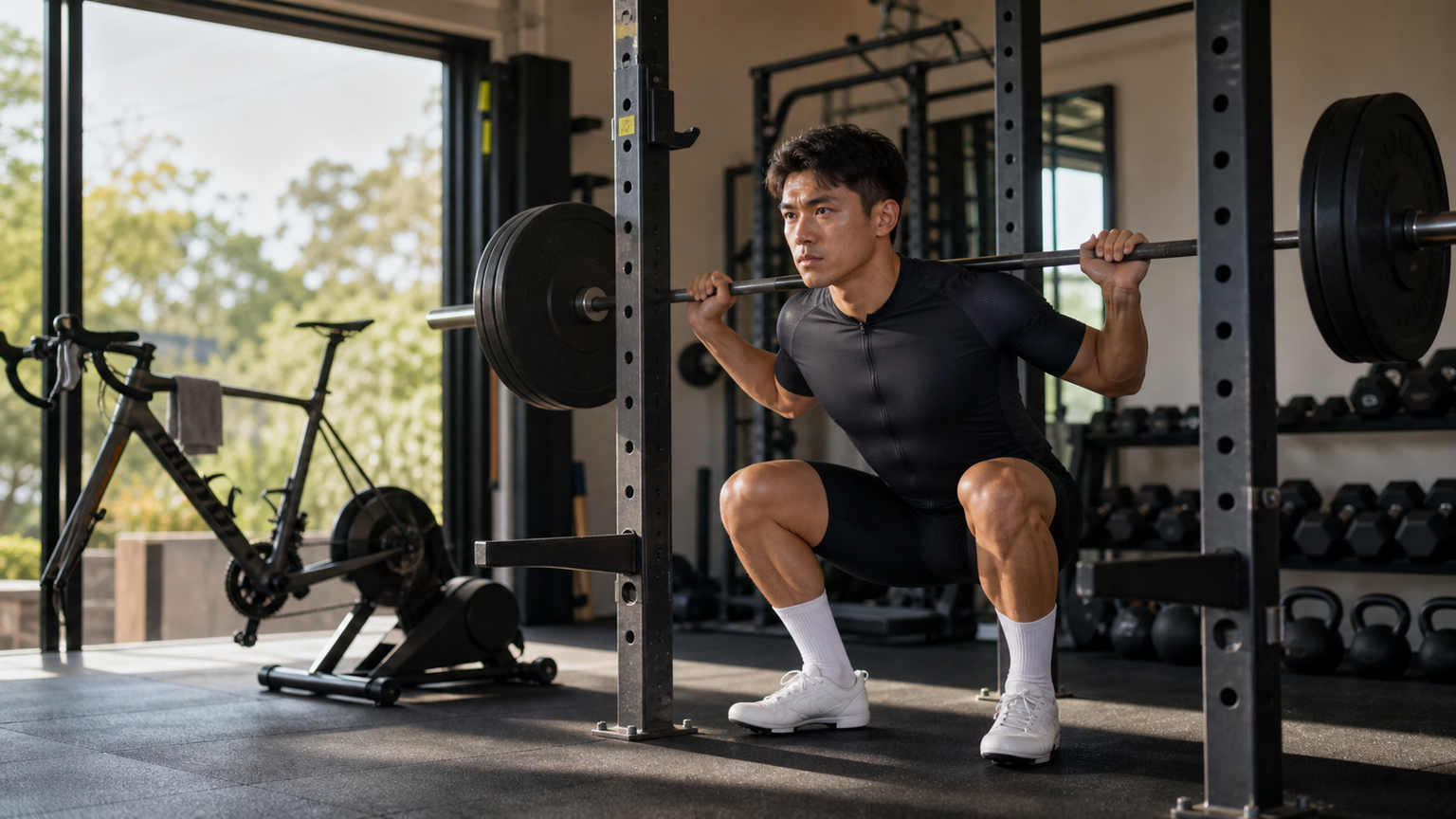
- Depth: At least squat until the thighs are near parallel (parallel squat); full range of motion transfers better to hip extensors than half squats.
- Load: In the off-season, enter the maximal strength zone at 80–90% 1RM, 3–5 reps.
- Frequency: 2–3 times per week in the off-season; drop to once per week as a maintenance dose during the season.
- Exercise Selection: Back squat as the primary movement, supplemented with leg press (controlled variables, lower lower-back risk), and single-leg leg press (to check left-right power symmetry).
12-Week Periodization Example
- Weeks 1–3 (Adaptation): Back squat 3x8 @ 70%, leg press 3x10, single-leg RDL 3x8/side, core anti-rotation.
- Weeks 4–8 (Maximal Strength): Back squat 4x4 @ 85–88%, deadlift 3x4, single-leg leg press 3x6/side.
- Weeks 9–11 (Power Conversion): Half-squat jumps 5x3 (maximal intent acceleration), explosive shrugs 4x3, keep one heavy squat set for maintenance.
- Week 12 (Deload): Cut volume in half, keep 1–2 sets of high-quality stimulus, transition to cycling-specific work.
In-Season Maintenance Dose (Critical and Often Overlooked)
If you stop lifting entirely during the season, neuromuscular strength and rate of force development begin to decline within 3–4 weeks, and sprinting and out-of-the-saddle efforts dull first. The maintenance formula is extremely streamlined:
- Once per week
- 2–3 compound movements (back squat + hip thrust/RDL + one explosive movement)
- 2–3 sets per movement, 3–5 reps, 80–85% 1RM
- Do not train to failure, keep total volume low, and barely encroach on cycling recovery
This dose has been proven sufficient to preserve the strength built during the off-season.
Connecting Strength to the Pedals: Bridging Training
Gym strength doesn’t automatically translate to pedal power; it needs bridging:
- Within 24–48 hours after lifting, schedule low-cadence, high-torque riding (e.g., 50–60 rpm, big ring, repeated seated climbs) to introduce newly recruited capacity into the cycling movement pattern.
- Sprint-specific work: standing starts at full effort, 6–10 seconds x several reps, to convert explosive strength into on-bike technique.
Common Mistakes
- Training only bilateral squats while ignoring left-right power asymmetry (use single-leg leg press to check).
- Stopping lifting entirely during the season, effectively throwing away the off-season investment.
- Taking strength days to failure, wrecking the quality of key interval sessions the next day.
The value of strength for a rider lies in that 8-second sprint, the launch on that steep climb, that decisive out-of-the-saddle surge—you don’t feel it on flat cruising, but it carries you in the decisive moments.
“FTP is the engine’s displacement, but races are often decided by that one surge before the engine is even fully warm. What you build in the gym is that surge.” — A体能 and power analyst for a professional team
Related Reading
- Lower-Body Explosive Power Training for Cyclists: Needed from Sprinting to Climbing
- The Value of Squats for Cyclists: How Deep, How Heavy, and How Often to Transfer to Pedal Power
- Strength Demands for Mountain Biking and Off-Road Riding: Special Considerations for Upper Body, Core, and Full-Body Power
- Explosive Power Training for Cyclists: Designing Workouts for Neuromuscular Activation
西進武嶺 免費訓練分析服務 Intervals | 練不夠還是練過頭?你哪一種類型選手?AI模型告訴你! | 備戰神器 | 公路車 訓練 | CT Yeh
4 年前
#公路車 #西進武嶺 配速配瓦實驗 坡度分析 四小時內攻略 建大盃 NeverStop #西進武嶺攻略
6 年前
一日北高/長距離團騎 常見問題補充篇 / 組團或跟團的眉角 / 壯車友容易被瘦車友慢性拉爆 / 原來屁股痛可能是這個原因...? / 風場配速法 / 公路車 / CT Yeh
2 年前
CT暗黑廚房) 車友必備 宇宙無敵鮮蚵湯 幫助訓練恢復 天然食補 好市多 超肥鮮蚵 破PR
7 年前
單車AI教練!全新 ChatGPT4o 幫你分析訓練成果!排武嶺課表,分析騎車姿勢! 太神了! / 公路車 / CT Yeh / feat. 緯緯
2 年前
昇陽SYB車隊 & Fuji 菁英選手們的趣味經驗分享,長知識了!市民車友必看~ 一路被拉爆後才給問 | 戀戀197 武嶺 凸台經驗分享 | 公路車 | CT Yeh
4 年前
#公路車 #Fitting 靠人工智慧APP 幫你調整單車
6 年前
西進武嶺 自製新版AI配速表產生器 x 賽前攻略 抱佛腳! 沒有功率計也可以產生配速表嗎?有什麼其他眉角賽前要注意的呢? | 西進武嶺 / 東進武嶺 KOM 攻略 | 公路車 | CT Yeh
4 年前