Strength Training Priorities for Aging Endurance Athletes: What to Prioritize When Time Is Limited
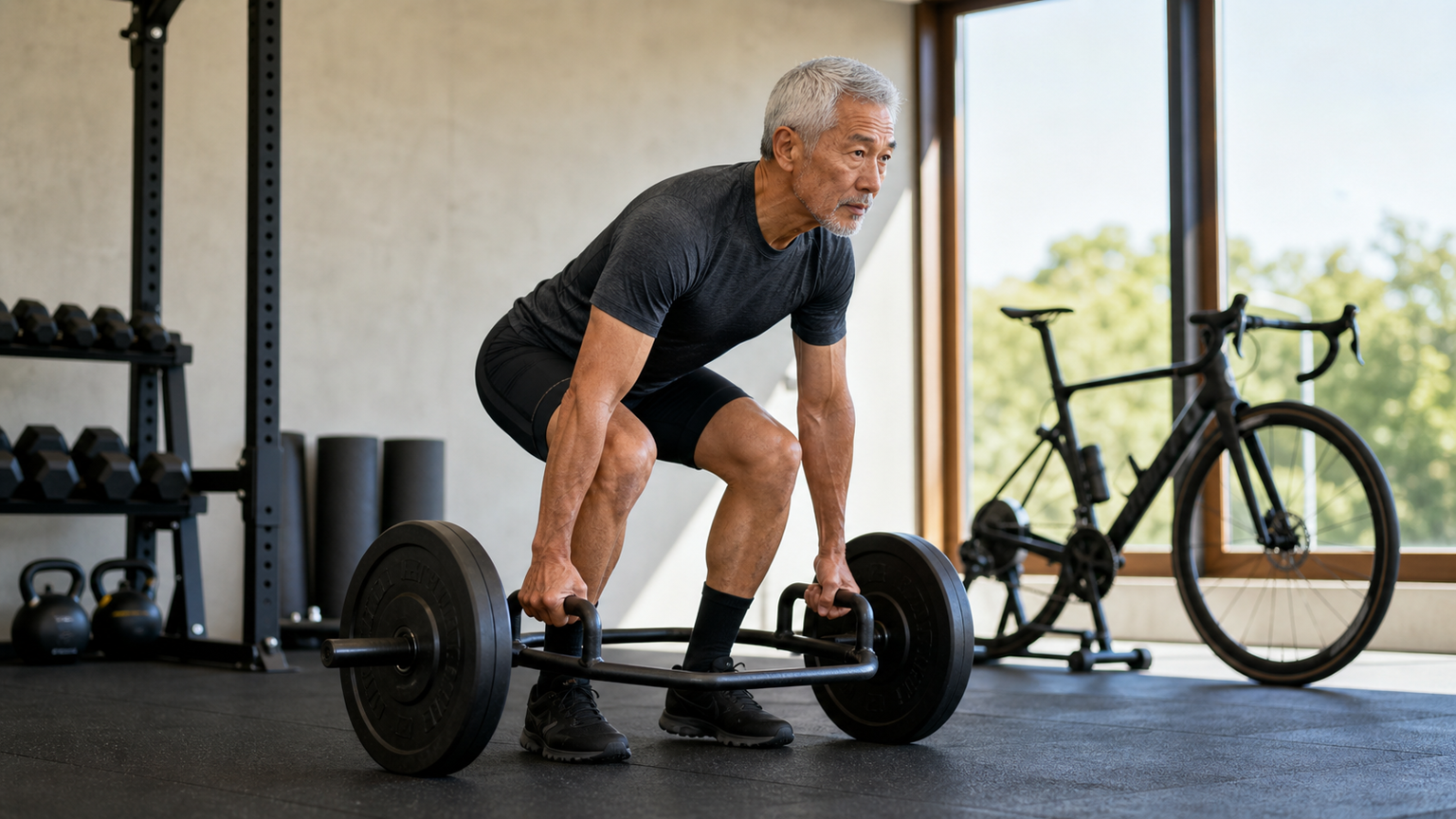
Premise: Strength Training at an Older Age Is “Trade-Offs Under Scarce Resources”
The reality for older endurance athletes is this: recovery resources are tighter than in youth, time and motivation are limited, and both endurance and strength must be maintained simultaneously. This means strength training cannot be all-encompassing—it must be prioritized by return on investment—first capturing the stimuli that are most critical, decline the fastest, and offer the greatest leverage for function and performance. This article provides that priority order.
What Declines Fastest Must Be Defended First
With age, the muscular system does not deteriorate uniformly. The aspects that decline fastest and have the greatest impact on function and performance are the following—and they therefore receive the highest priority:
| Priority | Capacity | Why It Comes First | Representative Stimulus |
|---|---|---|---|
| 1 | Maximal strength | Loss of strength and muscle quality directly threatens the foundation of function and performance | Moderate-to-heavy compound movements |
| 2 | Rate of force development (power/explosive strength) | Fast-twitch fibers and neural drive deteriorate even faster, and this relates to fall prevention and sport-specific explosiveness | Intent-velocity training, age-appropriate explosive movements |
| 3 | Posterior chain strength | Hip extension propulsion is the main engine of endurance, and also prevents falls and protects the lower back | Hip hinges, hip thrusts, single-leg RDLs |
| 4 | Single-leg stability and balance | Directly corresponds to unilateral force production in running/cycling and everyday fall prevention | Single-leg squats/RDLs, balance challenges |
Note item 2: many older individuals only train “slow, heavy maximal strength” while completely neglecting rate of force development—but explosive strength (how quickly force can be produced) declines faster than maximal strength, and is directly related to fall reflexes and sprint/attack ability. Preserving “fast, maximal-intent force production” training under safe conditions is a common blind-spot fix for older athletes.
A “Time-Limited” Strength Session for Older Athletes
Twice per week, 30–35 minutes per session, closely following the priority order above:
- Compound lower body (maximal strength): Sit-to-stand squats or leg press, 3 sets x 5–6 reps, moderate-to-heavy load, leaving 2–3 reps in reserve.
- Rate of force development stimulus: On safe movements, perform fast concentric contractions with maximal intent (e.g., explosive leg press, age-appropriate jumps or fast sit-to-stands), 3 sets x 4–5 reps, prioritizing speed quality and stopping when fatigued.
- Posterior chain: Hip hinge (trap-bar deadlift/hip thrust) or single-leg RDL, 3 sets x 6 per side.
- Single-leg/balance: Rear-foot-elevated split squats or single-leg balance challenges, 2–3 sets.
- Core anti-movement: Pallof press / dead bug, 2 sets (finisher).
What to drop (can be deprioritized when time is limited): isolated small-muscle bodybuilding movements, and excessive low-load, high-rep “muscular endurance” training (endurance sport already provides plenty of muscular endurance for older athletes, and this approach is inefficient for combating sarcopenia).
Coordination with Endurance Training (Older-Athlete Version)
- Separate strength days from high-intensity aerobic days, with greater spacing between them (older athletes recover more slowly).
- During race season/high-volume periods, maintain with the minimum effective dose (once per week, keep intensity but cut volume)—don’t stop entirely. Once older athletes detrain, they lose strength faster than younger athletes and regain it more slowly.
- Movement technique and safety always take precedence over load numbers.
Why This Order Matters Especially for Older Athletes
If a young athlete trains in the wrong order, the worst outcome is wasted time. For older athletes, the recovery budget is limited—spending scarce resources on low-return stimuli means allowing the fastest-declining capacities (maximal strength, rate of force development) to keep deteriorating—and this directly links to performance decline and fall risk. Getting the priority order right is the most important decision in strength training for older athletes.
Safety Prerequisites
Those aged 60+ or with chronic conditions should have a medical evaluation before starting or modifying resistance training; emphasize controlled breathing to avoid breath-holding, technique before load, and gradual progression. This article is training education and does not replace individual medical and professional guidance.
“Older athletes can’t afford to dabble in a bit of everything. I’d push them to first take care of maximal strength and ‘fast force production’—because in the moment of a fall, what saves you isn’t how much you can squat, but how quickly you can produce force. Get the priority order wrong, and no matter how diligently you train, you’re putting the effort in the wrong place.” —A coach specializing in strength and fall prevention for older adults
Related Reading
- Strength Training for Older (50+) Endurance Athletes: Preventing Sarcopenia
- Recovery Mechanics for Older Athletes: Why the Same Plan Is Harder to Absorb
- Maximal Strength vs. Muscular Endurance Training: Which Lifting Mode Should Endurance Athletes Choose
- Tendon and Connective Tissue Aging in Older Athletes: Why Progression Must Be Slower and Eccentrics Matter More
西進武嶺 免費訓練分析服務 Intervals | 練不夠還是練過頭?你哪一種類型選手?AI模型告訴你! | 備戰神器 | 公路車 訓練 | CT Yeh
4 年前
戰略) Zwift Race 如何咬在第一集團 如何評估自己要開多少推力 (請開1.5倍速看)
7 年前
[教學] Premiere 影片 手震 修正 教學 防抖 單眼 影像 GoPro 穩定 Video Stabilization
8 年前
福隆鐵人團練隨拍
8 年前
滑雪新手們慘摔學習全紀錄(請開字幕),滑雪好好玩 | Snowboard + Ski | 岩原 スキー場 | 滑雪APP使用 | GoPro Max
6 年前
FTL 與 SYB 車隊專訪 西進武嶺 實用攻略分享! 2小時 如何練?!你不知道的眉角!新手準備武嶺必看 EP1 | 實力派女車友 | 精華版 | 公路車 | CTYeh
4 年前
一日北高/長距離團騎 常見問題補充篇 / 組團或跟團的眉角 / 壯車友容易被瘦車友慢性拉爆 / 原來屁股痛可能是這個原因...? / 風場配速法 / 公路車 / CT Yeh
2 年前
CT 喇低賽) 武嶺牽車 才是王道 西進牽車四小時內秘訣 攝手位置 如何判斷 防抽筋小秘訣
7 年前