When Flying Abroad With Your Bike, the Real Cost Isn’t the Ticket — It’s the Mistakes
Flying overseas to ride Mallorca, the Stelvio, or compete in a race — the biggest cost and risk isn’t fitness. It’s whether your bike and gear can arrive safely, in compliance with the rules, without getting hit by sky-high oversize fees. Understanding the rules and packing properly ahead of time saves far more than discovering a problem at the airport.
Core Facts About Airline Check-In
| Item | Key Point |
|---|---|
| Rules differ by airline | Bike fee structures and size/weight limits vary widely between airlines — always check the official website in advance and see if sports equipment can be pre-booked |
| Oversize/overweight fees | Exceeding your free baggage or sports equipment allowance can trigger extremely high overweight/oversize charges |
| Advance registration | Most airlines recommend or require registering your bike ahead of time — declaring it only at the counter may get it refused or charged extra |
| Lithium battery rules | Bike computer, light, and electronic shifting batteries have carriage restrictions — some must be carried in the cabin and are prohibited from checked baggage |
Before departure, always confirm your bike check-in policy on the official website of the airline you’re actually flying — there’s no universal rule here, so don’t rely on assumptions.
Choosing a Bike Box
| Type | Protection | Weight | Storage | Best For |
|---|---|---|---|---|
| Hard case | Highest | Heavy | Takes up space | High-end bikes, frequent international travel |
| Soft case (with internal support) | Medium-high | Lighter | Foldable | A balanced choice |
| Cardboard box | Low | Light | Single-use | Extreme budget, at your own risk |
A hard case is the safest option but is heavy in itself, easily eating into your weight allowance; a soft case is lighter and easier to store but offers somewhat less protection. Choose based on your bike’s value, how often you travel internationally, and the airline’s weight rules.
Key Packing Steps
- Lower tire pressure (to account for cabin air pressure changes and avoid blowouts or deformation)
- Remove the pedals, front wheel, and seatpost; turn or remove the handlebar
- The rear derailleur (hanger) is the most fragile point — always remove it or protect it thoroughly
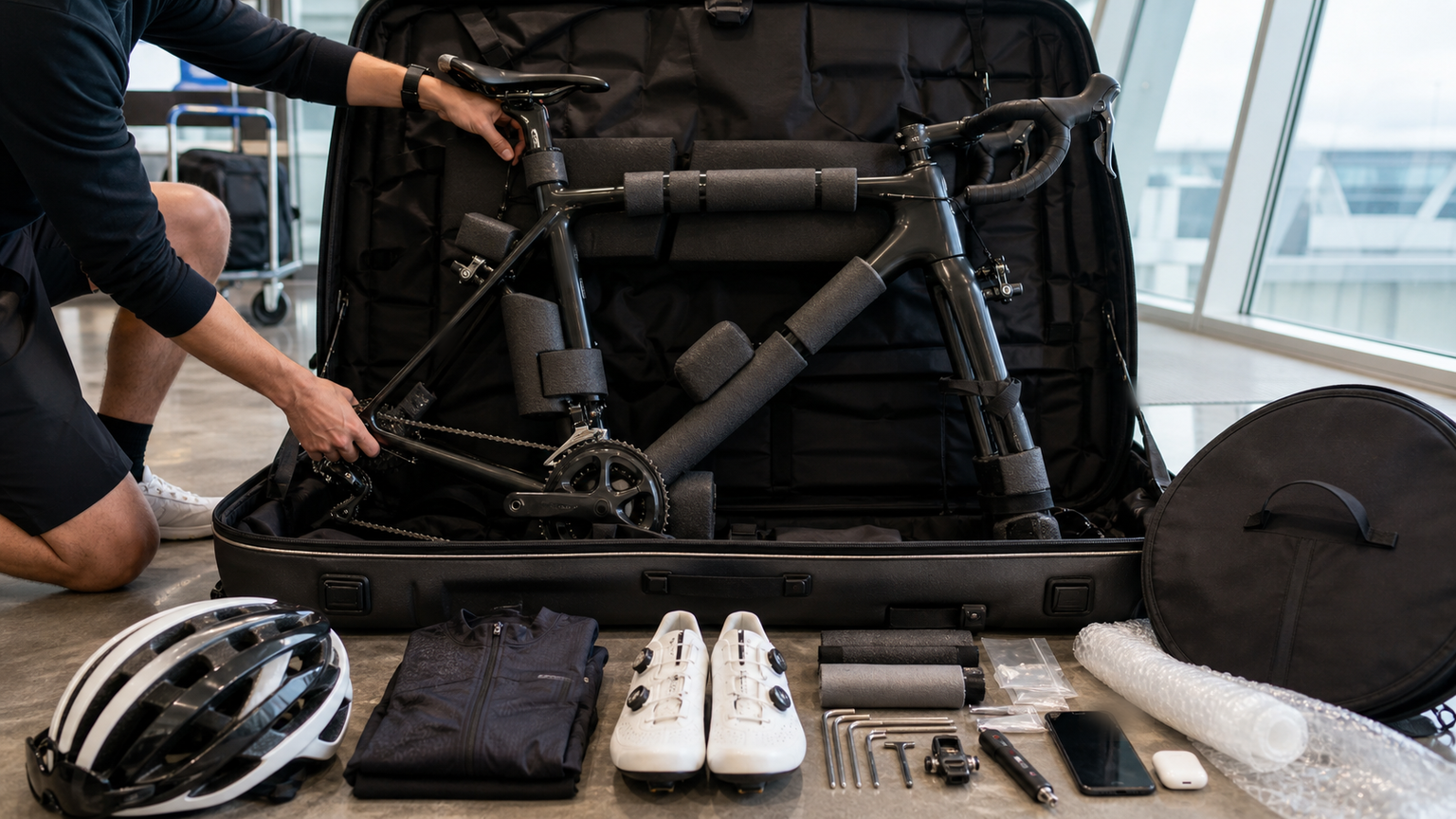
- Separate the tubes with foam or bubble wrap to prevent them knocking together during transit
- Use dummy axles or spacers to support the front and rear forks, preventing them from being crushed
- Photograph the disassembly sequence so reassembly at your destination doesn’t leave you stuck
Gear and Customs
- Tools like knives and CO2 cartridges are subject to airline restrictions — always confirm whether they can be checked or carried in the cabin
- Bringing in a high-value new bike or parts may involve customs duties in some countries — carry proof of purchase if needed
- Carrying large quantities of nutrition products (gels, powders) may be subject to food import regulations in some countries
After You Arrive
Set aside time to reassemble and test-ride the bike (ideally more than a day before the race), and check that the gears, brakes, and wheels haven’t shifted out of alignment during transit — don’t wait until race day to discover a bent derailleur hanger.
The golden rule of flying with your bike: think through the “what could go wrong” in advance. The one hour you spend understanding the rules and properly protecting that derailleur hanger could save you an entire day of tears upon arrival.
Related Reading
- The Complete Guide to International Bike Travel: Disassembly and Boxing Principles, Check-In Concepts, and Pre-Trip Preparation
- The Complete Guide to Bicycle Travel: Bike Boxing, Airline Regulations, Insurance, and Entry Practicalities
- Bicycle Travel Packing Techniques: How to Fly With a Road Bike
- Iron Horse Across the Ocean: The Complete Guide to International Bicycle Shipping
單車 一日北高 ( 雙城 ) 肥宅雙人瘋狂行 紀錄片 REACTO
10 年前
南竿 單車 | 老婆公路車首航 | 偽出國體驗 | 4K 高畫質 | 綠色騎跡低碳輕旅遊 | #公路車
5 年前
大家都在開箱的...單車用藍芽對講耳機真的有幫助嗎? SENA BiKom 20 長距離旅遊 & 海鷗繞圈賽 實際體驗心得 / 公路車 / CT Yeh
9 個月前
靠單車減肥35公斤 心得分享與整理
7 年前
單車賞雪 裝備準備及注意事項分享 | 公路車
5 年前
單車高張力拍攝神器 Antigravity A1 全景空拍機! / CT Yeh
30 天前
馬祖北竿單車體驗遊 | 被歐兜賣集體80差點摧不動 | 兩台公路車上飛機超重費...? 4K高畫質
5 年前
再快都跟的上!? 單車跟隨攝影機之王 HOVERAir X1 PROMAX 全面實測 / 唯一!8K畫質&自行車專用模式和跟蹤信標&前後避障 / DJI Neo 可參考/ 公路車 / CT Yeh
1 年前