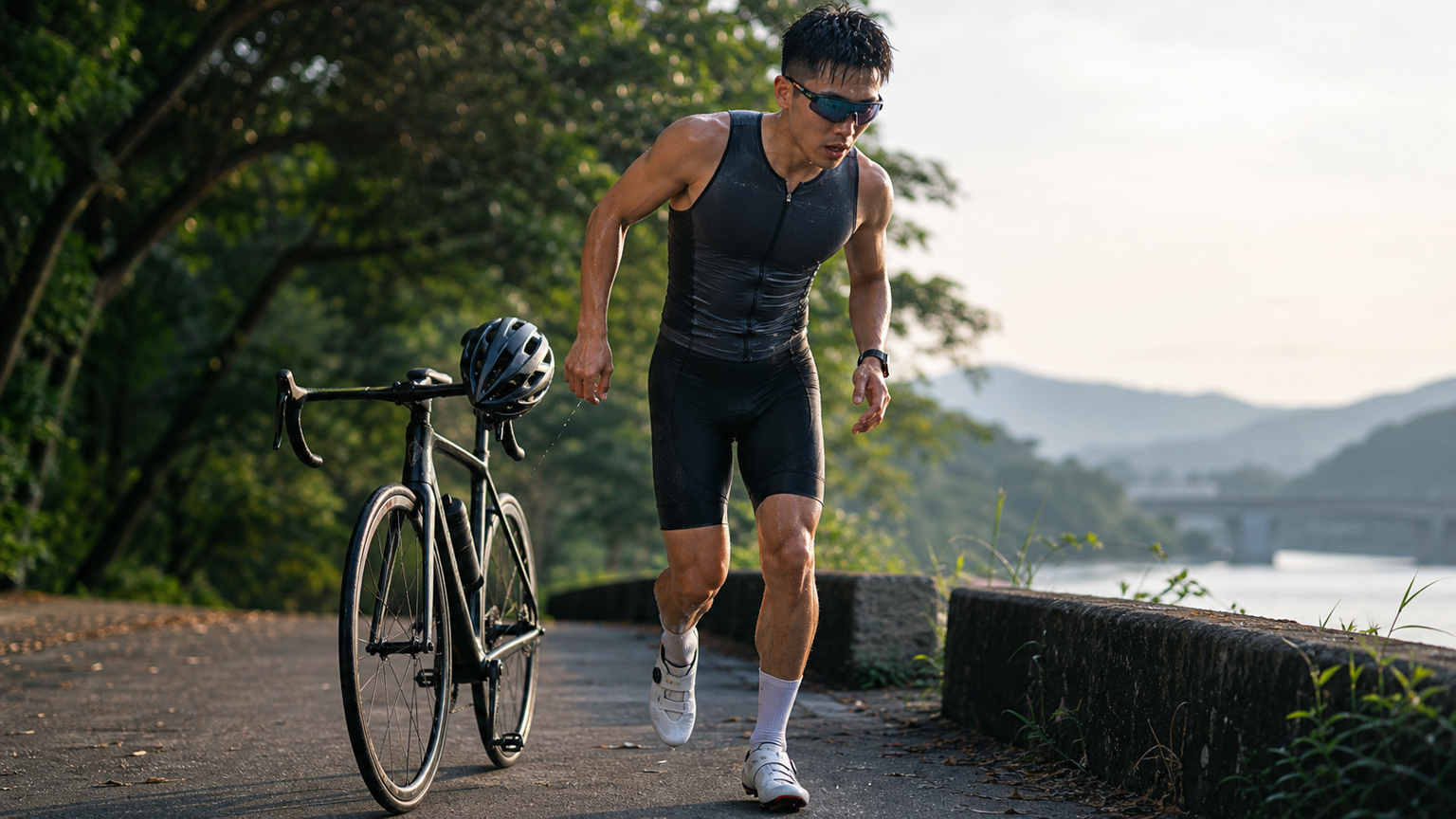
The Truth About “Brick Legs”
That heavy feeling in the first 5–8 minutes after dismounting and starting to run stems from three mechanisms: blood flow remains concentrated in the quadriceps, which dominate cycling; ankle range of motion has not yet switched from the fixed pedaling angle; and neuromuscular recruitment patterns are being reorganized. Research shows that the oxygen cost of running after cycling is 3%–11% higher than pure running during the first 10 minutes.
Three Types of Brick Workouts
| Type | Structure | Training Purpose | Frequency |
|---|---|---|---|
| Short Transition Brick | 60’ bike + 15’ run | Neuromuscular adaptation | 1 per week |
| Race Simulation Brick | 90’ bike + 40’ run | Pace integration | 1 every 2 weeks |
| Reverse Brick | 20’ run + 90’ bike | Pedaling under fatigue | 1 per month |
12-Week Progressive Prescription
- Weeks 1–4: 45’ bike @Z2 + 10’ run; the run just needs to “get moving”
- Weeks 5–8: 75’ bike @race IF + 20’ run; control pace for the first 1 km
- Weeks 9–12: 90’ bike + 30–45’ run; full nutrition simulation
Pace Rules for the Transition Run
In the first 1 km after dismounting, heart rate will read 8–12 beats higher than actual, so pace should be 10–15 sec/km slower than target marathon pace. From the 2nd km onward, reel it back in by 3–5 seconds per kilometer.
Breaking Down the Three Physiological Mechanisms and Their Solutions
The first is “blood flow hijacking”: during the cycling segment, the quadriceps account for roughly 70% of lower-limb blood flow, leaving the hamstrings and calves under-supplied, and lactate clearance efficiency drops about 20% in the 5 minutes before dismounting. The solution is to add 2 x 15-second efforts at 100+ rpm in the final 3 km before getting off the bike to redistribute blood flow. The second is ankle dorsiflexion angle: the pedaling ankle angle is fixed at ~15°, but running footstrike requires 20°–25°, so forcing a larger angle in the first 800 m is necessary to avoid “slapping” the foot down. The third is cadence reset: cadence often drops to 80–84 right after dismounting; deliberately counting to 88–92 can eliminate that extra 5%–8% oxygen cost within 1 km.
Brick Dosage by Race Distance
| Race Distance | Brick Run Length In-Season | Simulation Focus |
|---|---|---|
| Sprint | 10–15’ run after bike | Steady cadence at high heart rate |
| Olympic | 20–30’ run after bike | Pace control for first 2 km |
| 70.3 | 40–60’ run after bike | Nutrition + negative splits |
| Ironman | 30–45’ run after bike (controlled) | Posture maintenance at low intensity |
Note that the Ironman Brick run should actually not be too long: the goal is neuromuscular adaptation rather than accumulating fatigue, and going overboard only increases injury risk and recovery cost.
I often tell my athletes: the Brick isn’t about training your legs—it’s about training your brain to still give orders while your legs are protesting. Every brick session shortens that hellish first 8 minutes on race day.
Related Reading
- The Science of Brick Training — Muscle Adaptation Mechanisms and Workout Design for Bike-to-Run Transitions
- The Muscle Physiology of Brick Training: Neuromuscular Reprogramming from Pedaling to Striding
- The Science of Brick Training: Why Running After Cycling Feels Like Running on Cotton
- The Complete Guide to Brick Training: Why Running After Cycling Is Always So Painful, and How Coaches Crack the Transition Curse
iPhone內建一秒變長腿🤣 車友必備#cycling
2 年前
Live) 備戰2019彰化經典百K 賽前攻略 (已完賽請看新影片
7 年前
#公路車 #Fitting 靠人工智慧APP 幫你調整單車
6 年前
一日北高常見問題大集合 | 攻略 | 路線 | 訓練 | 補給 | 自行車 單車 | 一日雙城 | 雙塔 | TWB北高360 | 屁股痛
6 年前
下雨天就是要改車 #ceramicspeed #bike
1 年前
一日北高/長距離團騎 常見問題補充篇 / 組團或跟團的眉角 / 壯車友容易被瘦車友慢性拉爆 / 原來屁股痛可能是這個原因...? / 風場配速法 / 公路車 / CT Yeh
2 年前
靠單車減肥35公斤 心得分享與整理
7 年前
2016/4/20 - 中社路 夜騎 半年甩肉14KG 後測
10 年前