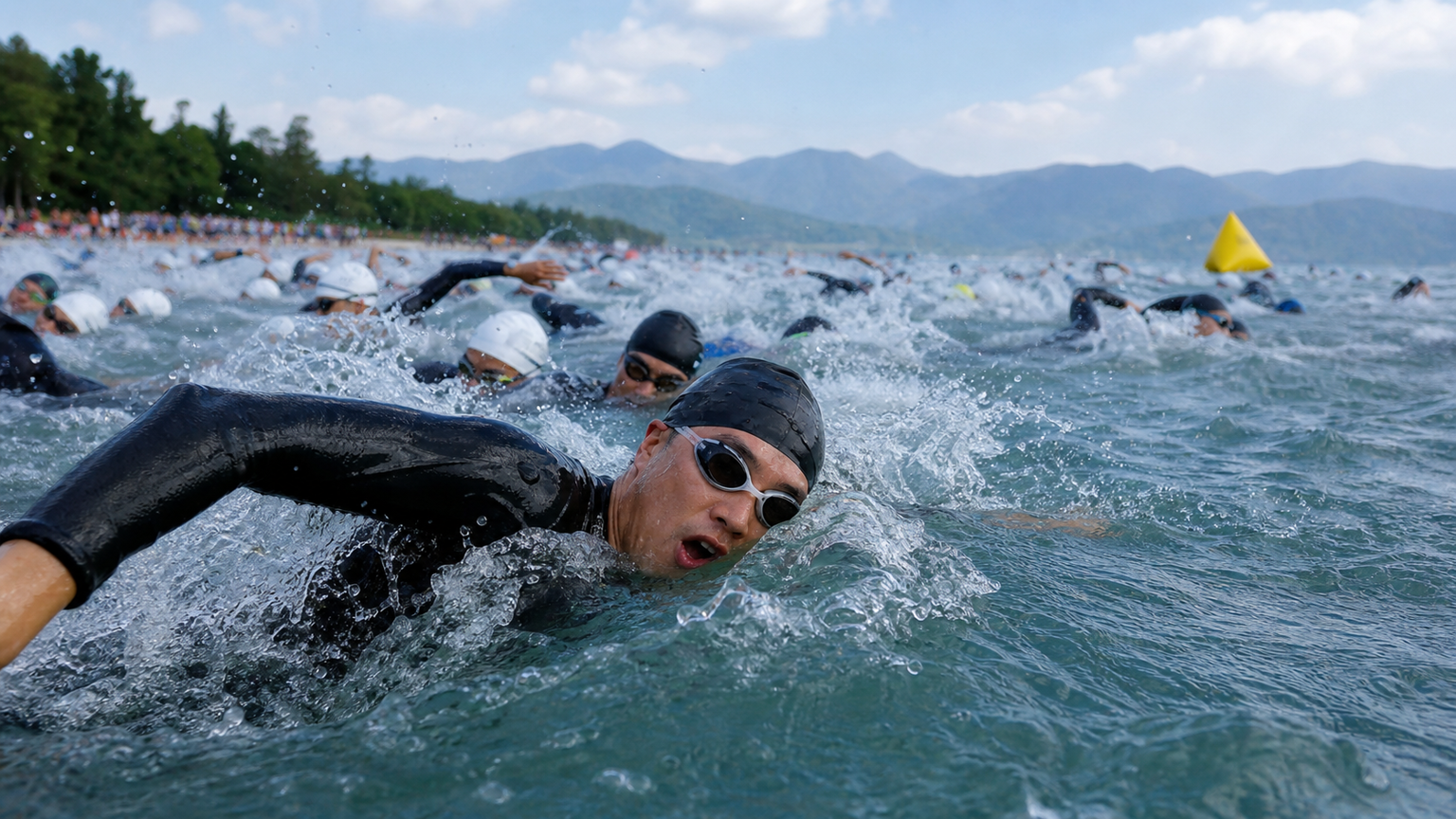
Mass Start: Rugby in the Water
Hundreds of swimmers enter the water at once, and the first 200m is the most collision-dense zone. Heart rates spike to 180+ instantly, and many people panic, cramp, or even drop out here. The key to survival is positioning and pacing, not brute force.
Start Positioning Strategy Table
| Your Ability | Recommended Position | Reason |
|---|---|---|
| Top 10% swimmer | Front row, center | Claim clean water |
| Mid-pack swimmer | Second row, slightly outside | Avoid head-on contact |
| Weaker swimmer | Back row or far outside | Give yourself room |
| Panic-prone swimmer | Far outside buffer zone | Psychological security |
Pacing the First 200m
Don’t let the pace of those around you dictate your rhythm. For the first 200m, deliberately swim 3–5 seconds/100m slower than your target pace, increase stroke rate while shortening stroke length, and keep your lead arm rotating continuously to avoid being pushed under. Your heart-rate anchor is “able to exhale through your nose.”
What to Do When Grabbed or Hit
- Foot grabbed: Don’t stop—kick harder and break free naturally
- Goggles hit: Tread water for 2 seconds, reset, and continue—don’t panic
- Boxed out of your lane: Move 5–10m to the outside to find space
- Panic attack: Flip onto your back, float for 10 seconds, take deep breaths, then resume swimming
Training Method
Do a “crowding simulation” in the pool before race day: 4–6 people start a 100m together in the same lane, deliberately creating contact so your nervous system gets used to physical touch.
Start Format Determines Survival Strategy
Different start formats require different tactics. Beach wave start: after the gun, high-knee wade until the water is about thigh-deep, then do two dolphin dives—this is 5–8 seconds faster and more efficient than swimming hard from the start. Rolling/TT start: swimmers enter every few seconds, so contact is minimal—the key is not to chase the swimmer ahead in the first 50m. Deep-water mass start: while treading water, keep your elbows slightly spread to protect your space; 10 seconds before the gun, switch to long strokes to warm up your shoulders. The most dangerous scenario is always the “funnel effect” in large mass starts—the crowd compresses within 50m of the buoy turn. Decide 100m in advance whether to take the inside line (shorter distance but more fighting) or swing 5m wide outside (10m extra but clean water).
The Physiological Chain of Panic and Three-Stage Interruption
| Stage | Symptoms | Interruption Tactic |
|---|---|---|
| Trigger | Pushed under, water swallowed, shore out of sight | Immediately flip to back float, switch to head-up breaststroke |
| Escalation | Rapid breathing, HR 190+ | Lengthen exhalation (exhale 4 counts, inhale 1 count) |
| Loss of control | Wanting to grab others, stopping to tread water | Move sideways out of the crowd, raise a hand to the rescue boat without quitting |
Panic almost always comes down to “respiratory rhythm collapse.” Practicing head-up breaststroke until it becomes a safety mode you can switch to at any moment matters more than swimming faster.
More people are scared off by open-water chaos than by lack of fitness. The first lesson I teach athletes isn’t swimming faster—it’s “don’t stop your arms even when you get hit.” Those who can keep their stroke steady in the melee are often not the strongest swimmers, but the most mentally stable.
Related Reading
- Open-Water Start and Washing-Machine Zone Survival: Tactics from Beach Sprint to Escaping the Chaos
- Open-Water Mass Start Combat Strategy: Finding Your Rhythm in the Crowd
- Open-Water Start Strategy: Positioning, Contact, and Rhythm Building
- Open-Water Swimming Start Strategy: Position and Pacing in a Group Start
西進武嶺 免費訓練分析服務 Intervals | 練不夠還是練過頭?你哪一種類型選手?AI模型告訴你! | 備戰神器 | 公路車 訓練 | CT Yeh
4 年前
CT 喇低賽) 武嶺牽車 才是王道 西進牽車四小時內秘訣 攝手位置 如何判斷 防抽筋小秘訣
7 年前
戰略) Zwift Race 如何咬在第一集團 如何評估自己要開多少推力 (請開1.5倍速看)
7 年前
一起升級!海鷗盃LSD團練...JJSC Zone2招待 騎到手抖 / 公路車 / CT Yeh
2 天前
[教學] Premiere 影片 手震 修正 教學 防抖 單眼 影像 GoPro 穩定 Video Stabilization
8 年前
西進武嶺 自製新版AI配速表產生器 x 賽前攻略 抱佛腳! 沒有功率計也可以產生配速表嗎?有什麼其他眉角賽前要注意的呢? | 西進武嶺 / 東進武嶺 KOM 攻略 | 公路車 | CT Yeh
4 年前
一日北高/長距離團騎 常見問題補充篇 / 組團或跟團的眉角 / 壯車友容易被瘦車友慢性拉爆 / 原來屁股痛可能是這個原因...? / 風場配速法 / 公路車 / CT Yeh
2 年前
戀戀197 血脈噴張 多視角剪輯版 最艱難的市民競賽組 M30 M35 參賽記錄 請開字幕 4K高畫質 #公路車
6 年前