Swim-to-Ride Neuromuscular Adaptation: Solutions for Uncooperative Legs After Getting Out of the Water
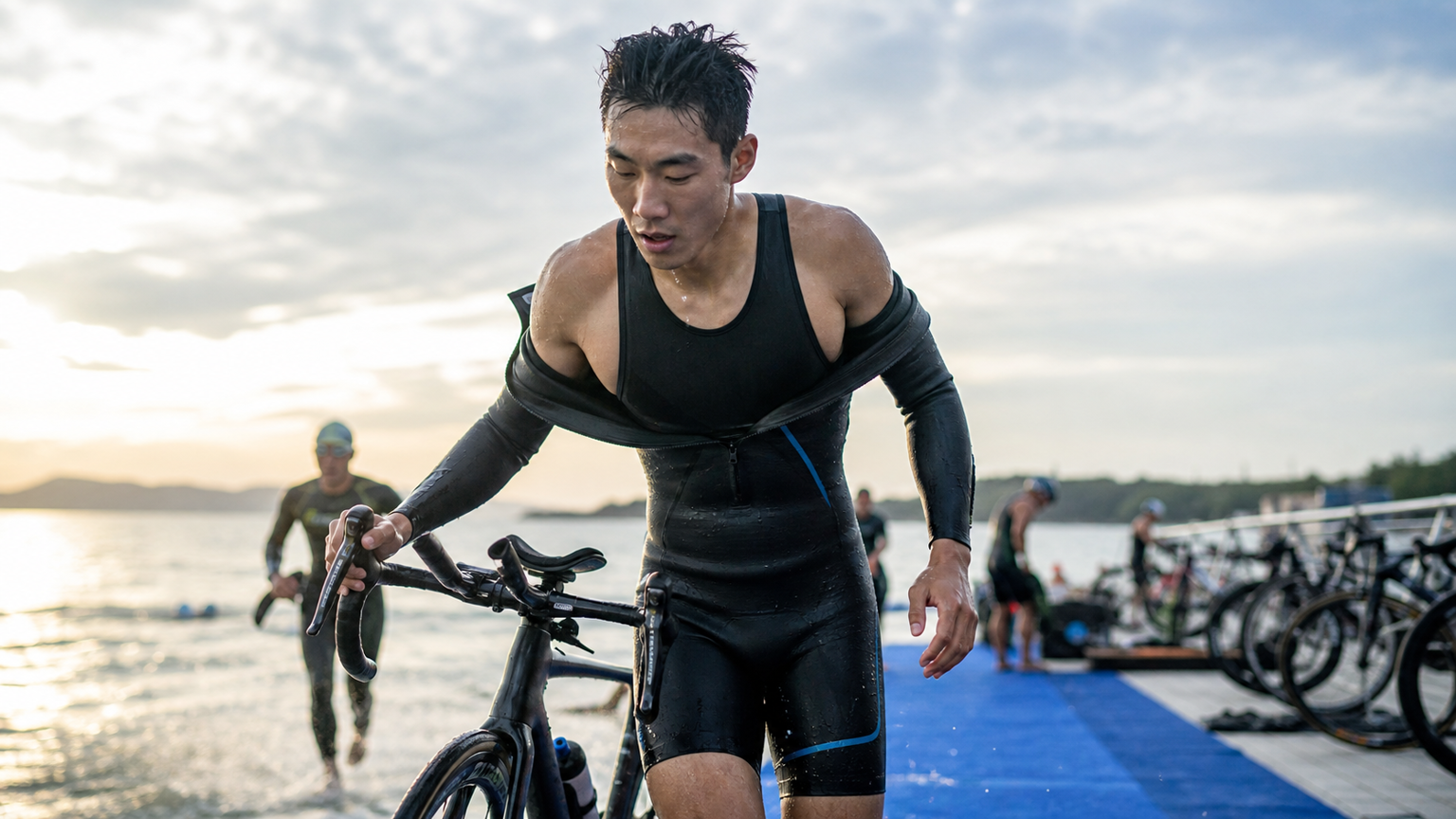
The Mystery of “Jelly Legs” in the First 5 Minutes on the Bike
Swimming relies mainly on the upper body and core, with the legs staying horizontal and at low intensity for a long time. The moment you get on the bike and need to produce high power output immediately, the neuromuscular system must switch from “horizontal, energy-saving kicking” to “vertical, high-tension pedaling.” This transition causes a 5%–12% drop in output during the first 5 minutes.
Three Bottlenecks in the Swim-to-Bike Transition
| Bottleneck | Mechanism | Countermeasure |
|---|---|---|
| Insufficient lower-limb blood flow | Swimming directs blood flow to the upper body | Kick harder in the final 200m of the swim |
| Neuromuscular recruitment switch | Different recruitment patterns | Practice bike-specific work after swimming |
| Artificially elevated heart rate | Body position shifts from horizontal to upright | Control power for the first 3 minutes on the bike |
Specialized Training: Swim-Bike
Do a “Swim-Bike” session once a week: swim 800–1500m → immediately ride for 20–40 minutes. For the first 5 minutes, deliberately hold power at race IF −0.05, then ramp it back up from minute 6 onward. After repeating this for several weeks, the jelly-leg phase can shrink from 5 minutes to 1–2 minutes.
The “Wake-Up Kick” at the End of the Swim
In the final 100–200m of the swim, increase kick amplitude and frequency to redirect blood flow back to the legs, which noticeably reduces jelly legs once on the bike.
Race-Day Application
For the first 2km on the bike after T1, don’t chase power out of impulse. Start 5% below target as planned to give the nervous system time to hand over—this is actually faster overall than hammering hard.
Quantifying the “Jelly-Leg Phase”: Self-Test with Power Drop
During Swim-Bike sessions, record your 3-second power at minute 1 and minute 8 after getting on the bike. Most age-groupers initially can only produce 85%–88% of target power at minute 1, only returning to 97%+ by minute 8. After 4–6 weeks of 1–2 Swim-Bike sessions per week, minute-1 power can rise to 92%–95%, effectively compressing the “dead first 5 minutes of usable power” into 1–2 minutes—saving roughly 25–40 seconds over an Olympic-distance race.
Dosage for the Wake-Up Kick at the End of the Swim
| Distance | Kicking Action | Heart Rate / Body Position Purpose |
|---|---|---|
| 300m before exiting | Maintain race stroke rate | Don’t disrupt rhythm |
| 200m before exiting | Increase kick amplitude and raise frequency by ~20% | Redirect blood flow back to the legs |
| 50m before exiting | Add a few strong push-offs/kicks | Pre-recruit the quadriceps |
Common Mistake: Blindly Chasing People You Got Passed By After T1
Weaker swimmers often exit the water behind and, out of anxiety, hammer hard on the bike to chase down riders ahead—spiking to IF 0.95+ in the first 2km, right into the most vulnerable window before the nervous system has finished handing over. The result is an even bigger fade in the middle and later sections of the bike leg. The correct approach is to accept your exit position, hold strictly at target IF −0.05 for the first 2km, and save the chasing for after minute 5, once the neural handover is complete.
Many people think jelly legs on the bike mean poor fitness, but it’s actually a nervous system that hasn’t trained the handover. Do Swim-Bike work for a month, and you’ll find that the first stretch on the bike goes from “disaster” to “transition.” A triathlete’s speed is hidden in the details of transitions.
Related Reading
- Bike-Run Neuromuscular Adaptation: Turning Brick Legs into Muscle Memory
- Transition Run After the Swim in Triathlon: Switching Your Body from Water to Bike
- Optimizing Swim Exit and T1 Transition Speed in Triathlon: The Critical 120 Seconds from Water to Bike
- Recovery Training for Swimmers: Easy Swimming, Deep-Water Running, and Relaxation Techniques
水金九不厭五分 10度寒流冷到不願停!feat. 卡卡 / 公路車 / CT Yeh
6 個月前
#公路車 #Fitting 靠人工智慧APP 幫你調整單車
6 年前
FTL 與 SYB 車隊專訪 西進武嶺 實用攻略分享! 2小時 如何練?!你不知道的眉角!新手準備武嶺必看 EP1 | 實力派女車友 | 精華版 | 公路車 | CTYeh
4 年前
2016/05/13 單車 冷水坑下滑
10 年前
滑雪新手們慘摔學習全紀錄(請開字幕),滑雪好好玩 | Snowboard + Ski | 岩原 スキー場 | 滑雪APP使用 | GoPro Max
6 年前
一日北高常見問題大集合 | 攻略 | 路線 | 訓練 | 補給 | 自行車 單車 | 一日雙城 | 雙塔 | TWB北高360 | 屁股痛
6 年前
西進武嶺 自製新版AI配速表產生器 x 賽前攻略 抱佛腳! 沒有功率計也可以產生配速表嗎?有什麼其他眉角賽前要注意的呢? | 西進武嶺 / 東進武嶺 KOM 攻略 | 公路車 | CT Yeh
4 年前
西進武嶺 免費訓練分析服務 Intervals | 練不夠還是練過頭?你哪一種類型選手?AI模型告訴你! | 備戰神器 | 公路車 訓練 | CT Yeh
4 年前